Biology Exam 5
 Call Kai
 Learn
Learn Practice Test
 Spaced Repetition
 Match
Match Flashcards
 Knowt Play
1/135

There's no tags or description
Looks like no tags are added yet.
Name | Mastery | Learn | Test | Matching | Spaced | Call with Kai | Chat |
|---|
No analytics yet
Send a link to your students to track their progress
136 Terms
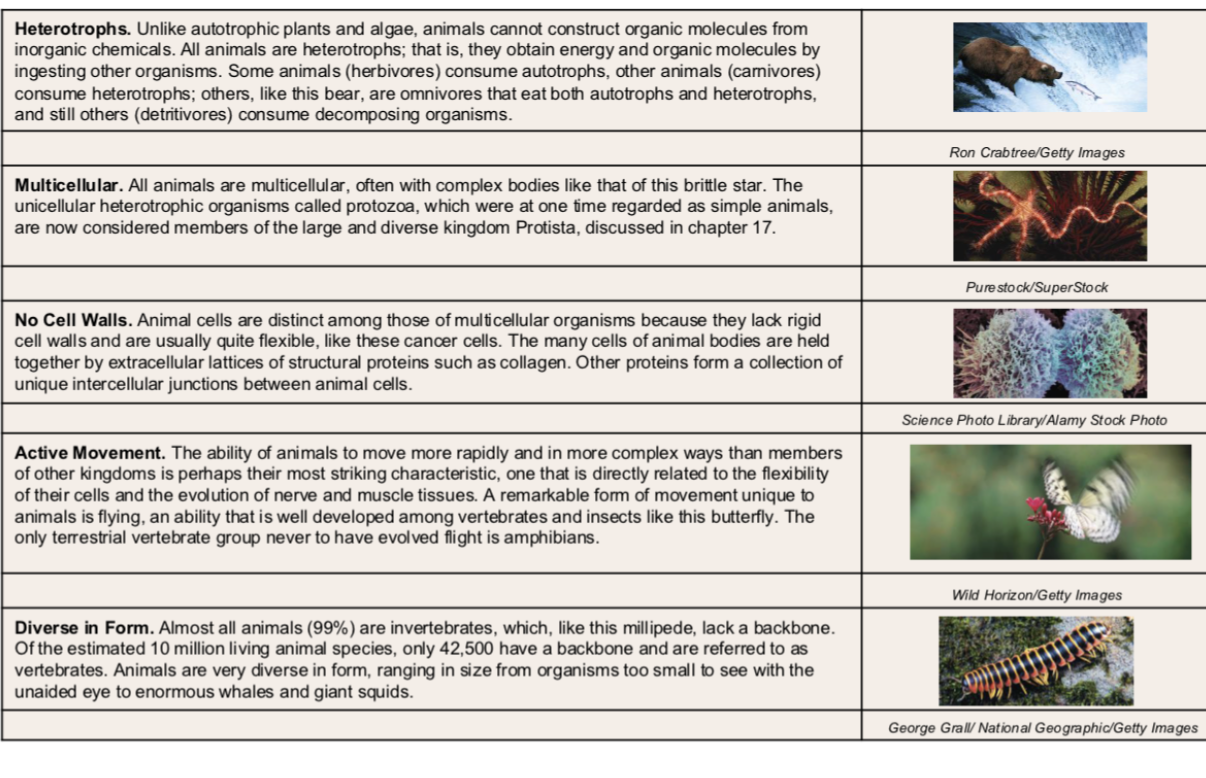
Animals share many important characteristics, including that they
• heterotrophs (plants are autotrophs)
• multicellular and lack cell walls
• can move from place to place
• have diverse forms and habitats
• reproduce, mostly by sexual reproduction
• have a common pattern of development
• have unique tissues
Table 22.1 General Features of Animals
The kingdom Animalia is traditionally
divided into two main branches based on
tissue presence what are they?
Parazoa and Eumetazoa
Parazoa
Possess neither tissues nor organs and have no discernible symmetry
• They are represented mostly by the phylum Porifera, the sponges
Eumetazoa
Have a definite shape and symmetry and, in most cases,
tissues organized into organs and organ systems
Although very different, the Parazoa and Eumetazoa are thought to have evolved from a common ancestor.
Eumetazoans are divided into two groups:
• Radiata have radial symmetry and two embryological
layers.
• Bilateria have bilateral symmetry and a third
embryological layer, the mesoderm
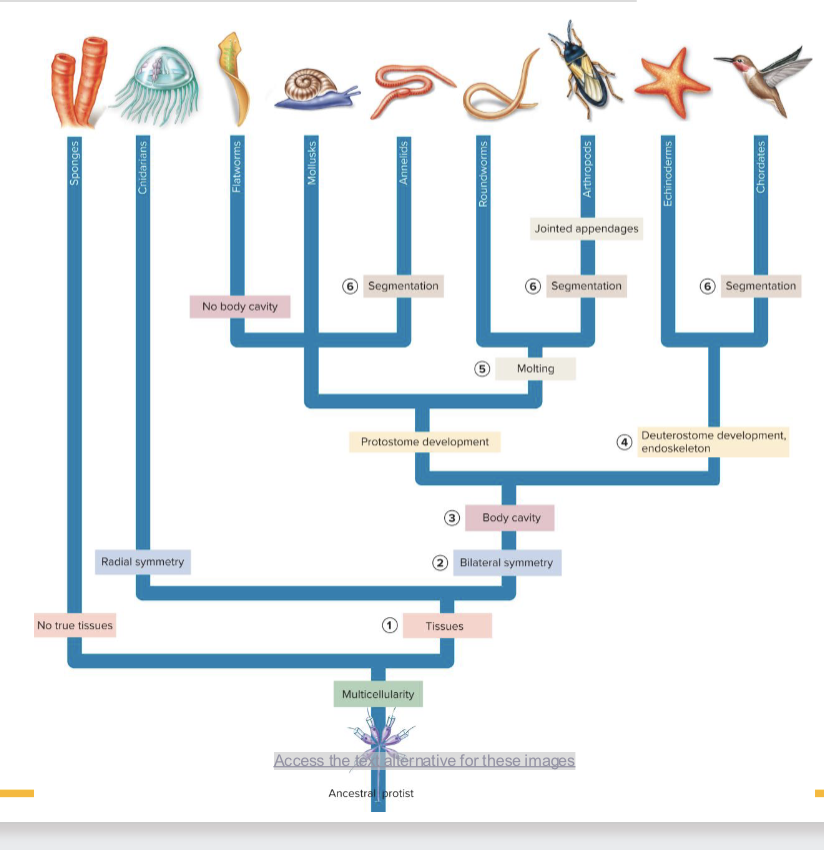
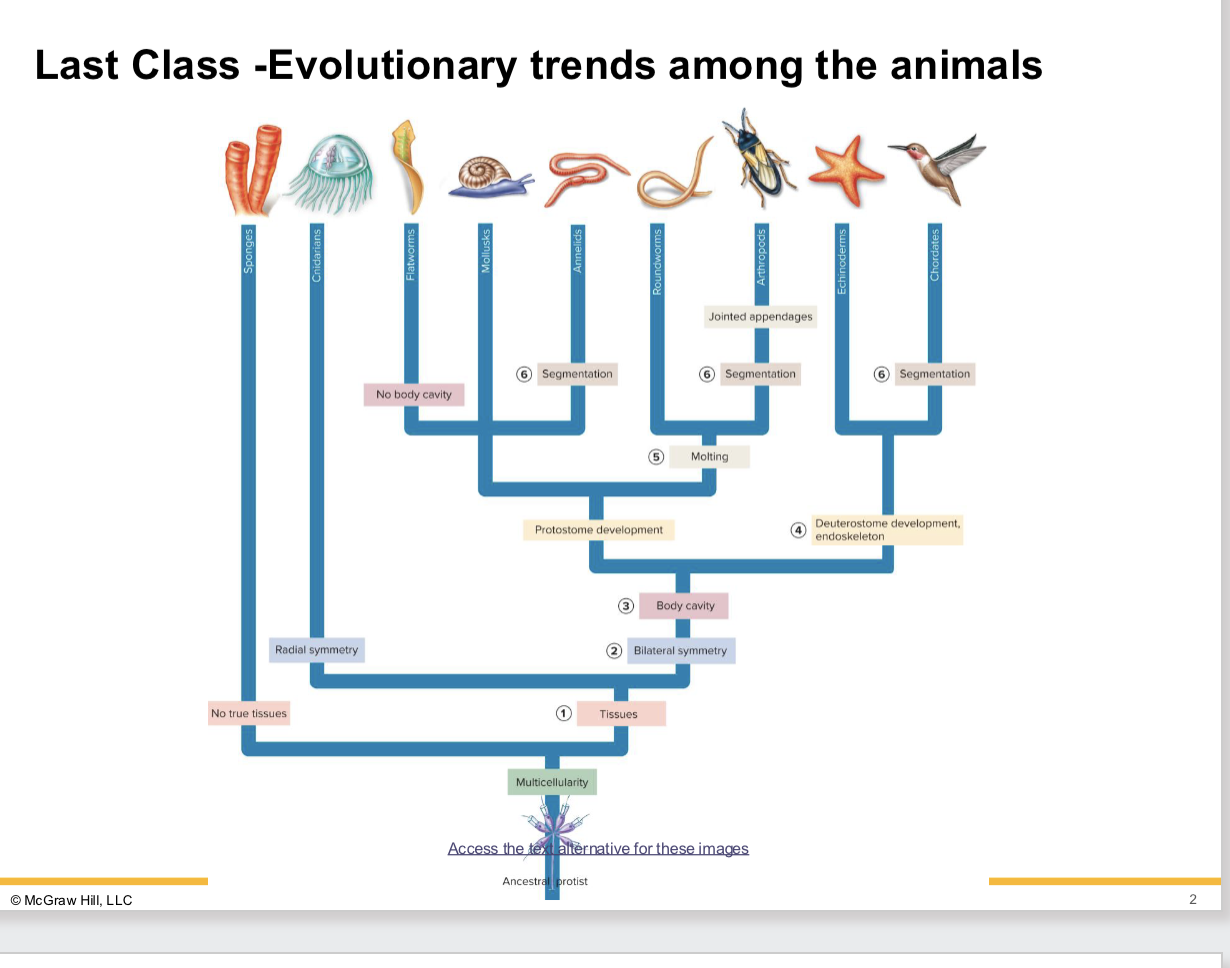
Six Key Transitions in Body Plan
The evolution of animals is marked by six key transitions in
body plan
• Tissues
• Bilateral symmetry
• Body cavity
• Deuterostome development
• Molting
• Segmentation
1. Tissues
The presence of tissues is the first key transition in the animal body plan
• Only the Parazoa, the sponges, lack defined tissues and organs.
• These animals exist as aggregates of cells with minimal intercellular coordination.
• All other animals, the Eumetazoa, possess
tissues.
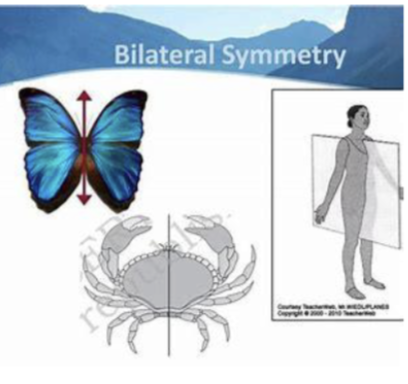
2. Bilateral Symmetry
Virtually all animals other than sponges have a definite shape and symmetry
a body plan with distinct right and left halves that are mirror
images
• The plan allows for specialization among body regions and more efficient movement.
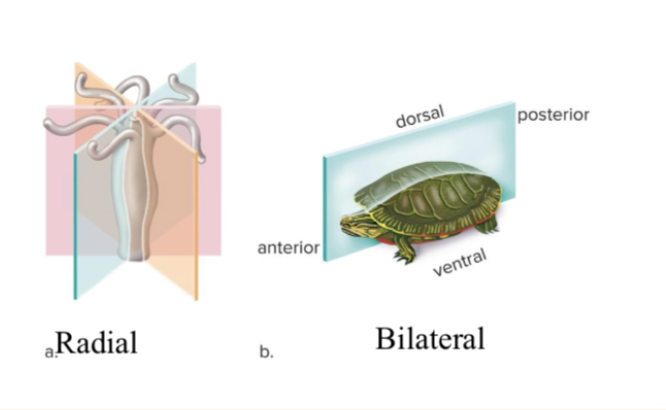
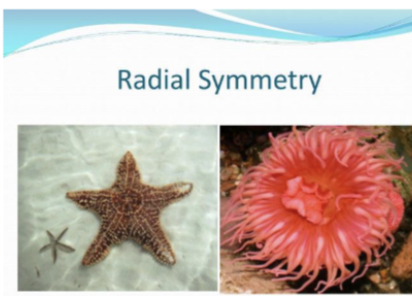
Radial symmetry
A body plan in which all parts of the body are arranged around a central axis.
• Any plane passing through the central axis divides the organism in halves that are approximate mirror images.
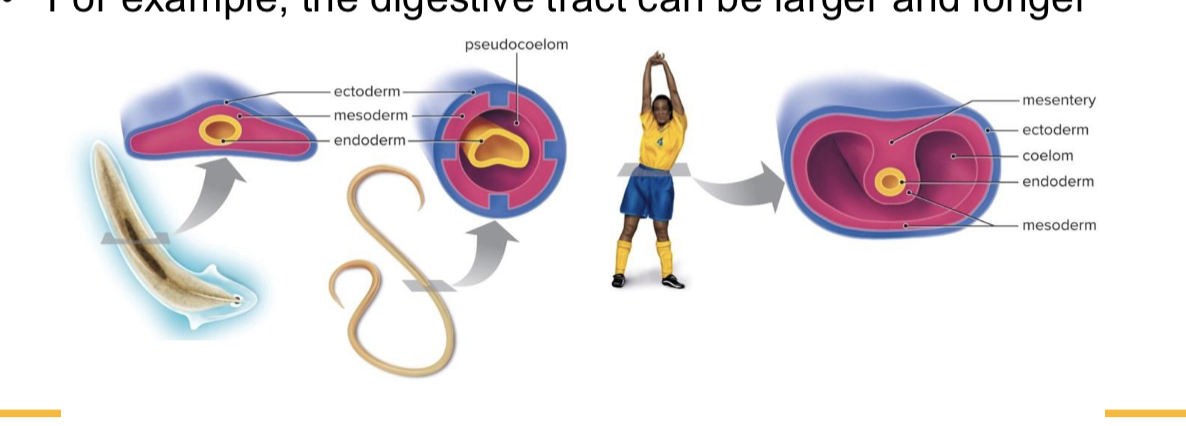
3.Body Cavity
The evolution of a body cavity was an important step in
animal evolution
• This internal space allowed for the support of organs,
distribution of materials, and coordination of development.
• For example, the digestive tract can be larger and longer
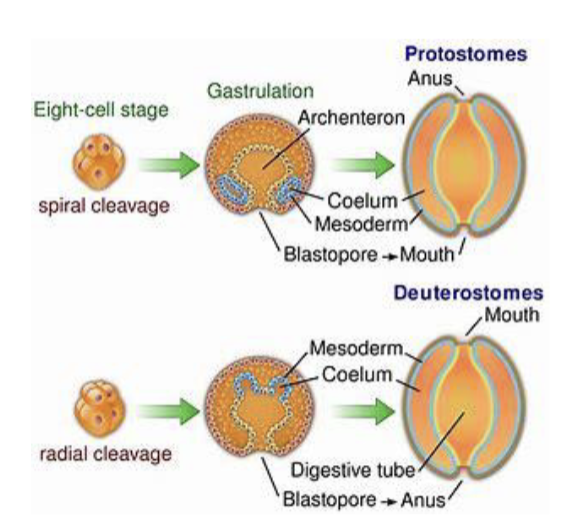
4. Deuterostome Development
Bilateral animals can be divided into two groups based on
differences in the basic pattern of development.
• Protostomes include the flatworms, nematodes,
mollusks, annelids, and arthropods.
• Deuterostomes include the echinoderms and the
chordates.
• Deuterostomes evolved from protostomes more than 630
million years ago.
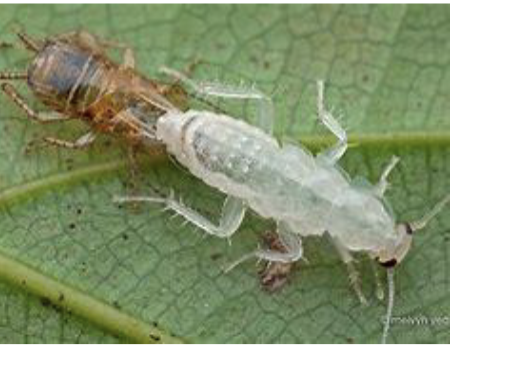
5.Molting
• Animals with an exoskeleton grow by shedding their
exoskeleton in a process called molting or ecdysis.
• Occurs in nematodes and arthropods
6. Segmentation
The subdivision of the body into segments is another key
transition in the animal body plan.
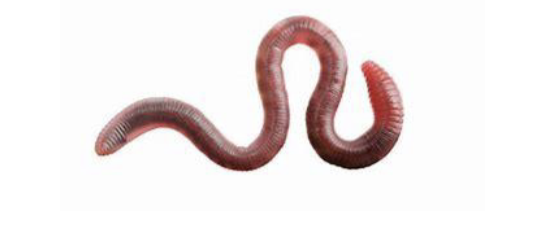
• In highly segmented animals, each segment can develop
a more or less complete set of adult organ systems.
• Each segment can function as a separate locomotory unit.
Evolutionary trends among the animals
Sponge: Animals Without Tissues
•Tissue (No true tissue)
• Symmetry (Body plan lacks symmetry)
Sponges are members of
phylum Porifera
Sponges characterstic
• Their bodies a little more than masses of specialized cells embedded in a gel-like matrix.
• Clumps of cells disassociated from a sponge can give rise to new sponges.
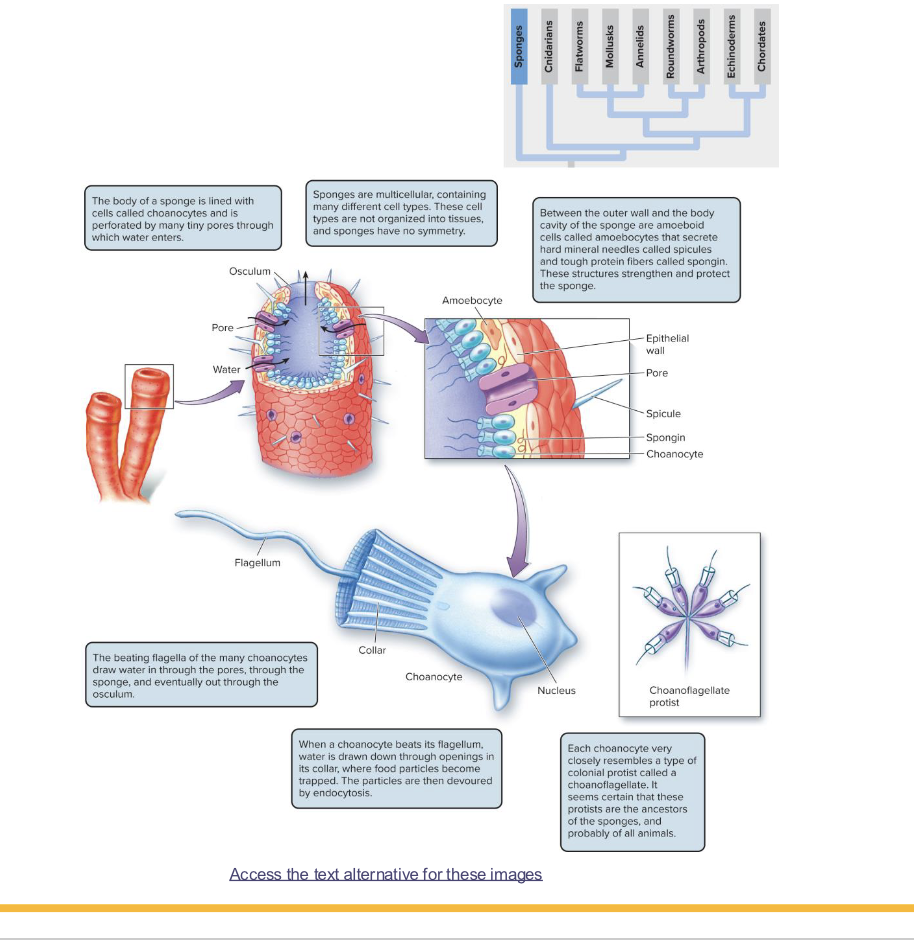
• The body of a sponge is perforated by
many pores.
• Choanocytes are flagellated cells that line the body cavity of the sponge and draw in water through the pores.
• The sponge is a filter feeder which traps
any food particles.
Choanocytes
Flagellated cells that line the body cavity of the sponge and draw in water through the pores
Sponges
Cnidarians: symmetry and tissues
• Tissue (First group with true tissue)
• Symmetry (Only group with true radial
symmetry)
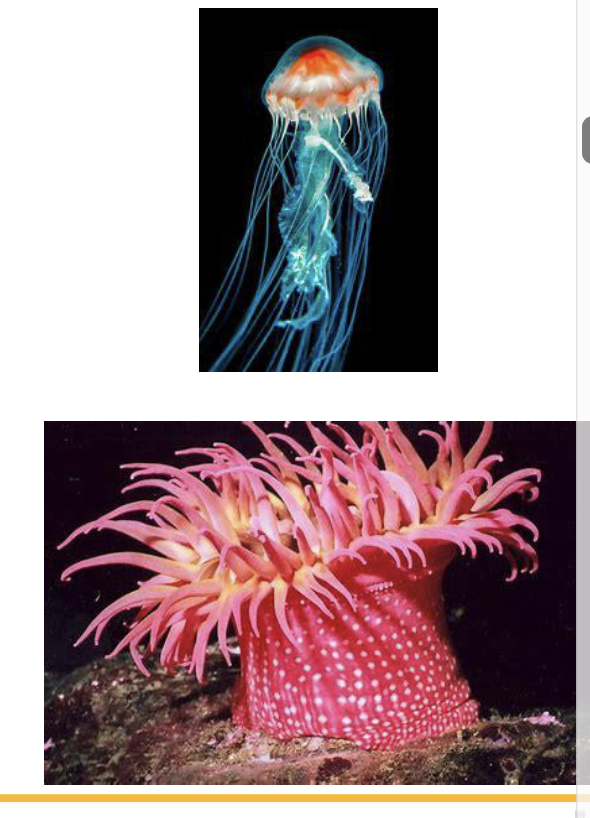
Cnidarians
carnivores that capture prey with tentacles that ring
their mouths
• Radial symmetry
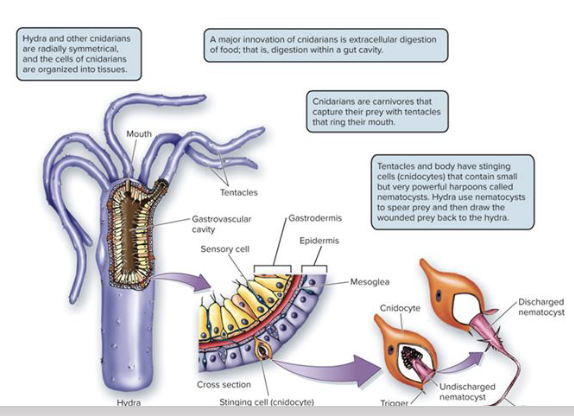
One of the phyla of Radiata (radially symmetrica)
Cnidaria comprises the hydra, jellyfish, corals, and anemones
The members of the Radiata
Have a body plan that allows them to interact with their environment on all sides.
A major evolutionary advance in the Radiata is extracellular digestion of food.
• Digestion begins outside of cells in a gut cavity called the gastrovascular cavity.
• This form of digestion allows animals to digest an animal larger than itself
Solid Worms: Bilateral Symmetry
Body symmetry differs among the Eumetazoa.d
Bilateral symmetry means that only one plane can cut
the organism in half to produce mirror images.
Cephalization-Most bilateral animals also have a definite
head end
Solid Worms
• Tissue (True tissue leading to first simple organs)
• Symmetry (First group with bilateral symmetry)
• Body cavity (Acoelomates)
• Development (Protostomes)
solid worms are
the simplest of all bilaterally symmetrical animals.
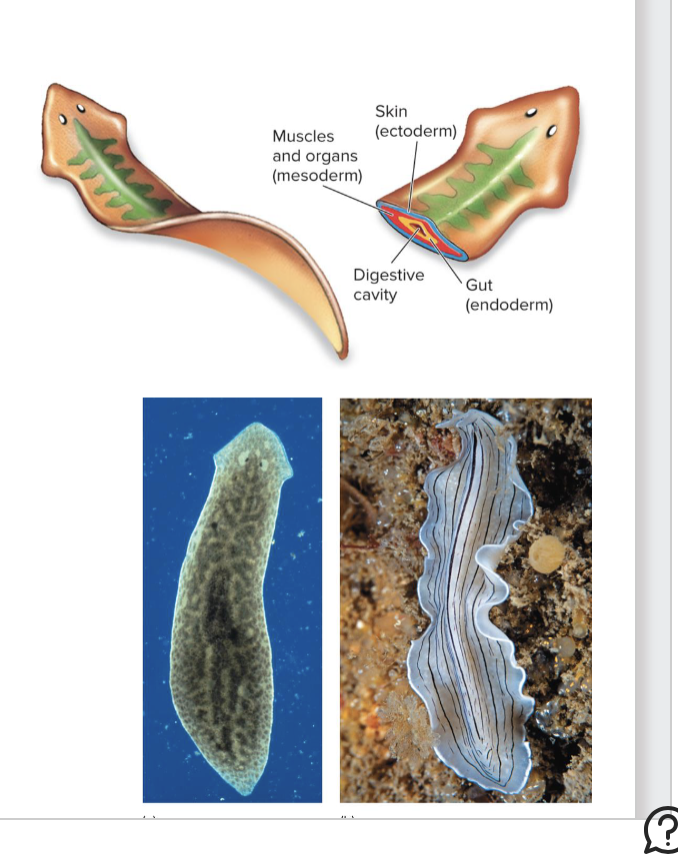
• The largest phylum of these worms is the flatworms.
• Flatworms are the simplest animals in which organs occur.
Flatworm Systems
Flatworms lack a circulatory system and all cells must be
within diffusion distance of oxygen and food.
Flatworms have a simple nervous system, either a nervenet or longitudinal nerve cords with cross connections.
• They use sensory pits or tentacles along the sides of the
head to detect food, chemicals, and movements.
• Most flatworms are hermaphroditic, meaning that each
individual contains both male and female reproductive
structures.
Hermaphroditic
contains both male and female reproductive structures.
The Evolution of a Body Cavity
A key transition in the evolution of the animal body plan was the evolution of the body cavity.
The evolution of an internal body cavity helped improve the
animal body design in three areas:
• Circulation
• Movement
• Organ function
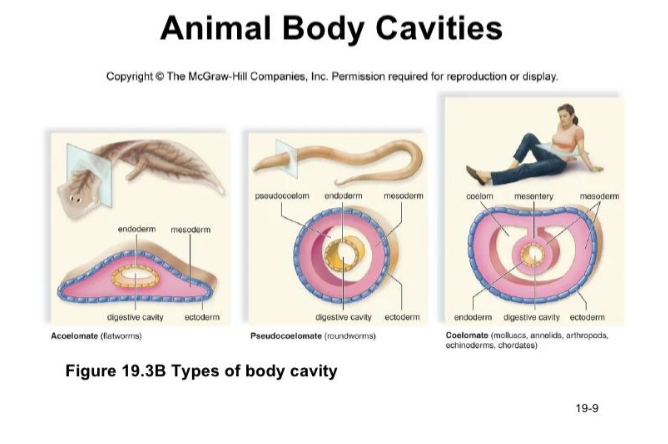
What are the 3 basic kinds of body plans found in bilaterally symmetrical animals
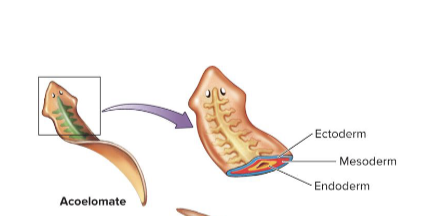
• Acoelomates
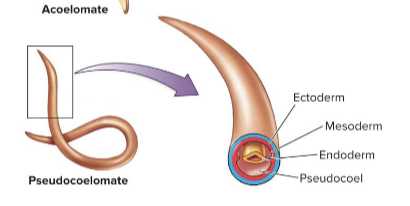
• Pseudocoelomates
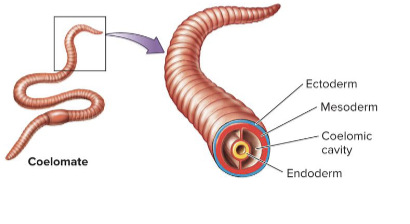
• Coelomates
Acoelomates
have no body cavity
Pseudocoelomates
have a body cavity (called a pseudocoel) located between the mesoderm and the endoderm
Coelomates
have a body cavity (called a coelom) that develops entirely within the mesoderm
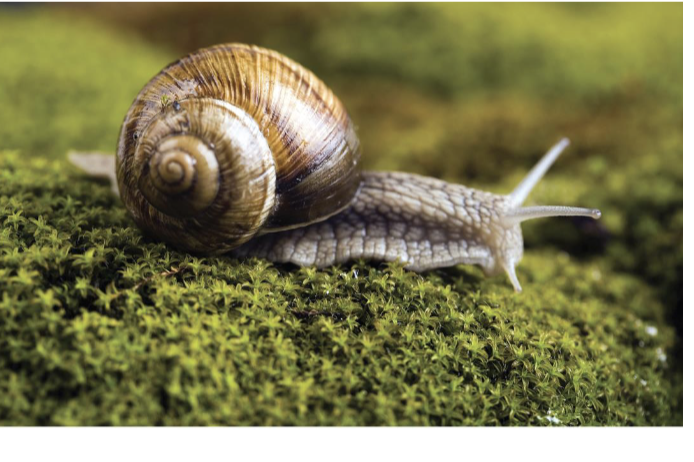
Mollusks: Coelomates 1
• Tissue (True tissue)
• Symmetry (Bilateral symmetry)
• Body cavity (First coelomates)
• Development (Protostomes)
• Segmentation (NOT segmented body)
3 major groups of mollusks:
• Gastropods
• Bivalves
• Cephalopods
Gastropods
include the snails and slugs
Bivalves
include clams, oysters, and scallops
Cephalopods
include the octopuses and squids
Annelids: The Rise of Segmentation
• Tissue (True tissue)
• Symmetry (Bilateral symmetry)
• Body cavity (coelomates)
• Development (Protostomes)
• Segmentation (Segmented body)
Annelids: The Rise of Segmentation
One of the early innovations in body plan to arise among the coelomates was
segmentation
• Segmentation is the building of a body from a series of similar segments.
• This body plan offers a lot of flexibility in that small changes to segments can produce a new kind of segment with different functions.
• The first segmented animals to evolve were the annelid
worms
Roundworms :Pseudocoelomates
• Tissues (True tissue)
• Symmetry (Bilateral symmetry)
• Body cavity (Only pseudocoelomate group)
• Development (Protostomes)
• Molting (First group that molts exoskeleton)
• Segmentation (NOT segmented body)
Roundworms :Pseudocoelomates
Body Cavity
The evolution of a body cavity improved:
Circulation
Movement
Organ function
Parasitic Roundworms
Some nematodes are parasitic in humans, cats, dogs, and animals of economic importance.
• Heartworm in dogs is caused by a
nematode.
• Hookworms are an intestinal parasite that once infected up to 40% of Americans in the rural South
• Pinworms are one of the most common parasitic infections in USA. About 10% of population infected at any given time.
Arthropods: Advent of Jointed Appendages
-Tissue (True tissue)
-Symmetry (Bilateral symmetry)
-Body cavity (coelomates)
-Development (Protostomes)
-Molting (Molts exoskeleton)
-Segmentation (Segmented body)
Arthropods: Advent of Jointed Appendages
The most successful of all animal groups is the phylum Arthropoda, consisting of the arthropods.
• 2/3 of all named species
• These animals have jointed appendages.
• In addition to joints, arthropods have an exoskeleton made of chitin.
• The muscles of arthropods attach to the interior of this
outer shell.
• The shell offers protection against predators and water loss.
Arthropods: Arachnida
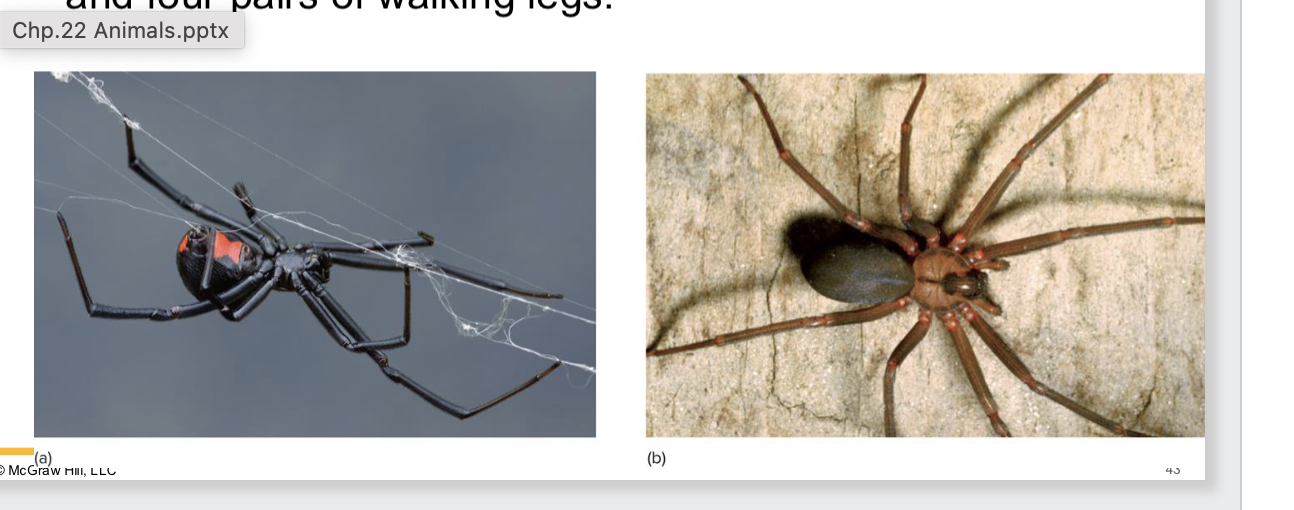
The class Arachnida has 57,000 named species of
arachnids, including spiders, ticks, mites, scorpions, and
daddy longlegs.
• Arachnids have a pair of chelicerae, a pair of pedipalps,
and four pairs of walking legs.
\
Arthropods: Crustaceans
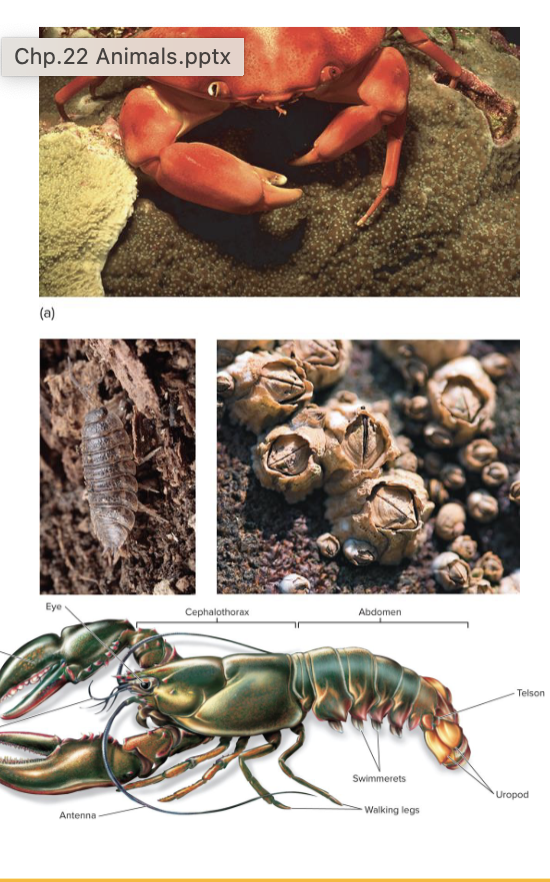
Crustaceans belong to the subphylum Crustacea and comprise a diverse group
• There are 35,000 species of crustaceans described, including species of crabs, shrimps, lobsters, crayfish, water fleas, pill bugs, and sowbugs.
• Most crustaceans have two pairs of antennae, three pairs of chewing appendages, and various numbers of legs
Arthropods: Insects
Insects belong to the Class Insecta and are the largest
group of arthropods.
• They are the most abundant eukaryotes on the earth.
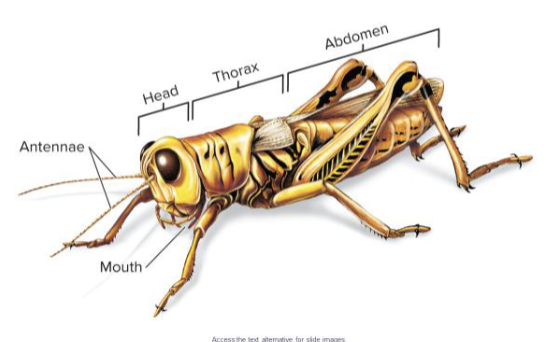
Insects have three body sections:
• Head
• Thorax
• Abdomen
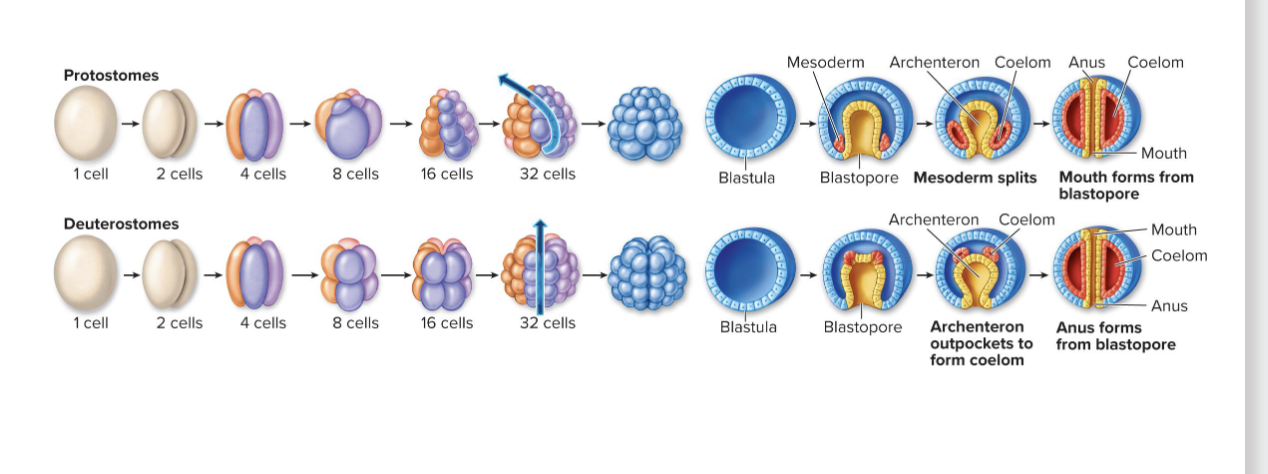
are two major kinds of coelomate animals representing two distinct evolutionary lines:
• Protostomes
• The mouth develops from or near the blastopore.
• Deuterostomes
• The anus forms from or near the blastopore; the mouth forms on another part of the blastula.
Echinoderms: The First Deuterostomes
• Tissue (True tissue)
• Symmetry (Bilateral symmetry as larvae, radial symmetry as adult)
• Body cavity (Coelomates)
• Development (First deuterostomes)
• Molting (Endoskeleton, NO molting)
• Segmentation (NOT segmented body)
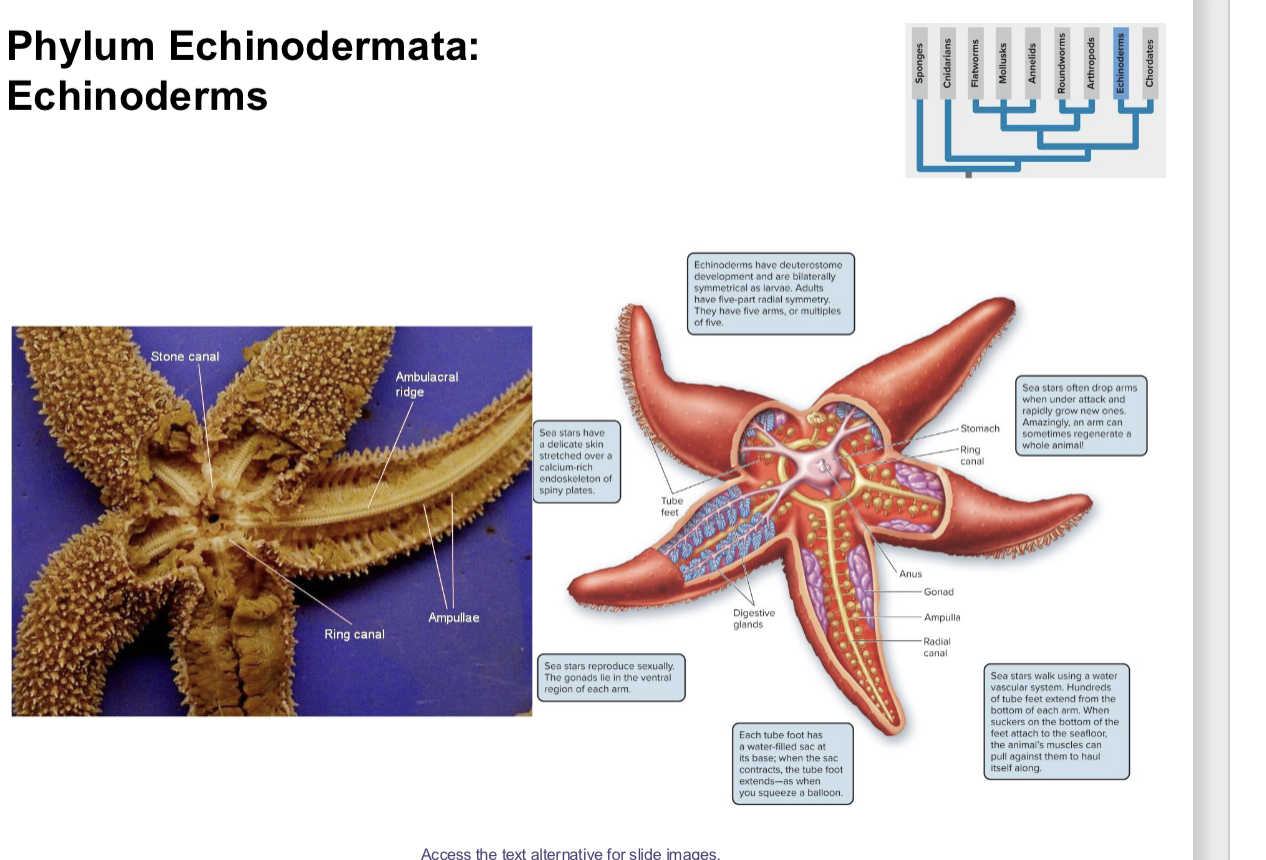
Echinoderms are deuterostomes that belong to the phylum Echinodermata
• Echinoderm means “spiny skin” and refers to the endoskeleton of calcium-rich ossicles just beneath
the echinoderm’s skin.
• Entirely marine animals, including. sea stars, sea urchins, sand dollars, and sea cucumbers
• All are bilaterally symmetrical as larvae but become radially symmetrical as adults.
Water Vascular System
A key adaptation of echinoderms is the water vascular system that aids movement.
• This system is fluid-filled and composed of a central ring canal from which five radial canals extend out into the arms.
• From each radial canal, tiny vessels extend through short side branches into thousands of tiny, hollow tube
feet.
• Echinoderms can extend the tube feet, attach them to the ocean floor, and pull against them to move.
Most echinoderms reproduce sexually but asexual regeneration is also common.
Chordates: Improving the Skeleton
• Tissue (True tissue)
• Symmetry (Bilateral symmetry)
• Body cavity (Coelomates)
• Development (Deuterostomes)
• Molting (Endoskeleton, NO molting)
• Segmentation (Segmented body)
Chordates: Improving the Skeleton
Chordates are deuterostomes that belong to the phylum
Chordata.
• They exhibit a truly internal endoskeleton with muscles
attached to an internal rod, called a notochord (this will
be replaced with a backbone in vertebrates).
• This innovation opened the door to large body sizes not
possible in earlier animal forms.
Chordates
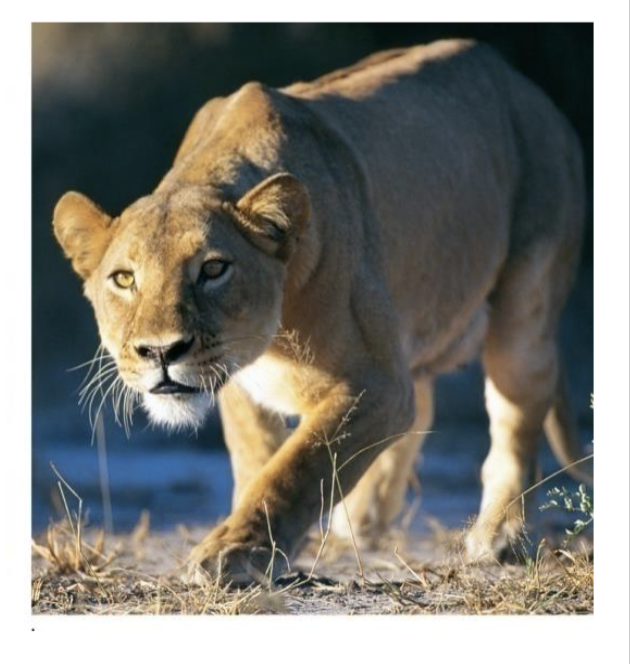
The approximately 56,000 species of chordates share four
principal features:
• Notochord
• Nerve cord
• Pharyngeal pouches
• Postanal tail
All chordates have all four of these characteristics at some time in their lives
Chordates: Nonvertebrate
Not all chordates are vertebrates.
• Tunicates and lancelets are chordates
Chordates: Vertebrates
Vertebrate chordates differ from tunicates and lancelets
in two important respects:
• Vertebrates have a backbone.
• This replaces the role of the notochord.
• Vertebrates have a distinct and well- differentiated head
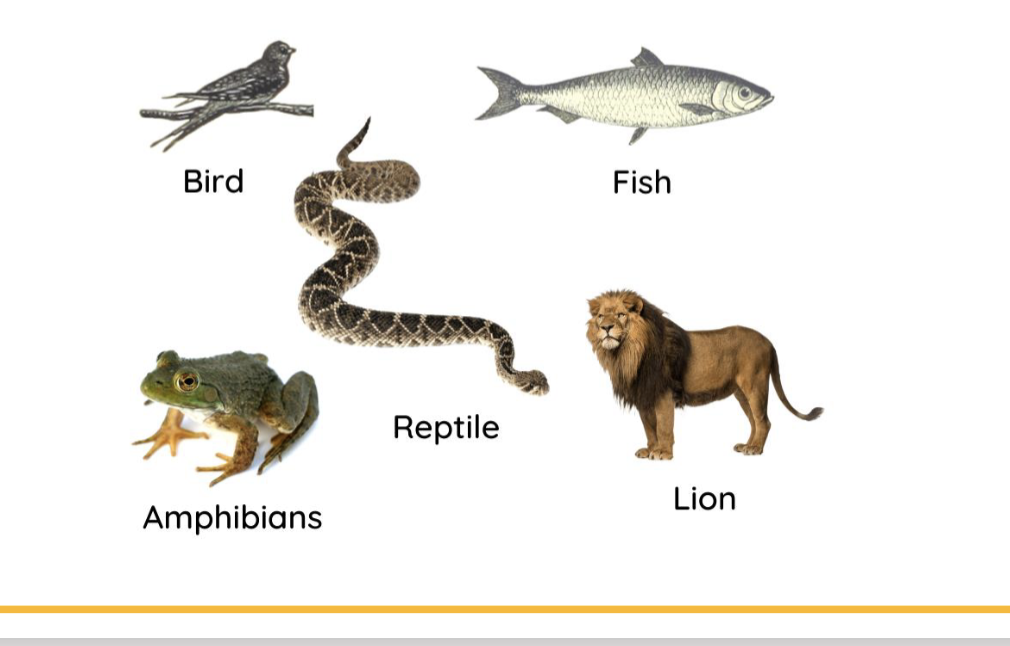
Vertebrates picture examples
Time periods
Scientists divide the earth’s past into different time periods
This gave them a way to organize fossils
• Large blocks of time are called eras (smaller
blocks- periods, epochs,and ages)
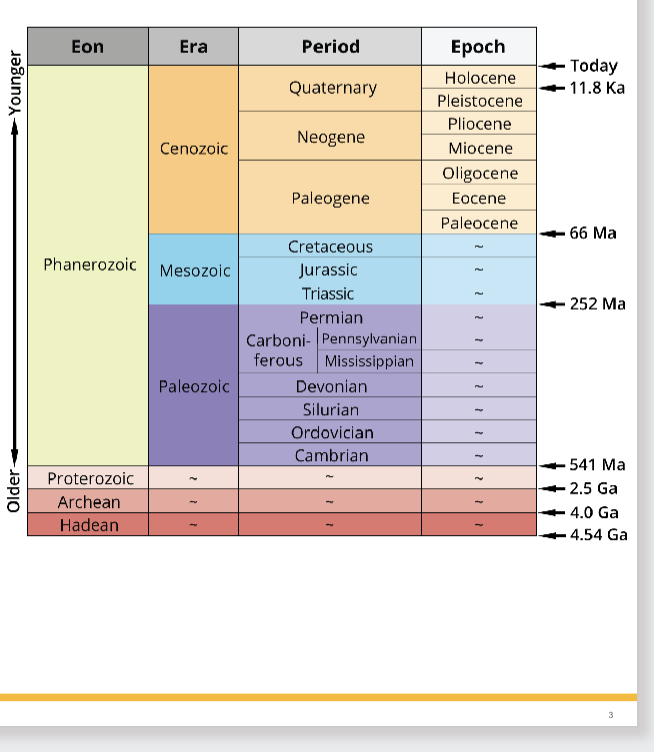
The Paleozoic Era
Animal life exploded in the sea at the beginning of the
Paleozoic era
• The diversification of animal life began soon after the Cambrian period (545 to 490 M.Y.A.).
• The first vertebrates evolved about 500 M.Y.A.
While most of the animal phyla that evolved in the Cambrian remained marine, a few phyla have successfully invaded land. Which one?
• Fungi and plants were the first terrestrial organisms,
appearing over 500 M.Y.A.
• Arthropods were the first terrestrial animals, invading
land about 410 M.Y.A.
• Vertebrates invaded the land during the Carboniferous
period (360 to 280 M.Y.A.)
Mass extinctions
sharp declines in species diversity
• 5 mass extinctions have occurred during the history of life.
• The most drastic occurred during the last 10M years of the Permian period, which marked the end of the Paleozoic era.
• An estimated 96% of all species of marine animals became extinct.
The Mesozoic Era
The Mesozoic era (248 to 65 M.Y.A.) has traditionally been divided into three periods:
• Triassic
• Jurassic
• Cretaceous
During the Jurassic period, the supercontinent of Pangaea
began to break up, sea levels were rising, and the world’s
climate became warmer and wetter.
The Mesozoic Era Had Intensive Evolution
Mesozoic era (248 to 65 M.Y.A.) was a time of intensive
evolution of terrestrial plants and animals.
• Reptiles continued their success and diversified greatly.
• The flowering plants evolved
• From reptile ancestors, dinosaurs, mammals, and birds
evolved.
• Dinosaurs and mammals appeared at about the same
time, 230 to 223 M.Y.A.
• But the dinosaurs filled the evolutionary niches for large animals
• For over 150 million years, dinosaurs were the dominant
land vertebrates.
12
Dinosaurs Disappeared
• 65 M.Y.A., at the end of the Cretaceous period, dinosaurs
disappeared in mass extinction event.
• This loss included flying reptiles (pterosaurs) and marine
reptiles.
• Mammals occupied most of the niches left open by the
loss of the dinosaurs.
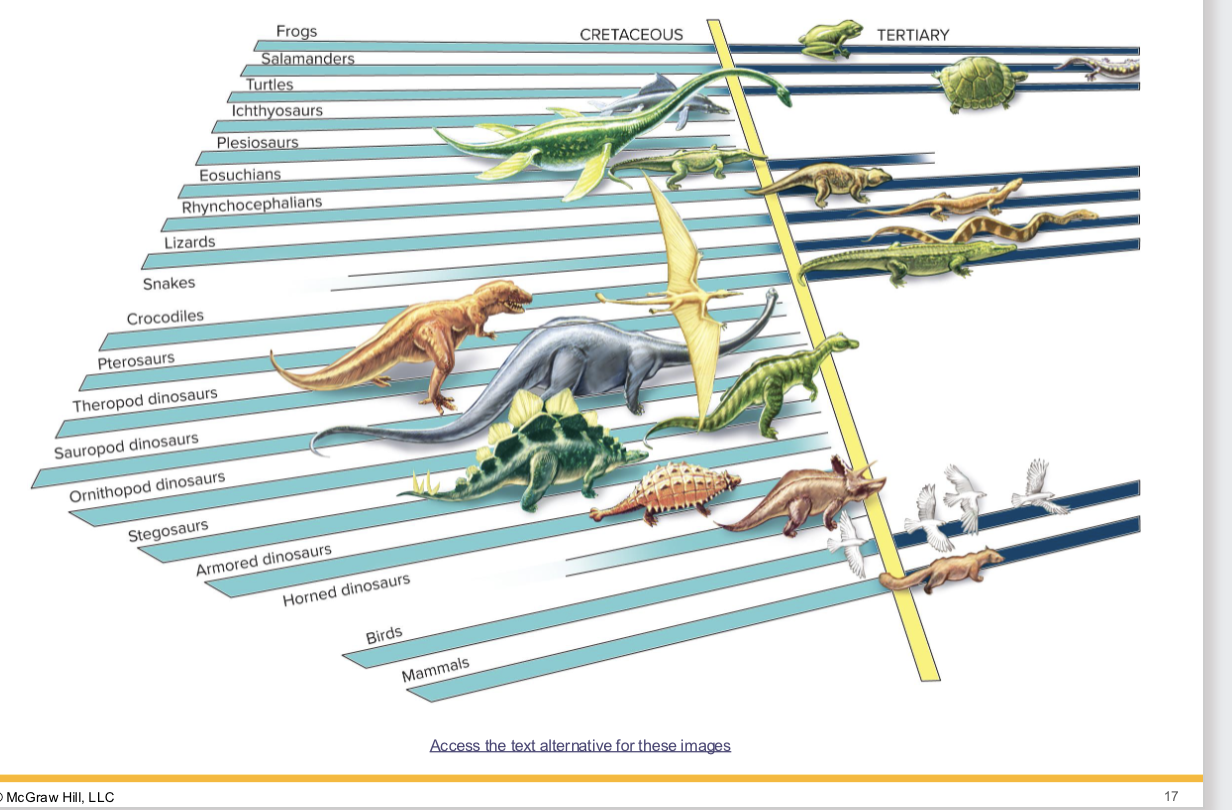
Explanations for the Demise of the Dinosaurs
Many explanations have been advanced to explain the
demise of the dinosaurs.
• The most widely accepted, proposed by Luis W. Alvarez,
blames an asteroid impact.
• Iridium is an element rare on earth but abundant in
meteorites.
• A layer of iridium is abundant in many parts of the world in a layer of sediment that dates to the end of the Cretaceous period.
The Cenozoic Era 1
Early in theCenozoic era (65 M.Y.A. to present), the climate was relatively warm compared to today’s colder and drier climate.
• The first half of the era was very warm with jungle-like forests at the poles.
The Cenozoic Era 2
A gradual cooling caused ice caps to form at the poles.
• The glaciation of Antarctica and the Northern Hemisphere 13 M.Y.A.
This was followed by a series of glaciations, the most recent ending about 10,000 years ago.
• Many very large mammals evolved during the ice ages,
including: mastodons, mammoths, saber-toothed
tigers, and cave bears.
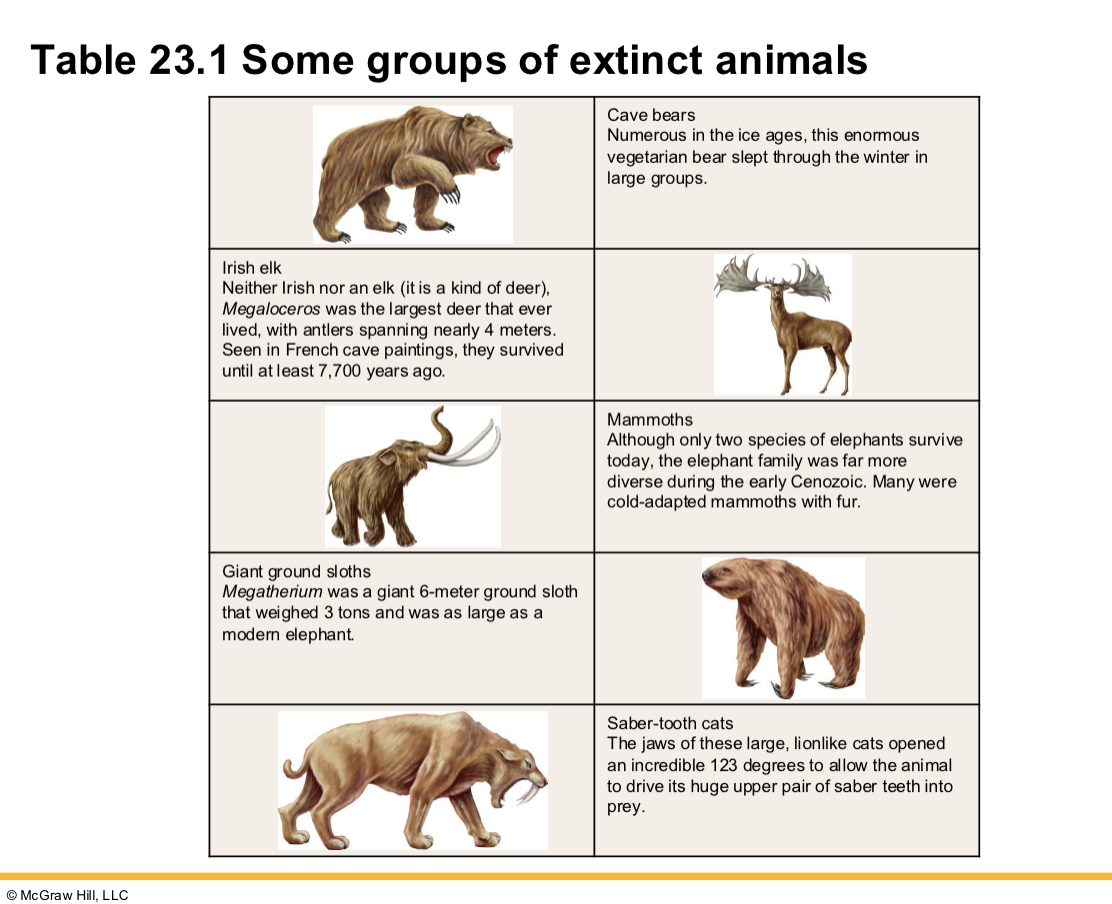
Fishes Dominate the Sea 1
A series of key evolutionary advances allowed vertebrates (animals with backbone) first to conquer the sea and then the land. More than half of all vertebrate species are
fishes.
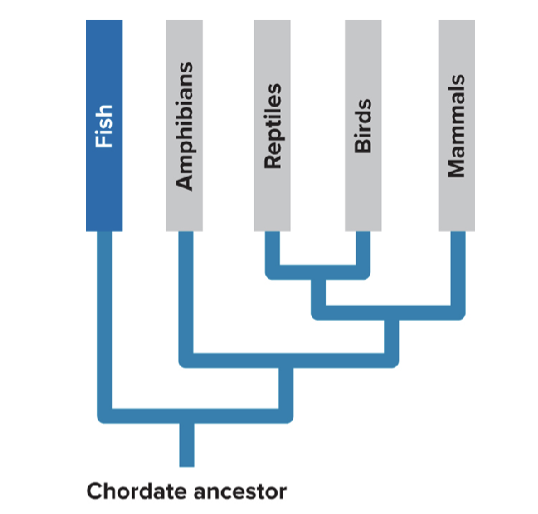
• Fishes provide the evolutionary base for the
invasion by land by amphibians.
vertebrates
animals with backbone
invertebrates
animals without backbone
Vertebrate family tree
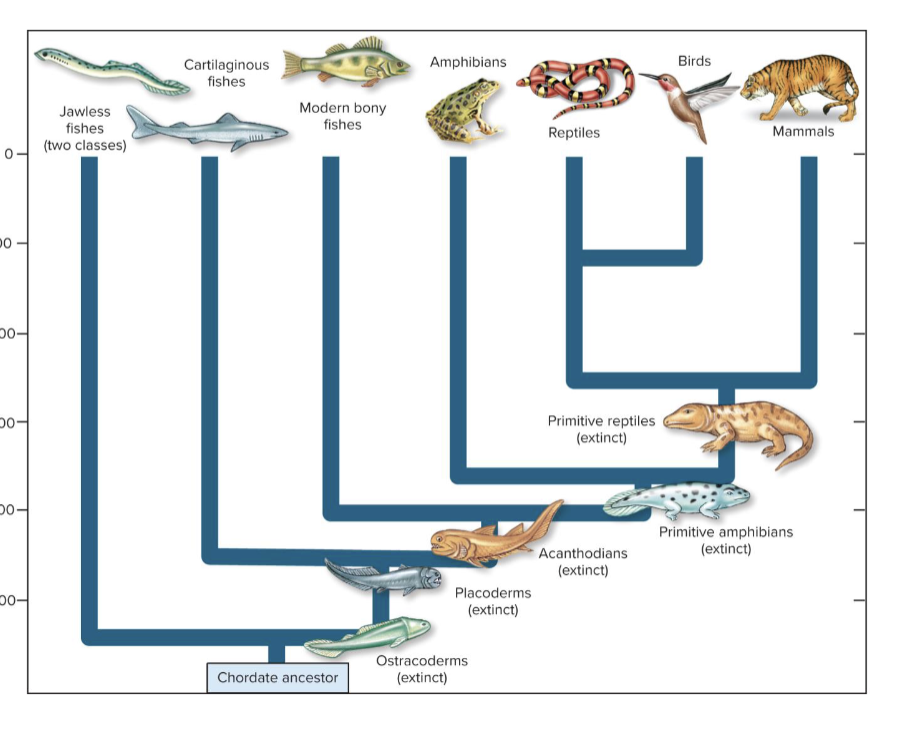
Agnathans
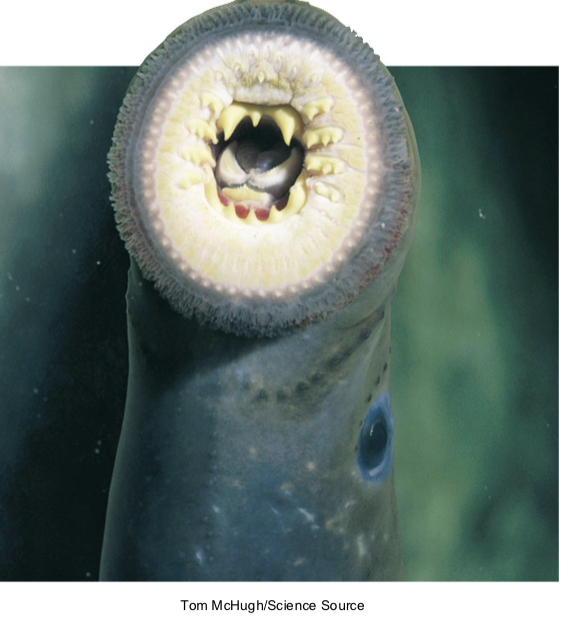
The first fishes were jawless fish that appeared in the sea
about 500 M.Y.A.
• Lampreys, hagfish and their relatives are only jawless fishes found today
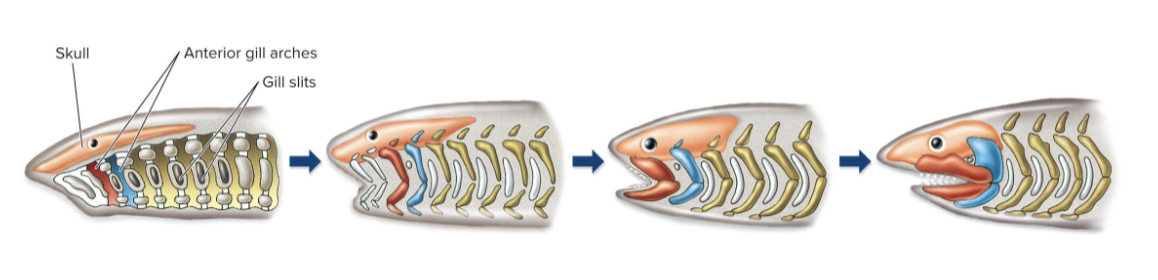
Jawed Fishes
Jawed fishes appeared around 410 M.Y.A.
• Jaws evolved from the frontmost of a series of
cartilaginous arch supports that reinforced the tissue
between gill slits
• Sharks and bony fishes appeared about 400 M.Y.A.
• Sharks and bony fish have dominated the seas for the
last 250 million years.
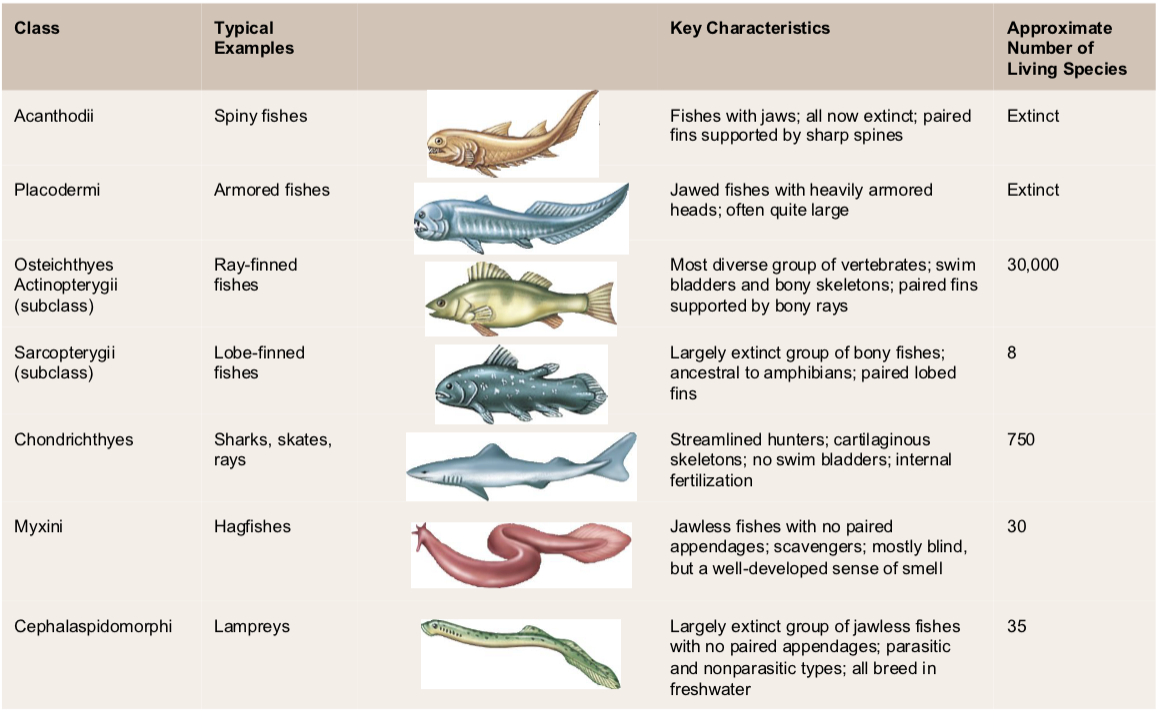
Chondrichthyes includes what animals? and how many species today?
Sharks, along with skates and rays, belong to the class
• There are 750 species in this class today.
Chondrichthyes
First major group of jawed vertebrates to evolve.
• Sharks have a flexible skeleton made of cartilage and are fast and maneuverable swimmers.
• While some are filter feeders, most sharks are predators and have a mouth armed with rows of sharp teeth.
• Sharks also have many special sensory adaptations that suit their predatory life.
Osteichthyes
Bony fishes
Bony fishes are the most successful of all fishes, indeed of
all vertebrates.
• There are nearly 30,000 species of bony fishes.
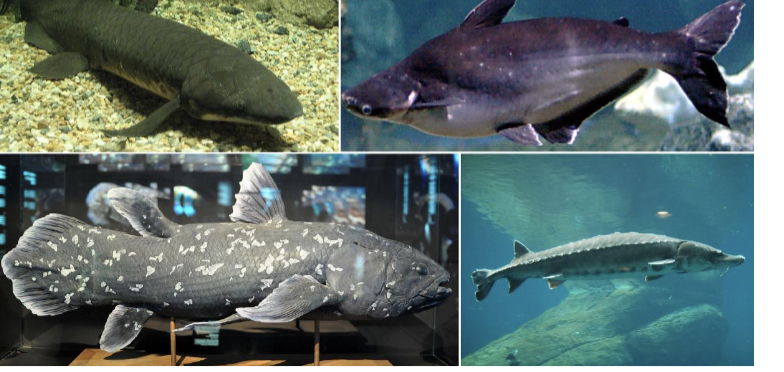
Bony fishes have a heavier internal skeleton made of
bone.
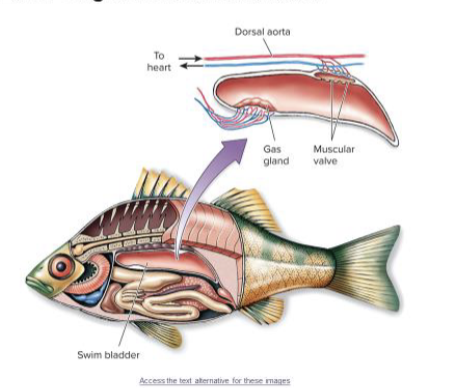
• They maneuver with the aid of a swim bladder, a gas-filled sac that allows fish to regulate their buoyancy.
• The swim bladder allows a bony fish to remain
suspended at any depth in the water without expending effort.
Bony fishes have several adaptations that have helped make them such evolutionary successes. What are there?
• Lateral line system
• Operculum
• Lateral line system
A special sensory system that enables fish to detect changes in water pressure (detect predators and prey)
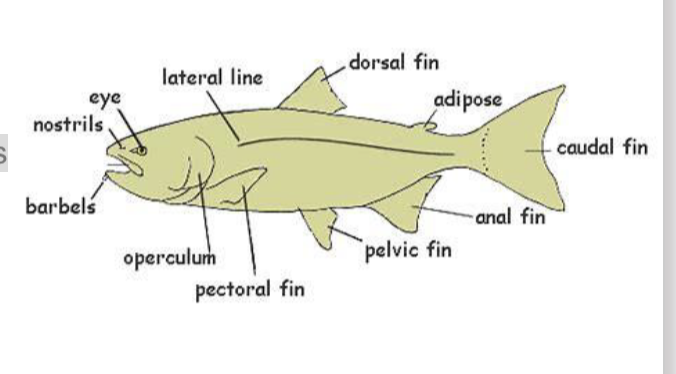
Operculum
• A bony covering on top of the opening of the gills.
• This allows the fish to ventilate the gills while remaining
stationary
Major classes of fishes
Amphibians Invade the Land
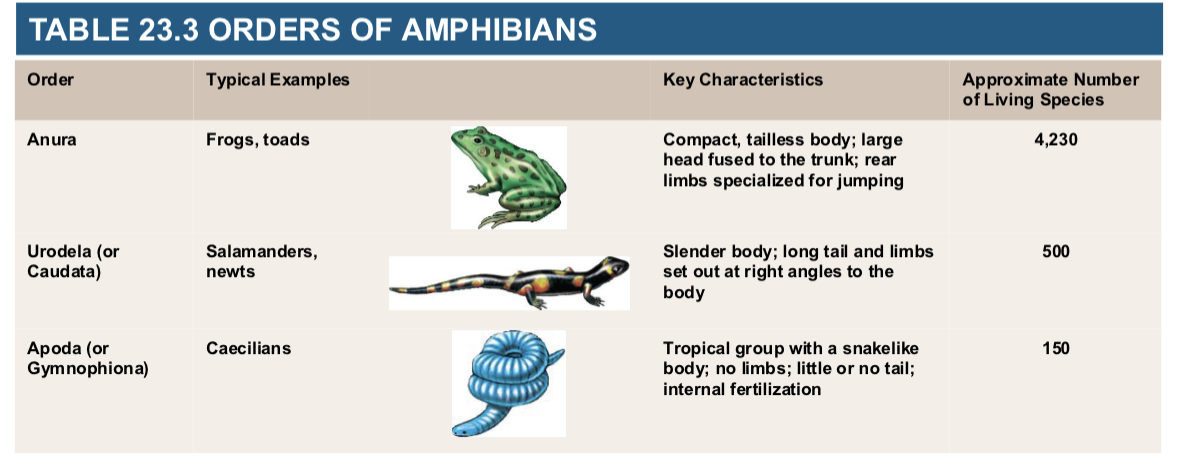
The amphibians include frogs, salamanders, and caecilians.
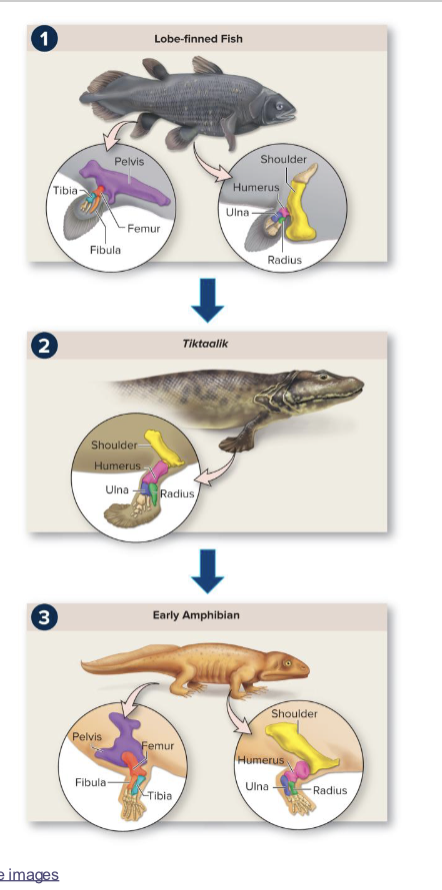
• They were the first terrestrial vertebrates and evolved from the lobe-finned fishes.
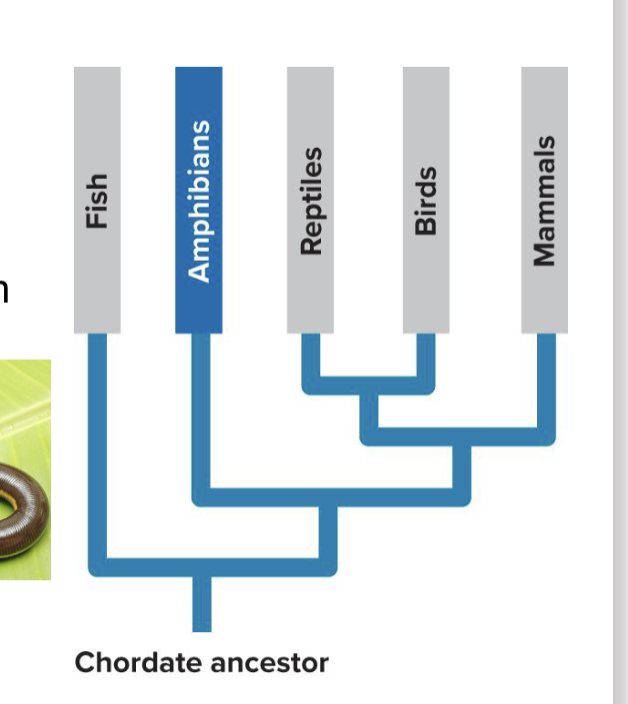
A key adaptation of amphibians
A fossil of the genus Tiktaalik (discovered in 2006) exhibited limb morphology that was transitional between fish and amphibians
Amphibian Characteristics
Amphibians have five key characteristics that allowed them
to invade land successfully:
• Legs
• Lungs
• Cutaneous respiration- breathe through skin
• Pulmonary veins-improved circulatory system
• Partially divided heart- separates non-oxygenated
blood from oxygenated
Amphibia
• amphibians of today must reproduce in water and are
not completely terrestrial.
• Approximately 4,850 species exist today in the class
Amphibia
Reptiles Conquer the Land
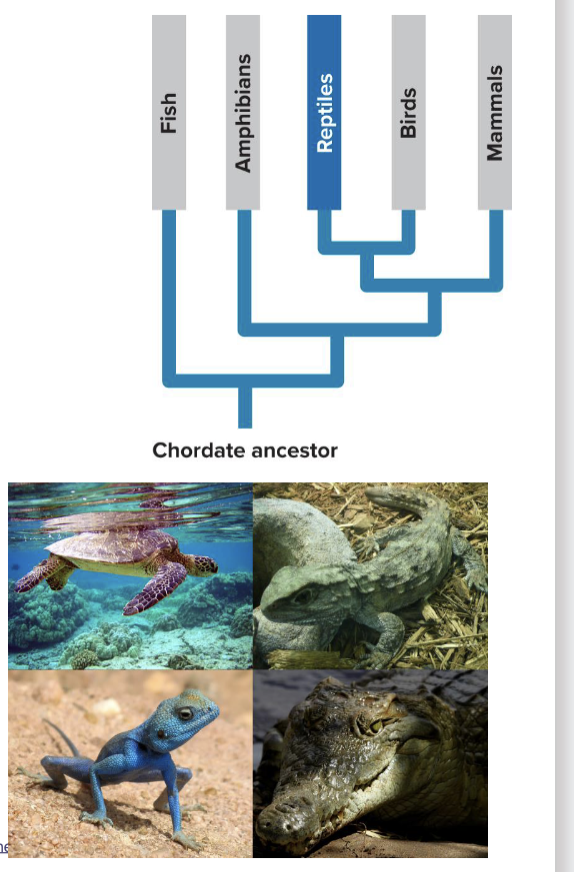
• Reptiles are more fully terrestrial than
amphibians.
• Todays reptiles: Snakes, turtles, lizards, alligators
All living reptiles share the following fundamental characteristics
Watertight egg
watertight skin
thoracic breathing
Amniotic egg (fundamental characteristics of reptiles)
This innovation is a watertight environment that
offers the embryo protection against drying out
Dry skin (fundamental characteristics of reptiles)
Reptiles are covered by scales or armor in order to prevent drying out
Thoracic breathing (fundamental characteristics of reptiles)
Reptiles increase their lung capacity by expanding their
chest cavity when breathing in air
Reptilia
Today some 7,000 species of reptiles belong to the class Reptilia.
Reptiles improved on the evolutionary innovations of amphibians to terrestrial life.
• Reptilian legs were arranged to better support body weight and to facilitate more efficient locomotion.
• Lungs and heart became more efficient in reptiles than in
amphibians.
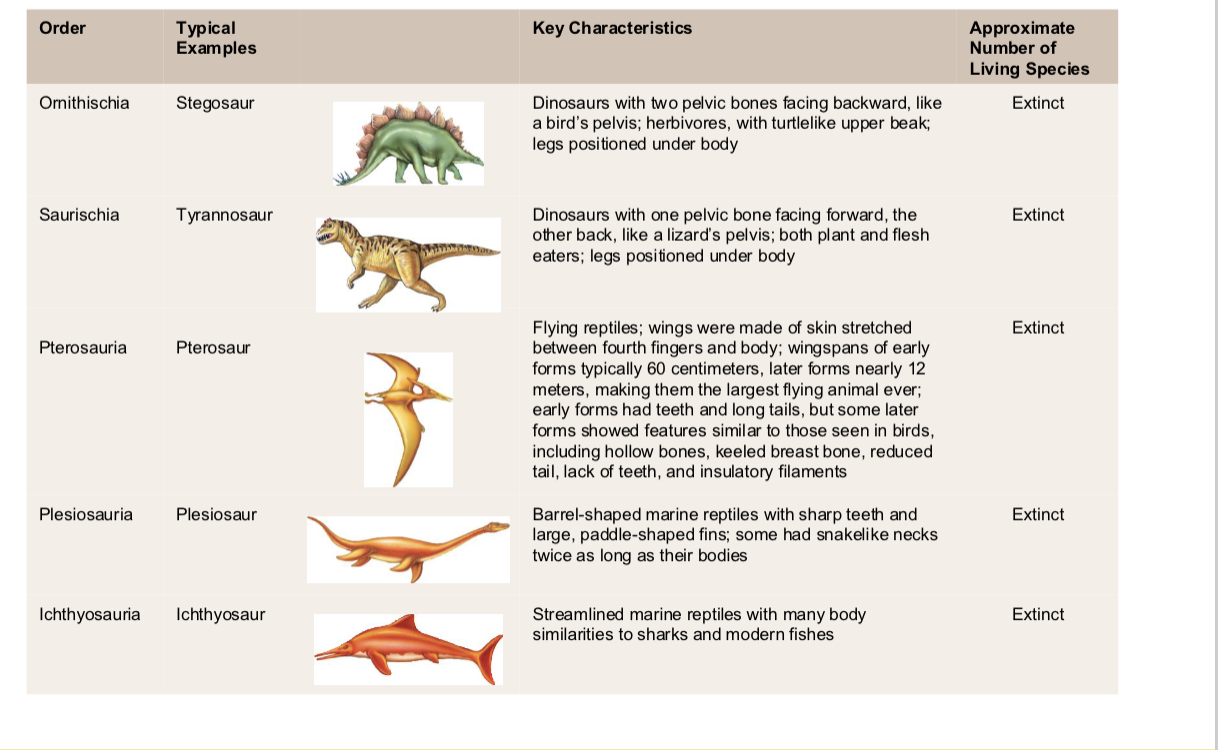
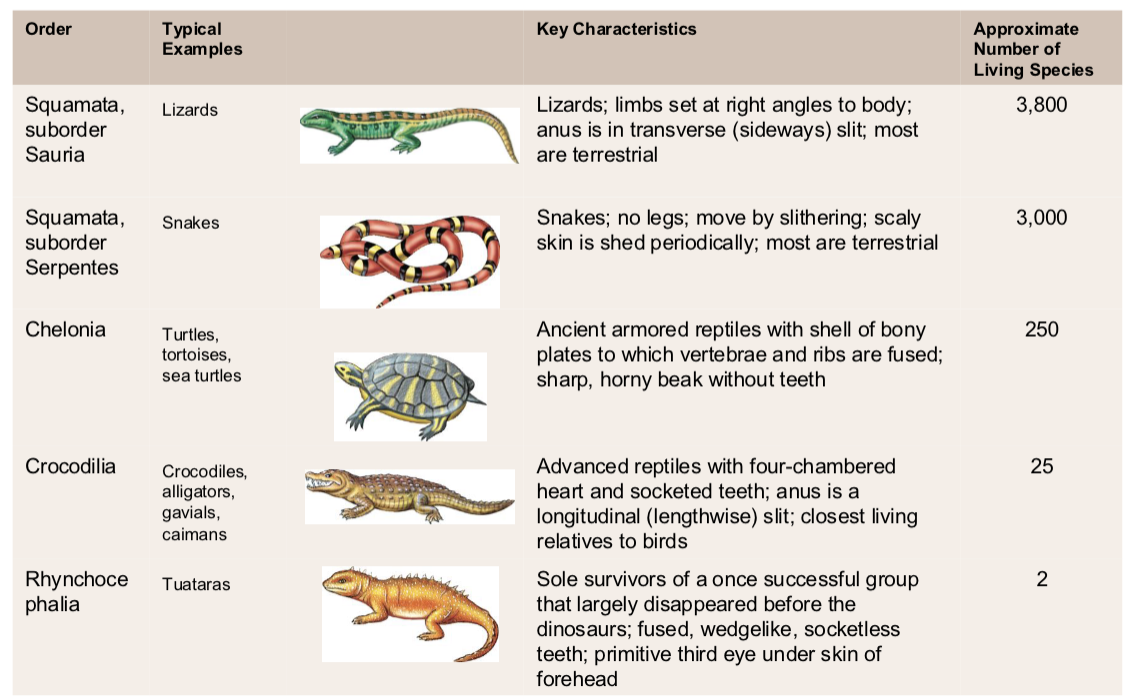
Orders of reptiles
Birds Master the Air
Birds evolved from bipedal dinosaurs about 150 M.Y.A.
• They only became common after the pterosaurs became extinct.
• Many scientists consider birds to be feathered dinosaurs, given their similarity in so many respects to dinosaurs
Bird Characteristics
Modern birds lack teeth and have only vestigial
tails. They retain many reptilian characteristics:
• Birds lay amniotic eggs (but with hard shells).
• Birds have reptilian scales on their feet and
lower legs.
Birds are different than reptiles in that they have:
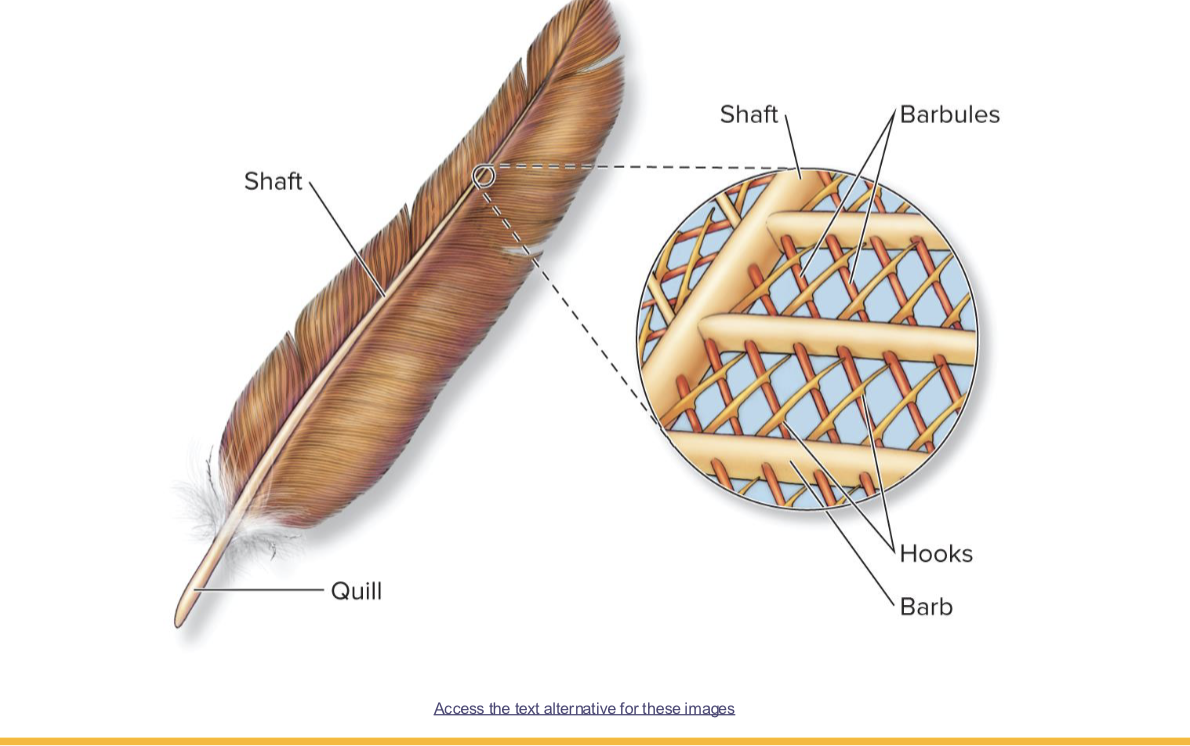
• Feathers
• Derived from reptilian scales but adapted for flight.
• Flight skeleton
• The bones of birds are thin and hollow, reducing
weight while providing enhanced points for flight
muscle attachment.
Birds Are Endothermic
Birds are endothermic.
• Their high body temperatures enhance
metabolism, satisfying the large energy requirements
of flight.
The oldest bird of which there is a clear fossil is Archaeopteryx.
There are about 8,600 species of birds in the class
Aves today.
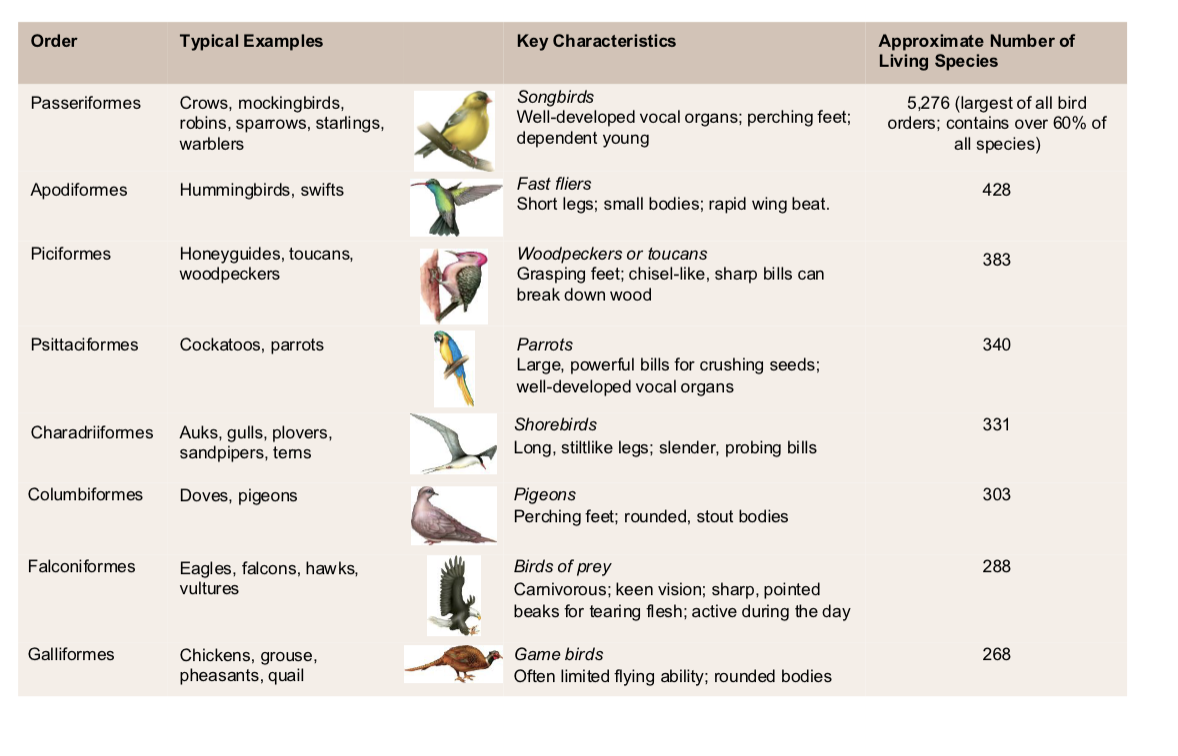
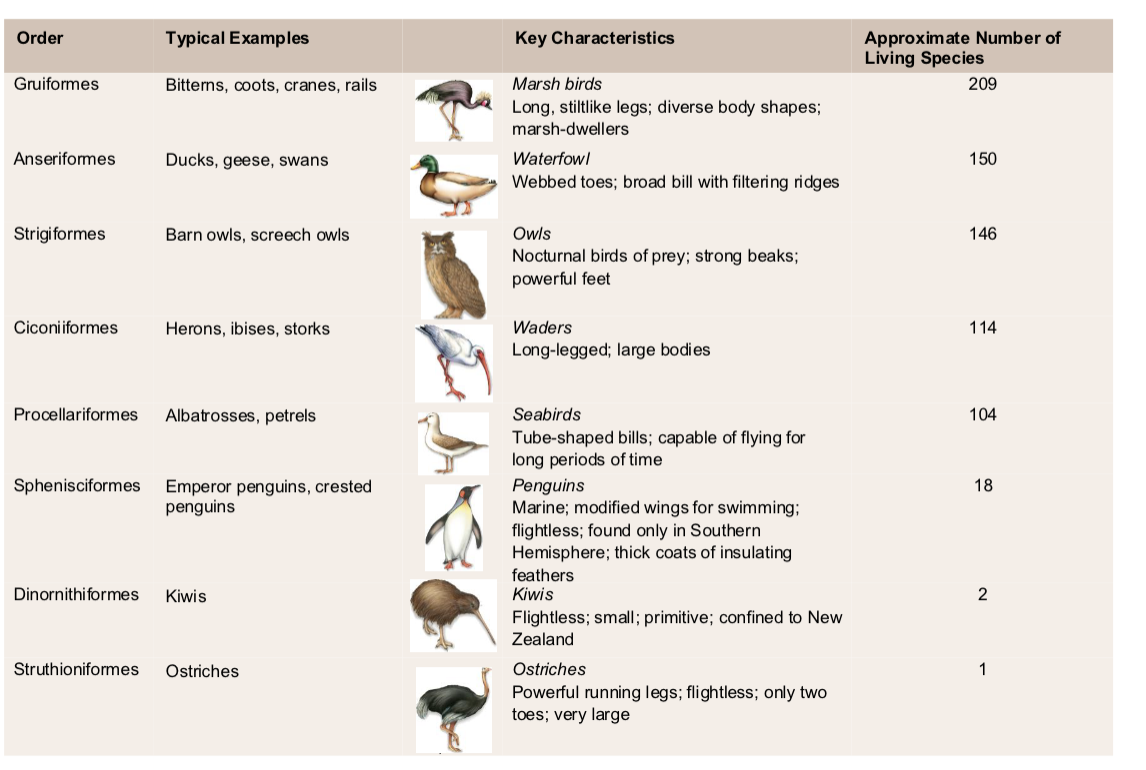
Major orders of birds
Mammals Adapt to Colder Times
Mammals evolved about 223 M.Y.A. and belong to the
class Mammalia.
• Members of this class share three key
characteristics:
• Mammary glands
• Hair
• Middle ear