organisation of cells
 Call Kai
 Learn
Learn Practice Test
 Spaced Repetition
 Match
Match Flashcards
 Knowt Play
1/33

There's no tags or description
Looks like no tags are added yet.
Name | Mastery | Learn | Test | Matching | Spaced | Call with Kai | Chat |
|---|
No analytics yet
Send a link to your students to track their progress
34 Terms
Why are cells specialised?
Cells become specialised so they can carry out a particular function more efficiently.
Describe the structure (2) and functions of the cell membrane (5)
Answer
The cell membrane is a thin, living boundary surrounding the cytoplasm.
Functions
Controls the movement of substances into and out of the cell.
Prevents cell contents from escaping.
Allows useful substances (oxygen, water, nutrients) to enter.
Allows waste products to leave.
Helps maintain suitable conditions inside the cell.
Structure
Thin and flexible.
Selectively permeable, meaning it only allows certain substances to pass.
Which cells have a cell membrane
Found in
✅ Plant cells
✅ Animal cells
✅ Bacterial cells
Describe the structure and functions of the cytoplasm.
The cytoplasm is a jelly-like substance inside the cell.
It contains:
enzymes
ribosomes
mitochondria
other organelles
Functions
Site of most chemical reactions.
Contains enzymes that control these reactions.
Suspends organelles.
Provides a medium for transport inside the cell.
Extra facts from your notes
The cytoplasm is about 90% water.
It also contains:
proteins
fats (lipids)
sugars
salts
Describe the structure and functions of the nucleus
The nucleus is usually the largest organelle in the cell.
It is surrounded by a nuclear membrane and contains chromosomes, which are made of DNA.
Functions
Controls all activities of the cell.
Controls enzyme production.
Controls cell division.
Contains genetic information.
Determines the type and function of the cell.
Extra facts
When a cell divides:
the nucleus divides first
the cytoplasm divides afterwards
A cell without a nucleus cannot divide.
Describe the structure and functions of ribosomes.
Ribosomes are tiny organelles found in the cytoplasm.
Function
They are the site of protein synthesis, where proteins are made.
Proteins produced may be:
enzymes
hormones
structural proteins
Found in
✅ Plant cells
✅ Animal cells
✅ Bacterial cells
Describe the structure and functions of mitochondria.
Mitochondria are small rod-shaped organelles found in the cytoplasm.
Function
They are the site of aerobic respiration.
During aerobic respiration they release energy in the form of ATP.
This energy is used for:
active transport
movement
growth
protein synthesis
cell division
Adaptation
Cells that require large amounts of energy contain many mitochondria.
Examples:
muscle cells
sperm cells
root hair cells
Describe the structure and functions of the cell wall.
The cell wall surrounds the cell membrane in plant cells.
Structure
Non-living.
Made mainly of cellulose.
Freely permeable.
Functions
Supports the cell.
Strengthens the cell.
Maintains cell shape.
Prevents bursting when water enters by osmosis.
Allows water and dissolved substances to pass through.
Found in
✅ Plant cells only (for your syllabus comparison).
Describe the structure and functions of the vacuole.
Most mature plant cells contain one large permanent vacuole.
Structure
Contains cell sap, which is made of:
water
sugars
mineral salts
pigments
Functions
Stores dissolved substances.
Maintains turgor pressure.
Pushes the cytoplasm against the cell wall.
Keeps the plant upright and firm.
Adaptation
Its large size allows it to hold large amounts of water, creating pressure that supports the plant.
⭐ Exam Tip
Animal cells may have small temporary vacuoles, but not a large permanent one.
Q. Describe the structure and functions of chloroplasts.
Chloroplasts are green organelles found in photosynthetic plant cells.
Structure
Contain the green pigment chlorophyll.
Functions
Site of photosynthesis.
Chlorophyll absorbs light energy.
Used to make glucose from carbon dioxide and water.
Adaptation
Palisade mesophyll cells contain many chloroplasts so they absorb as much light as possible.

Label this egg cell

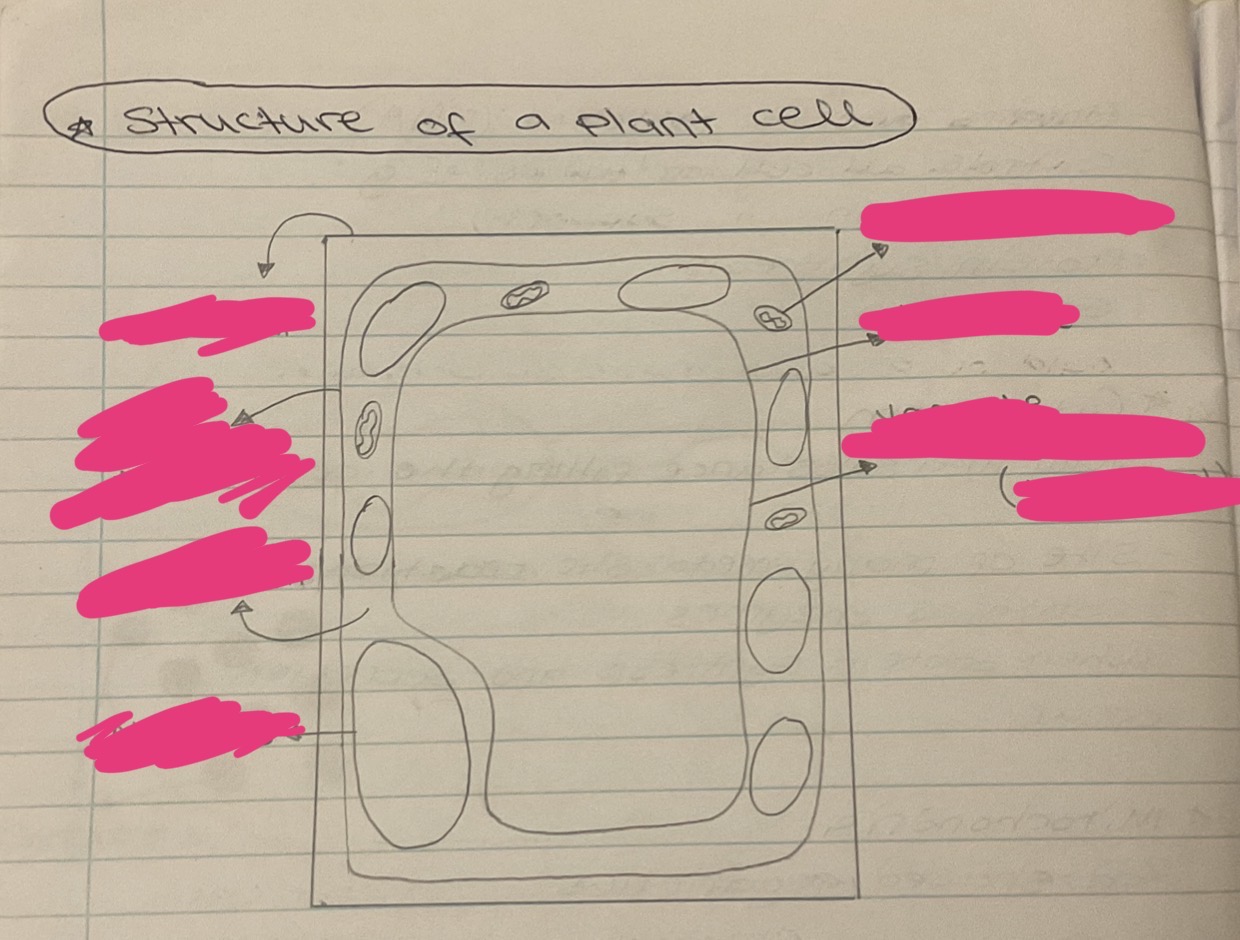
Label this plant cell

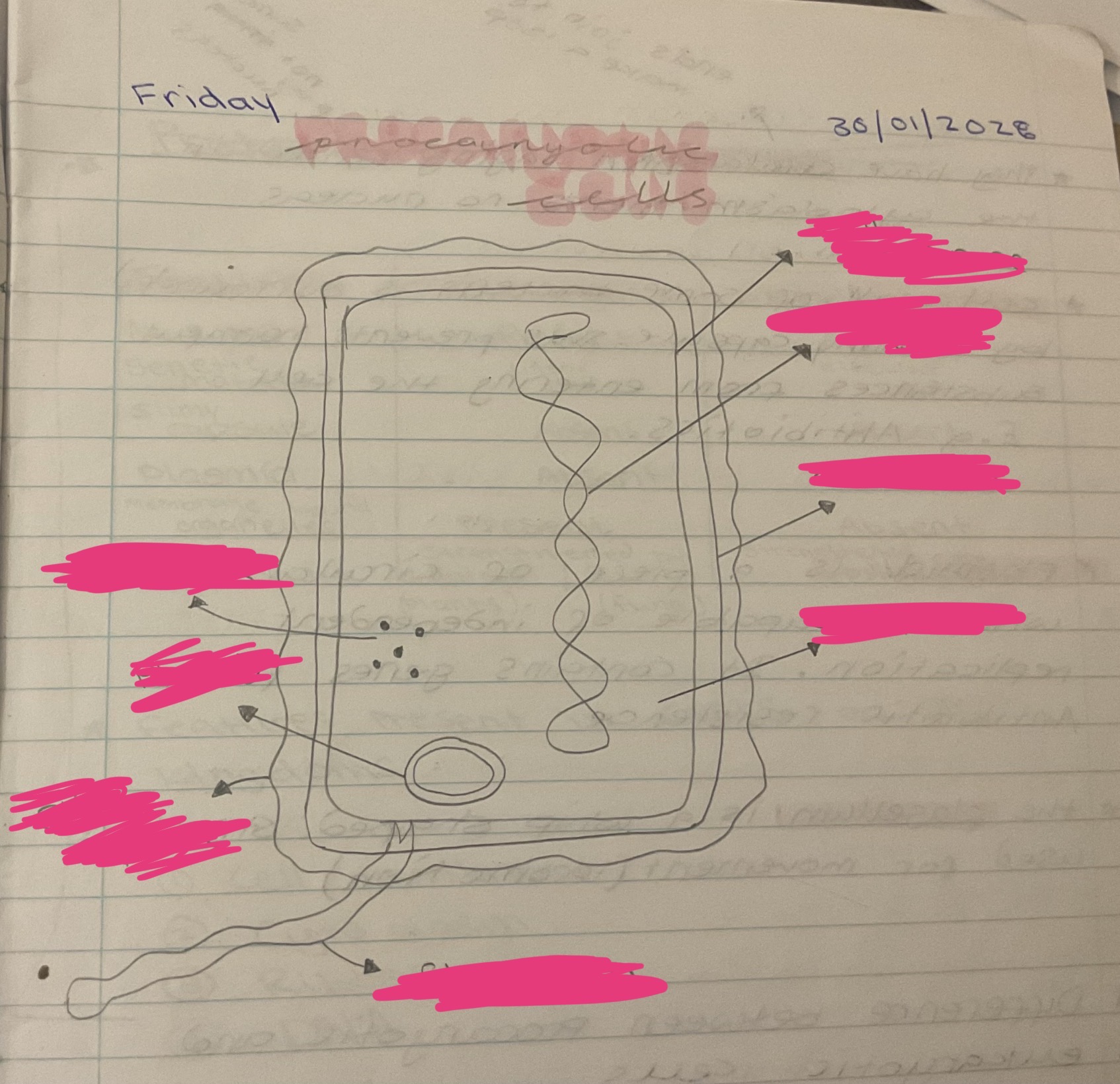
Label this plant cell

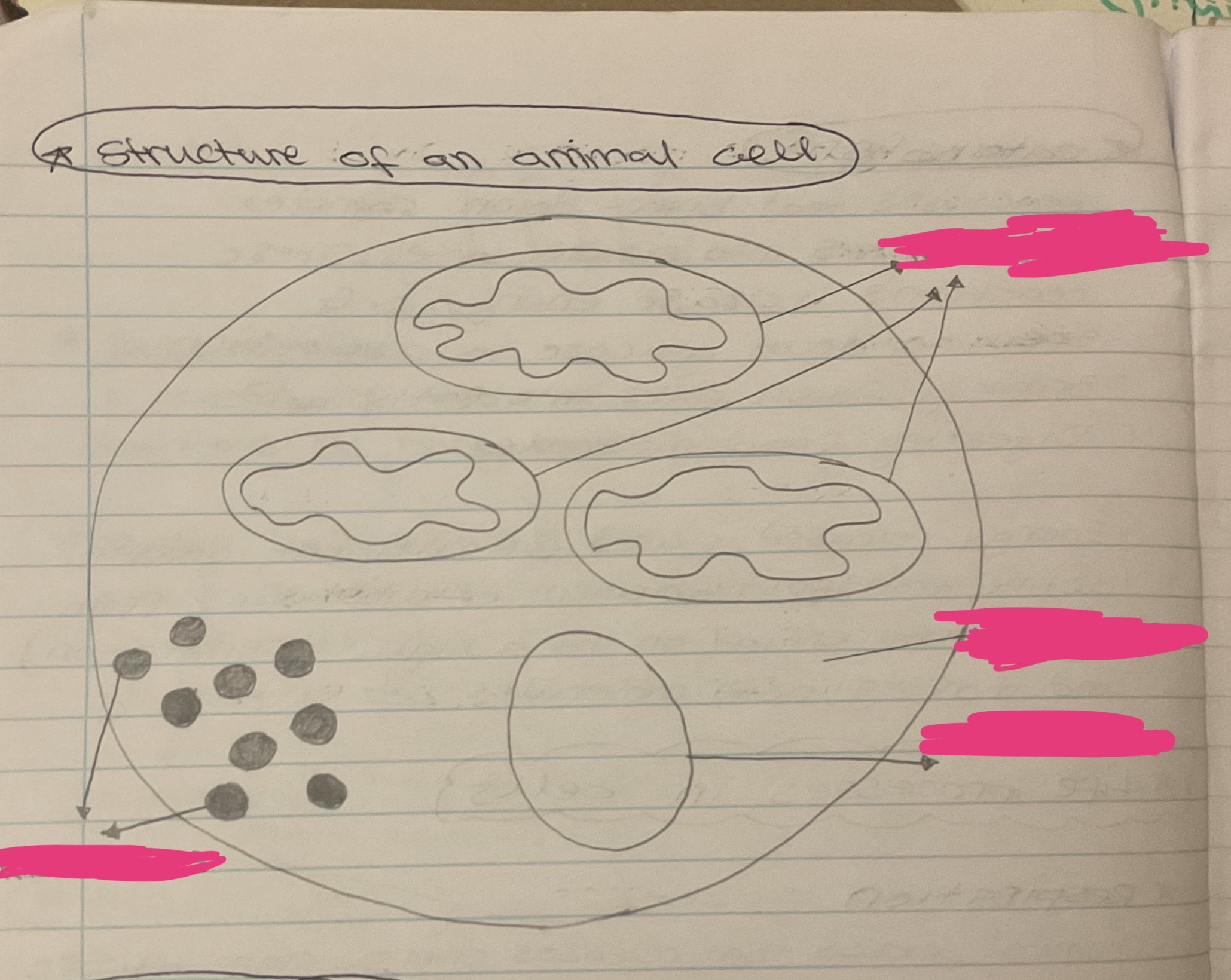
Label this animal cell

Compare plant cells and animal cells. ( differences only )
Plant Cell | Animal Cell |
Cell wall made of cellulose | No cell wall |
Chloroplasts (in photosynthetic cells) | No chloroplasts |
Large permanent vacuole | Small temporary vacuoles or none |
Usually regular/rectangular shape | Usually irregular or rounded shape |
Compare plant cells and animal cells. (Similarities )
Both contain):
Cell membrane
Cytoplasm
Nucleus
Mitochondria
Ribosomes
Describe the structure and functions of a bacterial cell.
Bacteria are prokaryotic cells, meaning they do not have a nucleus or membrane-bound organelles.
Structures and functions
Cell wall
Not made of cellulose.
Supports and protects the cell.
Prevents the cell from bursting.
Freely permeable.
Cell membrane
Selectively permeable.
Controls movement of substances into and out of the cell.
Cytoplasm
Jelly-like substance where most chemical reactions occur.
Contains ribosomes, circular DNA and plasmids.
Ribosomes
Site of protein synthesis.
Circular DNA
Main genetic material.
Controls cell activities, growth and division.
Plasmids
Small circular DNA molecules.
Carry extra genes that improve survival and reproduction.
Flagellum (some bacteria only)
Rotates to move the bacterium.
⭐ Exam Tip: Bacteria do not have:
Nucleus
Mitochondria
Chloroplasts
Large vacuole
Compare bacterial, plant and animal cells
Structure | Plant | Animal | Bacteria |
Cell membrane | Yes | Yes | Yes |
Cytoplasm | yes | yes | use… |
Ribosomes | Yes | yes | yes … |
Nucleus | yes… | yes… | no |
Mitochondria | yes… | yes | No |
Chloroplasts | yes | No | No |
Cell wall | yes… (cellulose) | no | ✅ (not cellulose) |
Large permanent vacuole | ✅ | No | No |
Circular DNA | no | No | yes… |
Plasmids | No | No | Yes |
How do animal cells divide?
New cells are produced by the division of existing cells.
Stages
The nucleus divides first.
The daughter nuclei move apart.
The cytoplasm pinches inwards.
The cell separates into two genetically identical daughter cells.
Importance
Growth
Repair of damaged tissues
Replacement of old or worn-out cells
Describe binary fission in bacteria.
Binary fission is the process by which bacteria reproduce.
Stages
The circular DNA replicates.
The bacterial cell grows longer.
The cell membrane and cell wall pinch inwards.
The cell splits into two genetically identical daughter cells.
Explain how ciliated cells are adapted for their function.
Function
Move mucus containing dust and microorganisms away from the lungs.
Adaptations
Numerous cilia
→ Beat continuously in coordinated waves.
→ Sweep mucus towards the throat where it can be swallowed or coughed out.
Many mitochondria
→ Release energy (ATP) needed for the constant beating of the cilia.
Thin layer of mucus covering the cells
→ Traps dust particles and microorganisms, preventing them from entering the lungs.
Found in
Trachea
Bronchi
⭐ Exam Tip: The cilia move the mucus, not the bacteria themselves.
Q. Explain how root hair cells are adapted for their function.
Function
Absorb water and mineral ions from the soil.
Adaptations
Long hair-like projection
→ Greatly increases surface area.
→ Allows more water and mineral ions to be absorbed.
Thin cell wall
→ Provides a short diffusion pathway.
→ Water enters more quickly by osmosis.
Large permanent vacuole
→ Contains concentrated cell sap.
→ Maintains a low water potential so water enters by osmosis.
Many mitochondria
→ Release ATP for active transport.
→ Mineral ions can be absorbed even when their concentration is lower in the soil than inside the cell.
No chloroplasts
→ Root hair cells grow underground where there is little or no light, so they do not photosynthesise.
⭐ Exam Tip: Water enters by osmosis; mineral ions are often absorbed by active transport.
Explain how palisade mesophyll cells are adapted for photosynthesis
Function
Carry out photosynthesis to make food for the plant.
Adaptations
Packed with chloroplasts
→ Increases light absorption.
Chloroplasts contain chlorophyll
→ Absorbs light energy needed for photosynthesis.
Long columnar shape
→ Allows many chloroplasts to fit inside the cell.
Large permanent vacuole
→ Pushes chloroplasts towards the edge of the cell where they receive more light.
Located beneath the upper epidermis
→ Receives maximum light.
⭐ Exam Tip: Palisade mesophyll cells contain more chloroplasts than any other leaf cell.
Explain how red blood cells are adapted for their function.
Function
Transport oxygen from the lungs to body cells and carry some carbon dioxide back to the lungs.
Adaptations
Biconcave disc shape
→ Increases the surface area to volume ratio.
→ Allows oxygen to diffuse into and out of the cell more quickly.
Thin centre
→ Provides a short diffusion distance.
→ Oxygen reaches the haemoglobin rapidly.
Contains haemoglobin
→ Haemoglobin combines reversibly with oxygen to form oxyhaemoglobin.
→ Enables large amounts of oxygen to be transported.
No nucleus (when mature)
→ Leaves more space for haemoglobin.
→ Increases the oxygen-carrying capacity of the cell.
Flexible cell membrane
→ Allows the cell to squeeze through very narrow capillaries without bursting.
Found in
Blood.
⭐ Exam Tip: Mature red blood cells do not contain a nucleus or mitochondria, so they do not use the oxygen they transport.
Q. Explain how sperm cells are adapted for their function.
Function
Fertilise the egg by delivering the male genetic material.
Adaptations
Long tail (flagellum)
→ Propels the sperm through fluid.
→ Allows it to swim towards the egg.
Many mitochondria in the mid-piece
→ Release large amounts of ATP by aerobic respiration.
→ Provides energy for the tail to move continuously.
Acrosome at the tip of the head
→ Contains digestive enzymes.
→ Digests the egg’s outer layers so the sperm can enter.
Haploid nucleus
→ Contains half the normal number of chromosomes.
→ Restores the correct chromosome number after fertilisation.
Streamlined head
→ Reduces resistance while swimming.
→ Helps the sperm reach the egg more efficiently.
Found in
Testes.
Explain how egg cells are adapted for their function.
Be fertilised by a sperm cell and provide nutrients for the early embryo.
Adaptations
Large cytoplasm containing yolk
→ Stores nutrients.
→ Nourishes the developing embryo after fertilisation.
Large size
→ Allows storage of food reserves needed for early development.
Haploid nucleus
→ Contains half the normal number of chromosomes.
→ Restores the diploid chromosome number after fertilisation.
Jelly coat (or protective membrane)
→ Protects the egg.
→ Changes after one sperm enters to prevent additional sperm from fertilising the egg.
Found in
Ovaries.
What is a tissue?
A tissue is a group of cells with similar structures working together to perform a shared function
What is an organ?
An organ is a structure made of different tissues working together to perform a specific function.
Q. What is an organism?
An organism is a complete living thing that carries out all the characteristics of life.
State the correct order of biological organisation.
Cell → Tissue → Organ → Organ System → Organism
Q. What are the key differences between plant, animal and bacterial cells?
Plant cells
Eukaryotic.
Have a nucleus.
Have mitochondria and ribosomes.
Cell wall made of cellulose.
Large permanent vacuole.
Chloroplasts in photosynthetic cells.
Animal cells
Eukaryotic.
Have a nucleus.
Have mitochondria and ribosomes.
No cell wall.
No chloroplasts.
Small temporary vacuoles or none.
Bacterial cells
Prokaryotic.
No nucleus.
No mitochondria or chloroplasts.
Cell wall not made of cellulose.
Contain circular DNA and plasmids.
Describe the differences between eukaryotic and prokaryotic cells
Eukaryotic cells (Plant and Animal)
Have a nucleus containing chromosomes.
Have membrane-bound organelles (e.g. mitochondria).
Larger and more complex.
Plant cells have a cellulose cell wall, chloroplasts and a large permanent vacuole.
Prokaryotic cells (Bacteria)
No nucleus; DNA is circular and free in the cytoplasm.
No membrane-bound organelles.
Smaller and simpler.
May contain plasmids and a flagellum.
Cell wall is not made of cellulose.
Explain why bacteria can survive without mitochondria.
Bacteria do not have mitochondria because they are prokaryotes.
They release energy for respiration using enzymes attached to their cell membrane, rather than inside mitochondria.
Explain why a root hair cell has many mitochondria
Root hair cells absorb mineral ions by active transport, which requires energy (ATP).
Many mitochondria release this energy through aerobic respiration, allowing the cell to actively transport mineral ions from the soil into the root.
⭐ Exam Tip: Water is absorbed by osmosis, not active transport.