Cardiovascular System: Blood and Lymphatic System Vocabulary
 Call Kai
 Learn
Learn Practice Test
 Spaced Repetition
 Match
Match Flashcards
 Knowt Play
1/72

Earn XP
Description and Tags
Vocabulary flashcards reviewing blood components, formed elements, hematopoiesis, blood grouping, the lymphatic system, and types of immunity based on Week 10 lecture notes.
Name | Mastery | Learn | Test | Matching | Spaced | Call with Kai | Chat |
|---|
No analytics yet
Send a link to your students to track their progress
73 Terms
Blood
A transport fluid essential for maintaining homeostasis in the body.
How blood transports?
Oxygen is carried from lungs to cell, then Carbon Dioxide from cells to lungs. Also delivers nutrients, ions, and water from the digestive tract to cells and carries waste to the kidneys.
What ph does the blood maintain?
7.5-7.45 ph
What are the two components of blood?
Plasma makes up 55%
Formed Elements 45%
Total blood volume of Females
4-5 Liters (8% of Body weight)
Total blood volume of Males
4-5 Liters (8% of Body weight)
Plasma
It is one of the components of blood and is 91% water and 9% solutes, including proteins, ions, nutrients, gases, waste products, and regulatory substances.
What are the three proteins found in plasma?
Albumins (58%), Globulins (38%), and Fibrinogen (4%)
Albumins
Plasma proteins that make up 58% of total plasma proteins and function to regulate water movement and maintain colloid osmotic pressure.
Globulins
Plasma proteins making up 38% of total plasma proteins that transport substances and include antibodies that protect against microorganisms.
Fibrinogen
A plasma protein constituting 4% of total plasma proteins that is involved in blood clotting.
Formed Elements
The cellular components of blood making up 45% of total blood volume, consisting of red blood cells (95%), white blood cells (5%), and platelets.
Hematopoiesis
The process of blood cell production, occurring in red bone marrow after birth where all formed elements originate from hemocytoblasts.
Hemocytoblasts
Adult stem cells located in red bone marrow that give rise to all formed elements of blood by differentiating into myeloid and lymphoid stem cells.
Hematopoiesis is regulated by colony-stimulating factors like hormones called?
Erythropoietin which stimulates RBC production
Orginates from hemocytoblasts
Then differentiates into myeloid and lymphoid stem cells
Myeloid froms RBCs, platelets, and most WBCs
Whereas lymphoid forms lymphocytes
Give the summary of the production of formed elements

Red Blood Cells (Erythrocytes)
Biconcave, non-nucleated cells comprising 95% of formed elements, measuring 7.5μm in diameter and 2.0μm in thickness, responsible for oxygen and carbon dioxide transport.
Hemoglobin
A protein constituting one-third of a red blood cell's volume, consisting of 4 globin chains each bound to a heme group with one iron atom, responsible for binding oxygen.
Three forms of hemoglobin
Embryonic, fetal, and adult
120 days for males and 110 days for females
How long does Red blood cells live?
Erythropoietin (EPO)
A hormone secreted primarily by the kidneys that stimulates red blood cell production in red bone marrow in response to low blood oxygen levels (hypoxia).
Spleen
Graveyard of the RBCs
In the spleen and liver. Globin breaks down into amino acids, heme is iron recycled
After 120 days, RBCs are destroyed in the _ & _ where hemoglobin is broken down:
Jaundice
A condition characterized by yellowing of the skin and eyes, caused by an accumulation of excess bilirubin due to impaired bilirubin removal.
Several months or years, mostly a few days
Lifespan of WBCs
5,000-10,000 cells
How many WBCs per microlitter of blood?
Buffy Coat
A thin layer containing white blood cells and platelets formed between plasma and red blood cells when blood is separated.
Granulocytes and Agranulocytes
WBCs posseses a nucleus which are then classified into two groups:

Neutrophils
Granulocytes constituting 55–70% of white blood cells that act as the first responders to infection by phagocytizing bacteria and debris.
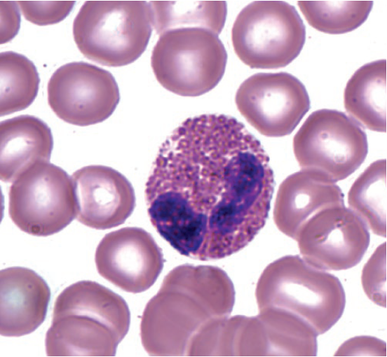
Eosinophils
Granulocytes making up 1–4% of white blood cells that combat parasitic infections and modulate inflammatory responses.

Basophils
Granulocytes constituting 0.5–1% of white blood cells that release histamine to promote inflammation and heparin to prevent blood clotting.

Lymphocytes
Agranulocytes making up 20–40% of white blood cells involved in adaptive immunity, including B cells and T cells.

Monocytes
Agranulocytes comprising 2–8% of white blood cells that differentiate into macrophages to phagocytize pathogens and activate other immune cells.
Ameboid movement
Directed movement using cytoplasmic projections.
Diapedesis
The process by which white blood cells elongate and pass through blood vessel walls into surrounding tissues.
Chemotaxis
The directed movement of white blood cells toward infection sites in response to chemical signals.
Platelets (Thrombocytes)
Cell fragments derived from megakaryocytes with a lifespan of 5-9 days that play a crucial role in blood clotting and hemostasis.
Hemostasis
The process of stopping bleeding to prevent excessive blood loss, consisting of vascular spasm (constriction of blood vessel), platelet plug formation, and coagulation (formation of blood clot).
Extrinsic pathway
Triggered by external tissue damage.
Intrinsic pathway
Initiated by blood vessel damage
Common pathway
Activated by either intrinsic or extrinsic pathways, leads to production of fibrin (form blod clot).
Transfusion
The transfer of blood or blood components from one individual to another to restore oxygen-carrying capacity following blood loss.
Infusion
The introduction of a fluid, such as saline or glucose, into the blood to prevent shock when blood volume drops.
Agglutination
The clumping of red blood cells that occurs when plasma antibodies bind to specific antigen markers on donated red blood cells.
Hemolysis
Rupture of red blood cells.
Antigens (Agglutinogens)
Are marker molecules on RBCs surface.
Antibodies (Agglutinins)
Proteins in the plasma that bind specifically to toantigens.
Type A Blood
Has:
A antigens
anti-B antibodies
Type B Blood
Has:
B antigens
anti-A antibodies
Type AB Blood
Has:
Both A and B antigens
No antibodies
Type O Blood
Has:
Neither A nor B antigens
Both anti-A and anti-B antibodies
Also called the universal donor.
Hemolytic Disease of the Newborn (HDN)
A condition where maternal anti-Rh antibodies cross the placenta during a subsequent pregnancy and destroy red blood cells in an Rh-positive fetus.
RhoGAM
Rho(D) immune globulin administered to Rh-negative mothers during and after pregnancy to prevent sensitization by inactivating fetal Rh antigens.
3 Liters
How many liters are left for the lymphatic system?
Lymph
Fluid inside the lymphatic system derived from interstitial fluid, composed of water, solutes, and cell-derived substances.
Lacteals
Specialized lymphatic vessels located in the intestinal wall of the digestive tract that absorb lipids.
Chyle
The lipid-rich lymph collected by lacteals in the digestive tract that is transported into the venous system.
Thoracic Duct
The largest lymphatic vessel in the body, draining lymph from the left side of the head, neck, chest, left upper limb, and all body regions below the thorax.
Lymphatic System
Is involved in immune response and associated with infectious diseases.
Lymphatic Capillaries
It is a
Immunocompetence
The state in which mature B and T lymphocytes become capable of recognizing antigens and initiating an immune response.
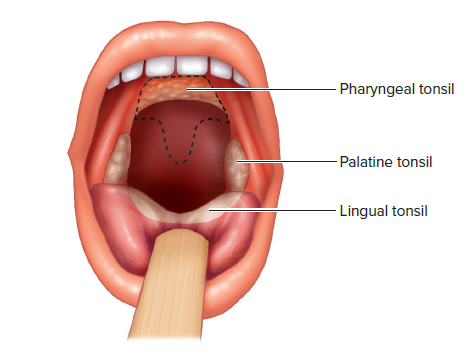
Tonsils
Large, non-encapsulated lymphatic nodules in the pharynx—comprising palatine, pharyngeal, and lingual tonsils—that protect against pathogens entering oral and nasal cavities.
Lymph Nodes
Small, bean-shaped structures (1–25mm) distributed along lymphatic vessels that filter lymph and house lymphocytes.
Spleen
A secondary lymphatic organ in the left upper abdomen consisting of white pulp and red pulp that filters blood, destroys old RBCs, and serves as a blood reservoir.
Thymus
A bilobed primary lymphatic organ situated in the mediastinum serving as the site for T-cell maturation.
Innate Immunity
Nonspecific, genetically determined resistance present at birth that responds in identical fashion upon each exposure to a pathogen.
Adaptive Immunity
Specific immunity that recognizes, responds to, and remembers particular antigens, producing faster and stronger responses upon repeated exposure.
Antibody-Mediated Immunity
A branch of adaptive immunity where B lymphocytes produce antibodies to combat extracellular pathogens and antigens.
Cell-Mediated Immunity
A branch of adaptive immunity where cytotoxic T lymphocytes directly destroy virus-infected cells, intracellular pathogens, and cancer cells.
Active Natural Immunity
Long-lasting adaptive immunity gained when an individual's immune system produces memory cells after natural exposure to an antigen during infection.
Active Artificial Immunity
Long-lasting adaptive immunity induced by deliberate exposure to an antigen through vaccination.
Passive Natural Immunity
Short-lived immunity provided when maternal antibodies cross the placenta or pass through breast milk to an infant.
Passive Artificial Immunity
Short-lived immunity achieved by injecting antibodies produced by another person or animal, such as antivenom or monoclonal antibodies.
