Week 6 Neuro 1: Neurotransmission and Sensory Transduction
 Call Kai
 Learn
Learn Practice Test
 Spaced Repetition
 Match
Match Flashcards
 Knowt Play
1/58

There's no tags or description
Looks like no tags are added yet.
Name | Mastery | Learn | Test | Matching | Spaced | Call with Kai | Chat |
|---|
No analytics yet
Send a link to your students to track their progress
59 Terms
action potential
result of changes in Vm leading to openin go fvoltage gated ion channels, but one does not for much unless can be transmitted to an effector organ/other neuron (where they can process info, amplify or block signals, or synthesize multiple outputs)
divergence
example of principle transmission, characterized by AP branching out and diverging from a single neuron initially
convergence
example of principle transmission, characterized by many AP from many neurons tunneling down into a global control center
limits of signal transmission
each AP will look like the preceding, IF that preceding is able to reach threshold
the applied voltage change will spread along the membrane, but only so far before it disperses and dies
space constant
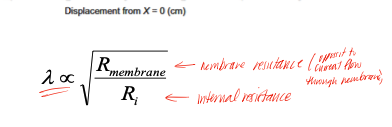
factor that determines the distance over which the applied voltage is able to spread out, distance at which the voltage has decayed by 63% from where the source was produced, typical values are 0.1-1.0 mm, is proportional to the membrane resistance and inversely proportional to the internal resistance
importance of myelinated sheaths
constant generation of new APs is energetically expensive and slow, if one fails, the signals dies
the sheaths allow for greater space constant, so have to generate AP
membrane resistance
how well the membrane is able to hold the charge, a low Rmembrane means that the membrane is “leaky” and will lose a lot of the current, decreasing its space constant
membrane internal resistance
how much current resistance there is inside of an “tube”, the less internal resistance, the more the current will be able to travel, which will increase the space constant, a big axon will have a low Ri
structure of more efficient axons “cables”
larger diameters (which decreases the Ri), insulation from myelination (increase Rmembrane)
cells that make up myelinated sheaths
schwann cells and oligodendrocytes(in the CNS instead of schwann cells bc they branch and encompasses a higher density of neurons that we have in CNS)
saltatory conduction
term that defines the movemnt of the AP along an axon, in a myelinated axon, the AP spreads more rapidly as they move through the myelinated portions and reach the nodes of ranvier, which contain high densities of voltage gated ions channels, allowing for the generation of more APs
Aalpha Group I peripheral nerves
largest, diameter of 13-20, fast speed of 80-120. and serve as proprioceptors and in skeletal muscle
Abeta Group II peripheral nerves
medium sized 6-12, medium speed 35-75, serve as mechanoreceptors
Agamma Group III peripheral nerves
smaller size 1-5, slower speed 5-30, involved in pain and temperature reception
C Group IV peripheral nerves
smallest size 0.2-1.5, slowest 0.5-2, involved in pain, temperature, itch (non-myelinated)
transduction
changing different forms of energy into nerve pulses to be sent to the CNS, example of one not in the nervous system is a dynamometer
external environmental sensations
exteroceptors- things like chemicals, temperature, light, position in space, sounds, applied loads
internal environmental sensations
interoceptors- things like termperature, hydration, movement, chemicals, mechanical forces (stretch, pressure) and since our system is homeostatic, it doesn’t like changes to these internal baselines
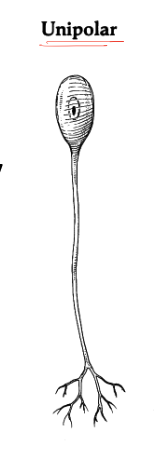
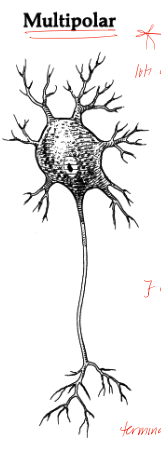
unipolar
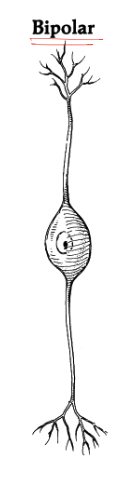
bipolar
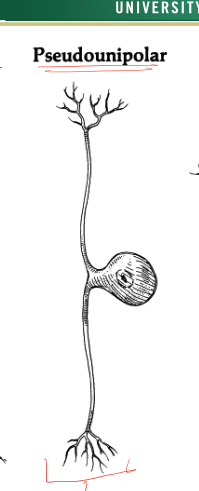
pseudounipolar
lots of sensory nerves fall into this morphology, more so than the multipolar that we see as a classic model
multipolar
classic model, lots of dendrites, terminal branches
types of receptors
chemical, thermal, mechanical, photon, important bc we process so much information, which are SPECIFIC to the modality
determining factor of signal transduction
the receptor! since they are modality specific, so sensory neurons may contain multiple receptor types, whcih will be able to affect local Vm by either depolarizing or hyperpolarizing the membrane
sensory receptors
can be categorized by structure or function, encode the modality of the stimulus (location, intensity, and duration), each will have an adqueate stimulus that allows them to encode the nature of the stimulus
meissner’s corpusles
superficial cutaneous receptors, small receptive fields which means good localization, numerous in skin in fingertips, have a role in fine touch and are rapidly adapting
merkel’s disks
superficial cutaneous receptor, disc shaped receptors, small receptive field, terminal extension of sensory fibers, found in hair and glabrous skins, involved in fine touch sensation and encode pressure, slowly adapting
types of superficial cutaneous receptors
meissners corpusles, merkel’s disk, hair receptors, free nerve endings
hair receptors
superficial cutaneous receptor, wrapped around a hair follicle, sensitive to displacement of hair, direction of motion
types of deep cutanous receptors
pacinian corpusles, ruffini’s corpusles, larger receptive fields and less localization
pacinian corpusles
encapsuled nerve ending similar to that of an onion, touch and vibration, rapidly adapting
free nerve endings
superficial cutaneous receptors, pain and temperature sensation, both slow adapting and rapid adapting
ruffini’s corpusles
deep cutaneous receptors, pressure and stretch of skin, detect tension on joint capsule, slowly adapting, an example are mechanoreceptors
transmission of course touch, temperature and nociception
sensed through free nerve endiings, information then sent to either A-delta (myelinated) or C fibers (unmyelinated), sensory testing for sharp/dull, hot/cold. some examples: numbness, tingling/prickling, anesthesia, hypesthesia (reduced sensibility)
nociception
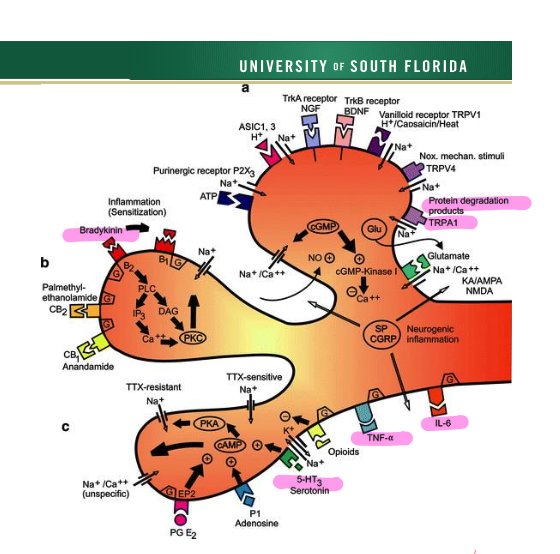
a component of pain, sends signal of something bad happening in tissue, with chronic there is disfunction in this sensation
graphic of some receptors in free nerve endings
Bradykinin, Seratonin, TNF-alpha, protein degredation products, etc
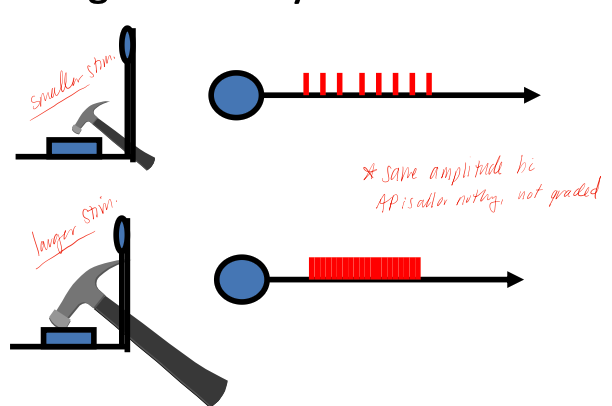
intensity
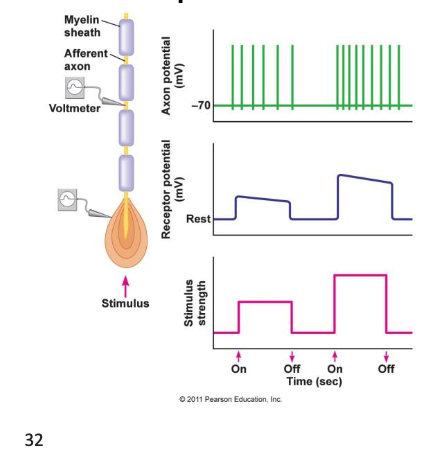
freqquency of AP generated at initial segment will encode proportionally for this
phasic receptor behavior
bursts of action potentials when stimulus applied
if the stimulus is maintained the magnitude to generator potential dies quickly
might see another burst at the end of stimulus- “on-off” of the stimulus
fast adapting
tonic receptor behavior
responds the entire time the stimulus is applied
APs are fired at the same rate (given the intensity stays constant)
“duration of stimulus”
slow-adapting
rate of adaptation
the neural response to stimulus
rate of firing is proportional to stimulus strength
can be slow (tonic) or fast (phasic)
both contribute to perception and duration of stimulus
receptor activation influence
receptors may be used to influence things that they don’t directly sense- such as thirst or urine production (baroreceptors and osmoreceptors in blood vessels)
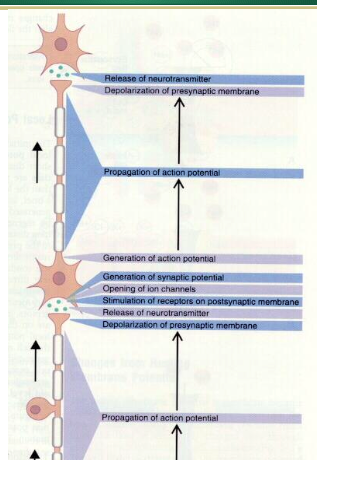
transmission of nerve impulses
electrocal current runs down along dendrite and axons, when reach the terminal ends enter the synapses with other neurons
synapses
specialized region of communication between neurons, ruled by 2 main processes: chemical and electrical transmission, each neuron forms abotu 1000 connections, and recieves anothe 10,000, and human brain has 10^14 of these in one human brain!
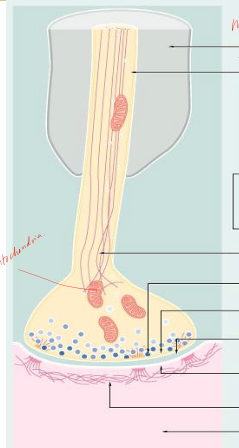
features of a generalized synapse
terminal bouton, synaptic cleft, synaptic vesicle, presynaptic membrane, post synaptic membrane, postsynaptic web, effector cell
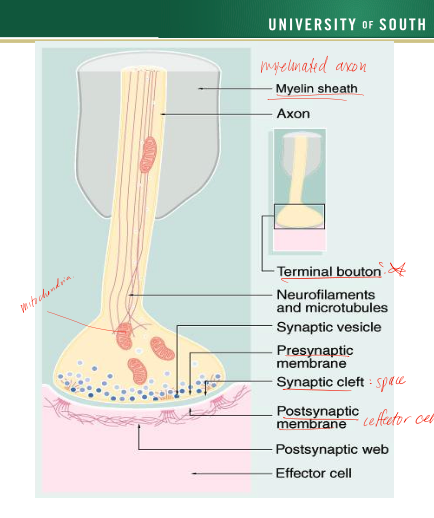
electrical synapses
rare in the neural circuits
direct connections between cells (connexins)
gap junctions, span synaptic cleft 3.5 nm
ionic currect transmits signal
virtually no delay and bidirectional (though some may be rectifying-not bidirectional)
examples are oculomotor nuclei and inferior olive
chemical synapses
more common in nervous system
no direct physical connection, synaptic cleft 20-40 nm
neutrotransmitters released from presynaptic neuron and diffuse across cleft, mostly unidirectional for a given signal
NT binds to ligand gated post synaptic receptor
considerable synaptic delay (0.3-5 ms, though mammalian skeletal is 0.3)
some common neurotransmitters
acetylcholine, dopamine, norepinephrine, epinephrine, serotonin, histamine, GABA, glycine, glutamate, NO, ATP, also many other peptide
advantages of chemical vs electrical synapses
unidirectional
inhibition/facilitation is easier
can summate different inputs
can delay in order to coordinate effects
plasticity- change in efficacy of signal, can change and mold signal
transmitter release
triggered by Ca2+ release from the presynaptic membrane, starts a signaling cascade
released in quanta (discrete increments)
vesicles bind to plasma membrane bc of calcium and release NT into the cleft by exocytosis (vesicle is recycled)
NT removed from synapse either through enzyme degradation or reuptake (glial cells)
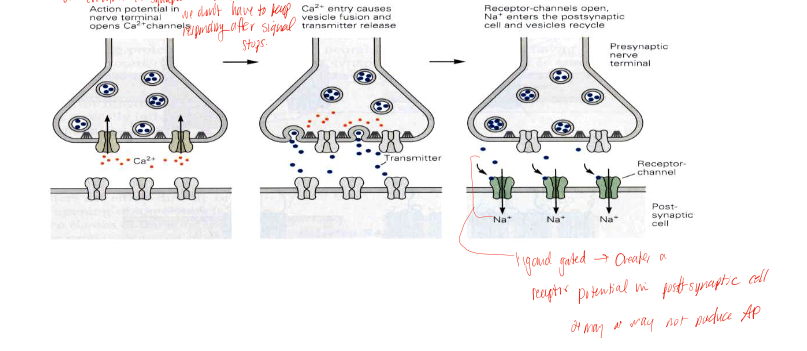
neurotransmission
communication between neurons
receptor potential
what sensory receptors tranduce physical stimulus into, also known as local membrane potential, temporal and spatial decrement, encode intensity and duration, a larger intensity will generate a larger potential and increase the rate of APs
post synaptic potentials
also graded potentials
can be (as a function of the receptor
excitatory (depolarizing)
inhibitory (hyperpolarizing)
summation of PSPs similar to those of receptor potentials at axon hillock
pre-synaptic control
synaptic efficiency may be changed by other synapses (connected), either presynaptic inhibition or facilitation
presynaptic inhibition
synapse at pre-synaptic terminal
results in decrease of excitatory NT release
hyperolarize membrane or alter CA2+ conductance
allows for selective elimination of specific inputs without altering effectiveness of others
IPSPs would hyperpolarize post-synaptic membrane and reduce effects of ALL inputs
presynaptic facilitation
synpase at pre-synaptic terminal
less clear on mechanism to which it occurs
still allows selective modulation without altering effectiveness of others
effector organ that allows perception
brain, no sensation without perception! signal has to get to brain for us to sense it
rapidly adapting cutaneous receptors
messieners corpusles, pacinian corpusles
slowly adapting cutaneous receptors
merkel’s discs, ruffini’s corpusles
both rapid and slowly adapting receptors
free nerve endings (hair receptors and cutaneous free nerve endings)