Modules 5-8
 Call Kai
 Learn
Learn Practice Test
 Spaced Repetition
 Match
Match Flashcards
 Knowt Play
1/83

There's no tags or description
Looks like no tags are added yet.
Name | Mastery | Learn | Test | Matching | Spaced | Call with Kai | Chat |
|---|
No analytics yet
Send a link to your students to track their progress
84 Terms
What is the definition of metamorphism?
The process of changing composition and/or texture of a rock without melting
Metamorphic rocks form when existing rocks are changed by:
Temperature, pressure, and/or fluids
What is the name for the original rock before metamorphism?
Protolith
Metamorphism occurs without:
Melting of minerals
How does temperature affect metamorphic rocks?
It changes the chemical equilibrium of minerals.
What happens if temperatures become high enough to melt rock?
Igneous processes begin
Which type of pressure is equal on all sides of a rock?
Confining pressure
Directed stress mainly changes a rock by:
Altering crystal arrangements and texture
Hydrothermal metamorphism involves the important role of:
Reactive fluids
Which two substances are the main components of hydrothermal fluids?
Water and carbon dioxide
What is the role of chemically reactive fluids in metamorphism?
They provide a medium for transporting ions within the metamorphing rock body.
Foliation refers to minerals aligned in:
Layers
Which metamorphic rock displays slaty cleavage?
Slate
Which metamorphic rock has a shiny surface caused by larger platy minerals?
Phyllite
Schist is characterized by:
Large visible platy minerals
Gneissic banding consists of:
Light and dark mineral bands
Migmatite represents a transition between:
Metamorphic and igneous rocks
Which of the following is a nonfoliated metamorphic rock?
Quartzite
Quartzite forms from the metamorphism of:
Sandstone
Marble is metamorphosed from:
Limestone
A drop of dilute hydrochloric acid will cause marble to:
Effervesce
Which metamorphic grade refers to significant metamorphic change in a rock?
High-grade
Contact metamorphism typically occurs under:
High temperature and low pressure
Regional metamorphism is commonly associated with:
Mountain-building at convergent boundaries
Which of the following statements about how rocks form is NOT true?
Metamorphic rocks form when preexisting rocks are subjected to elevated temperatures and pressures without melting.
What is the main result of weathering?
Formation of sediment
Which of the following is an agent of erosion?
Water
Chemical weathering would be most effective (blank).
In a warm, wet climate
Which of the following is NOT true of weathering?
Both forms of weathering require high temperatures to operate.
Mechanical weathering differs from chemical weathering because it:
Physically breaks rocks apart
What causes pressure expansion in rocks?
A decrease in pressure
Frost wedging occurs because water:
Expands when frozen
Which biological process can mechanically weather rocks?
Root wedging
Chemical weathering occurs most rapidly in:
Warm, humid climates
Increasing the surface-area-to-volume ratio of a rock will:
Increase weathering rates
Carbonic acid forms when carbon dioxide dissolves in:
Water
Which mineral is highly resistant to chemical weathering?
Quartz
Oxidation in rocks commonly involves the reaction of iron with:
Oxygen
Which of the following rock types is most abundant on Earth’s land surface?
Sedimentary rocks
Sedimentary rocks are primarily divided into which two categories?
Clastic and chemical
What process turns loose sediment into sedimentary rock?
Lithification
Which step of lithification squeezes sediment grains together?
Compaction
The classification of clastic sedimentary rocks is based on:
Grain shape, grain size, and sorting
Detrital or clastic sedimentary rocks are made up of:
Preexisting sediment pieces derived from mechanical weathering
Conglomerate differs from breccia because conglomerate contains:
Rounded clasts
Which sedimentary rock is primarily composed of sand-sized particles?
Sandstone
Chemical sedimentary rocks commonly form by:
Precipitation from solution
Bedding planes in sedimentary rocks represent:
Changes in deposition conditions
Mudcracks indicate that sediment was:
Exposed to air after being wet
What is relative dating?
Determining whether one rock or event is older or younger than another
Which scientist promoted the idea that “the present is the key to the past”?
James Hutton
How do relative and absolute age dating differ?
Relative age dating places rocks and events in chronological order while absolute ages gives an actual time frame for the events.
Which principle states that in an undisturbed sequence of sedimentary strata, any given rock unit is older than the ones above it?
Principle of Superposition
The principle of original horizontality states that sediments are originally deposited:
Horizontally
Which principle states that rock layers continue in all directions until they thin out or reach a barrier?
Lateral continuity
The principle of cross-cutting relationships states that structures like dikes and faults are (blank) than the rocks they cut across.
Younger
According to the principle of inclusions, fragments found within a rock are:
Older than the host rock
Fossil succession is based on the idea that:
Evolution produces unique fossil assemblages through time
Which of the geologic principle listed here is NOT correctly defined?
The principle of inclusions states that a piece of one rock within a rock layer is younger than that layer.
Even if rock layers are presently folded, what law tells geologists that the rock layers were deformed after deposition?
Principle of original horizontality
An unconformity is a buried (blank).
Surface of erosion separating younger strata above from older strata below
A nonconformity occurs when:
Sedimentary rocks overlie intrusive igneous or metamorphic rocks
Which unconformity is represented by horizontal strata overlying tilted strata?
Angular unconformity
A disconformity represents:
A break in deposition or erosion between parallel layers
Which of the following is NOT correct about unconformities?
An inconformity has extrusive igneous rocks on top of sedimentary rocks.

Which of the following lists places the structures in this diagram in the order in which they may have been formed?
A, C, B, D, E, H, F, G
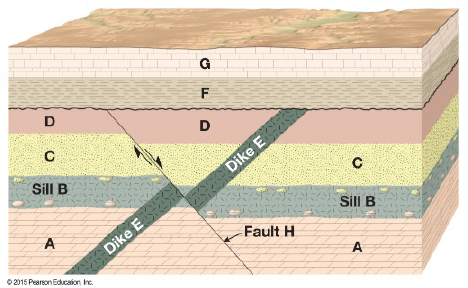
In the figure with the question above, is unit B older of younger than unit D? Which rule tells us this?
We can’t tell from what is here because we can’t see a spatial relationship to which we can apply one of the rule for relative dating.
Absolute dating became possible after the discovery of:
Radioactivity
An isotope is an atom with a different number of:
Neutrons
Radioactivity isotopes are characterized by being:
Unstable and capable of decay
The time required for half of a radioactive sample to decay is called the:
Half-life
Which rock type is generally best suited for radioisotopic dating?
Igneous rock
In radioactive decay, the original radioactive isotope is called the:
Parent isotope
Match the form of radioactive decay to its description
1.) Alpha (a) Decay
2.) Electron Capture
1.) Nucleus emits a particle that contains 2 protons and 2 neutrons. 2.) A proton and an electron combine to become a neutron.
Potassium-40 commonly decays to:
Argon-40
Carbon-14 dating is most useful for dating material up to approximately:
57,300 years
The currently accepted age of Earth is approximately:
4.54 billion years
Fossils are defined as:
Preserved evidence of past life
What two special conditions make preservation organisms as fossils more likely?
Hard parts and rapid burial
Which type of fossil preservation occurs when minerals fill spaces within an organism’s tissues?
Permineralization
Dinosaur footprints are an example of:
Trace fossils
The (blank) is the concept that ancient life forms evolved in a definite order and therefore their fossils can help determine the geologic ages of strata.
Principle of fossil succession
The principle of fossil succession is based on the fact that (blank).
Different layers of rock have different types of fossils.
Why do the eras of the Phanerozoic eon all end with “zoic”?
These names refer to life or living things; they invoke the changes in fossil organisms from one era to the next.