Portfolio Management Pathway
 Call Kai
 Learn
Learn Practice Test
 Spaced Repetition
 Match
Match Flashcards
 Knowt Play
1/95

There's no tags or description
Looks like no tags are added yet.
96 Terms
which has lower expense ratios for long-term investors, ETFs or mutual funds?
ETFs
Define overlays and main types.
An overlay is a derivatives position layered on top of an existing portfolio to adjust its risk or return characteristics, without disturbing the underlying holdings.
A completion overlay addresses an indexed portfolio that has diverged from its proper exposure. Typically used to address cash drag.
A rebalancing overlay addresses a portfolio’s need to sell certain constituent securities and buy others.
A currency overlay assists a portfolio manager in hedging the returns of securities that are held in a foreign currency
What are the pros/cons of using derivatives for portfolio management compared to using the cash markets?
With tactical allocation changes, derivatives can change exposure to an index with a single transaction. However, for long-term investors, derivatives require rolling. Derivatives also may not exist on certain securities.
advantage of swaps compared to futures
Swaps are traded otc and thus offer customization on the underlying index, maturity, etc. There is of course more counterparty risk.
Describe how separately-managed equity indices work
Managers first subscribe to a data service from the index provider. The data feeds an order management system (OMS) that automatically creates trading files and transmits them to a broker using the FIX protocol (Financial Information eXchange), who buys the securities using program trade. Program trade is the simultaneous buying/selling of many stocks. These managers also maintain good relationships with the brokers to minimize transaction costs.
Describe full replication method.
Hold all securities in the index. As the manager moves towards more illiquid securities, tracking error gross of transaction costs still decreases but net tracking error can start to go up at one point. In full replication, managers order Market On Close orders to fully match index performance measures.
Stratefied sampling.
Find strata will be mutually exclusive and also exhaustive. Now weight portfolio holdings proportionately to each stratum's weight in the index.
Optimization approach
Minimum portfolio tracking error subject to constraints such as maximum number of names, market capitalization, portfolio volatility.
pros/cons of optimization approach vs stratefied sampling.
Optimization approach has lower tracking error and takes into account asset correlations, but covariance data is computed on historical data, which might change over time.
Excess return vs tracking error
Excess return is Rp-Rb and can be negative or positive. Tracking error is never negative.
sources of tracking error.
management fees, sampling, intraday trading, commissions, cash drag,
During low interest rates, which sector outperforms, financials or utilities?
Utilities/telecom are high dividend payers. They outperform during periods of low rates, compared with financials, who struggle to lend profitably.
rewarded factors vs unrewarded
Some factors (most commonly, size, value, momentum, and quality) have been shown to be positively associated with a long-term return premium and are often referred to as rewarded factors.
What are the issues with the hedged portfolio approach in forming factor portfolios?
It only takes into account the top and bottom quantiles, although performance does not need to be linear across.
Explain factor tilt portfolios and factor mimicking portfolios.
The factor-tilting portfolio tracks a benchmark index closely but also provides exposures to the chosen factor.
The factor mimicking portfolio is the theoretical construct of having positions in every stock and a resulting exposure to only the one factor you’re interested in.
Tactics used by activist strategies include
Seeking board representation and nominations, engaging in proxy contests, proposing restructuring of balance sheet, reducing management compensation, initiate legal proceedings against existing management for breach of fiduciary duty, breaking up a conglomerate, launching media campaign,
How do markets react to activist announcements?
There is appreciation prior to the announcement, an average 2% on the announcement date, and further appreciation post-announcement.
Describe pairs trading in statistical arbs
Start from a moving average (for instance 130 day) of spreads (log of price differentials of a pair). Then establish a band of +2/-2 standard deviations. Whenever spread exceeds this band, take position. Exit when the spread moves back to the moving average.
Building blocks of portfolio construction
Rewarded factor weightings, alpha skills (timing to rewarded/unrewarded factors), position sizing (how exposed is the manager to idiosyncratic risks), breadth of expertise (#independent bets in fundamental law of active management)
Refresh on the fundamental law of active management.
E (RA) = IC x √BR x σ_RA x TC
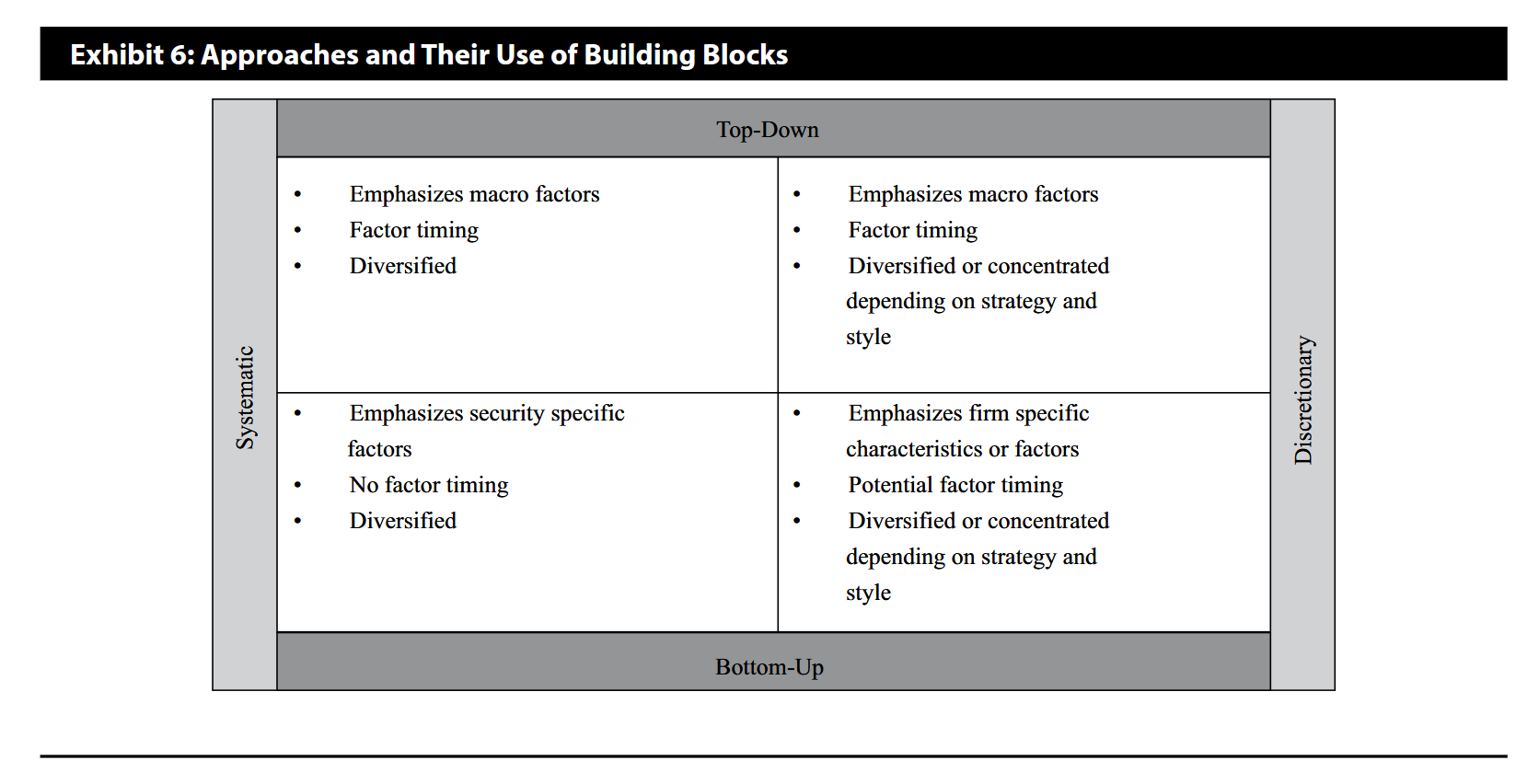
Characteristics of top-down vs bottom-up and systematic vs discretionary
Formulate a security’s contribution to portfolio variance or active return variance.
Recall that MCTR and CTR refer to volatility, where this question relates to variance.
Vp = ∑∑xi xj Cij. This follows directly from variance of a sum decomposition.
For security i only, CV_i=xi∑xj Cij=xi ∑xj cov(Ri, Rj)=xi cov(Ri, ∑xj Rj)=xi Cip = CTR * sigma_p.
For the variance of active return, replace weights with active weights.
The three practical limits of risk are
Implementation constraints, limited diversification benefits, reduction of compounded returns from leverage.
Regarding last point, Rg ≈ Ra − σ² / 2. This refers to “volatility drag”. Note that variance scales squared to leverage, whereas return is only linear.
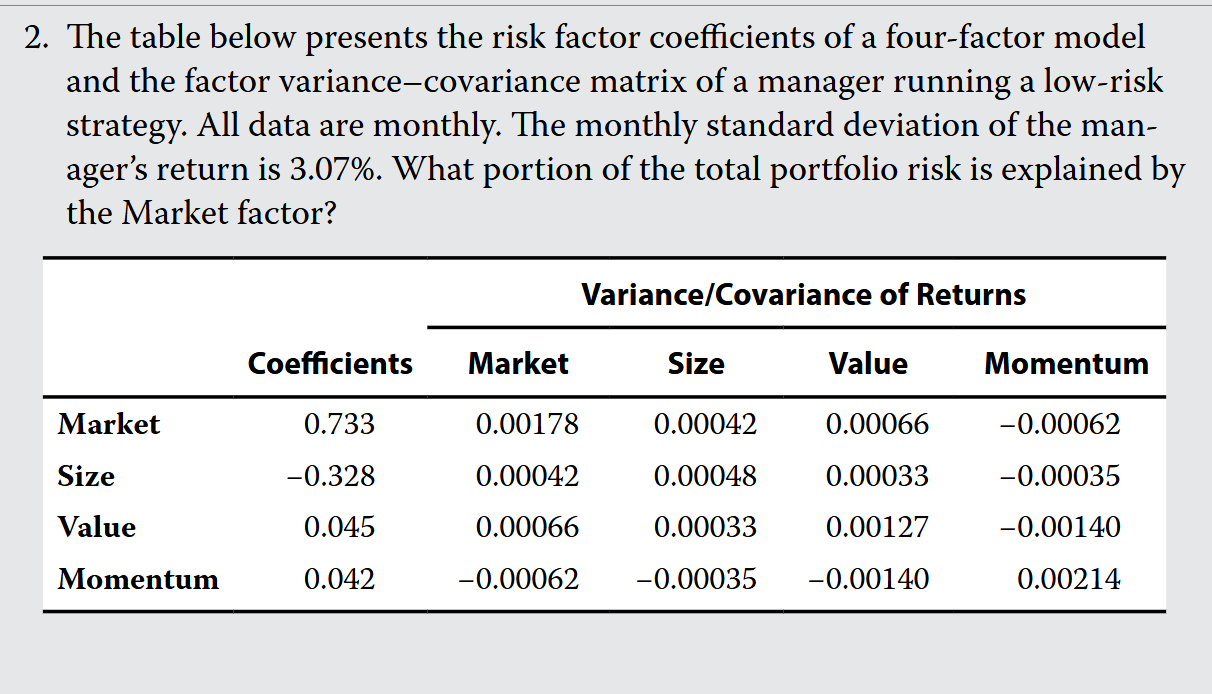
Recall CV_i=xi∑xj Cij. In the factor context, weights are loadings.
0.733 x (0.733 × 0.00178 + 0.00042 x -0.328 + 0.00066 × 0.045 + -0.00062×0.042) = 0.000858, so 91%.
Define formal vs heuristic risk measures.
Formal constraints are statistical in nature and are often tied to return distributions of the portfolio. Heuristics show up as controls imposed on permissible portfolio composition (sizing of positions, max sector deviations, max leverage, etc).
What is long extension?
Short proceeds are used to buy long. Net exposure is 100%. In a long extension, securities are used as collateral to hold the short positions.
Merits of long-only investing.
long-term risk premium, capacity/scability (shares not always available to short at large quantities), limited liability, transactional complexity, management costs, personal idealogy (short selling is wrong)
net exposure vs gross exposure
The absolute value of the longs minus the absolute value of the shorts is called the portfolio’s net exposure. The sum of the longs plus the absolute value of the shorts is called the portfolio’s gross exposure.
Pros/cons of a long/short strategy
Pros include ability to more fully express short ideas, efficient use of leverage and of the benefits of diversification, greater ability to calibrate/control exposure to factors.
Cons include more complexity associated with usage of short positions, possibility of reduced market return
How does ls achieve higher information ratios?
The ability to short improves transfer coefficient. Moreover, in a long-only, market risk dominates. The ability to neutralize the dominant factor allows a more spread out, even risk distribution
If 60% of deviations from the mean are negative, what skew is this?
Positive skew. Mode < Median < Mean
How does yield curve shape affect the difference between portfolio IRR and weighted average YTM of a bond portfolio? What about portfolio duration vs weighted average duration? Portfolio convexity vs weighted average convexity?
When yield curve is upward sloping, portfolio has higher IRR, convexity, and duration than the weighted average versions.
For intuition, imagine an equal-weighted two-bond barbell with yields of 2% and 5%. Discounting both at the 3.5% average, the gain on the long bond would far outweigh the loss on the short bond, because the long bond’s price is much more sensitive to rates. To make the gains and losses balance, the IRR must sit close to the long bond’s yield. As a result, the portfolio’s IRR exceeds the weighted-average yield. And because the IRR is below the long bond’s own yield, its cash flows get extra weight at the IRR, so portfolio duration and convexity also exceed their weighted averages
How to annualize dispersion and convexity? How to compute modified duration from duration?
By dividing the SQUARE of the periodicity (4 for semiannual)
ModDur = -dur/(1+r/m)
What is required for perfect immunization?
Ideally, it’s a zero-coupon bond, and macaulay duration of the portfolio should perfectly match the zero bond. However, as time passes, the duration falls out of place with the zero bond’s duration, which decreases linearly regardless of interest rate risk. Rebalancing is thus required to adjust the duration. Furthermore, changes in cash flow yield of the portfolio must match changes in the zero bond’s YTM.
What is structural risk? How to minimize it?
The risk is that yield curve twists and non-parallel shifts lead to changes in the cash flow yield that do not match the yield to maturity of the zero-coupon bond that provides for perfect immunization. Reducing dispersion around Macaulay duration reduces structural risk (ideal case is a zero-coupon bond, of course), which is identical to minimizing convexity holding duration and yield constant.
Characteristics of a bond portfolio structured to immunize a single liability are
Has an initial market value that equals or exceeds the present value of the
liability.
has a portfolio Macaulay duration that matches the liability’s due date.
minimizes the portfolio convexity statistic.
What is the difference with multiple liabilities portfolio?
Money duration matches as close as possible whereas in single exceeds.
Convexity and dispersion exceed that of liabilities.
Why would a manager uses derivatives to match duration? How many contracts are needed?
A manager might prefer short-term bonds due to liquidity or regulatory constraints.
Asset portfolio BPV + (Nf × Futures BPV) = Liability portfolio BPV, where in case of bond futures, Futures BPV = BPV_ctd/CF_ctd. Knowing the ctd is crucial to compute the right futures bpv.
What is contingent immunization?
The presence of a significant surplus, the difference between the market values of the assets and liabilities, allows the asset manager to consider a hybrid passive–active strategy known as contingent immunization.
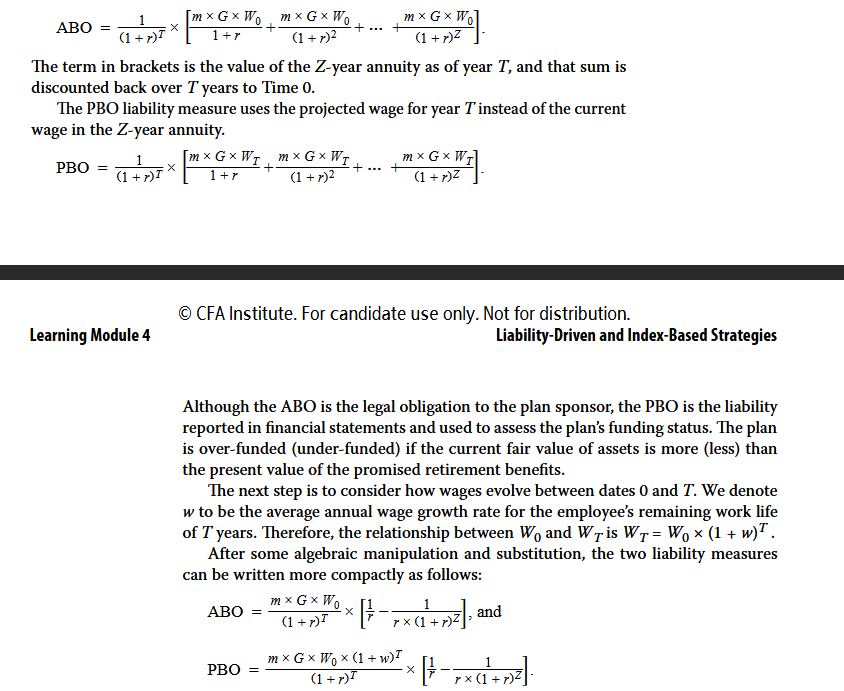
Accumulated Benefit Obligation (ABO) vs Projected Benefit Obligation (PBO)
ABO is the pv as specified by current wage and number of years worked. Projected is the pv as specified by the projected final wage. One may calculate effective durations on these measures.
How to compute notional on a swap to reduce duration gap?
Asset BPV + [NP × Swap BPV/100 ] = Liability BPV. Note that duration of a swap is computed from durations of the fixed leg and floating leg. Divide by 100 because BPV is defined per 100 notional on a swap.
Asset BPV = 528,384; Liability BPV = 1,215,000; Swap BPV = 0.1751 per 100 notional. Find the receive-fixed swap notional for a 75% hedge of the duration gap.
(1,215,000-528,384)/0.00175=392,127,927. For 75%, 294m.
How to use swaptions instead of swaps to reduce duration gap.
A receiver swaption is an option bought at a premium that when exercised, allows you to enter the swap with the swaption seller as the fixed receiver at the strike. The premium is defined on per dollar of notional.
A swaption collar is buying a receiver swaption and then writing a payer swaption.
Explain how a manager chooses between swap, swaption, or swaption collar.
If the manager believes rate stays below swap fixed rate, then swap is the most attractive.
At a certain point above the written payer swaption strike, the swaption becomes more attractive compared to swaption collar, as it is limited loss.
Risks in liability-driven investing
Durations for equity/alternatives may not be zero.
Assumption uncertainties in type 4 liabilities.
Corporate/Treasury yield spread when using bond futures.
Corporate/mrr spread when using swaps.
Counterparty risk in OTC derivatives without credit support annex(csa) and collateral risks.
Primary indexing risk factors for a bond portfolio are
Duration, key rate duration, percentage of sectors, credit quality makeup, Sector/coupon/maturity call weights, issuer exposure.
Explain the present value of distribution of cash flows methodology
Lay out the index's cash flows across time buckets ("vertices" — e.g., 0.5yr, 1yr, 2yr…) broken by call status.
Take the present value of the cash flows at each vertex, then express each as a percentage of the portfolio's total PV.
Weight each vertex by its contribution to duration (roughly, PV share × time), so vertices further out count more. This turns the PV distribution into a risk distribution across the curve.
Match your portfolio's distribution to the index's, vertex by vertex. If the index has 15% of its rate risk at the 5-year point, your portfolio should too.
How often do mutual funds trade?
Once a day.
What is constant maturity yield?
The commonly observed yield curve often does not stem from actual, observed trades. A 5-yr maturity treasury often no longer has exactly 5 years left to maturity, unless observed on issuance date. However, a constant maturity yield, which is often the default yield curve that we see, requires exactly 5 years left. Thus, interpolation is often required.
How does interest rate volatility affect yield curve shape?
Convexity becomes much more valuable during periods of high yield volatility, bidding up the prices of long-end bonds. All else equal, this leads to a flattening or even an inversion.
How can managers express views on a static yield curve?
Buy-and-hold (profit from having longer duration than benchmark in upward sloping curve), rolling down yield curve, repo carry trade.
With derivatives, a futures can replicate the rolling down yield curve, and a swap can replicate the repo carry trade.
Yield Curve Steepener Strategies
Duration neutral - buy the short-end, short the long-end such that the resulting has a net duration of 0.
Bullish steepening - If the manager has views on broadly lower rates, he can buy more short-end such that the resulting has net positive duration.
Bearish steepening - Vice versa if the manager has views on broadly higher rates.
Yield curve curvature strategies
Negative butterfly - Bets that butterfly spread will increase. Short middle bullet, long a barbell around the middle.
Positive butterfly - Bets that butterfly spread will decrease. Buy middle bullet, short a barbell.
How to hedge a carry trade in theory using swaps?
A fixed for fixed currency swap. Or a combination of pay-fixed USD currency swap, pay-floating USD cross currency basis swap, and a receive-fixed JPY currency swap.
A fixed-income manager is considering a foreign currency fixed-income investment in a relatively high-yielding market, where she expects bear flattening to occur in the near future and her lower-yielding domestic yield curve to remain stable and upward-sloping. Under this scenario, which of the following strategies will generate the largest carry benefit if her interest rate view is realized?
a. Receive-fixed in foreign currency, pay-fixed in domestic currency
b. Receive-fixed in foreign currency, pay-floating in domestic currency
c. Receive-floating in foreign currency, pay-floating in domestic currency
Pay floating, receive floating.
credit loss rate.
REALIZED percentage of par value lost to default for a group of bonds

Describe the credit cycle.
Describe empirical duration.
Empirical duration is a bond's rate sensitivity estimated by regressing its past price returns on benchmark-yield changes, taking the negated slope as duration.
Yield spread vs G-spread?
Yield spread is spread to the closest on-the-run treasury. G-spread require interpolation.
MRR spread vs I spread
MRR spread is for floating. I spread is for fixed. Requires interpolation.
Asset swap and asset swap spread
Asset swaps exchange a bond’s coupons to a fixed spread over MRR. The fixed spread is typically credit risk over MRR given a par-priced bond. Defined differently, it is the spread over the fixed rate in an interest rate swap. Requires interpolation.
CDS basis.
Difference between the Z-spread on a specific bond and the CDS spread of the same (or interpolated) maturity for the same issuer.
What is the relationship between OAS, Z-spread, and option cost?
Z-spread - option cost = OAS.

Formulate floating rate bond pricing.
Quoted Margin is coupon added by issuer to compensate for credit risk. Discount Margin plays a similar role of Z-spread in fixed bonds. Note that MRR in the equation is the current MRR, thus implying a flat forward curve.
Explain Z-DM
The pricing above assumes a flat MRR curve. We can replace the constant MRR in the equation with live points on the curve instead. For an upward sloping curve, Z-DM < DM.
Formulate excess spread
Spread0 − (EffSpreadDur × ΔSpread) − (POD × LGD). If the period is less than a year, Spread0 needs to be scaled accordingly.
Spread duration vs rate duration
Spread duration refers to changes in discount margin, rate duration on MRR.
Explain structural models.
1: Estimate market asset value and volatility from the stock price and equity volatility.
2: Set a default point from the firm's liabilities.
3: Compute distance to default: how many standard deviations assets sit above that point.
4: Convert DD to a PD, either through the normal distribution or, as the commercial models do, through calibration to historical defaults, sometimes with extra variables mixed in.

An investor considers the purchase of a new 10-year issue from the company
and expects the new bond to include a 10 bp new issue premium. What is the
fair value spread for the new issue based on outstanding debt?
First interpolate the issuer yields to get the 10yr-2.756%. Now interpolate the 5 and 15yr to get the 10yr on the benchmark (we do not use the real 10yr since it assumes a straight yield curve)-1.5%. The spread is 1.256%. Add the 10bp premium to get 1.356%.
Why do managers use OAS to measure portfolio credit quality instead of credit ratings of bonds?
A weighted factor is Moody's number for each rating that reflects its probability of default over 10 years, scaled so that 10,000 equals certain default, which makes risk grow much faster as ratings fall.
Credit ratings lag real market pricing of risk.
SP only prices POD, whereas Moody prices EL.
If spread curve for a sector flattens, does that signal weak or strong outlook?
Weak. The threat of near-term default raises short-end significantly.
Fixed income factors
Carry, defensive, momentum, value. .
CDS Price
1 + ((Fixed Coupon − CDS Spread) × EffSpreadDurCDS). Note that this needs to be used to compute pl if spread does not change. Note that (Fixed Coupon - CDS Spread)*Dur is the initial payment to the protection BUYER.
CDS long-short strategy
Make sure to match the BPV of each leg.
strategies for a static cds curve
Decrease credit qualify. Increase portfolio durations.
Categorize debt-to-GDP, budget deficit, currency reserve-to-GDP, external debt-to-GDP to liquidity, fiscal stability, and leverage measures.
external debt-to-gdp is leverage.
reserve-to-GDP is liquidity.
debt-to-gdp, budget deficit are fiscal stability.
Optionality in a MBS
Borrowers have the option of prepaying, that makes the MBS investor short the option.
Trade urgency and alpha decay.
Alpha decay refers to the erosion or deterioration in short-term alpha once an investment decision is made.
Trade Urgency refers to how quickly (aggressively) or slowly (patiently) the order is executed over the trading time horizon.
Motivations to trade
Profit seeking, risk management, cash flow needs, corporate actions/index reconstitution/margin calls
Trade strategy inputs
Order Characteristics - side, size, ADV
Security Characteristics - type, short-term alpha, price volatility (execution risk or market risk)
Market conditions - liquidity crisis.
User-based inputs - A trader with a high level of risk aversion is likely to be more concerned about market risk and will trade with greater trade urgency.
Reference prices.
Pre-trade benchmark: decision price, previous close (along with decision price, often used by quantatitive managers), opening price (often for long-term fundamental managers), arrival price
Intraday: VWAP, TWAP (for hard to predict volume profiles, trade outliers where traders cannot participate in certain quotes on the tape)
Post-trade: Closing Price
Price target
Explain high-touch vs automated orders and where they are appropriate
Automated orders require minimal human intervention and are best for highly-liquid markets. High-touch approaches involve human sell-side traders as intermediaries. These traders may attempt to fill a customer order by matching it with offsetting orders from other customers or fill it from their own book.
Direct market access.
With DMA, an institution is sending orders to the exchange directly through a broker's system. Contrast this with Robinhood, for instance, where you are sending orders to brokers still.
Scheduled execution algorithms
Percentage of volume - Specify a participation rate. Not guaranteed to execute all orders.
VWAP/TWAP - Guaranteed execution, but may not participate in periods of increased liquidity.
Scheduled is suitable for relatively small orders and when the PM doesn’t have opinions on price directions,
Explain liquidity seeking algorithms, arrival price algorithms, liquidity aggregators, smart order routers.
Liquidity-seeking: Take advantage of liquidity across venues when they occur. Use for large orders, thin or episodic liquidity, or leakage concerns. Overkill for small, liquid orders.
Arrival price: Front-load to stay near the starting price. Use when fearful of adverse price movements, in liquid stocks with modest size. Avoid for large orders in illiquid names.
Dark aggregators: Trade only in dark pools. Use for large orders in illiquid or wide-spread stocks when leakage is the main concern. Avoid when the full order must get done.
SOR: Routes orders to the best venue. Use for small orders sent straight to market.
Explain the trade implementations for the following asset classes: equity, fixed income, exchange traded derivatives, OTC derivatives, spot currencies.
Equity: large, non-urgent trades use algorithms; small trades use electronic; large urgent, illiquid trades use broker risk trades.
Fixed income: the illiquidity in most bond markets (except on-the-run treasuries) create challenges for algorithmic and electronic trades. Broker risk trades via RFQs are needed for urgent ones, where non-urgent ones may use agency trades.
Exchange traded derivatives: Non-urgent trades use a trading algorithm. Small buy-side traders tend to use direct market access.
OTC derivatives: Urgent trades may use broker risk, non-urgent agency.
Spot currency: For large, urgent trades, RFQs are generally needed. Large, non-urgent trades are mostly executed using algorithms or a high-touch agency approach. Small trades are usually implemented using DMA.
Mathmatically formulate the implementation shortfall.
Paper return = (Pn – Pd)(S) = (S)(Pn) – (S)(Pd), where Pd is price at decision and Pn is price now.
Actual return = (∑sj) (Pn) − ∑sj pj − Fees
IS = Σ(s_j × p_j) − Σ(s_j × P_d) + (S − Σs_j) × (P_n − P_d) + Fees
Or to decompose further to delay cost and trade cost:
IS = Σs_j × (P_0 − P_d) + Σ(s_j × p_j) − Σs_j × P_0 + (S − Σs_j) × (P_n − P_d) + Fees
Formulate arrival cost in basis points
Side × ( P − P*)/P* × 10, 000 bps, where P* is arrival price, P is realized average price, and Side=1 for buys.
Formulate implementation shortfall in basis points.
IS/(order shares x Pd) x 10,000bps
Market-adjusted cost
Market-adjusted cost (bps) = Arrival cost (bps) – β × Index cost (bps), where Index cost = Side × (Index VWAP − Index arrival price)/Index arrival price × 10,000 bps.
Formulate added value
Added value (bps) = Arrival cost (bps) – Est. pre-trade cost (bps)
Trade policy statement elements
Meaning of best execution: Beyond just trading cost, elements such as speed is also considered.
Factors that determine best execution: Urgency, characteristics of securities, characteristics of venues, investment horizon, rationale for trade.
List of eligible brokers: Quality of service (do they beat benchmarks, financial stability, reputation, speed, cost competitiveness, willingness to commit capital.
Process Used to Monitor Execution Arrangements: The above traits are monitored continuously. Execution quality on realized transactions through different brokers should also be monitored continuously. Trading records should be kept for at least a couple years.
Define liquidity classification table (time-to-cash table) and liquidity budget
The liquidity classification schedule defines portfolio categories based on the time needed to convert assets into cash. The liquidity budget assigns portfolio weights considered acceptable to each liquidity classification in the time-to-cash table.
Unlevered cost: ETF 27 bps, futures 32 bps. Use 3× leverage for one year. MRR = 1.8%. ETF borrowing = MRR + 35 bps. Which is cheaper on a levered basis?
ETF: (180+35) x 2/3 + 27 = 170.33 bps. Futures: 180 × 2/3 + 32 = 152. Choose futures.
Discuss the usage of option price theory for illiquidity premium.
The size of the discount an investor should receive in return for illiquidity can be represented by the value of a put option with an exercise price equal to the marketable price of the illiquid asset at the time of purchase. (The “marketable price” is a hypothetical price at which the illiquid asset could be sold if it were freely traded)
Yale formula for endowment spending rules.
A smoothed formula such as Spending for current fiscal year = (60% × Spending for previous fiscal year) + [40% × (5% × Endowment market value at the end of previous fiscal year)]. Note that this formula can have a countercyclical effect, where percentage increases for down years but decreases during up years.