CH6.2-6.4 Skeletal System: Bone Composition and Classification
 Call Kai
 Learn
Learn Practice Test
 Spaced Repetition
 Match
Match Flashcards
 Knowt Play
1/21

There's no tags or description
Looks like no tags are added yet.
Name | Mastery | Learn | Test | Matching | Spaced | Call with Kai | Chat |
|---|
No analytics yet
Send a link to your students to track their progress
22 Terms
Osteoprogenitor (osteogenic) cells
Stem cells located in the inner periosteum layer and endosteum that differentiate into osteoblasts.
Periosteum
A dense connective tissue has an inner layer (could be stem cells or octeroblasts) that covers the outer surface of bones, providing protection and housing osteoprogenitor cells.
Function of Bones
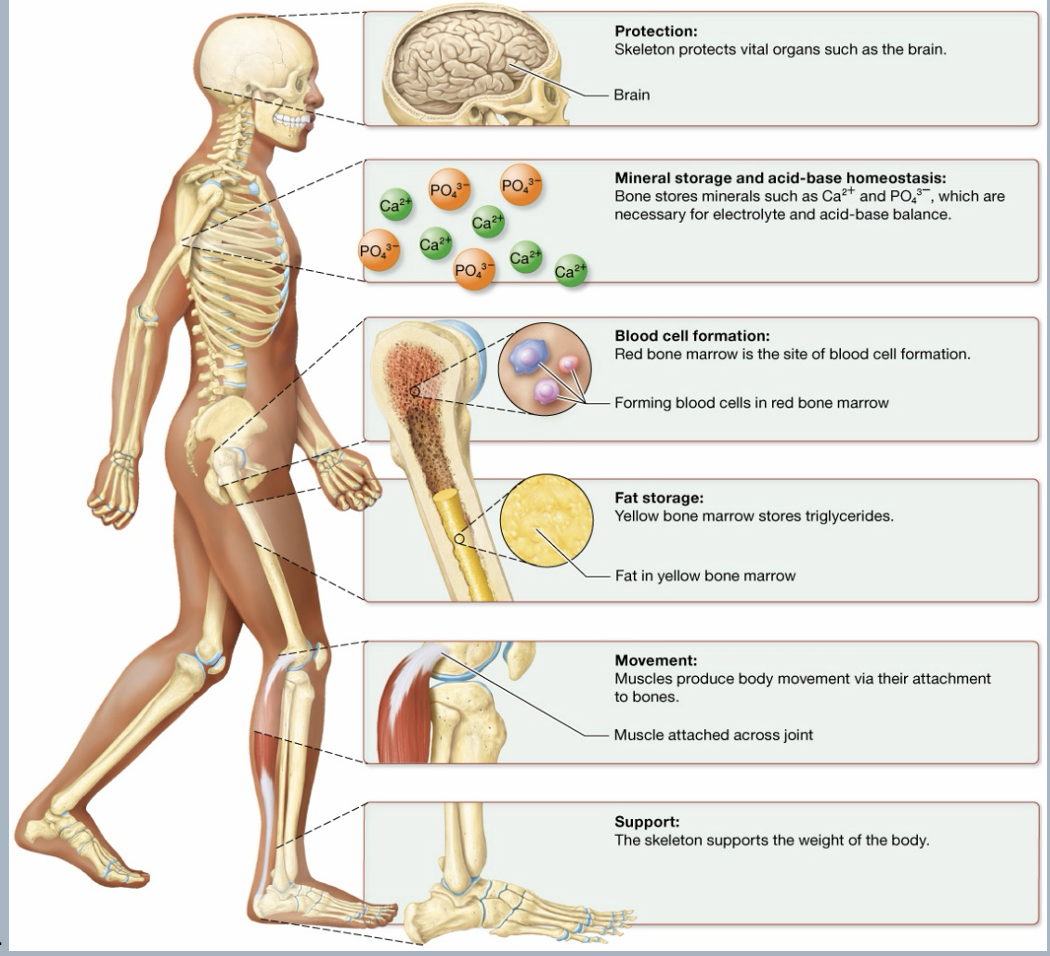
Bone composition
CT: Cells, fibers, ground substance
Cells: Osteoprogenitor (osteogenic) cells, osteoblasts, osteocytes, osteoclasts.
Fibers: collagen
Ground substance: calcium salts
Osteoblasts
Bone-forming cells responsible for ossification/osteogenesis that secrete extracellular matrix, including collagen fibers. → Makes bone

Describe the cells and how they work together

Osteocytes
Mature bone cells located inside lacunae that monitor, maintain, and secrete chemicals required for the mineralized bone matrix.
Resorption: Process by which osteoclasts break down bone tissue, releasing minerals back into the bloodstream.
Same location as the osteoblasts
Osteoclasts
Bone-resorbing cells located in the inner periosteum layer and endosteum that break down bone tissue using lysosomal enzymes and H+.

Osteoid = Organic
The organic component of bone extracellular matrix composed of collagen, proteoglycans, and glycoproteins, providing strength and flexibility.
Hydroxyapatite → Inorganic Mineral salts
The inorganic mineral salt with the chemical formula Ca10(PO4)6(OH)2, formed from calcium and phosphate (calcium salts), that fills spaces between fibers to give bone hardness and resist compression.

Bottom left: bone soaked in acid. The acid dissolves the mineral salts and leaves only the collagen framework. The bone keeps its shape but becomes so bendy you can tie it in a knot, like rubber. (Rickets and osteomalacia work on a milder version of this: poor mineralization makes bones soft and bowed.)
Bottom right: bone that was baked. Heat burns off the organic components (collagen) and leaves only the mineral. The bone is still hard but brittle, so it shatters when struck. (Osteogenesis imperfecta, a collagen defect, gives this kind of fragile bone.)
minerals give hardness, collagen gives flexibility. Remove minerals and you get rubber; remove collagen and you get chalk.
Long bone
A bone shape classification for bones that are longer than they are wide, including limb bones and phalanges.
Short bone
A bone shape classification for bones that are about as long as they are wide, such as carpal (wrist) and tarsal (ankle) bones.
Flat bone
A bone shape classification for bones that are broad, flat, and thin, including the sternum, ribs, scapula, and cranial bones.
Irregular bone
A bone shape classification for bones whose shapes do not fit into other classes, such as vertebrae, facial bones, cranial bones, and hip bones.
Sesamoid bone
A round, flat bone found embedded within a tendon, such as the patella, characterized by variable location and prevalence.

Red bone marrow
Specialized tissue located within bone that serves as the site of blood cell formation.
Yellow bone marrow
Tissue found in bones that stores energy in the form of triglycerides (fat).
Mineral storage and acid-base homeostasis
A vital function of bone involving the storage of minerals such as Ca2+ and PO43−, which are necessary for electrolyte and acid-base balance.

Bone Component Alterations
Treatment of bone with acid dissolves inorganic mineral salts, whereas treatment with heat destroys organic components.

Bone Cell Lineage
The structural types of bone cells, including osteogenic cells (stem cells), osteoblasts (matrix-synthesizing cells), osteocytes (matrix-maintaining cells), and osteoclasts (bone-resorbing cells).

Classification of Bones by Shape
Anatomical classification system categorizing bones into long, short, flat, irregular, and sesamoid based on their geometric proportions.