Organic Chem + Isomerism
 Call Kai
 Learn
Learn Practice Test
 Spaced Repetition
 Match
Match Flashcards
 Knowt Play
1/26

There's no tags or description
Looks like no tags are added yet.
Name | Mastery | Learn | Test | Matching | Spaced | Call with Kai | Chat |
|---|
No analytics yet
Send a link to your students to track their progress
27 Terms
Hybridisation in Carbon
Electrons in valence shell must be excited or promoted from 2s to 2p orbitals so as to get 4 unpaired electron
How to tell if is stronger bond?
Hybrid orbitals with higher % of s character overlap to form a stronger bond
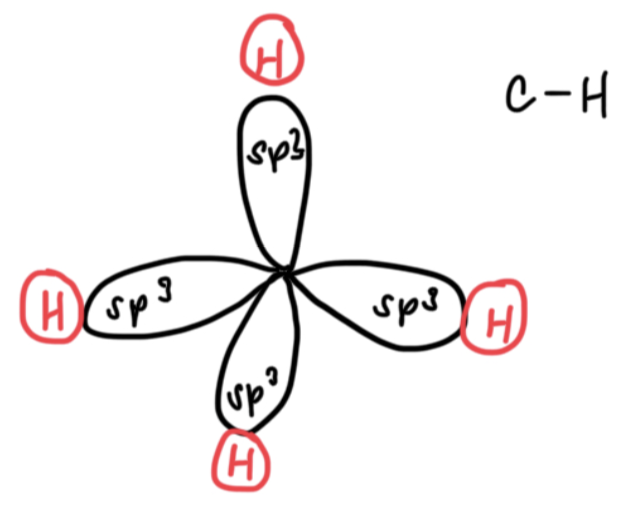
sp3 bonding (diagram)
Shape: Tetrahedral about C
Bonds: C—H head on overlap with 1s orbital of H to form sigma bond
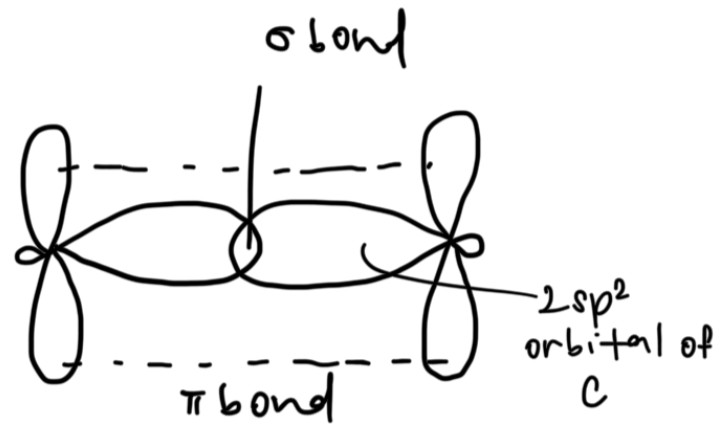
sp2 bonding (diagram)
Structure: Trigonal planar about C
Bonds:
C=C: Head-on overlap between sp2 and sp2 to form sigma bond, sideway overlap between 2p and 2p to form π bond
C-H: Head-on overlap between sp2 of C and 1s of H to form sigma bond
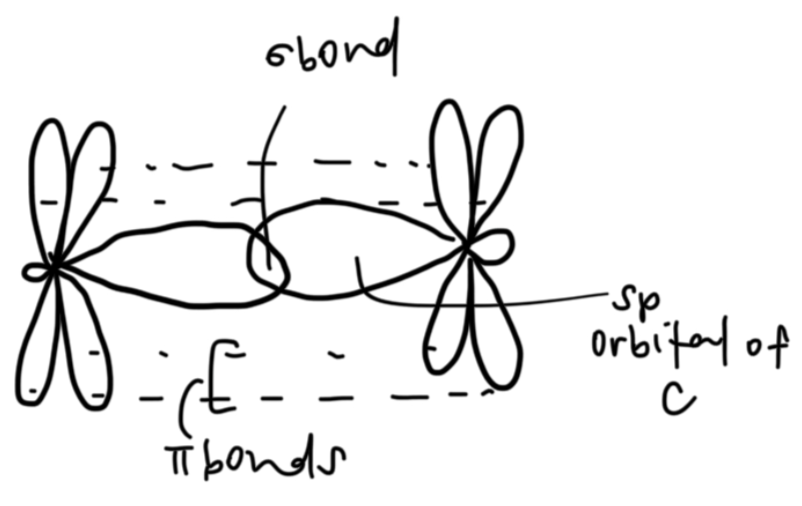
sp bonding (diagram)
C≡C: Head-on overlap between sp and sp to form sigma bond, 2 sideway overlaps between 2p and 2p to form 2π bonds
C-H: Head-on overlap between sp2 of C and 1s of H to form sigma bond
Conditions for delocalisation
Continuous overlap of p orbitals over at least 3 adjacent atoms, allowing for delocalisation of π electrons
How to see how many delocalised electrons
Count how many negative charge
Count how many double bonds
Benzene
Bond order of C=C in benzene is 1.5
6 C atoms in benzene are sp2 hybridised, hence each C has an unhybridised p orbital containing one electron
6 unhybridised p orbitals in benzene overlap continuously, allowing for delocalisation of 6 π electrons
Nucleophiles
Electron rich (π bonds or lone pair of electrons), can donate electrons
Can be neutral molecules with lone pair of electron (H2O, NH3)
Negatively charged ions (OH-, CN-)
Electrophiles
Electron deficient, can accept an electron pair
Can be atoms with partial positive charge (Br in Br2, H in HBr)
Positively charged ions (CH3+, Br+)
Atom with empty orbital in valence shell (Al in AlCl3)
Homolytic fission
When 2 bonding atoms are of relatively similar electronegativities, 2 shared electrons in covalent bond can be split equally between 2 atoms
Forms radical, contains unpaired electron and is extremely reactive
Heterolytic fission
2 atoms of different electronegativities, shared electrons are split unequally
More electronegative atom acquires both bonding electrons forming anion, less electronegative atom forms cation
Bond formation
Two radicals collide to form stable product
Electron rich region donates an electron pair to an electron deficient region
Substitution
Atom is substituted for another atom
Addition
2 species react to form a single product without any elimination of atom
Elimination
Atoms are removed to form a product with a double bond
Hydrolysis
Molecule is split by providing water
Condensation
2 molecules react to form a bigger molecule with the elimination of small molecule
Oxidation
O added
Reduction
H added
Structural isomerism
Chain isomers: straight vs branched
Positional isomers: different location of group on hydrocarbon chain
Different physical properties, similar chemical properties
Functional group isomers
different physical and chemical properties
Cis-trans isomerism
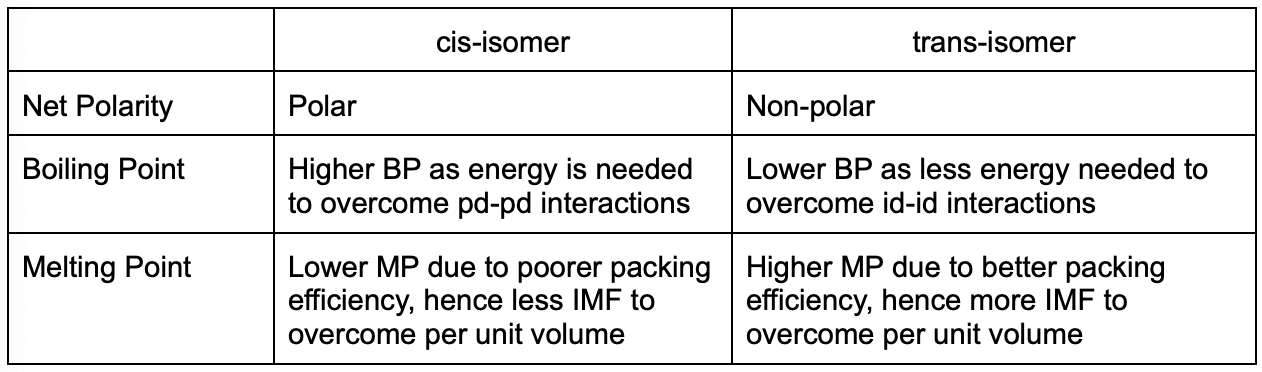
2 different groups on each of the C atoms with restricted rotation, conversion of cis isomer to trans isomer requires π bond to be broken
Cis VS Trans properties
Chiral centre
C is attached to 4 different atoms (use Mercedes logo to find from structural formula)
Enantiomers
Non-superimposable mirror images of each other
Rotate plane of plane-polarised light by equal angles in opposite directions
Have similar chemical properties
Have similar physical properties
Different biological properties
Racemic mixture
Solution that contains equal concentrations of enantiomers
Equal and opposite rotation of plane polarised light results in net zero enantiomer activity
Hence mixture is optically inactive
Mesocompounds
Contains 2 chiral centres, but has a plan of symmetry
Optically inactive as effect on plane polarised light by each half of the molecule is equal in magnitude and opposite in directions, hence cancel each other out