Unit 6 Endocrine System Diabetes
 Call Kai
 Learn
Learn Practice Test
 Spaced Repetition
 Match
Match Flashcards
 Knowt Play
1/50

There's no tags or description
Looks like no tags are added yet.
Name | Mastery | Learn | Test | Matching | Spaced | Call with Kai | Chat |
|---|
No analytics yet
Send a link to your students to track their progress
51 Terms
Endocrine System
The endocrine system is your body's messenger system .
It is made up of glands that produce hormones .
What are glands?
Glands are organs that make and release hormones .
Examples:
Pituitary gland
Thyroid gland
Adrenal glands
Pancreas
What are hormones?
Hormones are chemical messages that tell different parts of the body what to do.
Think of hormones like text messages sent through your blood.
Example:
A hormone can tell your body to grow.
A hormone can tell your body to use energy.
A hormone can tell your body when to sleep.
"Glands secrete hormones directly into the bloodstream" Secret = release
So this means:
Endocrine glands release hormones directly into the blood.
The blood then carries the hormones all around the body to the cells that need the message.
Easy example:
Thyroid gland makes a hormone.
Hormone enters the bloodstream.
Blood carries it throughout the body.
Cells receive the message and respond.
What does the endocrine system regulate?
1. Metabolism
Metabolism = how your body uses energy.
It controls:
How fast you burn calories
How much energy do you have?
How your body uses food
Example:
Thyroid hormones help control metabolism.
2. Growth
Hormones help you:
Get taller
Build muscles
Develop bones
Example:
Growth hormone helps children and teens grow.
3. Development
Development means the body changes as you get older.
Examples:
Puberty
Sexual development
Brain development
Hormones help control these changes
4. Tissue Function
Tissues are groups of cells that do a job.
Hormones help tissues:
Work correctly
Repair themselves
Communicate with other body parts
Example:
Insulin helps body cells take in glucose (sugar) for energy.
Negative Feedback System
This is the body's way of keeping hormone levels balanced.
Think of it like a thermostat in a house.
Too cold → heater turns on.
Too hot → heater turns off.
Your body does the same thing with hormones.
What does the endocrine system regulate?
When hormone levels are LOW
"Decrease of hormone level → RF, more is produced"
RF = Releasing Factor (or Releasing Hormone)
What happens:
Hormone level drops.
Brain detects the drop.
Releasing factors are sent out.
Glands are told to make more hormone.
Hormone level rises back to normal.
Easy example:
Not enough thyroid hormone:
Brain notices low level.
Sends signals.
The thyroid gland produces more hormones.
Levels return to normal.
When hormone levels are high "Hormone level is too high → production stops"
What happens:
Hormone level gets high enough.
Brain detects it.
Signal to make more hormone stops.
Gland slows down or stops production.
Hormone level falls back to normal.
Easy example:
Enough thyroid hormone:
Brain says, "We have enough."
Thyroid stops making extra hormone.
Balance is maintained.
Endocrine System
Super Simple Memory Trick
LOW hormone = MAKE MORE
⬇ Hormone → Brain notices → Signal sent → More hormone made
HIGH hormone = STOP MAKING
⬆ Hormone → Brain notices → Signal stops → Less hormone made
One-Sentence Summary
The endocrine system is a group of glands that release hormones into the bloodstream to control metabolism, growth, development, and tissue function , and it uses negative feedback to keep hormone levels balanced by doing more when levels are low and stopping production when levels are high.
Endocrine Glands = Hormone Factories
1-3
These glands make hormones and send them into the blood to tell the body what to do.
Think of each gland as having a special job.
1. Pituitary Gland 🧠 Nickname: "The Master Gland"
Location:
Under the brain
Job:
Controls many other endocrine glands.
Helps with growth, reproduction, and water balance.
Think: The boss of the hormone system.
The pituitary gland has two parts :
Previous Pituitary (Front Part)
It makes hormones that:
Help you grow
Control the thyroid
Control the adrenal glands
Help reproduction
Easy memory:
Previous = Action
(It sends out lots of hormones.)
Posterior Pituitary (Back Part)
Stores and releases hormones that:
Control water in the body
Help during childbirth
Easy memory:
Later = Water & Birth
2. Thyroid Gland 🦋
Location: Front of the neck
Job: Controls metabolism
Metabolism = how fast your body uses energy.
Think:
The body's speed controller.
If it works faster:
More energy, Faster calorie burning
If it works slower:
Less energy, Slower calorie burning
Easy memory:
Thyroid = Thermostat for body speed.
3. Parathyroid Glands 🦴
Location:Tiny glands behind the thyroid
Job:Control calcium levels
Calcium helps:
Bones, Teeth, Muscles, Nerves
Think:
Parathyroid = Calcium manager.
Para = Protects calcium.
Endocrine Glands = Hormone Factories
4. Adrenal Glands ⚡
Location: Sit on top of the kidney
Job: Help during stress and emergencies
They release hormones that:
Increase heart rate
Raise blood pressure
Give extra energy
Think:
Fight-or-flight gland.
You almost get hit by a car
Your adrenal glands say
"Emergency! Get ready!"
Your body gets a burst of energy.
Adrenal = Adrenaline = Action.
5. Pancreas 🍬
Location:
Behind the stomach
Job:
Controls blood sugar
Makes:
Insulin → lowers blood sugar
Glucagon → raises blood sugar
Think:
Blood sugar manager.
Pancreas = Sugar controller.
6. Gonads (Reproductive Glands)
Job:
Take sex hormones
Help reproduction
There are two types:
Male Gonads = Testes ♂
Location: In males
Job:
Testosterone production
Produce sperm
Female Gonads = Ovaries ♀
Location: In females
Job:
Make estrogen and progesterone
Produces eggs
Endocrine Glands
SUPER EASY CHART
Gland | Main Job | Easy Memory |
|---|---|---|
Pituitary | Controls other glands | Boss gland |
Anterior Pituitary | Growth & control hormones | Action |
Posterior Pituitary | Water balance & birth | Water & Birth |
Thyroid | Metabolism | Speed controller |
Parathyroid | Calcium levels | Calcium manager |
Adrenal | Stress response | Emergency gland |
Pancreas | Blood sugar | Sugar controller |
Testes | Testosterone & sperm | Male hormone factory |
Ovaries | Estrogen, progesterone & eggs | Female hormone factory |
"Boss, Speed, Calcium, Stress, Sugar, Boys, Girls"
Boss = Pituitary
Speed = Thyroid
Calcium = Parathyroid
Stress = Adrenal
Sugar = Pancreas
Boys = Testes
Girls = Ovaries
Pancreas 🍬
The pancreas is the body's blood sugar manager .
Its main job is to keep the amount of sugar (glucose) in your blood at a healthy level.
Think of it like a thermostat:
Blood sugar too high → lower it
Blood sugar too low → raise it
To do this, the pancreas uses two hormones :
Insulin
Glucagon
INSULIN What does insulin do?
Insulin lowers blood sugar (glucose) levels.
Think: Insulin = "Put sugar away."
When you eat food, especially carbohydrates (bread, pasta, rice, fruit, candy), your blood sugar rises.
The pancreas releases insulin to bring it back down.
"Decreases blood glucose levels" Blood glucose = blood sugar
After eating: Blood sugar goes up
Insulin tells the body:
"Take some sugar out of the blood."
Result:
Blood sugar decreases
Returns to normal
Insulin = LOWERS blood sugar.
"Promotes CHO storage (glycogen synthesis)" CHO = Carbohydrates
Carbohydrates are foods that become glucose.
Examples: Bread, Rice, Paste, Cereal, Fruit
Glycogen
Glycogen is the body's stored form of glucose .
Think:
Glucose = spending money
Glycogen = savings account
Your body stores extra glucose for later.
Glycogen Synthesis
"Synthesis" means doing something .
SW:
Glycogen synthesis = making glycogen from glucose.
Insulin tells the liver and muscles:
"Store the extra glucose for later."
Insulin helps save extra sugar.
"Brings glucose into cells for energy"
Cells need glucose for fuel.
Think of glucose as gasoline for a car.
Without glucose:
Cells can't work properly
You have less energy
Insulin acts like a key.
It unlocks cells and says: "Come in, glucose."
Then the cells use glucose for energy.
Insulin = key that lets glucose into cells.
"Essential for metabolism and storage of fat and protein" Metabolism
Metabolism = how your body uses food for energy.
Insulin helps the body:
Use glucose, Store nutrients, Make energy
at Storage
When there's extra energy, insulin helps store it as fat for later use.
Protein Storage
Insulin also helps the body:
Build muscle, Store protein, Repair tissues
Insulin helps use and store nutrients.
Pancreas
GLUCAGON
What does glucagon do?
Glucagon raises blood sugar levels.
Think: Glucagon = "Release more sugar."
"Increases blood glucose levels"
When you haven't eaten for a while:
Blood sugar drops
The body still needs energy
The pancreas releases glucagon.
Glucagon tells the liver:
"Send more glucose into the blood."
Result: Blood sugar goes up
Glucagon = RAISES blood sugar.
"Stimulates glycogen breakdown (glycogenolysis)"
Big word, easy meaning.
Glycogenolysis
Glycogen = stored sugar
Lysis = break apart
Glycogenolysis = breaking stored glycogen into glucose.
The liver takes stored glycogen and turns it back into glucose.
Glucagon breaks open the sugar savings account
"New glucose to be formed (gluconeogenesis)"
Gluconeogenesis
Gluco = glucose
Neo = new
Genesis = creation
Gluconeogenesis = making new glucose.
If stored glycogen starts running low, the body can make new glucose from other materials.
Gluconeogenesis = creating brand-new glucose.
How Insulin and Glucagon Work Together
They are opposites.
Hormone | Blood Sugar |
|---|---|
Insulin | Lowers it |
Glucagon | Raises it |
After a Meal 🍕
Blood sugar goes up.
Pancreas releases: ➡ Insulin
Insulin:
Moves glucose into cells
Stores extra glucose as glycogen
Blood sugar drops.
When You Haven't Eaten 🍽❌
Blood sugar goes down.
Pancreas releases: ➡ Glucagon
Glucagon:
Breaks down glycogen
Makes new glucose
Blood sugar goes up.
Pancreas
"Balance to maintain adequate blood glucose levels"
The body wants blood sugar to stay in a healthy range.
Not too high.
Not too low.
SW:
If blood sugar is high
➡ Insulin lowers it.
If blood sugar is LOW
➡ Glucagon raises it.
Together they keep blood sugar balanced.
Super Easy Summary
Pancreas = Blood Sugar Manager
Insulin 🗝
Lowers blood sugar
Moves glucose into cells
Gives cells energy
Stores extra glucose as glycogen
Helps store fat and protein
Glucagon 📈
Raises blood sugar
Breaks glycogen into glucose ( glycgenolysis )
Makes new glucose ( gluconeogenesis )
Main Goal 🎯
Keep blood sugar balanced:
Too high → insulin
Too low → glucagon
Insulin Secretion (How Insulin Is Released)
Basal Insulin Release
Basal = small amount all day long.
Even when you're not eating, your pancreas releases a little insulin to keep blood sugar stable.
Think:
➡ Background insulin working 24/7.
Peaks With Meals
When you eat, blood sugar rises.
Your pancreas releases more insulin to help move that glucose into cells for energy.
Think:
➡ Eat food → blood sugar rises → insulin rises.
Stored Insulin Is Released
A healthy pancreas already has insulin stored and ready.
When you eat:
Blood sugar goes up.
Pancreas quickly releases stored insulin.
Blood sugar returns toward normal.
Think:
➡ Insulin is waiting on standby.
Coordinated Insulin Secretion
The pancreas releases the right amount of insulin at the right time .
This helps keep blood sugar healthy.
Think:
➡ Not too much insulin, not too little.
Insulin Secretion
gluts 2-4
GLUT2 What is GLUT2?
A transporter (a doorway) that lets glucose enter beta cells in the pancreas.
When glucose enters beta cells:
➡ The pancreas knows blood sugar is high.
➡ Insulin is released.
GLUT2 = glucose detector for insulin release.
GLUT4 What is GLUT4?
A transporter (doorway) found in body cells.
Insulin tells GLUT4 to open.
Then:
➡ Glucose enters the cells.
➡ Cells use it for energy.
Think:
GLUT4 = lets glucose into cells.
GLUT2 = tells pancreas to release insulin
GLUT4 = lets glucose into body cells
Glycogenolysis
Glycogen = stored glucose
Lysis = break apart
Glycogenolysis = breaking stored glucose apart to use for energy.
This happens:
During fasting, Between meals, When blood sugar gets low
Think:
➡ Your body opens its glucose storage when it needs energy.
GLP-1 and GLP-2
These are hormones called incretins .
They:
✅ Increase insulin release
✅ Helps lower blood sugar
✅ Prevent the liver from making extra glucose
Think:
➡ GLP-1 & GLP-2 help insulin do its job.
DPP-4
DPP-4 is an enzyme.
Its job is to break down (turn off) GLP-1 and GLP-2.
enzyme that inactivates incretins (GLP-1, GLP-2)
Think:
➡ GLP-1 and GLP-2 help insulin.
➡ DPP-4 stops GLP-1 and GLP-2.
Insulin Secretion
Quick Memory Chart
Term | Easy Meaning |
|---|---|
Basal insulin | Small amount released all day |
Meal peak | More insulin released after eating |
GLUT2 | Detects glucose and triggers insulin release |
GLUT4 | Lets glucose into cells for energy |
Glycogenolysis | Breaks stored glucose into usable glucose |
GLP-1 & GLP-2 | Increase insulin and reduce liver glucose production |
DPP-4 | Turns off GLP-1 and GLP-2 |
GLUT2 senses glucose → pancreas releases insulin → GLUT4 lets glucose into cells for energy.
GLP-1 and GLP-2 help insulin work better, while DPP-4 shuts them off.
When you haven't eaten, glycogenolysis breaks down stored glucose to keep blood sugar normal.
Glucagon Secretion (Easy Version)
Think of glucagon as the hormone that raises blood sugar when it gets too low .
When is glucagon released?
Between meals 🍽
During fasting (when you haven't eaten for a while)
If your blood sugar starts dropping, your body says:
"We need more glucose!"
So the pancreas releases glucagon .
Released from the pancreas
Glucagon is made and released by the pancreas .
Think:
➡ Pancreas = blood sugar manager
Activates glycogenolysis in the liver
Glycogenolysis = breaking down stored glucose.
The liver stores extra glucose as glycogen .
Glucagon tells the liver:
"Open the storage and release glucose!"
This raises blood sugar.
➡ Glycogenolysis = opening the glucose storage closet.
Stimulates gluconeogenesis in the liver
Gluconeogenesis = making new glucose.
If the liver needs more glucose, glucagon tells it:
"Make new glucose!"
This also helps raise blood sugar.
➡ Gluconeogenesis = creating brand-new glucose.
Glucagon Secretion
Super Easy Summary
Glucagon = raises blood sugar.
When blood sugar gets low:
Pancreas releases glucagon.
Liver breaks down stored glucose ( glycogenolysis ).
Liver makes new glucose ( gluconeogenesis
Blood sugar goes back up.
Memory Trick
Insulin puts sugar away ⬇
Glucagon gives sugar back ⬆
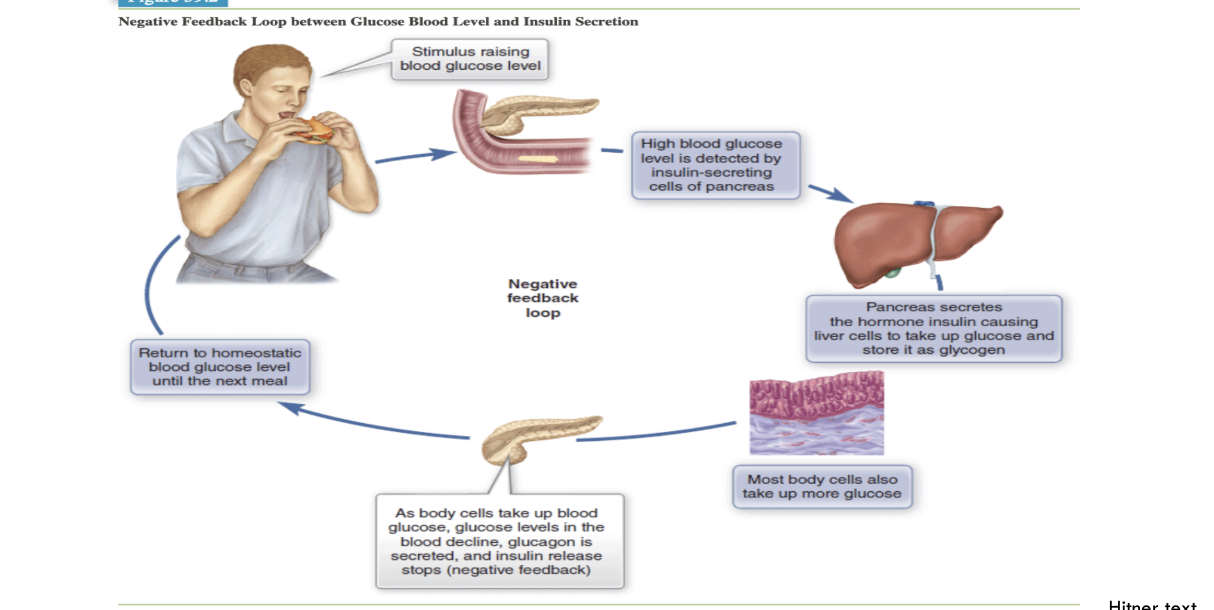
Negative Feedback for Blood Sugar Levels
The Goal 🎯
Your body wants blood sugar to stay just right .
Not too high ❌
Not too low ❌
Just right ✅
This is called homeostasis (balance).
Step 1: You Eat 🍔
You eat food.
The food is broken down into glucose (sugar) .
➡ Blood sugar goes UP .
Step 2: Pancreas Notices 👀
The pancreas checks blood sugar levels.
It sees:
"Whoa! Blood sugar is getting high."
Step 3: Pancreas Releases Insulin 🔑
The pancreas releases insulin into the blood.
Think:
Insulin = the key that helps glucose leave the blood.
Step 4: Cells Take In Glucose 🚪
Insulin tells body cells:
"Open up and let glucose in!"
The cells take in glucose and use it for energy.
Step 5: Liver Stores Extra Glucose 🏪
The liver takes extra glucose and stores it as glycogen .
Think:
Glucose = sugar you use now
Glycogen = sugar saved for later
Step 6: Blood Sugar Goes Down ⬇
Because:
Cells are using glucose
The liver is storing glucose
There is less glucose in the blood.
Blood sugar returns to normal.
Step 7: Insulin Stops 🛑
The pancreas sees:
"Blood sugar is normal again."
So it stops releasing extra insulin.
This is called negative feedback .
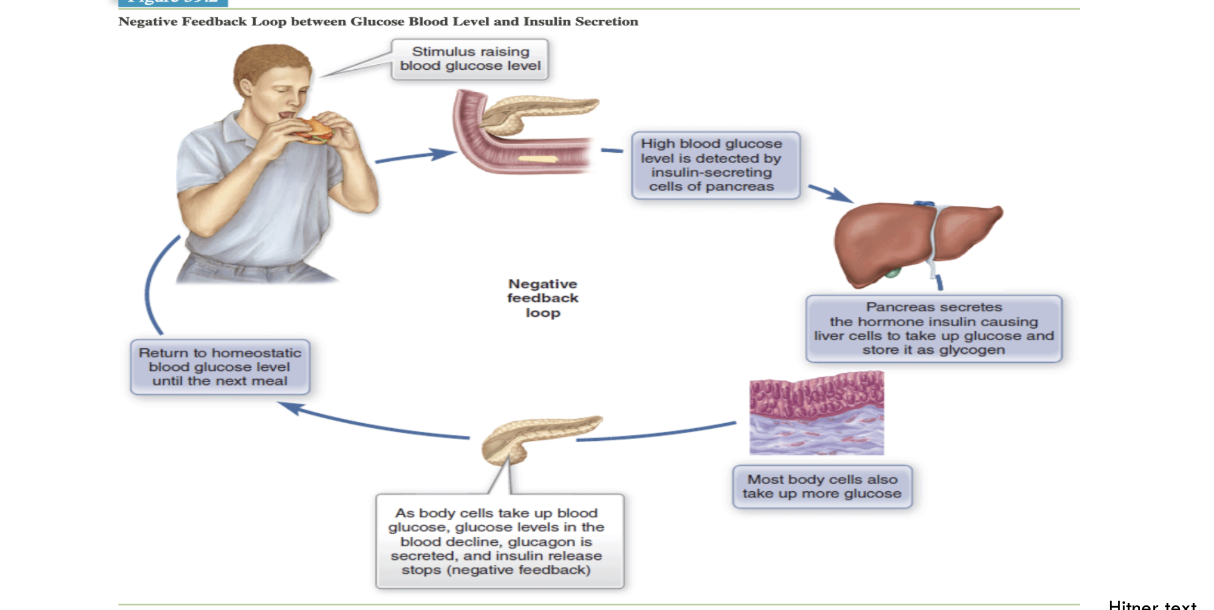
Negative Feedback for Blood Sugar Levels/ pancreas
Why Is It Called Negative Feedback?
The body fixes the problem by doing the opposite.
Problem | Body's Response |
|---|---|
Blood sugar too high | Release insulin |
Blood sugar returns to normal | Stop insulin release |
Super Easy Memory Story
🍔 Eat food
⬆ Blood sugar rises
👀 Pancreas notices
🔑 Insulin released
🚪 Cells take in glucose
🏪 Liver stores extra glucose as glycogen
⬇ Blood sugar returns to normal
🛑 Insulin stops
✅ Balance restored
One-Sentence Summary
When you eat, blood sugar rises, the pancreas releases insulin, cells and the liver take up glucose, blood sugar falls back to normal, and insulin release stops—this is a negative feedback loop.
Normal Blood Glucose
Test | Normal Result | Easy Meaning |
|---|---|---|
FBS (Fasting Blood Sugar) | 70–99 mg/dL | Your blood sugar after not eating for about 8 hours. |
HbA1c | Less than 5.7% | Shows your average blood sugar over the last 2–3 months. |
GTT (Glucose Tolerance Test) | Less than 140 mg/dL | Checks how well your body handles sugar after drinking a glucose drink. |
FBS = Blood sugar right now while fasting
HbA1c = Blood sugar over the last few months
GTT = How your body handles a sugar challenge
Super Short Summary
✅ FBS 70–99 = Normal fasting blood sugar
✅ HbA1c < 5.7% = Normal average blood sugar over months
✅ GTT < 140 = Normal response after drinking glucose/sugar
Prediabetes Diagnosis
Prediabetes means your blood sugar is higher than normal, but not high enough to be diabetes yet.
Think:
➡ Normal → Prediabetes → Diabetes
Prediabetes is a warning sign that diabetes could develop if changes aren't made.
Blood Sugar Numbers for Prediabetes FBS (Fasting Blood Sugar)
100–125 mg/dL
This is your blood sugar after not eating for about 8 hours.
HbA1c
5.7%–6.4%
Shows your average blood sugar over the last 2–3 months .
GTT (Glucose Tolerance Test)
140–199 mg/dL
Shows how your body handles sugar after drinking a glucose drink.
Prediabetes Diagnosis
Treatment
1. Modify Lifestyle
Make healthier daily habits.
Think:
➡ Better choices every day.
2. Exercise 🏃
Move your body regularly.
Exercise helps:
Lower blood sugar
Help insulin work better
3. Weight Loss (if needed) ⚖
If a person is overweight, losing some weight can help lower blood sugar.
4. Nutrition Changes 🥗
Eat healthy foods and reduce excess sugar and unhealthy foods.
Examples:
More fruits and vegetables
More whole grains
Less sugary drinks and sweets
5. Reassess 🔄
Check blood sugar again later to see if it has improved.
Prediabetes = blood sugar is higher than normal but not diabetes yet.
Numbers:
FBS: 100–125
HbA1c: 5.7–6.4%
GTT: 140–199
Treatment:
✅ Healthy lifestyle
✅ Exercise
✅ Weight loss (if needed)
✅ Better nutrition
✅ Recheck blood sugar later (reassess)
Diabetes Diagnosis
Diabetes means your blood sugar is too high because your body isn't using insulin properly or isn't making enough insulin.
Numbers That Mean Diabetes
🔹 FBS (Fasting Blood Sugar)
126 mg/dL or higher
Blood sugar after not eating for about 8 hours.
🔹 HbA1c
6.5% or higher
Average blood sugar over the last 2–3 months.
🔹 GTT (Glucose Tolerance Test)
200 mg/dL or higher
Blood sugar after drinking a glucose (sugar) drink.
Test | Normal | Prediabetes | Diabetes |
|---|---|---|---|
FBS | 70–99 | 100–125 | 126+ |
HbA1c | <5.7% | 5.7–6.4% | 6.5%+ |
GTT | <140 | 140–199 | 200+ |
Super Short Summary
If FBS is 126+, HbA1c is 6.5%+, or GTT is 200+, it means diabetes because blood sugar is staying too high. 🩸⬆🍬
Type 1 Diabetes Mellitus (Type 1 DM)
What is it?
Type 1 diabetes is a disease where the body does not make insulin at all.
Think:
➡ No insulin = glucose can't get into cells properly.
➡ Blood sugar stays high.
Usually Before Age 20
Often diagnosed in:
Children
Teenagers
Young adults
That's why it used to be called juvenile diabetes .
Very Thin
Many people with Type 1 diabetes are often thin when diagnosed because their body can't use glucose properly for energy.
Absolute Insulin Deficiency
This means:
🚫 No insulin production
The cells in the pancreas that make insulin are destroyed.
Insulin-Dependent (IDDM)
Because the body makes little or no insulin:
✅ They must take insulin (shots or a pump) to live.
Cause : Genetics 🧬
It can run in families.
Autoimmune Disease ⚔
The body's immune system mistakenly attacks and destroys the insulin-producing cells in the pancreas.
Type 1 Diabetes Mellitus (Type 1 DM)
What is it?
Type 1 Diabetes = the pancreas stops making insulin.
Usually starts before age 20
Often thin at diagnosis
No insulin production
Must take insulin
Caused by genetics and an autoimmune attack on the pancreas
Type 1 = "No insulin is made." 🚫💉➡ Need insulin injections.
Type 1 Diabetes Symptoms (Super Easy)
Hyperglycemia 🩸⬆
High blood sugar
Blood glucose is 126 mg/dL or higher after fasting for 8 hours.
Happens because there is not enough insulin.
Glycosuria 🚽
Sugar in the urine (pee)
Blood sugar gets so high that some sugar spills into the urine.
Polyuria 🚽🚽
Frequent urination (peeing a lot)
Extra sugar pulls water out of the body.
You pee more often.
Polydipsia 🥤
Very thirsty
Because you're losing lots of water from peeing.
Polyphagia 🍔
Very hungry
Cells aren't getting enough glucose for energy.
The body thinks it needs more food.
Drowsiness/Fatigue 😴
Tired all the time
Cells aren't getting enough energy.
Dry Skin 🌵
Skin becomes dry
Caused by dehydration from excessive urination.
Ketoacidosis (DKA) 🍎
Dangerous condition
Blood sugar is usually over 250 mg/dL .
The body starts burning fat for energy.
Breath may smell fruity or sweet .
Think:
➡ Not enough insulin → body burns fat → DKA.
Unexplained Weight Loss ⚖⬇
Losing weight without trying
The body can't use glucose properly.
It starts breaking down fat and muscle for energy.
Type 1 Diabetes Symptoms (Super Easy)
Easy Memory Trick
The 3 P's of Type 1 Diabetes:
✅ Polyuria = Peeing a lot
✅ Polydipsia = Very thirsty
✅ Polyphagia = Very hungry
Plus:
✅ High blood sugar
✅ Tired
✅ Dry skin
✅ Weight loss
✅ Fruity breath (DKA)
Type 1 diabetes causes high blood sugar because there is no insulin. People often pee a lot, feel very thirsty, very hungry, tired, lose weight, and may develop fruity-smelling breath if DKA occurs. 🍬⬆💉❌
Diagnosis of Type 1 Diabetes (Super Easy)
Doctors use blood tests and urine tests to see if someone has diabetes.
Blood Draws 🩸 FBS/FBG (Fasting Blood Sugar)
126 mg/dL or higher (twice) = diabetes
Taken after not eating for 8 hours
Think:
➡ High fasting blood sugar = diabetes
Random Blood Sugar
200 mg/dL or higher = diabetes
Can be checked at any time
HbA1c
Shows average blood sugar over the last 3 months
Normal = less than 5.7%
Diabetes = 6.5% or higher
Think:
➡ 3-month report card for blood sugar
GTT (Glucose Tolerance Test)
Shows how well the body handles sugar
In diabetes, the body is glucose intolerant (can't handle sugar normally)
Urinalysis (Urine Test) 🚽 Glycosuria
Sugar in the urine
Proteinuria
Protein in the urine
Can be a sign the kidneys are being affected
Ketones Present
Body is burning fat for energy because it can't use glucose properly
BUN and Creatinine Elevated
These are blood tests that check kidney function .
If they are elevated:
➡ The kidneys may be under stress or not working as well.
Diagnosis of Type 1 Diabetes (Super Easy)
Super Short Study Guide
Blood draws
FBS or FBG >or =126 mg/dL (X 2) or random BS >or =200 mg/dL
HbA1c: BS control over previous 3 mos (normal is <5.7%, diagnosis of diabetes is at 6.5% or higher)
GTT: intolerant
Urinalysis: glycosuria, proteinuria, ketones present
BUN and creatinine elevated
✅ FBS ≥ 126 = Diabetes
✅ Random BS ≥ 200 = Diabetes
✅ HbA1c ≥ 6.5% = Diabetes
✅ Glycosuria = Sugar in urine
✅ Proteinuria = Protein in urine
✅ Ketones = Burning fat for energy
✅ High BUN & Creatinine = Possible kidney problems
Blood: High sugar 🩸
Urine: Sugar, protein, ketones 🚽
Kidneys: High BUN & creatinine 🫘 (kidney function tests)
Complications of Diabetes (Super Easy)
Complications = problems that can happen when blood sugar stays high for a long time.
pt.1
👀 Retinal Hemorrhages
Bleeding in the blood vessels of the eye.
Think:
➡ Eye damage
👁 Blindness
Diabetes can damage the eyes and cause vision loss.
Think:
➡ Can't see well or may lose vision
🫘 Renal Dysfunction
Renal = kidneys
The kidneys may not filter blood properly.
Think:
➡ Kidney damage
🤕 Neuropathy
Nerve damage
Can cause:
Numbness
Tingling
Pain (especially in feet and hands)
Think:
➡ Nerve problems
🦠 Recurrent Skin Infections
Frequent skin infections that keep coming back.
Think:
➡ More infections
Complications of Diabetes (Super Easy)
Complications = problems that can happen when blood sugar stays high for a long time.
pt.2
♀ Vaginal Infections
High blood sugar can make these infections more common.
Think:
➡ Frequent vaginal infections
❤ Heart Disease
Diabetes can damage blood vessels and increase heart problems.
Think:
➡ Heart damage
🧠 Stroke
Blood flow to the brain can become blocked.
Think:
➡ Brain damage from poor blood flow
🍽 GI Problems
GI = Gastrointestinal (digestive system)
Can cause:
Stomach problems
Digestion problems
Think:
➡ Digestive issues
👶 Fertility Problems
Can make it difficult to have children.
Think:
➡ Problems with reproduction
Complications Associated with Diabetes
Super Easy Memory Trick
Diabetes can damage:
👀 Eyes
🫘 Kidneys
🤕 Nerves
🦠 Skin
❤ Heart
🧠 Brain
🍽 Stomach/Digestion
👶 Fertility
Super Short Summary
High blood sugar over time can damage many parts of the body, especially the eyes, kidneys, nerves, heart, brain, skin, digestive system, and reproductive system.
Sources of Insulin (Super Easy)
Insulin can come from 3 places :
1. Humans 👨
Insulin made from human sources.
Think:
➡ Human insulin
2. Animals 🐮🐷
In the past, insulin was taken from:
Cows
Pigs
Think:
➡ Animal insulin
3. Recombinant DNA / Genetic Engineering 🧬
Scientists use bacteria or other cells to make insulin that is almost identical to human insulin.
This is the most common source today.
Think:
➡ Lab-made human insulin
Super Easy Memory Trick
HAG
👨 H = Human
🐮🐷 A = Animal (cows & pigs)
🧬 G = Genetic engineering
Super Short Summary
Insulin can come from humans, animals (cows/pigs), or be made in a lab using genetic engineering. Today, most insulin is made using genetic engineering. 🧬💉
Types of Insulin (Super Easy)
1. Regular Insulin 💧
Clear (looks clear)
Short-acting (starts working fairly quickly)
Can be mixed with NPH insulin
Memory: ➡ Regular = Clear & Short-acting
2. NPH Insulin ☁
Cloudy (looks cloudy)
Intermediate/longer acting
Works longer than Regular insulin
Memory: ➡ NPH = Cloudy & Lasts Longer
Mixing Regular and NPH
When drawing them into the same syrinx:
Rule:
Clear before Cloudy
Draw up Regular (clear) first
Draw up NPH (cloudy) second
Memory:
➡ Clear before Cloudy
Premix Insulin (Novolin 70/30)
Already mixed for you:
70% NPH (cloudy, longer acting)
30% Regular (clear, short acting)
Benefits:
Starts working quickly
Lasts longer
Memory:
➡ 70/30 = 70% NPH + 30% Regular
Quick Study Sheet
💧 Regular = Clear, short-acting
☁ NPH = Cloudy, longer-acting
💉 Mixing = Clear before Cloudy
📦 70/30 = 70% NPH + 30% Regular (premixed)
Human DNA Insulin (Super Easy)
What is it?
This is insulin made using genetic engineering to be very similar to human insulin.
Think:
➡ Lab-made human insulin 🧬
Clear
It looks clear , not cloudy.
Think:
💧 Clear insulin
Cannot Be Mixed With Other Insulin
This means:
❌ Don't combine it in the same syringe with another type of insulin.
It must be given by itself.
Think:
➡ Human DNA insulin likes to work alone.
Super Short Summary
🧬 Human DNA insulin = lab-made human insulin
💧 Clear appearance
❌ Cannot be mixed with other insulins in the same syringe
Clear; cannot be mixed with any other insulin
Types of Insulin (Super Easy)
rapid vs short vs intermediate
1. Rapid-Acting Insulin ⚡
Works very fast
Starts working: 5–10 minutes
Strongest effect (peak): 1–2 hours
Lasts: up to 4 hours
Think:
➡ Rapid = Fast in, fast out
Usually taken right before eating.
2. Short-Acting Insulin 🕒
Works a little slower
Starts working: 30–60 minutes
Peak: 2–3 hours
Lasts: 6–8 hours
Think:
➡ Short = Slower than fast, lasts longer
Usually taken about 30 minutes before eating.
3. Intermediate-Acting Insulin ⏳
Works much longer
Starts working: 2–4 hours
Peak: 4–14 hours
Lasts: up to 24 hours
Think:
➡ Intermediate = Slow start, long-lasting
Helps control blood sugar throughout the day.
Easy Memory Trick
⚡ Rapid = Starts in minutes
🕒 Short = Starts in about 30–60 minutes
⏳ Intermediate = Starts in hours and lasts most of the day
Super Short Summary
Rapid: 5–10 min start, lasts up to 4 hr
Short: 30–60 min start, lasts 6–8 hr
Intermediate: 2–4 hr start, lasts up to 24 hr
The faster it starts, the shorter it lasts. 😊💉
4. Long-Acting Insulin ⏳
Long acting
Works for a long time
Starts working: 2–4 hours
Lasts: up to 24 hours
Think:
➡ Long-acting = all-day protection
It helps keep blood sugar steady throughout the day and night.
5. Combination Products 💉
These are insulins that are already mixed together by the manufacturer.
Example:
Fast-acting insulin + longer-acting insulin in one injection
Important:
❌ Do NOT mix them with other insulins.
They're already mixed correctly and ready to use.
Think:
➡ Combination = premixed insulin
➡ Leave it alone—don't add other insulins
⏳ Long-acting = Slow start, lasts all day
💉 Combination = Already mixed, cannot be mixed with other insulins
Super Short Summary
Long-acting insulin: starts in 2–4 hours and works up to 24 hours.
Combination insulin: premixed insulin that should not be mixed with any other insulin.
DIABETIC DRUG THERAPY
Insulin: Antidiabetic Agents
Rapid acting
aspart Novolog®
lispro Humalog®
glulisine Apidra®
Methods of Giving Insulin 💉
IV (Intravenous)
Given directly into a vein
Only Regular insulin can be given this way
➡ IV = Regulate insulin
Subcutaneous (SubQ)
Injected into the fat under the skin
Most common method
Think:
➡ Under the skin
Pump
Small device that gives insulin continuously
Think:
➡ Automatic insulin delivery
Syringe & Needle
Traditional insulin shot
➡ Insulin injection
Pen
Insulin comes in a pen-like device
Easier to use than a syringe
➡ Easy insulin shot
Storage & Ordering
🧊 Store insulin in the refrigerator
📏 Insulin is measured in units, not milligrams
Super Short Summary
IV = Regular insulin only
SubQ = under the skin
Pump = automatic insulin
Syringe = insulin shot
Pen = easy-to-use insulin shot
Store in refrigerator
Ordered in units 💉🧊
Side Effects of Insulin (Super Easy)
Insulin Allergy 🤧
Some people may have an allergic reaction.
Signs:
Swelling
Itching
Anaphylaxis (severe allergic reaction/emergency)
Think:
➡ Allergic reaction to insulin
Lipodystrophy 💉
Loss of fat under the skin where insulin is injected.
The skin may look:
Pitted
Dented
Concave (sunken in)
Prevention:
✅ Rotate injection sites
➡ Don't inject in the same spot every time
Blurred Vision 👀
Vision may become blurry because blood sugar changes can affect the lens of the eye.
Think:
➡ Changes in eyesight
Hypoglycemia ⬇🍬
Low blood sugar
This is the most common side effect of insulin.
➡ Too much insulin = blood sugar drops too low
🤧 Insulin allergy = swelling, itching, anaphylaxis
💉 Lipodystrophy = loss of fat at injection site (rotate sites)
👀 Blurred vision = lens changes
⬇🍬 Hypoglycemia = low blood sugar (most important to remember)
Hypoglycemia ⬇🍬
What is it?
Hypoglycemia = low blood sugar
Blood sugar is less than 70 mg/dL
Think:
➡ Too little sugar in the blood
Severe Hypoglycemia ⚠
Blood sugar less than 50 mg/dL
Can lead to insulin shock (diabetic shock/coma)
➡ Very low blood sugar = emergency
What to Do Before Insulin Shock Happens
Give something with sugar:
✅ Glucose tablets
✅ Juice
✅ Regular soda (not diet)
➡ Give sugar fast
Insulin Shock
Insulin shock = too much insulin causes blood sugar to drop too low.
Treatment:
✅ Give a hyperglycemic agent (something that raises blood sugar)
Think:
➡ Low sugar → give sugar
⬇ Hypoglycemia = Low Blood Sugar (<70)
⚠ Below 50 = Insulin Shock Emergency
🥤 Treat with glucose tablets, juice, or regular soda .
Hypoglycemia Symptoms (Low Blood Sugar) ⬇🍬
Hunger 🍔
I feel very hungry
Irritability 😠
Easily annoyed or moody
Headache 🤕
Head starts hurting
Blurred Vision 👀
Hard to see clearly
Anxiety/Nervousness 😟
Feel worried or shaky
Fatigue 😴
Very tired or weak
Sweating 💦
Sweating more than normal
Jittery 🤲
Shaky or trembling
Tachycardia ❤
Fast heartbeat
Confusion 🤔
Trouble thinking clearly
Easy Memory Trick
Low blood sugar = "Hungry, Shaky, Sweaty, Confused."
🍔 Hungry
🤲 Shaky/Jittery
💦 Sweaty
🤔 Confused
DIABETIC DRUG THERAPY
Insulin: Antidiabetic Agents full drug
Short acting
regular Novolin R®, Humulin R®
Intermediate acting
NPH Humulin N® or Novolin N®
Long acting
glargine Lantus® (basal acting insulin)
Combination Products
Humulin N and R Humulin 70/30®
Insulin aspart protamine/insulin aspart Novolog Mix 70/30®
DIABETIC DRUG THERAPY
Hyperglycemic Agents
drug
glucagon Glucagen®
50% Dextrose Solution
Non-Pharmacological Diabetic Care
Non-pharmacological = ways to manage diabetes without medicine.
🍞 Diet – Limit CHO (Carbohydrates)
Eat fewer sugary and high-carb foods.
No sugar or limit it as much as possible.
Think:
➡ Less sugar = better blood sugar control
🏃 Exercise
Be physically active.
Helps lower blood sugar.
⚖ Maintain Weight Control
Maintain a healthy weight.
📚 Education
Learn about diabetes and how to manage it.
🩸 Self-Monitoring of Blood Sugar (BS)
Check your blood sugar regularly.
Think:
➡ Know your numbers
✅ Compliance
Follow the treatment plan.
Take medications as prescribed and follow healthy habits.
Super Short Summary
🥗 Healthy diet (less carbs/sugar)
🏃 Exercise
⚖ Healthy weight
📚 Learn about diabetes
🩸 Check blood sugar
✅ Follow the treatment plan (compliance)
Type 2 Diabetes Mellitus (Type 2 DM)
What is it?
Type 2 diabetes means the body still makes insulin, but it doesn't work well enough.
Think:
➡ Insulin is there, but the body doesn't use it properly.
Relative Deficiency
This means:
Not enough insulin may be made
The body's cells don't respond well to insulin ( insulin resistance )
Insulin may not be released properly
Think:
➡ Insulin works poorly or there isn't enough of it.
Usually Over Age 40
Most common in adults, although younger people can get it too.
Often Overweight ⚖
Being overweight increases the risk of Type 2 diabetes.
Usually Non-Insulin Dependent
Many people can control it with:
🥗 Diet changes
🏃 Exercise
💊 Oral medications (pills)
💉 Sometimes injectable medications
Insulin may be needed later, but not always.
Causes
🧓 Aging
🍔 Poor diet
🧬 Genetics (family history)
🩸 Previous glucose intolerance (prediabetes)
Type 1 = No insulin ❌💉
Type 2 = Insulin doesn't work well ⚠💉
Super Short Summary
Type 2 diabetes usually happens in adults who are often overweight. The body still makes insulin, but it doesn't use it properly. It is often managed with diet, exercise, and medications. 🍽🏃💊
Type 2 Diabetes Mellitus (Symptoms) - Super Easy
Diagnosis
Doctors use the same tests as Type 1:
🩸 FBS (Fasting Blood Sugar)
🩸 HbA1c (3-month average blood sugar)
🚽 Urinalysis (checks urine for sugar)
Symptoms Hyperglycemia ⬆🍬
High blood sugar
Fasting blood sugar 126 mg/dL or higher
Think:
➡ Too much sugar in the blood
Glycosuria 🚽
Sugar in the urine
Extra sugar spills into the pee
Polyuria 🚽🚽
Peeing a lot
High blood sugar causes more urination
Polydipsia 🥤
Very thirsty
Because you're losing water by peeing a lot
Polyphagia 🍔
Very hungry
Cells aren't getting enough energy
Drowsiness/Fatigue 😴
Feeling tired
The body isn't using glucose properly for energy
Fertility Issues 👶
Problems with reproduction or getting pregnant
Unexplained Weight Gain ⚖⬆
Gaining weight without a clear reason
Common in many people with Type 2 diabetes
Easy Memory Trick
The 3 P's:
🚽 Polyuria = Peeing a lot
🥤 Polydipsia = Very thirsty
🍔 Polyphagia = Very hungry
Plus:
😴 Tired
⚖ Weight gain
👶 Fertility problems
Super Short Summary
Type 2 diabetes causes high blood sugar. Common symptoms are the 3 P's (peeing, thirst, hunger), tiredness, weight gain, and fertility problems. 🍬⬆
Oral Hypoglycemic Agents
Sulfonylureas (Secretagogues)
💊 What are they?
A type of medicine used to treat Type 2 Diabetes .
AKA Secretagogues
"Secretagogue" means:
➡ Makes the pancreas secrete (release) more insulin.
💊 "Pushes the pancreas to make more insulin."
How Do They Work? (MOA)
These medicines attach to beta cells in the pancreas.
This causes the beta cells to:
➡Open a process that lets calcium (Ca++) enter the cell.
➡ Calcium tells the cell:
"Release insulin!"
➡ More insulin is released into the blood.
Super Easy Memory
💊 Sulfonylureas = Type 2 diabetes medicine
🏭 Work on beta cells in the pancreas
📈 Cause more insulin release
🍬 More insulin = lower blood sugar
Sulfonylureas help treat Type 2 diabetes by making the pancreas release more insulin. 💉⬆🍬⬇
bind to beta cells of pancreas causing release of insulin; bind to K+ channel of beta cells; allow influx of Ca++ across membrane which triggers insulin release
Anti-Diabetic agents-Type 2 Diabetes
Oral Hypoglycemic Agents
Sulfonylureas (secretagogues)
drug
formerly known as second generation
glyburide
glipizide
glimepiride
Anti-Diabetic agents-Type 2 Diabetes
Oral Hypoglycemic Agents
Non-sulfonylureas (meglitinides, secretagogues)
repaglinide Prandin®
nateglinide Starlix®
Side Effects (SEs) of Sulfonylureas 💊
⬇ Hypoglycemia
Low blood sugar (most important side effect)
Think:
➡ Too much insulin = blood sugar drops too low
☀ Photosensitivity
Skin becomes more sensitive to sunlight.
Think:
➡ Sunburns more easily
🤢 GI Upset
Stomach problems such as:
Nausea
Diarrhea
⚖ Weight Gain
May cause weight gain.
🍺 Alcohol Reaction (Disulfiram-Type Reaction)
Do not drink alcohol while taking this medicine.
Alcohol can cause:
Flushing (red face), Headache
Nausea/vomiting, Fast heartbeat
Dizziness, Low blood pressure
Confusion
➡ Alcohol + Sulfonylurea = Bad reaction
😴 Weakness, Fatigue, Dizziness
May feel:Weak, Tired, Dizzy
Patient Teaching 📚 ❌ Sulfa Allergy
Do not take if allergic to sulfa drugs .
🍽 Take With Meals
Take the medication when eating.
➡ Helps lower the risk of low blood sugar.
Super Easy Study Sheet
SEs of Sulfonylureas
💊 Sulfonylureas = Make pancreas release more insulin
Side Effects:
⬇ Hypoglycemia
☀ Photosensitivity
🤢 Nausea/diarrhea
⚖ Weight gain
🍺 No alcohol
😴 Weakness, fatigue, dizziness
Patient Teaching:
❌ No sulfa allergy
🍽 Take with meals
Memory Trick
"More insulin = lower sugar, so watch for hypoglycemia." 🍬⬇