AP Bio Unit 8 Bacteria and Behavior
 Studied by 0 people
 Call Kai
 Learn
Learn Practice Test
 Spaced Repetition
 Match
Match Flashcards
 Knowt Play
1/41

Earn XP
Description and Tags
Name | Mastery | Learn | Test | Matching | Spaced | Call with Kai |
|---|
No study sessions yet.
42 Terms
What type of signal is brief and can work among obstructions at night?
visual
olfactory
magnetic
auditory
auditory
Circannual rhythms in birds are influenced by _____.
periods of daylight and darkness
periods of food availability
lunar cycles
magnetic fields
periods of daylight and darkness
Upon returning to its hive, a European honeybee communicates to other worker bees the presence of a nearby food source it has discovered by _____.
performing a round dance
vibrating its wings at varying frequencies
performing a waggle dance
visual cues
performing a round dance
Displays of nocturnal mammals are usually _____.
olfactory and auditory
visual and auditory
tactile and visual
visual and olfactory
olfactory and auditory
A cage containing male mosquitoes has a small earphone placed on top, through which the sound of a female mosquito is played. All the males immediately fly to the earphone and go through all of the steps of copulation. What is the best explanation for this behavior?
The sound from the earphone irritates the male mosquitoes, causing them to attempt to sting it.
The reproductive drive is so strong that when males are deprived of females, they will attempt to mate with anything that has even the slightest female characteristic.
Copulation is a fixed action pattern, and the female flight sound is a sign stimulus that initiates it.
Through classical conditioning, the male mosquitoes have associated the inappropriate stimulus from the earphone with the normal response of copulation.
Copulation is a fixed action pattern, and the female flight sound is a sign stimulus that initiates it.
A stickleback fish will attack a fish model as long as the model has red coloring. What animal behavior idea is manifested by this observation?
imprinting
cognition
classical conditioning
sign stimulus
sign stimulus
Scientists believe that the direction birds go when migrating is guided in part by _____.
I) the stars in the night sky
II) the Sun during the day
III) the magnetic field of the Earth
only I
only II
only III
I, II, and III
I, II, and III
The proximate causes of behavior are interactions with the environment, but behavior is ultimately shaped by _____.
the nervous system
hormones
evolution
pheromones
evolution
During a field trip, an instructor touched a moth resting on a tree trunk. The moth raised its forewings to reveal large eyespots on its hind wings. The instructor asked why the moth lifted its wings. One student answered that sensory receptors had fired and triggered a neuronal reflex culminating in the contraction of certain muscles. A second student responded that the behavior might frighten predators. Which statement best describes these explanations?
The first explanation is testable as a scientific hypothesis, whereas the second is not.
The first explanation refers to proximate causation, whereas the second refers to ultimate causation.
The first explanation is correct, but the second is incorrect.
Both explanations are reasonable and simply represent a difference of opinion.
The first explanation refers to proximate causation, whereas the second refers to ultimate causation.
Listed below are several examples of types of animal behavior. Choose the letter of the correct term (A-E) that matches each example in the following question.
A human baby performs a sucking behavior perfectly when it is put in the presence of the nipple of its mother's breast.
operant conditioning
agonistic behavior
innate behavior
imprinting
altruistic behavior
innate behavior
Some dogs love attention, and Frodo the beagle learns that if he barks, he gets attention. Which of the following might you use to describe this behavior?
The dog is displaying an instinctive fixed action pattern.
The dog's behavior is a result of operant conditioning.
The dog is trying to protect its territory.
The dog has been classically conditioned.
The dog's behavior is a result of operant conditioning.
White-crowned sparrows can only learn the "crystallized" song for their species by _____.
performing the crystallized song as adults when they become sexually mature, as the song is programmed into the innate behavior for the species
observing and practicing after receiving social confirmation from other adults at a critical period during their first episode of courtship behavior
listening to adult sparrow songs during a sensitive period as a fledgling, followed by a practice period until the juvenile matches its melody to its memorized fledgling song
listening to the song of its own species during a critical period so that it will imprint to its own species song and not the songs of other songbird species
listening to adult sparrow songs during a sensitive period as a fledgling, followed by a practice period until the juvenile matches its melody to its memorized fledgling song
Which of the following is true of innate behaviors? Innate behaviors _____.
are expressed in most individuals in a population
occur in invertebrates and some vertebrates but not mammals
are only weakly influenced by genes
are limited to invertebrate animals
are expressed in most individuals in a population
Learning has the most influence on behavior when _____.
animals reproduce asexually
making mistakes result in death
animals have enormous cognitive ability
making mistakes does not result in death
making mistakes does not result in death
Fred and Joe, two unrelated, mature male gorillas, encounter one another. Fred is courting a female. Fred grunts as Joe comes near. As Joe continues to advance, Fred begins drumming (pounding his chest) and bares his teeth. Joe then rolls on the ground on his back, gets up, and quickly leaves. This behavioral pattern is repeated several times during the mating season. Choose the most specific behavior described by this example.
territorial behavior
fixed action pattern
agonistic behavior
learned behavior
agonistic behavior
Female spotted sandpipers aggressively court males and, after mating and egg laying, leave the clutch of young for the male to incubate. This sequence may be repeated several times with different males until no available males remain, forcing the female to incubate her last clutch. Which of the following terms best describes this behavior?
promiscuity
polygyny
polyandry
monogamy
polyandry
Feeding behavior with a high energy intake-to-expenditure ratio is called _____.
heterotrophy
search scavenging
optimal foraging
autotrophy
3.optimal foraging
Which of the following best describes "game theory" as it applies to animal behavior?
The total of all of the behavioral displays, both male and female, is related to courtship.
The fitness of a particular behavior is influenced by other behavioral phenotypes in a population.
The play behavior performed by juveniles allows them to perfect adult behaviors that are needed for survival, such as hunting, courtship, and so on.
The evolutionary "game" is played between predator and prey. The prey evolve a behavior in response to the nature of the predatory behavior.
The fitness of a particular behavior is influenced by other behavioral phenotypes in a population.
Which of the following statements about evolution of behavior is correct?
Innate behaviors cannot be altered by natural selection.
An animal may show behavior that minimizes reproductive fitness.
Natural selection will favor behavior that enhances survival and reproduction.
If a behavior is less than optimal, it will eventually become optimal through natural selection.
Natural selection will favor behavior that enhances survival and reproduction.
The presence of altruistic behavior is most likely due to kin selection, a theory maintaining that _____.
genes enhance survival of copies of themselves by directing organisms to assist others who share those genes
companionship is advantageous to animals because in the future they can help each other
natural selection has generally favored the evolution of exaggerated aggressive and submissive behaviors to resolve conflict without grave harm to participants
critical thinking abilities are normal traits for animals and they have arisen, like other traits, through natural selection
genes enhance survival of copies of themselves by directing organisms to assist others who share those genes
Jams, jellies, preserves, honey, and other foods with high sugar content hardly ever become contaminated by bacteria, even when the food containers are left open at room temperature. This is because bacteria that encounter such an environment ____.
are obligate anaerobes
are unable to metabolize the glucose or fructose, and thus starve to death
are unable to swim through these thick and viscous materials
undergo death as a result of water loss from the cell
undergo death as a result of water loss from the cell
Use the information in the following paragraph to answer the question(s) below.
A hypothetical bacterium swims among human intestinal contents until it finds a suitable location on the intestinal lining. It adheres to the intestinal lining using a feature that also protects it from phagocytes, bacteriophages, and dehydration. Fecal matter from a human in whose intestine this bacterium lives can spread the bacterium, even after being mixed with water and boiled. The bacterium is not susceptible to the penicillin family of antibiotics. It contains no plasmids and relatively little peptidoglycan.
This bacterium's ability to survive in a human who is taking penicillin pills may be due to the presence of _____.
1. penicillin-resistance genes
2. a secretory system that removes penicillin from the cell
3. a Gram-positive cell wall
4. a Gram-negative cell wall
5. an endospore
A. 2 or 3
B. 4 or 5
C. 1 or 5
D. 2, 4, or 5
D. 2, 4, or 5
Use the information in the following paragraph to answer the question(s) below.
A hypothetical bacterium swims among human intestinal contents until it finds a suitable location on the intestinal lining. It adheres to the intestinal lining using a feature that also protects it from phagocytes, bacteriophages, and dehydration. Fecal matter from a human in whose intestine this bacterium lives can spread the bacterium, even after being mixed with water and boiled. The bacterium is not susceptible to the penicillin family of antibiotics. It contains no plasmids and relatively little peptidoglycan.
In which feature(s) should one be able to locate a complete chromosome of this bacterium?
1. nucleolus
2. prophage
3. endospore
4. nucleoid
A. 4 only
B. 1 and 3
C. 2 and 3
D. 3 and 4
D. 3 and 4
The following table depicts characteristics of five prokaryotic species (A-E). Use the information in the table to answer the question(s) below
Trait | Species A | Species B | Species C | Species D | Species E |
Plasmid | R | None | R | F | None |
Gram Staining Results | Variable | Variable | Negative | Negative | Negative |
Nutritional Mode | Chemohetero- | Chemoauto- | Chemohetero- | Chemohetero- | Photoautotroph |
Specialized Metabolic Pathways | Aerobic methanotroph | Anaerobic methanogen | Anaerobic butanolic fermentation | Anaerobic lactic acid fermentation | Anaerobic nitrogen fixation and aerobic photosystems |
Other Features | Fimbriae | Internal membranes | Flagellum | Pili | Thylakoids |
Which species are capable of directed movement?
species A
species B
species C
species D
species C
Which of the following observations about flagella is true and is consistent with the scientific conclusion that the flagella from protists and bacteria evolved independently?
The protein structure and the mechanism of movement in protist flagella are different from those of bacteria flagella.
Although the mechanism of movement in both flagella is the same, the protein that accomplishes the movement is different.
The flagella of both protists and bacteria are made of the same protein, but the configuration is different.
The mechanics of movement and protein structure are the same in these flagella, but there are significant genetic differences.
The protein structure and the mechanism of movement in protist flagella are different from those of bacteria flagella.
Chloramphenicol is an antibiotic that targets prokaryotic (70S) ribosomes, but not eukaryotic (80S) ribosomes. Which of these questions stems from this observation, plus an understanding of eukaryotic origins?
Why aren't prokaryotic ribosomes identical to eukaryotic ribosomes?
Can chloramphenicol also be used to control human diseases that are caused by archaeans?
Can chloramphenicol pass through the capsules possessed by many cyanobacteria?
If chloramphenicol inhibits prokaryotic ribosomes, should it not also inhibit mitochondrial ribosomes?
If chloramphenicol inhibits prokaryotic ribosomes, should it not also inhibit mitochondrial ribosomes?
Use the following information and graph to answer the question(s) below.
The figure below depicts changes to the amount of DNA present in a recipient cell that is engaged in conjugation with an Hfr cell. Hfr cell DNA begins entering the recipient cell at Time A. Assume that reciprocal crossing over occurs (in other words, a fragment of the recipient's chromosome is exchanged for a homologous fragment from the Hfr cell's DNA).
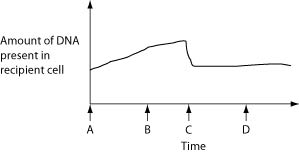
What is occurring at Time C that is decreasing the DNA content?
degradation of DNA that was not retained in the recipient's chromosome
cytokinesis
crossing over
reversal of the direction of conjugation
degradation of DNA that was not retained in the recipient's chromosome
Use the following information and graph to answer the question(s) below.
The figure below depicts changes to the amount of DNA present in a recipient cell that is engaged in conjugation with an Hfr cell. Hfr cell DNA begins entering the recipient cell at Time A. Assume that reciprocal crossing over occurs (in other words, a fragment of the recipient's chromosome is exchanged for a homologous fragment from the Hfr cell's DNA).
During which two times can the recipient accurately be described as "recombinant" due to the sequence of events portrayed in the figure?
during Times C and D
during Times A and B
during Times A and C
during Times B and D
during Times C and D
Use the information in the following paragraph to answer the question(s) below.
A hypothetical bacterium swims among human intestinal contents until it finds a suitable location on the intestinal lining. It adheres to the intestinal lining using a feature that also protects it from phagocytes, bacteriophages, and dehydration. Fecal matter from a human in whose intestine this bacterium lives can spread the bacterium, even after being mixed with water and boiled. The bacterium is not susceptible to the penicillin family of antibiotics. It contains no plasmids and relatively little peptidoglycan.
The cell also lacks F factors and F plasmids. Upon its death, this bacterium should be able to participate in _____.
transduction
transformation
conjugation and transduction
conjugation
transformation
The following question refer to the figure below.
In this eight-year experiment, twelve populations of E. coli, each begun from a single cell, were grown in low-glucose conditions for 20,000 generations. Each culture was introduced to fresh growth medium every twenty-four hours. Occasionally, samples were removed from the populations, and their fitness in low-glucose conditions was tested against that of members sampled from the ancestral (common ancestor) E. coli population.
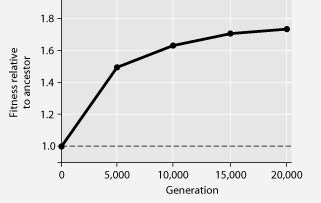
Which term best describes what has occurred among the experimental populations of cells over this eight-year period?
speciation
adaptive radiation
microevolution
stabilizing selection
microevolution
The following question refer to the figure below.
In this eight-year experiment, twelve populations of E. coli, each begun from a single cell, were grown in low-glucose conditions for 20,000 generations. Each culture was introduced to fresh growth medium every twenty-four hours. Occasionally, samples were removed from the populations, and their fitness in low-glucose conditions was tested against that of members sampled from the ancestral (common ancestor) E. coli population.
If the vertical axis of the figure above refers to relative fitness, then which of the following is the most valid and accurate measure of fitness?
number of daughter cells produced per mother cell per generation
amount of glucose synthesized per unit time
average swimming speed of cells through the growth medium
number of generations per unit time
number of generations per unit time
The following question refer to the figure below.
In this eight-year experiment, twelve populations of E. coli, each begun from a single cell, were grown in low-glucose conditions for 20,000 generations. Each culture was introduced to fresh growth medium every twenty-four hours. Occasionally, samples were removed from the populations, and their fitness in low-glucose conditions was tested against that of members sampled from the ancestral (common ancestor) E. coli population.
E. coli cells typically make most of their ATP by metabolizing glucose. Under the conditions of this experiment, as time passed, E. coli generation times should be _____.
faster than in the typical environment
slower than in the typical environment
the same as in the typical environment
slower than in the typical environment
The sea slug Pteraeolidia ianthina (P. ianthina) can harbor living dinoflagellates (photosynthetic protists) in its skin. These endosymbiotic dinoflagellates reproduce quickly enough to maintain their populations. Low populations do not affect the sea slugs very much, but high populations (> 5 x 10⁵ cells/mg of sea slug protein) can promote sea slug survival.
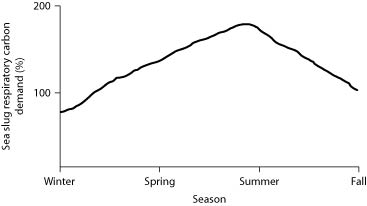
Percent of sea slug respiratory carbon demand provided by indwelling dinoflagellates.
If we assume that carbon is the sole nutrient needed by sea slugs to drive their cellular respiration, then based on the graph, during which season(s) is it LEAST necessary for P. ianthina to act as a chemoheterotroph?
fall
winter
summer
spring
summer
Use of synthetic fertilizers often leads to the contamination of groundwater with nitrates. Nitrate pollution is also a suspected cause of anoxic "dead zones" in the ocean. Which of the following might help reduce nitrate pollution?
using ammonia instead of nitrate as a fertilizer
adding nitrifying bacteria to the soil
growing improved crop plants that have nitrogen-fixing enzymes
adding denitrifying bacteria to the soil
growing improved crop plants that have nitrogen-fixing enzymes
Biologists sometimes divide living organisms into two groups: autotrophs and heterotrophs. These two groups differ in _____.
their electron acceptors
the way that they generate ATP
their mode of nutrition
being prokaryotes vs. eukaryotes
their mode of nutrition
Use the information in the following paragraph to answer the question(s) below.
A hypothetical bacterium swims among human intestinal contents until it finds a suitable location on the intestinal lining. It adheres to the intestinal lining using a feature that also protects it from phagocytes, bacteriophages, and dehydration. Fecal matter from a human in whose intestine this bacterium lives can spread the bacterium, even after being mixed with water and boiled. The bacterium is not susceptible to the penicillin family of antibiotics. It contains no plasmids and relatively little peptidoglycan.
This bacterium derives nutrition by digesting human intestinal contents. Thus, this bacterium is an _____.
aerobic chemoautotroph
anaerobic chemoautotroph
aerobic chemoheterotroph
anaerobic chemoheterotroph
anaerobic chemoheterotroph
While examining a rock surface, you have discovered an interesting new organism. Which of the following criteria will allow you to classify the organism as belonging to Bacteria but not Archaea or Eukarya?
It can survive at a temperature over 100°C.
Cell walls are made primarily of peptidoglycan.
The organism does not have nucleus.
The lipids in its plasma membrane consist of glycerol bonded to straight-chain fatty acids.
Cell walls are made primarily of peptidoglycan.
Which of the following describe all existing bacteria?
extremophiles, tiny, abundant
pathogenic, omnipresent, morphologically diverse
morphologically diverse, metabolically diverse, extremophiles
tiny, ubiquitous, metabolically diverse
tiny, ubiquitous, metabolically diverse
Assuming that each of these possesses a cell wall, which prokaryotes should be expected to be most strongly resistant to plasmolysis in hypertonic environments?
cyanobacteria
extreme thermophiles
extreme halophiles
methanogens
extreme halophiles
Which of the following extremophiles might researchers most likely use as a model for the earliest organisms on Earth?
a bacterium that thrives in a highly acidic environment
a bacterium found on another planet or moon
an archaean capable of surviving in the polar ice caps
an anaerobic archaean species
an anaerobic archaean species
Foods can be preserved in many ways by slowing or preventing bacterial growth. Which of these methods should be LEAST effective at inhibiting bacterial growth?
Closing previously opened containers: prevents more bacteria from entering, and excludes oxygen.
Canning in heavy sugar syrup: creates osmotic conditions that remove water from most bacterial cells.
Refrigeration: slows bacterial metabolism and growth.
Pickling: creates a pH at which most bacterial enzymes cannot function.
Closing previously opened containers: prevents more bacteria from entering, and excludes oxygen.
Broad-spectrum antibiotics inhibit the growth of most intestinal bacteria. Consequently, assuming that nothing is done to counter the reduction of intestinal bacteria, a hospital patient who is receiving broad-spectrum antibiotics is most likely to become _____.
unable to fix carbon dioxide
antibiotic resistant
unable to synthesize peptidoglycan
deficient in certain vitamins and nutrients
deficient in certain vitamins and nutrients