Principles of biomedical science 3.1 review
 Call Kai
 Learn
Learn Practice Test
 Spaced Repetition
 Match
Match Flashcards
 Knowt Play
1/53

Earn XP
Description and Tags
Name | Mastery | Learn | Test | Matching | Spaced | Call with Kai | Chat |
|---|
No analytics yet
Send a link to your students to track their progress
54 Terms
outbreak
A sudden rise in the incidence of a disease
epidemic
regional outbreak of a disease
Pandemic
an epidemic that has spread over several countries or continents
endemic
native or confined to a particular region or people; characteristic of or prevalent in a field
nosocomial infection
an infection acquired during hospitalization
epidemiologist
identifies and treats diseases as they occur in a group of people
infection
Contamination or invasion of body tissue by pathogenic organisms
host
An organism on which a parasite lives.
disease
An abnormal state in which the body is not functioning normally
Pathogen
a bacterium, virus, or other microorganism that can cause disease
microbe
An organism invisible to the naked eye
Prion
protein particles that cause disease
Virus
A tiny, nonliving particle that invades and then reproduces inside a living
Bacteria
single-celled organisms that lack a nucleus; prokaryotes
prokaryotes
A unicellular organism that lacks a nucleus and membrane bound organelles
Protists
A eukaryotic organism that cannot be classified as an animal
Fungi
A kingdom made up of nongreen, eukaryotic organisms that have no means of movement, reproduce by using spores, and get food by breaking down substances in their surroundings and absorbing the nutrients
helminth
A parasitic worm (as a tapeworm, liver fluke, ascarid, or leech).
susceptible host
a person likely to get an infection or disease
Reservoir host
infected organism (usually an animal) which makes the parasite available for transmission to other hosts
chain of infection
infectious agent, reservoir, portal of exit, mode of transmission, portal of entry, susceptible host
indirect contact
Exposure or transmission of disease from one person to another by contact with a contaminated object.
innate immunity
Immunity that is present before exposure and effective from birth. Responds to a broad range of pathogens.
acquired immunity
immunity that the body develops after it overcomes a disease
Antigen
substance that triggers an immune response
T cells
Type of white blood cell that offers protection against microbes
B cell
A lymphocyte that produces proteins (antibodies) that help destroy pathogens. Matures in bone marrow
antibody
a protein made by B cells that works to destroy pathogens
vaccine
A harmless variant or derivative of a pathogen that stimulates a host's immune system to mount defenses against the pathogen
herd immunity
the resistance to the spread of a contagious disease within a population that results if a sufficiently high proportion of individuals are immune to the disease
Morphology
study of form (words)
Metabolism
All of the chemical reactions that occur within an organism
isolation streak
Method used to isolate individual cells on an agar plate
aseptic technique
a method used to prevent contamination with microorganisms
Microbiologist
An expert in microbiology
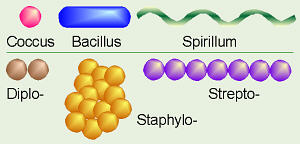
Coccus
round spherical-shaped bacteria
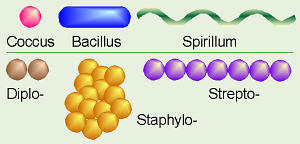
Bacilus
Rod shaped bacteria
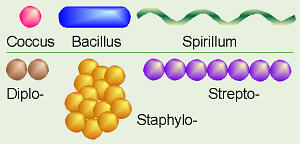
Spirillum (spirilla)
curved or spiral shaped bacteria
peptidoglycan
A protein-carbohydrate compound that makes the cell walls of bacteria rigid
Gram stain
Used to classify prokaryotes based on cell wall composition. Important for antibiotics some antibiotics work on one but not the other.
gram negative
Pink in color
gram positive
Purple color one wall but thicker peptidoglycan
Prokaryote
A unicellular organism that lacks a nucleus and membrane bound organelles
Nucleoid
A dense region of DNA in a prokaryotic cell.
capsule
A sticky layer that surrounds the cell walls of some bacteria
cell wall
A rigid structure that surrounds the cell membrane and provides support to the cell
cell membrane
A cell structure that controls which substances can enter or leave the cell.
Plasmid
a genetic structure in a cell that can replicate independently of the chromosomes
Pili
A hair like appendage found in the surface of bacteria
Ribosome
site of protein synthesis
Flagella
A long, whip-like filament that helps in cell motility. Many bacteria are flagellated, and sperm are flagellated.
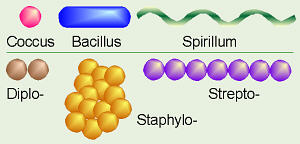
Diplo-
Prefix for colony arrangement; cells are arranged in pairs
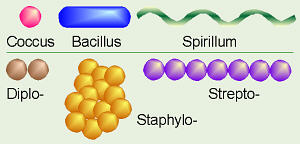
Staphylo-
Prefix for colony arrangement; yellow, round, opaque, large bundles/groups
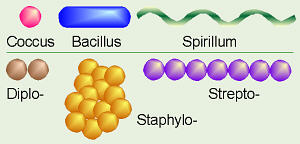
Strepto-
Prefix for colony arrangement; smooth, chain like arrangement