quiz 1 SLOs BIO 152
 Call Kai
 Learn
Learn Practice Test
 Spaced Repetition
 Match
Match Flashcards
 Knowt Play
1/81

There's no tags or description
Looks like no tags are added yet.
Name | Mastery | Learn | Test | Matching | Spaced | Call with Kai | Chat |
|---|
No analytics yet
Send a link to your students to track their progress
82 Terms
Biological molecule
Molecules with carbon as its backbone, made by living organism
Monomer
Smallest unit of biological molecule, single LEGO piece
Polymer
Molecule made of lots of monomers bonded together into macromolecules
Hydrophilic
Water loving
Hydrophobic
Water fearing
Saturated
Max number of bonds hanging off carbon backbone is bonded to hydrogens, forms straight lines
Unsaturated
Form double bond or ring, forms kinked chains
Hydrocarbon
Carbon backbone dominated with hydrogen bonds
Metabolism
Overall sum of input and release of energy in a cell
Anabolic
Rxn needs net input energy
Catabolic
Rxn releases more energy than consumed
Activation energy
Amount of energy that must be added to a Rxn to get Rxn to proceed/start
Substrate
Raw ingredient for rxn
Product
What’s created by rxn
Intermediate
Temporary molecule that is no longer the substrate but is not in finished product, something in between
Enzyme
Background molecule that helps speed up rxn, not consumed (what comes in is what comes out)
Inhibition
Decrease/stop activity of an enzyme
Activation
Turning on ability of an enzyme to carry out a chemical rxn
Allosteric
Binding of a molecule to a protein at a site other than the active site and influences the activity of the protein
Cell membrane
Phospholipid bilayer structure that separates different water based compartments
Intercellular
Inside cell
Extracellular
Outside cell
Amphipathic
Two distinct chemically different regions on the same molecule
Fluidity
Ability of molecules in plasma membrane to move around
Permeability
Measure of how easy it is for molecules to move across a membrane, dependent on membrane structure
Selectively permeable
Only some molecules can move across membrane, allows cells to set up specialized environments
Solute
Molecules in watery environment
Solvent
Liquid component used to dissolve molecules and allow them to move around
Solution
Solute + solvent
Diffusion
Movement of a solute from high concentration to low
Net diffusion
Difference between gradient concentration moving a solute in one direction vs movement in opposite direction
Concentration
Mass of solute/mass of solvent
Osmosis
Net diffusion of water across a membrane
Passive
No extra energy cost to the cell to get solute to move
Active
Costs cell energy to move from high concentration to low
Facilitate
Protein helper involved in movement across membrane
Tonicity
Relative movement of water across a membrane and its effect on the volume of a cell
Crenate
Volume of cell has decreased below normal
Lyse
Cell membrane has ruptured
Turgid
Normal cell size
Cytoplasm
Jelly like substance that fills a cell and is enclosed by cell membrane
Cytoskeleton
Interlinks protein fibers and tubules that extends throughout the cytoplasm, provides structural support
Endomembrane system
Exchange material between intracellular structures within a eukaryotic cell
Endocytosis
Movement of material into the cell in bulk
Exocytosis
Movement of material out of the cell in bulk
Genome
Collection of genetic material passed from parent to offspring
Carbohydrates
Carbon backbone with groupings of hydrates
Function : store energy long term, break bonds into smaller pieces to get energy, and structural support


Lipids
Hydrophobic, generally neutral, structure usually dominated by hydrocarbons
Function : long term energy storage

Protein
Made of long chain of amino acids, nitrogen containing carboxyllic acid group
Function : many, mainly transportation

Nucleic acid
Made of nucleotide monomers, hydrophilic due to phosphates
Ex: DNA, ATP

How is carbon chemically the backbone of biological molecules
Carbon can make 4 strong covalent bonds with itself and other elements making it a good backbone for biological molecules. Carbon to carbon bonds are very strong
Enzymes
Enzymes lower AE of a rxn without changing the free energy and increases the chance of a rxn occurring
What biological molecules make up the cell membrane
Phospholipids : acts as main structural fabric and creates a semi permeable barrier. Forms a double layer of water loving phosphate heads on the outside and water fearing fatty acid tails pointing inward
Proteins : transport molecules across the membrane, acts as receptors for cell signaling and provides structural support
Cholesterol: a type of lipid tucked between phospholipid tails, regulates membrane fluidity, keeps membrane stable and flexible
Carbohydrates : sugar chains attached to proteins or lipids on outer surface of cell
How does the structure of phospholipid influence interactions with water and the formation of bilayers?
Since the phospholipid heads are hydrophilic, they create the outer layer to interact with water and regulate what molecules enter the cell. The fatty acid tails are hydrophobic making up the inside layer which is where proteins and transportation happens
Describe difference between saturated fatty acid tail and unsaturated fatty acid tail.
Saturated fatty acid tail will have two equal/similar looking legs, unsaturated fatty acid tails will have one kinked tail looking like a k
Describe different types of membrane proteins and their functions
Transport proteins: move small molecules across membrane
Receptor proteins: binds/receives molecule messages from other cells
Integral protein: can’t be removed from membrane without destroying the membrane, spans across membrane
Peripheral proteins: sits of surface of membrane and can be removed without destroying
Identify 2 functions of cholesterol in the plasma membrane
Regulate fluidity and maintain structural stability
Identify typical structure and functions of eukaryotic plant cells and animal cells
Plant cells have a cell wall, eukaryotic cells do not.

Describe structures and functions of cytoskeleton
Provides structural support, shape, and internal organization
What are catabolic and anabolic rxnx and how do they contribute to cells metabolism
Catabolic: release energy
Anabolic: take in energy
Overall cell metabolism = catabolic + anabolic
Describe ATP and the ATP cycle
ATP: Stores and carries energy around cells
ATP cycle: the process in which living cells use break down and regenerate ATP
Induced fit model
Enzyme changes shape when substrate binds and becomes activated
Explain how enzyme catalyzed rxns are controlled
Enzyme activation: turning on ability for enzyme to carry out rxn (binding of substrate or other activators)
Enzyme inhibition: decrease/stop activity of enzyme (binding of products that block active site, exposure to less optimal environment)
Identify the difference between enzyme catalyzed rxn vs metabolic pathways
Enzyme catalyzed: single chemical step, sped up rxn
Metabolic pathway: sequence of steps working together to form product
Explain how metabolic pathways are controlled in cells
Allosteric binding: binding of molecule to a protein at a site other than the active site
Explain why hydrophilic molecules require transport proteins but hydrophobic molecules do not
Hydrophilic molecules require proteins because they are water loving and polar which inhibits them from passing through the water fearing middle layer
What is membrane fluidity, give examples of things that can change fluidity
Membrane fluidity: how easy it is for molecules in a membrane to move
Factors that can effect fluidity: heat makes molecules move faster making membrane more fluid, chill takes away molecules energy slowing them down making membrane less fluid
Describe difference between passive and active transport
passive: no extra energy is used
Active: cellular energy is consumed
Compare and contrast the two types of diffusion
Simple diffusion: does not need protein to move across a membrane
Facilitated diffusion: solute moves across membrane with help of protein
Identify the two ways water/solutes can move across cell membrane
Passive and active transport
Describe osmosis
Osmosis: net diffusion of water across membrane (water moves from low concentration to high concentration)
Describe active transport
Solute moves from low concentration to high concentration, uses cellular energy, always facilitated
Describe endomembrane system
Exchange material between intracellular structures within a eukaryotic cell
Identify what is meant by membrane permeability
How easy it is for molecules to pass through a membrane
What does it mean for a membrane to be selectively permeable?
Only some molecules have the ability to move across a membrane
When and why do we use tonicity?
Determines the direction and extent of water movement across a cells semi permeable membrane. Used to track water shifts between fluid compartments, prevents cellular damage (cell swelling or shriveling)
Describe advantage of having many membrane bound compartments inside a cell
Prevent conflicting chemical rxns, increase metabolic efficiency, isolate dangerous materials
Compare and contrast role of cell membranes vs cell walls
Membranes: selectively permeable barrier, separate intracellular and extracellular
Walls: extracellular structures, main role is strength and support of cell
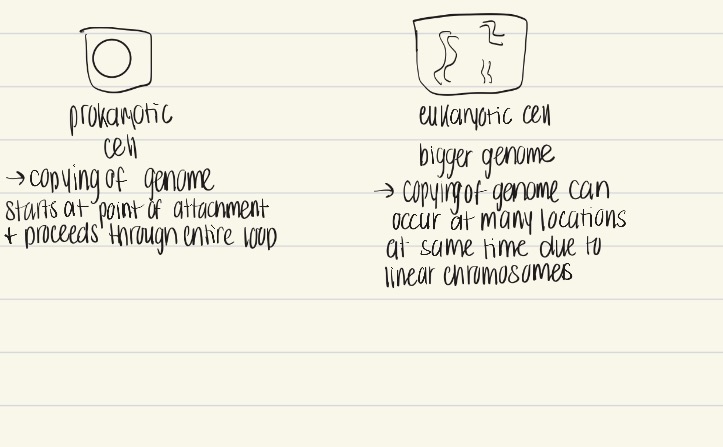
Explain how eukaryotic genome differs from prokaryotic genome
Eukaryotic: bigger genome, copying of genomes can occur at many locations at the same time
Prokaryotic: smaller genome, circular shape so copying of genome can only occur in a single cycle starting at point of attachment and continuing throughout the loop
Microfilaments
Made of actin, provide structural support, allows cell to change shape and move
Microtubules
Provide track where vesicles can move through the cell
Intermediate filaments
structural support, holds everything in place