SCIENCE
 Call Kai
 Learn
Learn Practice Test
 Spaced Repetition
 Match
Match Flashcards
 Knowt Play
1/97

Earn XP
Description and Tags
syllabus point
Name | Mastery | Learn | Test | Matching | Spaced | Call with Kai | Chat |
|---|
No analytics yet
Send a link to your students to track their progress
98 Terms
Qualitive
uses the 5 senses to observe ( touch, smell, taste, hear, sight)- descriptive
Quanatitve
uses numbers and measurements- numerical- recorded through graphs both line and column.
observation
Includes information that's been acquired through any of the senses.
independent
change (cause)
dependent
measure (effect)
Archimedes Principle
He found out that the amount of water displaced = volume of a subject
Submerged the crown in water to measure the volume & used it to determine if its density was equal to gold.
Density = mass
Volume
Alexander Flemings
He left his petri dish containing cultural bacteria poorly sealed & went on holidays
Once he came back he observed that mould (penecillin) had grown
The area around the mould was free of bacteria
He isolated the mould & tested with different bacteria & found the cause effect.
It was Australian scientist Howard Florey who succeeded in separating and purifying the penicillin antibiotic.
Galileo Observations:
While viewing Jupiter through his homemade telescope, he saw what he thought were 3 fixed starts in a line through the planet
After a month of observations he found out that it was 4 objects and that they were orbiting jupiter
This led to the observation that contested the traditionally cosmology idea that there was one centre of motion in the solar system.
He soon learnt that the stars were actually the moon.
Firestick Farming
Adapted by the Aboriginal and Torres strait island peoples.
Firestick farming is the same as modern day back burning.
It was used to reduce the risk of bushfires, increase the amount/ diversity of food, heat from fire, increased germination of seeds, ash used as fertilizer, fresh vegetation attracted animals, also flushed out animals, used to make paths.
Bush Medicines:
Used by Indigenous and torres strait islander peoples included:
Tea Tree Oil: Crushes leads and applied the paste to wounds as antiseptic, it was also used as brewing for throat ointments
Eucalyptus Oil: Infused for body pains, fevers & chills, can also be used as an antiseptic directly on the skin.
Emu Bush: leaves were used to wash sores and cuts, occasionally being gargled, also used as antiseptic.
Random Errors
Reduces the reliability
Will shift each from its try value by a random amount or direction
They can be eliminated or reduced through repetition and averaging
Systematic Errors
Reduces the accuracy
Shift measurements from their true value by the same amount & same direction all the time
Usually aries from the equipment, to eliminate them use calibrated equipment to eliminate any zero or parallax errors.
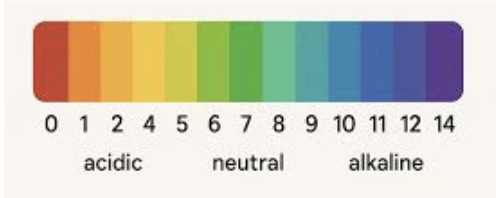
PH scale
Inference
Is the conclusion you arrive at based on evidence
Wonky Holes
One way the underground water ( fresh water) flows into the ocean
They are high nutrients & therefore home to rich areas of fish & supplies them with food & fresh water
Submarine freshwater springs found along the great barrier reef
Attract large numbers of fish & are throughout to act as nursery
Collision theory
Chemical reactions can only take place when the reacting particles collide with each others
The collisions must have sufficient energy
Role of chemical reaction is determined by the frequency of successful collisions
Particles in solution can only react with particles on the surface of the solid
The rate of a reaction increases when we increase the surface area of a solid.
Surface area to volume ratio
Smaller sized blocks of solid reactant have a greater surface area to volume ration than larger blocks
Therefore they have more particles on the surface so there are more collisions per second
This increases the rate of reaction
Why are secondary resources important in primary investigations?
Scientific investigations require support
Allows scientists to build on knowledge
Can direct future investigations
Prevents research that has already been completed from being repeated
Cave formations & chemical reactions:
Limestone caves form from erosion due to carbon dioxide in water
Caves form in limestone (calcium carbonate) & occasionally in dolomite (calcium magnesium carbonate), when water containing dissolved carbon dioxide seeps into rock crevices & joints
Secondary sources data can be used after a primary investigation to:
Validate & check if your original explantation is correct
To see if our explanation is relevant in the investigation
To gain a deeper understanding of what scientific principles are at work
To open up new areas of interest, new question, future investigations
Apply & see relevance to other areas of life & science
Making inferences
All scientific investigations require evidence to support their findings
Scientists can challenge the reasoning underpinning the inferences drawn from observations in previous studies and go on to test them
This has the potential to establish an alternative of the evidence and overturn flawed conclusions
Develop inquiry questions
By other scientists & find gaps in the research where questions have not been fully answered to
Construct suitable hypotheses:
Developed by making a proposition about how the independent variable and the dependent variable relate to one another (cause & effect).
By reviewing the research a scientist can determine which variable and their relations to other variables have been tested in the past, how these variables may relate to a potential inquiry question and which variable may not have been tested.
Reasons to consult research:
To learn from the research methods of other scientists to improve validity, & reliability
To avoid unnecessary investigations by seeing what investigations have been conducted in the past
To make inferences from the research by learning from the work of other scientists
To develop inquiry questions by determining which questions have been answered & which haven't
To construct hypotheses to test variables that may have been identified in the research
Fractals in nature:
made by a simple repeating process that can produce shapes of infinite complexity eg/ pyramids
useful in modelling structures & identifying patterns in some phenomena that appear irregular
Fibonacci sequences (irregular):
Is a sequence of numbers that goes 1,1,2,3,5,8,13,21…
Each number is the sum of the two numbers before it
Some plants exhibit the pattern like branches of trees, succulents and spider webs
The aurora australis (irregular):
Light emitted when the upper atmosphere is hit by energetic charged particles, especially electrons from the solar wind, which travel along the earth's magnetic field lines.
When these electrons collide with oxygen and nitrogen, the gases emit light, producing mainly greens, red and violet colours
type 1 error
when a hypothesis is incorrectly accepted
type 2 error
when a hypothesis is incorrectly not accepted
Paradolia
The tendency to interpret a vague stimulus as something known to the observer eg/ seeing faces in objects or patterns
Cognitive processes are activated by the face life object which alerts the observer to both the emotional state & identity of the object before the conscious mind processes the information
Optical Illusion:
We have evolved to recognise patterns, often our brains cannot help but we see things that aren't there, even if we’re aware of them
They are a result of our brain taking ‘shortcuts’ in order to interpret information quickly
Regression analysis
statistical process of establishing the relationship between variables
Data outlier
data point distant from other observation & measurements that may indicate an error
correlation
refers to how closely related two sets of data are (variables)
Inverse correlation
opposite ion directing, means there is an inverse relationship between two variables
Regression analysis (r)
is a statistical analysis of the relationship between two variables
Correlation coefficient
the strength of the correlation, is described using an r value between -1 to 1
Miasma
The Miasma theory was the belief that diseases were caused by “bad air or noxious vapour”.
Francesco Redi
(1626-1697) was an Italian Physician whose work contributed significantly to disproving Aristotle's spontaneous generation theory.
In 1668, Redi performed one of the first experiments to falsify the concept that maggots spontaneously generate on meat that was left out in open air.
John Snow
During the Cholera outbreak in 1854 John Snow discovered another way to disprove the spontaneous generation theory through the discovery that diseases were transmitted through sewage contaminated water, rather than through miasma.
After this observation, Snow removed the handle of the water pump leading to the contaminated water, therefore forcing the individuals in the area to find water from a less contaminated source.
Louis Pasteur
Louis Pasteur’s work involving the swan neck experiment in 1862 was one of the most pivotal contributions to disproving the spontaneous generation theory as it helped introduce the germ theory through scientific evidence.
He designed the necks of the flasks like this to allow air inside the flasks to be exchanged from the air outside, but it prevents the introduction of any bacterial particles that could find its way to the sterile liquid, as they would get stuck inside the bend of the flask's neck.
Robert Koch
a German physician and microbiologist, discovered through experiments that certain microbes are the cause of specific diseases.
In 1884, Koch isolated the cholera-causing bacterium, where he developed a technique to grow the pure culture and proved that a specific bacterium directly caused disease.
Phlogistion theory: origional assumption
Phlogiston would be released & absorbed in the air, setting the object on fire
Need of oxygen for combustion as the fuel required to keep a flame burning believed to be the phlogiston, was constantly being released
Scientist that debunked Phlogistion assumption
He studied the gain or loss of weight when tin, lead, phosphorus, & sulfur underwent reactions of oxidation or reduction. He noticed that the heated metal increased in weight which opposed the belief that the mass of the metal should decrease in the form of released phlogiston.
Radioactivity
Also known as radioactive decay or nuclear decay, is the process by which an unstable atom emits radiation
There are 3 types → alpha,beta & gamma
People to be included:
Dalton
X-rays → Wilhelm Conrad Roentgen
Rutherford (1899)
Barquel
Marie Currie
origoinal assumption for atmospheric pollution
Greenhouse gases from human activities are not the most significant driver of observed climate change since the mid 20th century
scientist who debunked atmoshperic pollution
Called it Hiatus Dr Richard Millar of Oxford university, said this update on earlier estimates suggested that “we have a little more breathing space then previously thought & we can meet ambitious Paris climate change agreement goal to limit global temperatures rise to 1.5C by 2100 ( but only if the country stops using coal”
Generalisation
Taking something specific & applying it more broadly
Taking 1 or more facts & making a broader, more universal statement
assumptions
Something you assume to be the case without proof
Is a thing that's accepted as true and certain to happen without proof
correlations
Process of establishments a relationship between two or more things
peer
a person who works either directly or indirectly with you
collaboration
has a number of benefits over competition or working alone when trying to find the answer to inquiry questions that otherwise would have been next to impossible to answer. Formed as a result of the shared goals of the scientists involved
benefits of collaboration
Increased efficiency
Cross-discipline research
International research
Developed capacity of young scientist
Crosschecking & alternative perspectives
Reduces bias & errors
steps in peer review
Scientist study something
Scientists write article about their results
Journal editor receives an article & sends it out for peer review
Peer review reads the articles and provide feedback for the editor
If an article finally meets editorial & peer standards its published in a journal
benefits of collaboration
Decreasing effects of bias
More money involved
A range of expertise
Larger studies
scientific consensus
the collective judgement positions & opinions of the community of scientists in a field od study through peer review, communication & debates
Limitations of understanding
Development of technology
Lack of historical records
Financial support
atmoic element
The periodic table includes 118 elements
The periodic table is set out according to
- atomic mass
- Periods (rows)
- Groups (columns)
Richard feynmaium
a noble price winning physicist who worked in quantum physics, proposing that neutral atoms cannot exist beyond element 137
His prediction is based on mathematical calculations & the Bohr election orbital model of the atom, which describes the nucleus of an atom having substantial size, yet the number of possible elements is still unknown.
Hubble constant
expanding universe, the further something is away from you, the faster its receding. Using new generational instruments like the Hubble telescope, astronomers have since reduced any uncertainty in the Hubble constant, preceding a more accurate value.
ATSI & BIAS
The biases & assumptions of the European settlers that saw indigenous societies as inferior due to an apparent lack of science, economy & organised religion, or at least one that they could easily recognise. The result was the ATSI peoples were dismissed as nomadic hunter-gatherers & considered a part of flora & fauna, rather than humans with a rich culture that practised advanced agriculture & land management techniques over tens of thousands of years
Cultural bias
Every culture has differences in the way they perceive, do things & understand the natural world
European culture tends to have the most scientists, therefore a cultural bias has been created leading other perspectives or methods from different cultures to be ignored or overlooked.
European bias against Aboriginals
Europeans had little regard for the intelligence, or ability of indigenous societies to maintain complex agricultural or sustainable practices. It's only recently that we have understood & appreciated these:
Recycling harvest waste → compost
Controlled burning → firestick farming
Using plants for medicable purposes
Harvesting grain & yams
scientific models
developed to help people understand scientific concpets & represent them in a visual medium. They are used to make predictions & may include physical & digital models. Models can be refined overtime by the inclusion of new scientific knowledge
Advantages of scientific models
Useful for large or small things (cells, solar system)
Very intricate & complex concepts
Processes or occurrences that happen very slowly or very quickly (evolutions)
Making predictions based on past & present information (climate change)
They are constantly evaluated for accuracy by the scientific community by using peer reviews (collaborations)
Limitations of scientific models
|
Types of model: Diagrams
are the most basic of scientific models, they’re visual representations of our understanding, they can vary in their complexity due to detail (3D/2D), whether they’re scaled or labelled EG/ Nohr model of an atom, plant/animal cell.
They are easy to understand, show structure & relationships, quick to communicate ideas.
Although they AREN’T to scale & cannot show details
Types of models: Physical Replicas
used to represent the very large or very small. Models can be scaled to show relative sizes. The models can also be created so that they function in a way that mimics a real process EG/ DNA structure, body
They can be touched & manipulated, help visualise 3D objects, good for demonstrations.
Although, they might NOT be to scale, expensive, time consuming & may oversimplify
Types of models: Analogies
used to make comparisons between a familiar idea with a less familiar idea. Science uses analogies to simplify more difficult concepts & build an understanding by connecting it to an already established idea EG/ water pump representing electrical system
Makes complex ideas easy to understand by comparing them with similar things
Although they AREN'T always exact & leads to misconceptions
Types of models: Mathematical
used to represent an idea or phenomena. We can use equations to determine the likelihood of an event occurring or as a way to measure a relationship between two variable EG F=ma, population growth
They have accurate predictions, analyse patterns, tests variables, handles large amounts of data
Although it DEPENDS on accurate data & assumptions, may not include real world factors,
Type of model: computer simulations
the increase in the processing power of computers has allowed us to calculate more complex scenarios, improving the reliability of our models. Consider situations where there are many variables to play & require large amounts of calculations which modern computers are able to be more effective EG/ Climate & weather forecasts
They stimulate dangerous or expensive situations, process data quickly, easily changed
Although it DEPENDS on the programing data which may not represent reality
endemic
a disease that is generally found among particular people or in a certain area eg/ malaria
epidemic
a widespread occurrence of an infectious disease in a community at a particular time eg/ black plague, small pox NOT WORLD WIDE
Pandemic
an infections disease that is found worldwide eg/ covid
SIR MODEL
is a mathematical model of epidemics.
S in SIR model?
susceptible. The number of people who aren't infected, although they aren't immune to it.
I in SIR model?
infected or infectious. People that are infected with the disease & can transmit the disease to susceptible people.
R in SIR model?
recover. People who have recovered from the disease & are immune, so they ant be infected with the disease
Big Bang theory
Is the most accepted theory for the origion & evolution of the universe
In the beginning the universe was thought to have been concentrated into a single point of immense energy. An explosion within the first split second converted some of this energy to the simplest form of matter particles such as quarks which are the building blocks of protons & neutrons.
Evdience for Big Bang: Doppler effect
evidence that the universe is expanding is based on measuring the movement of the stars & galaxies away from the earth using the (fib). Changing pitch is sound waves & can be seen in light as well.
Evidence for the Big Bange: Red shift
the black lines or missing colours in the spectra of stars are shifted from their expected position. A shift to the lower or red frequencies is called a red shift & results from a star movement away from the earth
Evidence 2 for Big Bange
the abundance of hydrogen & helium
Evidence 3 for Big Bang
cosmic background radiation. Engineers are trying to track communication satellites picking up on a consistent radio noise they can't get rid of. It was the microwave background radiation. It was the discovery of this that put an end to the steady state theory.
Steady State theory
That the universe has always existed & that the universe is expanding & constantly creating matter as the universe expands
Geocentric model
The Sun, Moon, planets and stars orbit Earth. Proposed by Aristotle
Heliocentric model
The planets (including Earth) orbit the Sun. The Moon orbits Earth. Proposed by Galileo
Democritus
first proposed the idea that everything is made up of atoms. Since the first proposals, scientists have developed a series of more accurate & detailed models to help understand the nature & predict the behaviour of atoms & matter.
Bohr model of an atom
applied mathematics & physics principles to chemistry, influencing Rutherford's experiment & developing the Bohr model of the atom. This model, supported by physics experiments & theoretical explanations, is considered accurate & still studied in chemistry today.
development of climate models
Climate is the average weather & climate models are the basis of how the global climate model works.
There is always some uncertainty in models but their reliability can be tested against real data
Using models to understand humans impacts: current climate models stand up to testing against past data well & strongly suggest that human-caused greenhouse gas emissions are causing the increased warming we are seeing
climate models
Developments in climate change understanding including Tydal’s greenhouse effect proposal in 1861 & advanced computer models have enabled refining of climate change predictions
Global coding was considered a possible issue in the future, two different models with two different out comes: → global coding & global warming
greenhouse effect
CO2 is absorbed infr-red heat (radiation) into the atmosphere which is known as the greenhouse effect
Evidence that helps refine/update climate models:
Spectrograph → used to demonstrate absorption of infa-red heat into the atmosphere by CO2
Isotope analysis → CO2 released from fossil fuels; increased atmospheric levels
Deep- sea core → showed shorted cycles in global climates, suggesting the climate is more responsive to small challenges in atmospheric composition,
Advantages of SIMPLE models
They convey very specific information without any illusion to being representations of the real world meaning that people typically understand when they have limited predictive capacity
They’re usually quicker to build, easier to implement, easier to interpret & to update
Application of the model is generally very easy
Increased level of transparency → can easily find where they go wrong
Limitations of SIMPLE models
Very limited in capacity to predict the real world
Trade off between generality, precision & realism
Advantages of COMPLEX models
The predictive capabilities of complex models allow for the easy prototyping of structures & systems without the expenses of constructing & trailing something in the real world. EG/ when designing a new aeroplane, complex models allow for virtual prototyping of hundreds of designs before going to the expense of building it in the real world.
Limitations of COMPLEX models
The algorithms used to build the model can be subject to unknown or unrecognised sources of bias, & people may assume it is truly representative of the real world when it may not be
Reduction in clarity → it’s not easy to ask simple questions of these models, a lot of variables must be included to get an answer & peripheral variables could be having more influence than necessary
They are costly to build, interpret, & implement in both time, money & computing power.
Model of scientific concept
Before constructing a model you should understand the concept you are modelling to develop an accurate & effective model (background research)
Planning your research/ mindmap
Appropriate representation: need to think about the types of model that will best facilitate the purpose of the model. Consider the audience
Demonstrate a prediction → a useful model has predictive power: for a complex climate model this means considering variables & being able to adapt to changes in data. For a simpler model like a physical model of the respiratory system, this may mean being able to see what happens with different gases or what happens if a lung is punctured
Feedback strategies: scientists give each other feedback through PEER REVIEW. This allows us to improve our ideas
Example → physical model & analogy model of the respritory system
respiratory system model
Concept → the respiratory system & how the lungs expand & contract
Benefits → allows students to visualise & interpret with the model. Can adjust variables to make predictions. Can be made to scale to give a sense of size
Limitations → can’t show microscopic structures. Time consuming. NOT 100% ACCURATE