DEFINING READING
 Call Kai
 Learn
Learn Practice Test
 Spaced Repetition
 Match
Match Flashcards
 Knowt Play
1/71

There's no tags or description
Looks like no tags are added yet.
Name | Mastery | Learn | Test | Matching | Spaced | Call with Kai | Chat |
|---|
No analytics yet
Send a link to your students to track their progress
72 Terms
Why is reading considered a culturally learned ability?
Humans are not biologically predisposed to read. Unlike spoken language, reading does not develop naturally; it must be taught and learned.
Why is reading a complex process?
Because it involves multiple processes working together, including word recognition, comprehension, background knowledge, inferencing, memory, and strategies.
What are the main purposes for reading?
Searching for simple information, skimming, learning, integrating information, reading to write, critiquing texts, and general comprehension.
What are the characteristics of fluent reading?
Fluent reading is rapid, efficient, interactive, strategic, flexible, evaluative, purposeful, comprehending, learning-oriented, and linguistic.
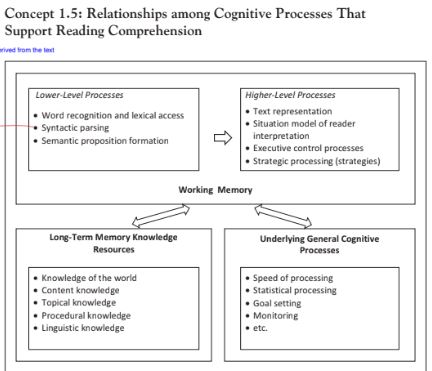
What are lower-level processes?
They are relatively automatic linguistic processes: word recognition and lexical access, syntactic parsing, and semantic proposition formation.
What are higher-level processes?
They involve constructing a representation of the text, developing a situation model, using background knowledge and inferences, applying strategies, and monitoring comprehension.
What is lexical access?
It is recognizing a word and accessing its meaning. For fluent readers, this happens rapidly and automatically.
Why is automatic word recognition important?
It reduces the cognitive effort needed to recognize words, leaving more resources available for comprehension.
What is syntactic parsing?
It is processing grammatical and structural information to determine how words and clauses are organized and contribute to meaning.
What is semantic proposition formation?
It is combining word meanings and syntactic information to form basic meaning units at the clause level.
What is a text representation?
It is the reader’s developing mental representation of the meaning expressed by the text.
How are main ideas formed during reading?
Ideas are connected as reading continues. Repeated or strongly connected ideas remain active, while less useful ideas gradually fade.
What is a situation model?
It is the reader’s interpretation of the text that incorporates the text’s meaning with their background knowledge, goals, attitudes, and purposes.
What is the difference between text representation and situation model?
Text representation concerns the meaning expressed by the text, while the situation model involves interpreting that meaning in relation to the reader’s knowledge, goals, and perspective.
Why is background knowledge important?
It helps readers connect new information with what they already know and contributes to constructing an interpretation of the text.
How can background knowledge cause problems?
If background knowledge is incorrect or incomplete, it can lead to incorrect interpretations of the text.
What is working memory?
It keeps information and cognitive processes active while reading, allowing readers to connect new information with what they have already processed.
Why is processing speed important?
Information remains active in working memory for a limited time, so it needs to be processed quickly enough to be integrated before it fades.
What is comprehension monitoring?
It is checking whether the text is being understood and, when necessary, adjusting strategies or repairing comprehension.
What are general cognitive processes?
They are cognitive abilities that support reading but are not specific to reading, such as working memory, long-term memory, inferencing, attention, processing speed, cognitive flexibility, and self-regulation.
What is implicit learning?
It is learning that occurs without conscious awareness and includes learning patterns and associations through processes such as statistical and associative learning.
How does reading purpose affect reading processes?
Different purposes emphasize different processes. For example, searching emphasizes word recognition, while reading to learn emphasizes building an accurate text representation and situation model.
What does reading to learn involve?
It involves constructing an accurate representation of the text, developing a strong interpretation, and connecting the information with existing or revised background knowledge.
What does reading to integrate information involve?
It involves determining which information is important, evaluating relationships among information, and deciding how it should be combined.
Why is reading a linguistic process?
Because readers must process the language of a text in order to understand and interpret its meaning.
What is the main idea of the chapter?
Reading is a complex process in which linguistic, cognitive, and comprehension processes interact, with different processes receiving greater emphasis depending on the reader’s purpose.
What is a clause-level meaning unit?
It is a basic unit of meaning formed from the information in a clause. The reader combines word meanings with syntactic information to construct this unit, which can then be connected with other ideas in the text.
What is a clause?
In this context, a clause is a grammatical unit that contains information that contributes to the meaning being constructed during reading. The reader processes the words and their grammatical relationships to form a clause-level meaning unit.
What is semantic proposition formation?
It is the process of combining word meanings and syntactic information to create basic meaning units at the clause level. These units are then integrated into the developing understanding of the text.
What is lexical access?
Lexical access is retrieving the meaning of a word when it is recognized. In fluent reading, this process becomes rapid and largely automatic.
What is syntactic parsing?
Syntactic parsing is processing the grammatical structure of a sentence so that the reader can determine how its words and clauses are related and contribute to meaning.
What is word recognition?
It is recognizing the written form of a word. When recognition becomes automatic, the reader can access the word’s meaning without using much conscious effort.
What is a text representation?
It is the reader’s developing mental representation of what the text means. It is built by connecting the meaning units and ideas encountered during reading.
What is a situation model?
It is the reader’s interpretation of the text that incorporates the text’s meaning with their background knowledge, goals, attitudes, and purposes.
What is the difference between a text representation and a situation model?
A text representation focuses on the meaning expressed by the text, while a situation model incorporates that meaning into the reader’s broader interpretation using their knowledge, goals, and other relevant resources.
What is background knowledge?
It is knowledge already stored in the reader’s long-term memory that can be connected to new information in the text. It helps the reader interpret and integrate what they are reading.
What is an inference?
It is a connection or understanding that the reader constructs when information is not directly provided in the text. Inferences help connect new meaning with the text and with related knowledge.
What is working memory?
It is the system involved in keeping information and cognitive processes active while reading. It allows readers to work with new information while connecting it to information already being processed.
What is long-term memory?
It is the memory resource that contains knowledge available to the reader, including background and linguistic knowledge, which can be activated during reading.
What is comprehension monitoring?
It is checking and evaluating whether the text is being understood. It can involve focusing attention, recognizing comprehension problems, and adjusting strategies or repairing understanding when necessary.
What is strategic processing?
It is using reading strategies according to the reader’s goals and comprehension needs. It can involve adjusting how one reads, monitoring comprehension, and dealing with comprehension problems.
What is executive control?
It refers to cognitive control processes that help readers direct attention, monitor their understanding, evaluate their success, and regulate their reading.
What is automaticity in reading?
It means that certain reading processes become rapid and require little conscious effort. This allows cognitive resources to be used for higher-level comprehension.
What is implicit learning?
It is learning that occurs without conscious awareness of exactly what is being learned. It includes learning patterns and associations through processes such as statistical and associative learning.
What is statistical learning?
It is a general cognitive learning process involved in detecting patterns and regularities in information. The chapter connects it with implicit learning.
What is associative learning?
It is a general learning process through which information becomes connected through associations. The authors identify it as one mechanism involved in implicit learning.
What is chunking?
It is a general cognitive process involved in organizing information into meaningful patterns or units. The authors connect chunking with implicit learning.
What is processing speed?
It is the ability to process information rapidly. In reading, it is important because information in working memory needs to be processed and integrated before it fades.
What is cognitive flexibility?
It is a general cognitive ability that supports mental processing and allows cognitive activity to adapt as needed. The authors identify it as one of the general cognitive abilities involved in reading.
What is selective attention?
It is the ability to focus attention on relevant information during cognitive processing. In reading, attention supports comprehension and monitoring.
What is self-regulation?
It is a general cognitive ability involved in controlling and regulating one’s own cognitive processes. The authors identify it as one of the abilities supporting reading comprehension.
What are lower-level processes?
They are relatively automatic linguistic processes involved in constructing meaning from written language: word recognition and lexical access, syntactic parsing, and semantic proposition formation.
What are higher-level processes?
They are comprehension processes involving text representation, situation-model construction, strategic processing, background knowledge, inferencing, and executive control.
What are general cognitive processes?
They are cognitive abilities that are not specific to reading but support reading comprehension, such as working memory, attention, processing speed, inferencing, cognitive flexibility, and self-regulation.
What is knowledge about the word?
This refers to the knowledge a reader has about individual words, which is connected to lexical knowledge and long-term memory. When you recognize a word, you need to be able to access its meaning. The chapter connects lexical access with vocabulary knowledge and explains that our verbal knowledge is reflected in our lexical knowledge.
What is content knowledge?
It is knowledge about the subject matter or content being discussed in a text, which the reader can draw on during comprehension.
What is topical knowledge?
It is knowledge the reader already has about the specific topic of a text, which can help with understanding and interpreting new information.
What is procedural knowledge?
It is knowledge about how to carry out a process or procedure
What is linguistic knowledge?
Linguistic knowledge is knowledge about language, including verbal/lexical and syntactic knowledge. It allows readers to process the linguistic information in a text.
What are strategic processes in reading?
They are processes readers use to manage comprehension according to their goals, such as monitoring understanding, adjusting strategies, making inferences, and repairing misunderstandings.
What is inhibitory control?
It is a general cognitive ability that helps control or inhibit information or responses that are not relevant to the current task.
Why is speed of processing important for reading?
It allows information and reading processes to be handled rapidly enough for different pieces of information to be integrated during comprehension.
What is self-regulation?
It is the ability to regulate one's own cognitive processes and learning, helping the reader manage comprehension and other mental activity.
What is selective attention?
It is the ability to focus attention on relevant information while reading and comprehending a text.
What is attention shifting?
It is the ability to redirect attention from one piece of information or process to another when needed during reading.
What is cognitive flexibility?
It is the ability to adjust one's cognitive processing when the demands of a task change.
What is goal setting in reading?
It is establishing goals for reading and, when necessary, reassessing or adjusting those goals as comprehension develops.
What is consolidation in reading?
Consolidation refers to the process involved in learning and storing information so that it becomes part of longer-term knowledge
What is the drive for coherence?
This is the reader’s tendency to try to make the information in a text fit together into a coherent understanding. The reader connects different ideas in the text with each other and with relevant background knowledge. The strength of this drive can depend on the reading purpose: when readers have a higher standard of coherence, they put more effort into making sure details are integrated into a coherent understanding.
What is phonological awareness?
Phonological awareness is the ability to be aware of and process the sound structure of language. In the chapter, it is one of the abilities involved in lexical access. Before a reader can efficiently access a word’s meaning, word recognition involves processes such as phonological awareness, orthographic knowledge, letter-sound correspondences, and meaning activation.
What is timing integration of multiple processes?
It is the ability to coordinate multiple reading and cognitive processes at the right time so that information can be rapidly integrated into comprehension.