Reagents for Final
 Call Kai
 Learn
Learn Practice Test
 Spaced Repetition
 Match
Match Flashcards
 Knowt Play
1/17

Earn XP
Description and Tags
Key reagents to products
Name | Mastery | Learn | Test | Matching | Spaced | Call with Kai | Chat |
|---|
No analytics yet
Send a link to your students to track their progress
18 Terms
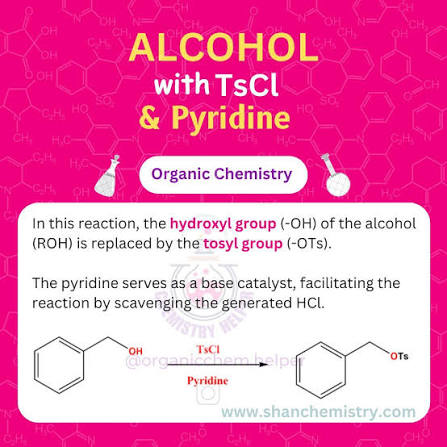
TsCl, pyridine
Product: Alcohol, Tosylate R-OH, R-OTs (OH is a bad leaving group, OTS is a great leaving group, only changing the leaving group
TsCl, pyridine
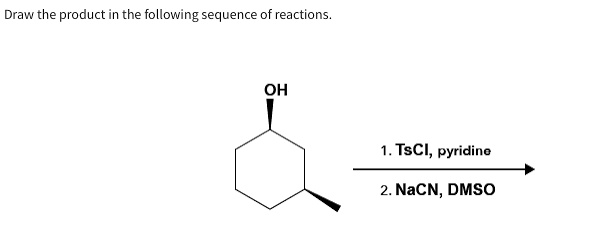
NaCN
R-OH—> R- CN (SN2 major, inversion. CN replaces OTS TsCl makes a good leaving group → CN attacks.
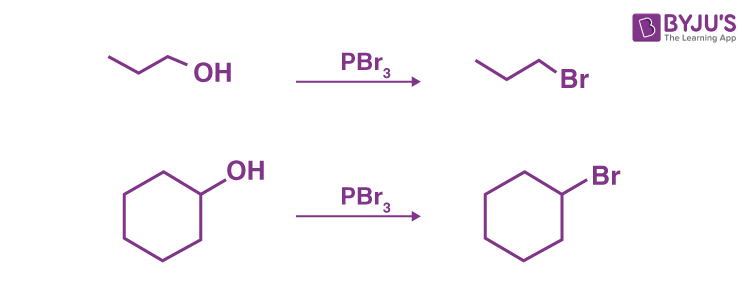
PBr3
R-OH—> R- Br (substitution, SN2, inversion of stereochem, no carbocation forms
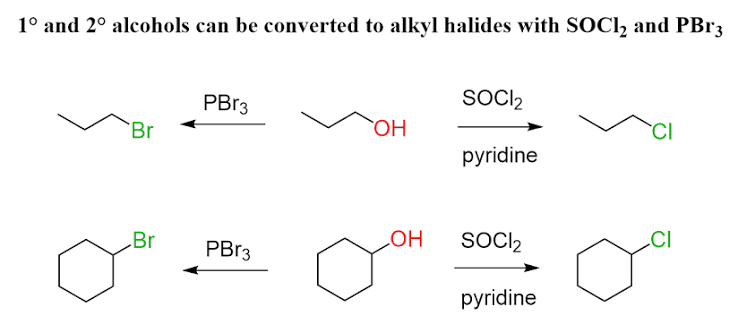
SOCl2
R-OH—> R-Cl (substitution, produces alkyl chloride, major product only
R: HX so any halogen (HCl, HBr, HI)
tert alcohol—> tert bromide (Usually SN1 (especially tertiary alcohols)
Adds H + X
X goes to the more substituted carbon
H goes to the less substituted carbon
Markovnikov
No stereoselectivity
Carbocation intermediate, so rearrangements are possible
Acid (H2SO4 or h30+) AND heat
OH—> Alkene + H20 (E1, possible carbocation rearrangments, forms more substituted (Zaitsev) alkene as major product
Lots of water
OH favored (Le Chaterlier’s principle) water pushes equilibrium toward alcohol
Heat
Alkene favored, heat removes water (shifts equilibrium toward elimination
OH ALONE
poor LG, Usually won't undergo SN1/SN2/E1/E2 until OH is converted into a better leaving group (like OTs or H2O).
1.BH₃·THF
H2O2, NaOH
alcohol (hydroboration-oxidation)
Adds H + OH
OH goes to the less substituted carbon
H goes to the more substituted carbon
Anti-Markovnikov
Syn addition
No rearrangements
OSO₄, H2O2 or KMnO₄, NaOH
Vicinal diol TWO OH groups on neighboring groups
One OH goes on each former alkene carbon.
Adds OH + OH
Syn addition
No regioselectivity because both groups are OH
The slides say you do not need the mechanism
H2 ·Pd. Pt. Ni
Alkane (adds H to each alkene carbon)
Adds H + H
Removes the π bond
Syn addition
No regioselectivity
Acid catalyzed hydration H20, H+, H30+
Alcohol (OH)
Adds H + OH
OH goes to the more substituted carbon
H goes to the less substituted carbon
Markovnikov
No stereoselectivity: syn and anti products may form
Carbocation intermediate, so rearrangements are possible
HBr, ROOR, heat or light
Alkyl Bromide
Adds H + Br
Br goes to the less substituted carbon
H goes to the more substituted carbon
Anti-Markovnikov
No stereoselectivity
Radical mechanism
This special peroxide effect applies to HBr
X2 (Br₂, Cl₂)
Vicinal dihalide
That means one halogen is added to each of the two former alkene carbons.
Adds X + X
Anti addition
No regioselectivity because both groups are identical
Forms a halonium-ion intermediate
No carbocation rearrangements
X2, H2O (Br₂, H₂O or Cl₂, H₂O)
Halohydrin
One alkene carbon receives OH, and the other receives X.
OH goes to the more substituted carbon
X goes to the less substituted carbon
Anti-addition
No rearrangements
Hg(OAc)₂, H₂O
NaBH₄
Oxymercuration-demercuration
Alcohol
Adds H + OH
OH goes to the more substituted carbon
H goes to the less substituted carbon
Markovnikov hydration
According to these class slides, the new H and OH bonds are treated as anti
No carbocation rearrangements because a mercurinium ion forms instead of a free carbocation
Hg(OAc)₂, ROH (CH3OH)
NaBH₄
Alkoxymercuration-demercuration
Ether:
Adds H + OR
OR goes to the more substituted carbon
H goes to the less substituted carbon
Markovnikov
Anti relationship according to the class treatment
No rearrangements
For methanol, the group added is OCH₃.