Binomial Heaps
 Call Kai
 Learn
Learn Practice Test
 Spaced Repetition
 Match
Match Flashcards
 Knowt Play
1/21

There's no tags or description
Looks like no tags are added yet.
Name | Mastery | Learn | Test | Matching | Spaced | Call with Kai | Chat |
|---|
No analytics yet
Send a link to your students to track their progress
22 Terms
Priority Queue Abstract Data Type
Object: Set S of elements with “keys” (“priority”) that can be compared
Operations: Insert(S,x), Max(S), Extract_Max(S)
What operation does Priority Queue ADT can’t do?
Union(Q1, Q2)
What data structure does ordinary priority Queue use?
Data type: Min-heap
Give min heap complecity for insert, min, extract min, union
O(logn)
O(1)
O(logn)
N/A
Data structure of mergeable priority Queues
Min binomial heap
Min binomial heap runtime for insert, min, extract min, union
O(logn)
O(logn)
O(logn)
O(logn)
Binomial trees vs Binomial Forest
k is number of nodes to create 1 tree
k is n is number of total nodes for collection of distinct tress
How to create Bkth binary tree?
Take all the tress from {bk-1, …b1, b0} trees, attach a root node on top of them
Number of nodes per each depth of binomial tree
Binomial Coefficent (k choose choose depth)
Binary tree (Bk) properties

Binomial Forest Fn (size n)
Sequence of Bk trees with strictly decreasing k’ s and a total of n node
Binary Forest Properties
n nodes
n = <bt, bt-1, .. , b0> number of bits
has a(n) tress [# where bit is 1]
edges = n - a(n)
Min Binomial Heap (size n)
Each node in Fn stores one element
Each bk in forest is min heap ordered (Min-Heap property)
Min-Heap property
Parent is smaller than or equal to priority of children
Only valid for the whole path; not necessarily subtrees
Binomial Tree facts
1 key comparison for 1 binomial heap edge
Binomial Heap for n elements can be built in O(n) key-comparisons; going in order of S
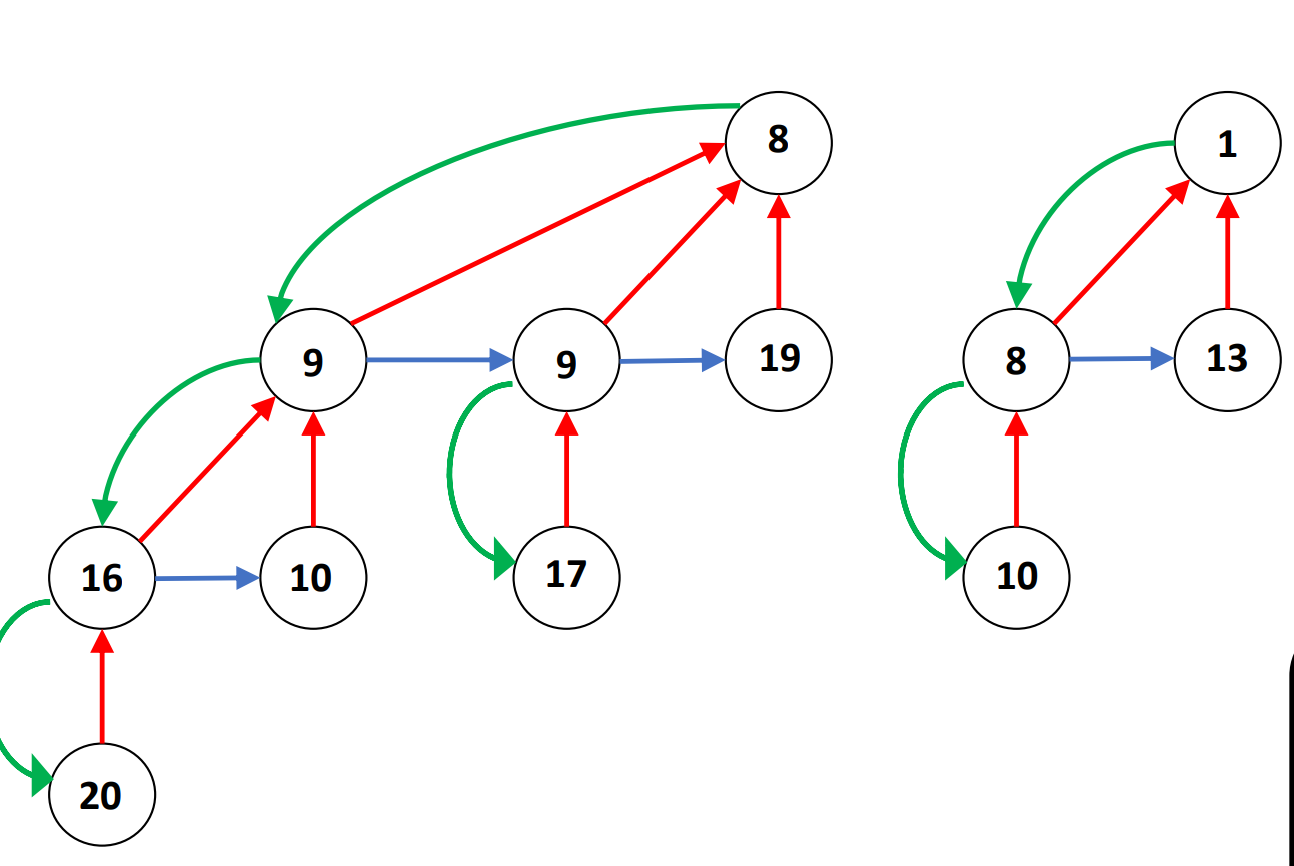
Explain these arrows. Why is it this way?
Green - left child pointer
Blue - right child pointer
red - parent pointer
Want atmost 3 pointers per node.

Where is head?
the root of B0
keys vs edges
Keys are stored valued in nodes
edges are connecting 2 nodes together in bk
Lemma 1 of binary tress
Can merge two min heap-ordered Bk trees into a single min heap-ordered Bk+1 tree with just one key comparison
Lemma 2 of binary trees
Deleting the root of a min heap-ordered Bk tree gives a min binomial heap
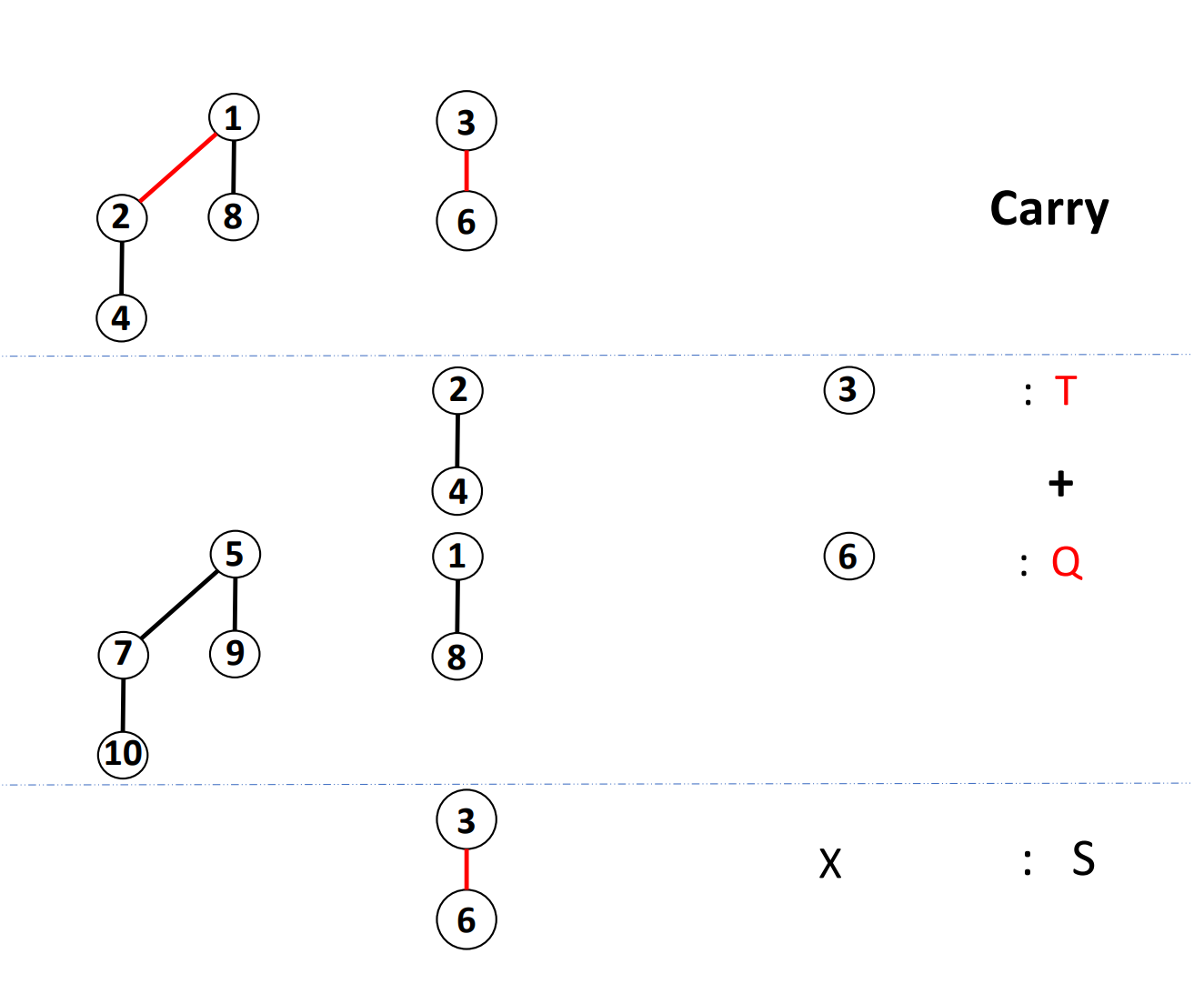
Explain what is going on in picture
When you add 2 binary heaps, you add each b0, b1, .., bk trees. The top shows carry and bottom is the new b0,…bk trees (which uses lemma 1 to combine root)
WC complexity of union(P,Q)
If each tree has atmost <= n nodes.
By fact and lemma 1 → we have atmost O(logn) trees each for p and q
Thus O(logn) key comparisons.