language acquisition week 1
 Call Kai
 Learn
Learn Practice Test
 Spaced Repetition
 Match
Match Flashcards
 Knowt Play
1/31

There's no tags or description
Looks like no tags are added yet.
Name | Mastery | Learn | Test | Matching | Spaced | Call with Kai | Chat |
|---|
No analytics yet
Send a link to your students to track their progress
32 Terms
How many natural human languages do you estimate are in current daily use in the world?
7100 languages
True or False: Any normal child growing up in any language environment will master the local language, even if they are blind or deaf?
True where even children who are blind, deaf, or neurologically impaired may develop language well
True or False: Adults are better at learning languages than children
False: Normal adults have difficulty achieving competence, let alone fluency, in a second language, despite greater cognitive sophistication than children and explicit instruction in classrooms
Language Landmarks: 0-3 Months
coo
burp
Language Landmarks: 3-6 months
• Cooing • Laughs • Cries • Gurgles • Recognizes name
Language Landmarks: 6-9 months
• Babbling • Turn-taking • Gestures ( Waving • clapping )
Language Landmarks: 9-12 months
• Pointing • Jargon • First words around 12 months
Language Landmarks: 12-18 months
• Learning 2 words/week • 50 words @ 18 mo. • Imitates words • Names for body parts, animals, etc.
Language Landmarks: 18 -24 months
• Talking about here and now • Follows simple commands • Loves stories, songs • Start combining words
Language Landmarks: 2-3 years
• 500 Words • Asks Questions • Past tense • Grammatical words (in, on, etc) • Produces many sounds clearly
Language Landmarks: 3-4 years
• 800 Words • Can follow simple plots • Time words: morning, afternoon, today • Some speech sounds still distorted
Language Landmarks: 1st grade
• 10,000 spoken words • Fewer words in reading & writing
Language definition
A system made up of different modules (components) that interact with one another
• phonology • morphology • syntax • semantics • pragmatics
Morphology (morpheme)
the smallest unit of meaning units in language
ex: cat_s (2 morp)
ex: runn_ing
Phonology & Phonetics: phonemes
the smallest unit sound in a language that can change the meaning of a word
phonetics: how we combine sounds
semantics vs pragmatics
semantics: literal meaning
pragmatic: meaning in context
e.g. “It’s fine”
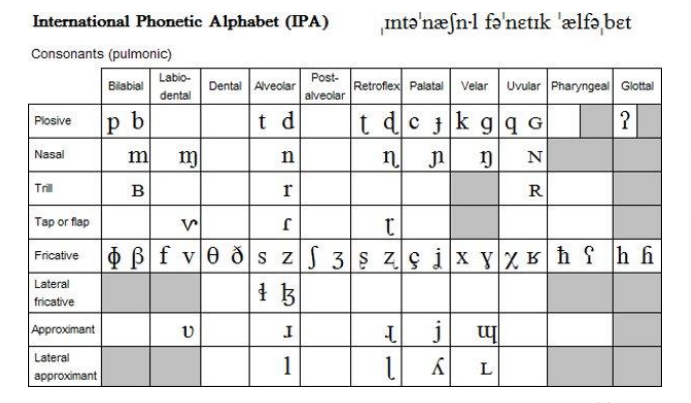
be able to describe this chart
mention of fricative
syntax
• Order and arrangement of words in phrases and sentences
• Combinations of subject, verb, object
what is the most common syntax order
subject object verb - like korean!
semantics
• Study of meaning and sense
• Words, phrases, sentences, and larger
• Mental dictionary = lexicon (KNOW THIS)
• Word relations and awareness

Pragmatics
• Language use in context
• Intentions (Denial, refusal, blame, flattery, labeling, demand)
• Politeness rules are culturally dependent
True or False: There are more than one method of communication
True, language is only ONE method of many communication ones
language vs communication
there could be communication without language (doggy?)
because language is a method of communication
FINISHEEEEHAFHSKJFLKSHLAKHwhat distinguishes language and communication
textbook: 3 features (Brown, 1973)
hockett (1960)
debunked language is sound (sign language)
doesnt have to be all 5
arbitrariness
aka semanticity or symbolism
arbitrary nature of language symbols make it possible to represent abstract concepts and imaginary ideas
ex) whale is big but word is short / microbiomes long but very small
stop sign - iconic (not arbitrary)
onomatopoeia - non arbitrary sounds
grammatically
ensures that communication of meaning is precise
GO ____ HOUSE
away? in? to?
Displacement
language is not limited to talking about the here and now
past and future
abstract concepts like feelings!
duality of patterning:
small # of meaningless sounds that, when combined in many ways, yield unlimited # of meaningful words and sentences
human language structures
two levels of structure
meaningful elements (words/morphemes)
word-internal meaningless elements ( phonemes)
english = 44 sounds