Atomic Structure unit 1 chemistry
 Call Kai
 Learn
Learn Practice Test
 Spaced Repetition
 Match
Match Flashcards
 Knowt Play
1/30

Earn XP
Description and Tags
IH chemistry Plano East Senior High
Name | Mastery | Learn | Test | Matching | Spaced | Call with Kai | Chat |
|---|
No analytics yet
Send a link to your students to track their progress
31 Terms
Who first proposed that matter was made of tiny particles called atoms?
Democritus
What did Democritus mean by “atom”?
Indivisible

Who developed the Billiard Ball Model?
John Dalton
What was Dalton's model of the atom?
A solid, indivisible sphere (“billiard ball”).
What part of Dalton's theory was disproven by isotopes?
That all atoms of the same element are identical.
What did J.J. Thomson discover?
The electron.

What was Thomson's atomic model called?
The Plum Pudding Model
What did Rutherford discover?
The nucleus.
What experiment did Rutherford perform?
The Gold Foil Experiment.

What did Bohr propose?
Electrons exist in specific energy levels around the nucleus.

What did Schrödinger's model introduce?
Electron clouds/orbitals where electrons are likely to be found.
What did Chadwick discover?
The neutron.
Which particle has almost no mass?
electron
what particle has about 1 AMU
protron and neutron
What does frequency measure?
The number of waves per second.
What is a photon?
A particle of light/electromagnetic radiation.
What happens to energy when frequency increases?
Energy increases.
What is an orbital?
A region where an electron is likely to be found.
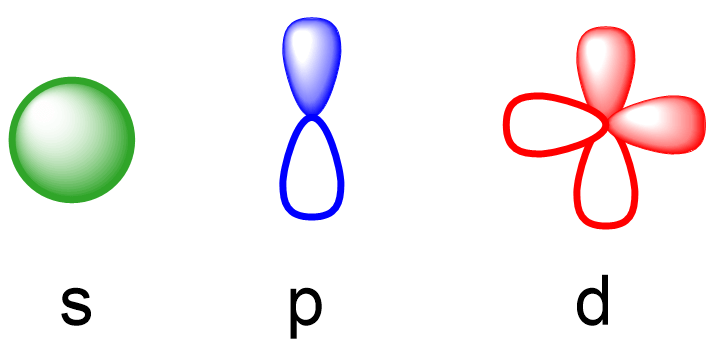
s orbital shape + electrons?
Sphere, 2 electrons

p orbital shape + electrons?
Dumbbell, 6 electrons

d orbital shape + electrons?
Daisy/four-leaf, 10 electrons
Aufbau Principle?
Fill lowest-energy orbitals first.
Hund's Rule?
One electron in each orbital before pairing.
Pauli Exclusion Principle?
Maximum 2 electrons per orbital, with opposite spins.
What are isotopes?
Same element, different number of neutrons.
What is atomic mass?
Weighted average of the isotopes.
What is an ion?
An atom with a charge because it gained or lost electrons.
Lose electrons → ?
Positive (anion)
Gain electrons → ?
Negative (cation)
What determines the element?
Number of protons
What does isoelectronic mean?
Same number of electrons