L17- introduction to nerve cells and excitability
 Call Kai
 Learn
Learn Practice Test
 Spaced Repetition
 Match
Match Flashcards
 Knowt Play
1/11

There's no tags or description
Looks like no tags are added yet.
Name | Mastery | Learn | Test | Matching | Spaced | Call with Kai | Chat |
|---|
No analytics yet
Send a link to your students to track their progress
12 Terms
what are neurons
they are specialised cells in the nervous system that transmit information throughout the body
the most common type is the motor neurons
the majority of them are found int he brain and the spinal cord
they aren’t able to regenerate
they are classified by their function or their shape
neuron structure
describe the movement of signals
the signals go from the dendrites its then processed in the cell body then its moved through the axon
after the information is processed and released in the synaptic terminals
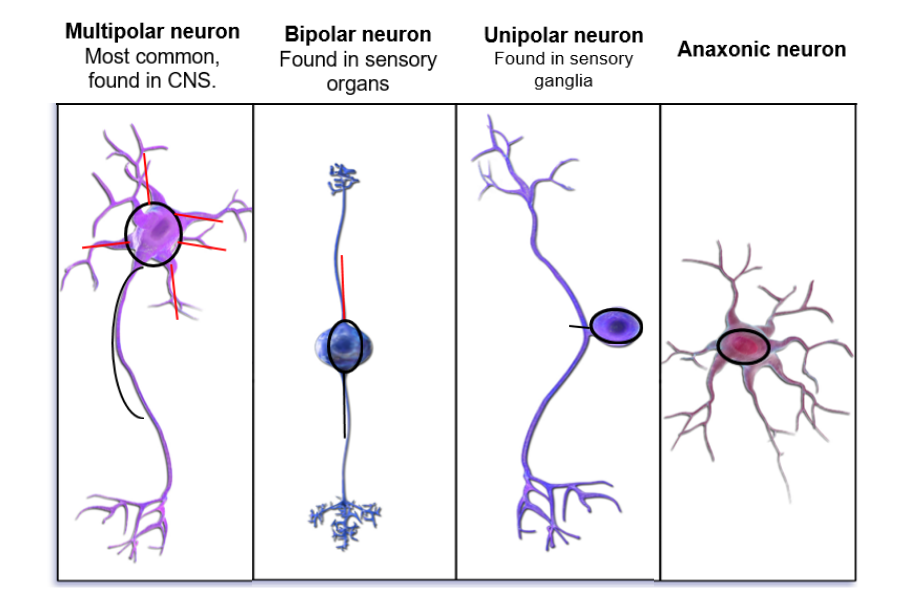
describe how you classify neurons
draw a circle around the cell body of the neurons
then draw how many dendrites are present
if you have one axon then many dendrites its a multipolar neuron
if you have one cell body with one dendrite and one axon its a bipolar neuron
if you have one cell body with one projection its unipolar
what are the three types of neurons and their functions
afferent ( sensory )= transmits signals to the CNS
efferent ( motor )= sends commands from the CNS to the muscles/glands
interneurons= processes information within the CNS
what is meant by-” neurons are excitable cells”
they can generate electrical signals in response to stimuli
what is the resting membrane potential
it is the electrical charge difference across the membrane of a neuron when a signal isn’t being sent
the inside is more negative then the outside
explain how the membrane controls ion movement
all cells have a outer phospholipid bilayer that regulates what charged ions or proteins enter as its selectively permeable
so only specific ions are able to enter and leave through channels and pumps
describe how ions move across a membrane
they move across a membrane using channels and pumps
in channels the ions diffuse down a concentration gradient from high concentration to low concentration
in pumps the ions are moved against concentration gradient
and they can be used to gradient and they require ATP
explain how sodium-potassium pumps maintain excitability/ resting potential
the sodium-potassium pump moves 3Na+ out for every 2 k+ that goes in the membrane
the resting potential is -70Mv
The sodium voltage gated ion channels are all closed allowing no sodium ions to renter the membrane whilst some potassium ions are able to leak back through their channel
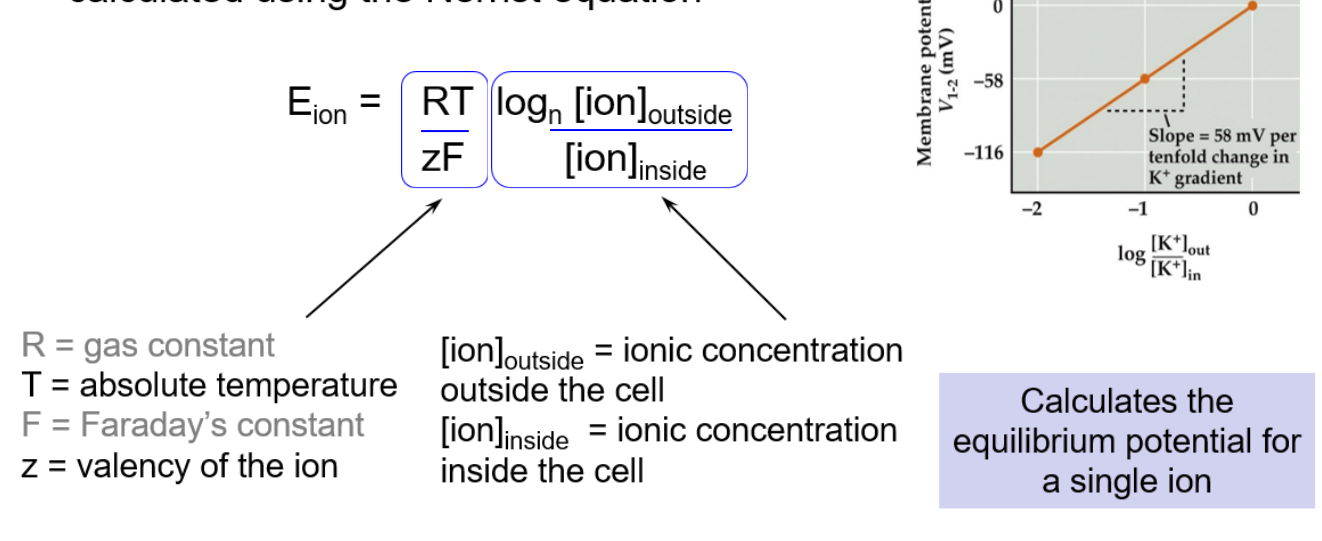
how do you calculate the equilibrium potential for any ion ( Eion ) nernst equation
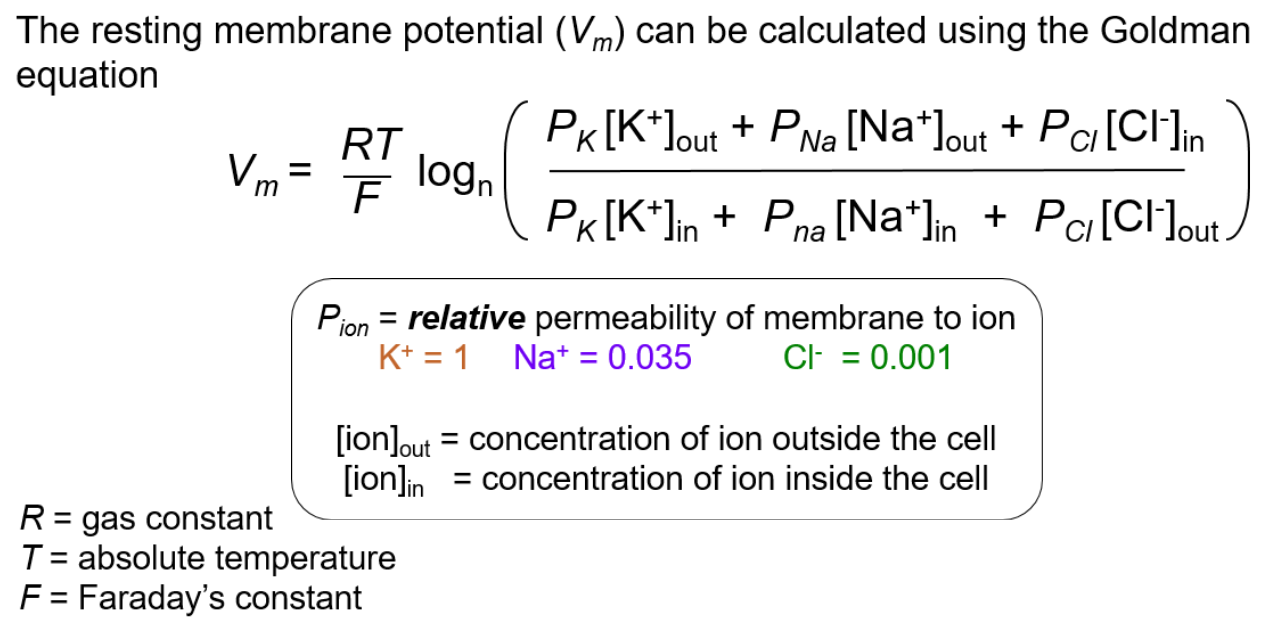
how do you calculate the resting membrane potential Vm