Studying Brain Lesions
 Call Kai
 Learn
Learn Practice Test
 Spaced Repetition
 Match
Match Flashcards
 Knowt Play
1/50

There's no tags or description
Looks like no tags are added yet.
Name | Mastery | Learn | Test | Matching | Spaced | Call with Kai | Chat |
|---|
No analytics yet
Send a link to your students to track their progress
51 Terms
Lesions: Accidental Experiments - Phineas Gage
Railroad tamping rod blown through his skill lesioning his frontal cortex
recovered extremely quickly
but was left with some long-term personality changes
1848
Paul Broca
1861
described two patients who had lost the ability to speak after lesions to the left posterior inferior frontal gyrus
“tan” - man could utter only the syllable “tan”; but, could understand language and follow simple verbal commands
Carl Wernicke
1871
hypothesized the role of the left posterior superior temporal gyrus in receptive language
Wernicke’s aphasia - ability to interpret spoken language is affected, but ability to produce spoken language fluidly is intact
associated with damage to a posterior portion of the left hemisphere at the junction of the temporal and parietal lobes
Modular vs. distributed cognitive processing
modular: Fodor (1985) —> a portion of a processing system is dedicated to a single function not performed elsewhere within that system (each part of the brain has complete control over a specific function)
distributed: Lashley (1929) —> the nature of cognitive deficits following brain damage hinged not on which region of the brain was destroyed but rather on the extent of the damage: the larger the amount of tissue destroyed, the greater were the decrements in performance
mass action - all the processes of the brain contribute to all functions
Double Dissociations
occurs when lesions have opposite effects on two distinct cognitive functions
ex. one brain lesion causes a disruption in Cognitive Function A but not Cognitive Function B, whereas a different lesion causes a disruption in Cognitive Function B but not Cognitive Function A
we can infer that the functions can be independent
Broca’s aphasia versus Wernicke’s aphasia —> the ability to produce speech and the ability to comprehend speech are distinct
HM
1953
bilateral medial temporal lode resection for intractable epilepsy
loss of ability to encode any new episodic memory
procedural learning intact (e.g., mirror drawing)
What type of memory is used for this task?

Animal Lesion Studies
creating legions
monkeys: object recognition (Gross et al. 1972), attention (Moran and Desimone, 1985), and memory (Mishkin, 1982)
advantages: better control over environmental factors, size and nature of lesions, previous life experience
single-cell recordings - electrode put into brain and experimenter records the electrical output of the cell/cells contacted by exposed electrical tip

Limitations of studying lesions
we cannot directly observe the function performed by the damaged portion of the brain (only how the rest of the brain performs without that portion)
only identifies the regions of the brain critical to a given cognitive function (not the entire set that may participate)
brain can “mask” the damage: if brain damage destroys a region that participates but is not critical to the performance of a function, behavior can appear to be more or less intact, because other brain regions can act to take over or support that function
the effects of damage may be masked if people utilize a new strategy for performing a task, one that relies on intact rather than damaged areas
Hemispheric Specialization
the difference in processing between the hemispheres
the hemispheres of the brain are distinct yet connected —> hemispheres have some fundamental differences, but many cognitive processes are redundant and can be carried out by both hemispheres
left and right hemispheres
sagittal view reveals the commissures, the large white-matter fiber tracts that connect the hemispheres
corpus callosum: largest fiber tract in the brain
connects more than 250 million axons
2 smaller brands of fibers: the anterior and posterior commissures

Contralateral Information Processing
sensory information from the eyes, ears, and rest of the body is sent to the opposite hemisphere
motor information sent out to the body also comes from the opposite hemisphere
there is also ipsilateral information processing, but less common
Left Hemisphere
sequential analysis: systematic, logical interpretation of information
interpretation and production of symbolic information: language, mathematics, abstraction and reasoning
detail processing
making sense of things (“Interpreter”)
Right Hemisphere
holistic analysis: processing multi-sensory input simultaneously to provide “holistic” picture of one’s environment
nonverbal and spatial skills
face recognition, music
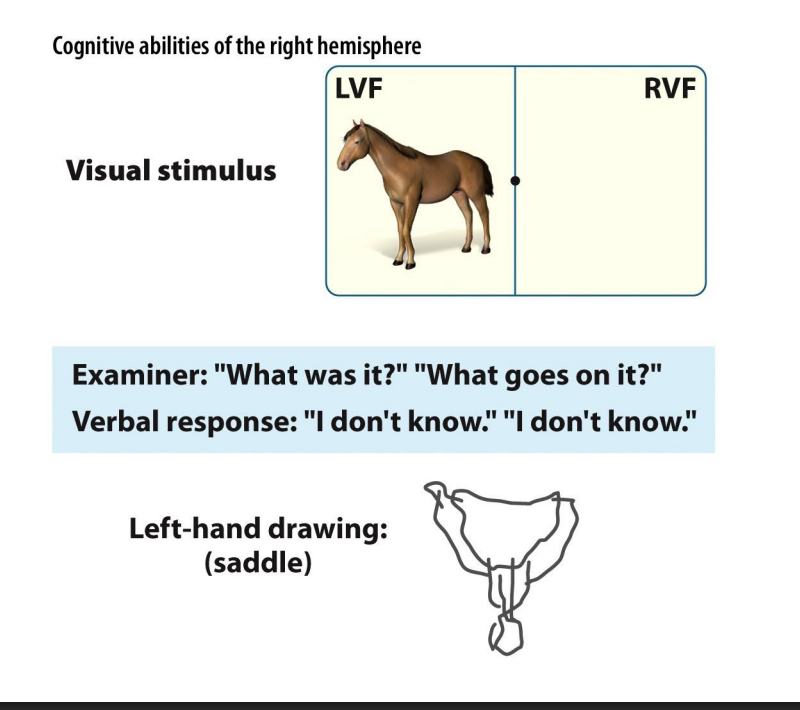
right hemisphere is mute
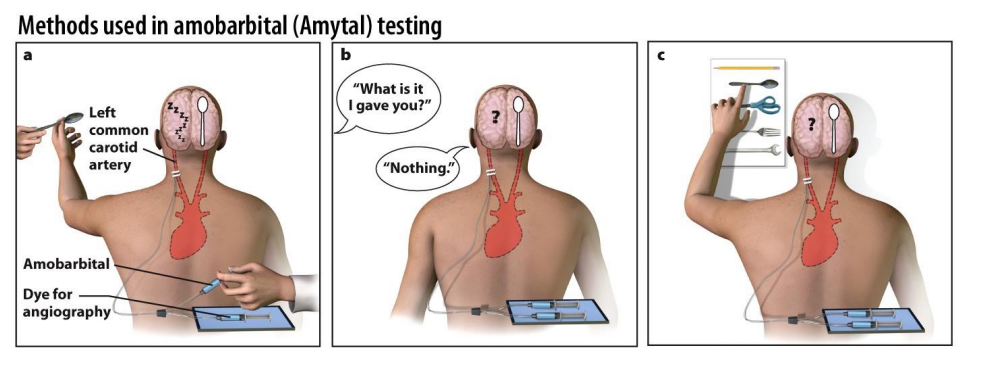
Wada Test
Intracarotid sodium amobarbital procedure (ISAP) is used to determine which side of the brain controls language function and how important each side of the brain is for memory function.
Amobarbital is administered to the left hemisphere through the carotid artery, anesthetizing that hemisphere.
Split Brain
For images in the left visual field or objects felt with left hand
cannot name of describe objects
for visual stimuli, patients often say that they don’t see anything
For images in the right visual field or objects felt with right hand
patients can easily name objects
repeat numbers or words
Left Hemisphere: Interpreter

Right Hemisphere: Unable to draw inferences

Right Hemisphere: Mute
Sperry
in split-brain objects felt by a given hand are perceived exclusively by the contralateral hemisphere (right - left, and vice versa)
patients were able to name the objects placed in the right hand, but not those placed in the left
the right hemisphere can demonstrate its knowledge of the object non-verbally even though it is mute
Right Hemisphere: Spatial Task
split-brain patients asked to view chimeric faces (faces composed of two different sides) —> asked to point to the face shown —> accuracy much greater with left hand than right
also held for abstract forms
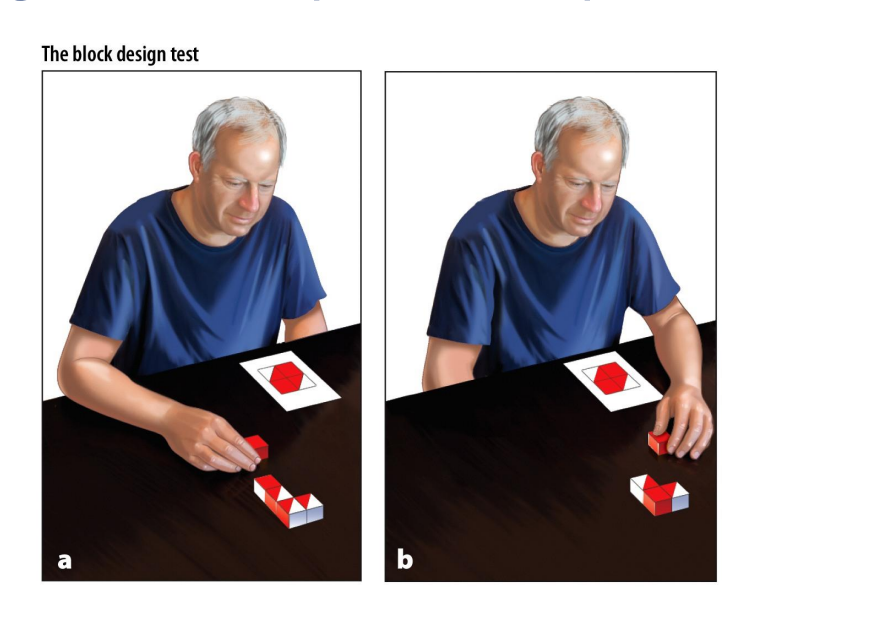
the hemispheres have two distinct modes of processing that provide complimentary information about the world
left hemisphere appears to process information in a piecemeal and analytical fashion, with a special emphasis on temporal relationships
ex: performance of the left hemisphere on face recognition could be improved by focusing on details of the face
right hemisphere processes information in a gestalt and holistic fashion, with a special emphasis on spatial relationships
Right Hemisphere: Face Recognition
right hemisphere specialized in detecting upright faces and discriminating among similar faces
left hemisphere is better at recognizing self, and right hemisphere is superior to recognizing familiar other
Facial Expressions
The neural pathways that control voluntary and spontaneous facial expression are different.
The neural networks for spontaneous expressions involve older brain circuits (same in chimpanzees).
Voluntary expressions that can signal intention have their own cortical networks in humans and are controlled by left hemisphere.
Callosal Function Specificity
Posterior
visual information, auditory, tactile information
Anterior
transfer of higher-order semantic information without access to sensory information
Lesion Method
if damage to a particular brain region —> inability to perform a specific mental function, scientists assume that the function must have depended on that brain region
led us to conceptualize the brain as composed of different modules
module - a portion of a processing system that is dedicated to a single function not performed elsewhere within that system
important because it allows a specific region of tissue to be directly linked to a specific aspect of mental processing (allows for cause and effect inferences)
Localization of Function
modules are often located in specific regions of brain tissue
Broca
today, although we know that mental functions are localized in the brain, we also know that no brain region acts in isolation
localization of function vs mass action
different brain regions are responsible for different functions
vs
all pieces of brain contribute to all functions
Single-Case versus Group Studies
single case - we cannot be sure that the pattern observed for a single person is representative of people in general
group studies - people within the group can be quite heterogeneous along a number of dimensions
—> multiple-case-study approach: allows researchers to determine variability across group and the degree to which the overall group average typifies the behavior of those within the group
when a relationship between damage to a specific brain area and deficits is discerned despite variations in populations and differences in the nature of the damage, it is likely to be robust
Disconnection Syndrome
behavioral deficits that are caused by damage to white matter tracts that connect disparate brain regions
ex: conduction aphasia, split-brain procedure
Conduction Aphasia
a person has a specific difficulty in repeating back what has just been said
white matter tracts that connect Broca’s and Wernicke’s area are disrupted
Split-Brain Procedure
severs the primary route by which the left and right cerebral hemispheres interact, thereby splitting the brain in half
servers the corpus collosum (one of the brain’s commissures - structures that connect the hemispheres)
when the hemispheres are disconnected, information is essentially trapped within a single hemisphere
in animals - optic chasm was also severed (by severing the optic chiasm, visual input from a given eye was directed just to the ipsilateral hemisphere)
in humans - to control intractable epileptic seizures
Divided Visual Field Technique
method devised because only corpus callosum (not the optic chiasm) is severed for human epileptic treatment
participant is told to maintain fixation on a central point
information is presented laterally from midline for 200 ms or less (since it takes about 200 ms to move one’s eyes)
—> when information was presented visually to the left hemisphere, the right hemisphere was clueless to what it had just seen, and vice versa
Wada Technique
used to determine which hemisphere is responsible for speech output in patients
sodium amobarbital is injected into one of the carotid arteries that lead from the heart to the brain
because blood supply from the heart to the brain is unilateral, the barbiturate initially anesthetizes only one hemisphere
if the person is mute and unable to speak, the anesthetized hemisphere is inferred to be involved for speech output
revealed left-hemisphere is dominate for speech (in 95% of right-handers)
Does the right hemisphere have any language at all?
Yes, but:
cannot control speech output
cannot understand complicated grammatical constructions
vocab is limited to concrete words
unable to break words down into their constituent sounds (phonologic processing), which is required to determine whether two words rhyme
Right hemisphere lesion effects
disrupt many spatial and visuospatial abilities
poor at making judgements about line orientations
difficulty recognizing objects that are not in a standard or canonical form
poor at distinguishing between faces that were previously viewed and those that were not
difficulty distinguishing different pitches of sound or tones of voice
cannot interpret the emotional expression of faces
Research with Neurologically Intact People
general logic of these experiments is to pit the hemispheres in competition with one another and see which excels —> accomplished by info to each hemisphere simultaneously or separately
visual —> divided visual field technique
auditory —> dichotic presentation
perceptual asymmetries reflect hemisphere asymmetries
Dichotic Presentation
different information is presented simultaneously to each ear so that each hemisphere receives two competing pieces of information, one from the ipsilateral ear and one from the contralateral
info from right ear processed almost entirely by the left hemisphere, and vice versa
ex: if recall of information is superior when presented in the right visual field compared to when presented in the left, the left hemisphere is assumed to be specialized for processing that type of info
Differences in holistic (global) vs detail (local) processing
figure is called hierarchically organized figures
right-hemisphere damage —> difficulty paying attention to the global form of the item, but have no difficulty paying attention to local pieces or parts
left-hemisphere damage —> difficulty paying attention to the parts, but no difficulty with global form
—> right hemisphere pays attention to the forest while left hemisphere pays attention to the trees (both hemispheres contribute simultaneously to performance on almost all tasks)

Corpus Callosum
there is an orderly structure to the corpus callosum
anterior sections o the callosum connect anterior sections of the brain, etc.
corpus callosum is the major conduit for transfer of detailed information between the hemispheres
but, subcortical systems may be able to transfer some dichotomous information, such as whether the face is of a younger or older adult, is female or a male, or is an emotionally positive or negative image
Interhemispheric Interaction: complicated tasks
interhemispheric interaction enhances the overall processing capacity of the brain under highly demanding conditions
conditions: complex processing, information needs to be processed fast, task is difficult because you need to ignore distracting/irrelevant information
within-hemisphere processing is faster for easy tasks, but across-hemisphere processing is faster/superior for difficult ones
this advantage of interhemispheric communication is especially evident when the capacity of a single hemisphere is reduced (elderly, young)
when there is degradation to the structural integrity of the corpus callosum, reductions in cognitive performance are observed.
The anterior part of the corpus callosum transfers higher-order semantic information without access to sensory information.
True
False
True
Which statement about the Wada test is correct?
the corpus callosum is anesthetized
one hemisphere is anesthetized
blood flow to the brain is temporarily disrupted
electrical brain activity is temporarily disrupted
one hemisphere is anesthetized
Studies of the production of facial expressions suggest that although ________ can generate spontaneous facial expressions, ________ can generate voluntary facial expressions.
only the left hemisphere ; both hemispheres
only the right hemisphere ; both hemispheres
both hemispheres ; only the left hemisphere
both hemispheres ; only the right hemisphere
both hemispheres ; only the left hemisphere
The right hemisphere is mute.
True
False
True
What is severed in the split-brain procedure?
Cerebellum
Thalamus
Corpus callosum
Basal ganglia
Corpus callosum
What is the posterior commissure?
the largest axon tract in the brain connecting the right and the left hemisphere
an axon tract that connects the back portion of the left hemisphere with the back portion of the right hemisphere
an axon tract that connects the front portion of the left hemisphere with the front portion of the right hemisphere
an axon tract that connects the front portion of the left hemisphere with the back portion of the right hemisphere
an axon tract that connects the back portion of the left hemisphere with the back portion of the right hemisphere
The right visual field of a split-brain patient is flashed with a painting by Arcimboldo, a portrait that is made entirely of fruit. When the patient is asked to select an image that best matches what he saw, he will point with his ____________________ finger to the word _____________________________ .
right ; face
left ; fruits
right ; fruits
left ; face
right ; fruits
A person who has sustained damage to their left hemisphere would have cognitive deficits with which two of the following?
Recognition of others' faces
Language processing
Recognition of their own face
Processing spatial information
Language processing
Recognition of their own face
A small object, such as a key, is placed in the right hand of a split-brain patient who has her eyes closed. Assuming that this person has left-hemisphere language dominance, which of the following best describes her ability to report information about the object based on how it feels?
She will be able to point to a picture of the object with her left hand.
She will be able to name it verbally.
She will verbally misname the object.
She can't name the object but could pick it out of a series of pictures.
She will be able to name it verbally.
The left motor cortex controls the movement of the left site of the body.
True
False
False
Which of the following functions is associated with right hemisphere activity in most people
language production
systematic/logical analysis of information
visuospatial processing
drawing inferences
visuospatial processing
When people with left-hemisphere lesions copy hierarchical figures (global shape made up from different local elements, i.e., a large H is made of many small z’s) they focus on local elements (z’s) while missing global structure (H).
True
False
False