Psych 350: Human Memory Exam 1
 Call Kai
 Learn
Learn Practice Test
 Spaced Repetition
 Match
Match Flashcards
 Knowt Play
1/111

Earn XP
Description and Tags
AHHHHHHHHHHHHHHHHHHH
Name | Mastery | Learn | Test | Matching | Spaced | Call with Kai | Chat |
|---|
No analytics yet
Send a link to your students to track their progress
112 Terms
What is Memory?
The ability to store and retrieve information across time
Who was the first person to investigate human memory experimentally?
Herman EBBINGHAUS

What did bro (Ebbinghaus) discover?
The more time we study, the better
Study in increments (distributed practice) instead of cramming
If you think you know the material, keep studying (overlearning)
How do we divide up memory into different systems?
Content learned (i.e motor skills, facts, events)
By the brain systems responsible (ex. Hippocampus is responsible for declarative memory)
Duration: How long is the info maintained (sensory memory, STM, LTM)
Why divide up memory into separate systems?
Because of..
Different functional rules or principles
Different neural bases
Differences across species
Different developmental timeframes
Three types of memory?
Sensory memory: brief, direct sensory input, transfer to STM before it fades
Short Term Memory (STM): what are you thinking right now
Long Term Memory (LTM): unconscious info that can be brought up thru retrieval
Three Stages of Memory?
Encoding: Processing what we think, perceive or feel into memory
Storage: Maintaining and Organizing info over time
Retrieval: Bring the previously encoded/stored information to mind
What is visual sensory memory called and how long does it last?
Iconic memory
Lasts for 400ms
What is auditory sensory memory called and how long does it last?
Echoic Memory
Lasts for 3s
Sperling’s Full Report (Iconic Memory Test)
Participants were asked to recall letters from a grid
Participants were able to recall 4 out of 12 letters (no specific row)
Sperling’s Partial Report (Iconic Memory Test)
Participants were assigned to report a specific row depending on the pitch (presented after the image disappeared)
High pitch= top row, Mid pitch= mid row, Low pitch= bottom row
Participants were able to recall an entire row (4/4) of letters.
^ This holds true if the beep cue occurred QUICKLY enough
Why is Partial-Report accuracy higher than Full Report?
Participants recall seeing an entire grid but as they recalled letters, the mental image was fading away. Demonstrates how brief sensory memory can be
How do we know that Iconic Memory is purely visual?
A Partial test and whole test was used
Visual cues such as color and location had better performance
Cues based on sound or meaningful categories did not work
Why is Iconic memory useful?
To navigate our environment by creating smooth pictures of our surroundings
Darwin Experiments (Echoic Memory Test)
Similar to Sperling’s experiment\
List of 3 digits that lasted for one second
Played form left, right and center speakers
Partial report cue used to remember left, right or center speaker
Drawin Experiment Results (Echoic Memory Test)
Showed similar results to Sperling’s partial report but it was found that echoic memory lasts for 3s.
What is STM and how long does it last?
STM is what is in your mind currently
Lasts from 15-30 seconds.
HOWEVER, it does not exceed 30 seconds unless your repeat it to yourself (aka rehearsal)
Limited Capacity (3-7 items)
Brown-Peterson paradigm from 1970s (STM test)
Study Phase: Get three letters and one number
Retention Phase: count by 3s from the number until you reach zero
Test Phase: Recall letters
Brown-Peterson paradigm from 1970s Results (STM test)
The longer the delay (counting by 3s to zero from a higher number in this case), the less likelihood of remembering the information (letters in this case)
How do we measure STM capacity
Memory Span tests
Recency effect tests
What is involved in a Memory Span Test?
See or hear an item: then immediate recall
See or hear 2 items: recall
Keep adding items in order to figure out how many items it’ll take before a person begins to lose some
Results: 7 plus or minus 2
What is involved in Recency Effect Test?
Person gets a list of items one at a time
Tries to recall the items at the end
Showed more recall for first and last few items
Suggests that we can hold 3-4 items in our STM
Serial Position Curve
A U shaped curve. States that people are better at remembering items from the beginning of the list (primacy effect) and items from the end of the list (recency effect).
How do people overcome the small capacity of STM?
By chunking! aka grouping smaller units of words into meaningful units

True or False: Verbal material in STM is formatted differently
TRUTH NUKE

Baddeley Experiment (Verbal Material in STM)
Four groups with items to remember
Phonetically similar list: man, mad, cap, can, map
Semantically similar list: tall, huge, broad, long, tall
Phonetically different list
Semantically different list
Baddeley Experiment Results (Verbal Material in STM)
Similar-sounding words produce interference in STM. Therefore, STM uses a phonological code for words
Gateway idea suggets..
information MUST pass the STM in order to enter the LTM.

What are the limitations of the Gateway idea
If the Gateway idea were to be true then short term memory damage should prevent info from getting to the long term memory
Brain damaged patients with impaired STM still had their LTM fairly intact
Modern View of Memory Systems suggests that..
We need a temporary space where we can process information aka working memory.

What is Working memory?
Working memory is
Temporary storage plus processing
What’s the evidence that storage and processing compete for Working Memory?
Span + processing tasks showed worse performance than span tasks alone
Wilde, Strauss,\ & Tulsky, 2004 (Working Memory Span Task)
Presented with circles
A different circle will light up for a certain amount of times
Participants had to click which circle lit up in chronological order or in backwards order.

Daneman and Carpenter’s word span test (Working Memory Span Task)
Participants are asked to read a few sentences out loud
They had to recall ONLY the last word of each sentence in order
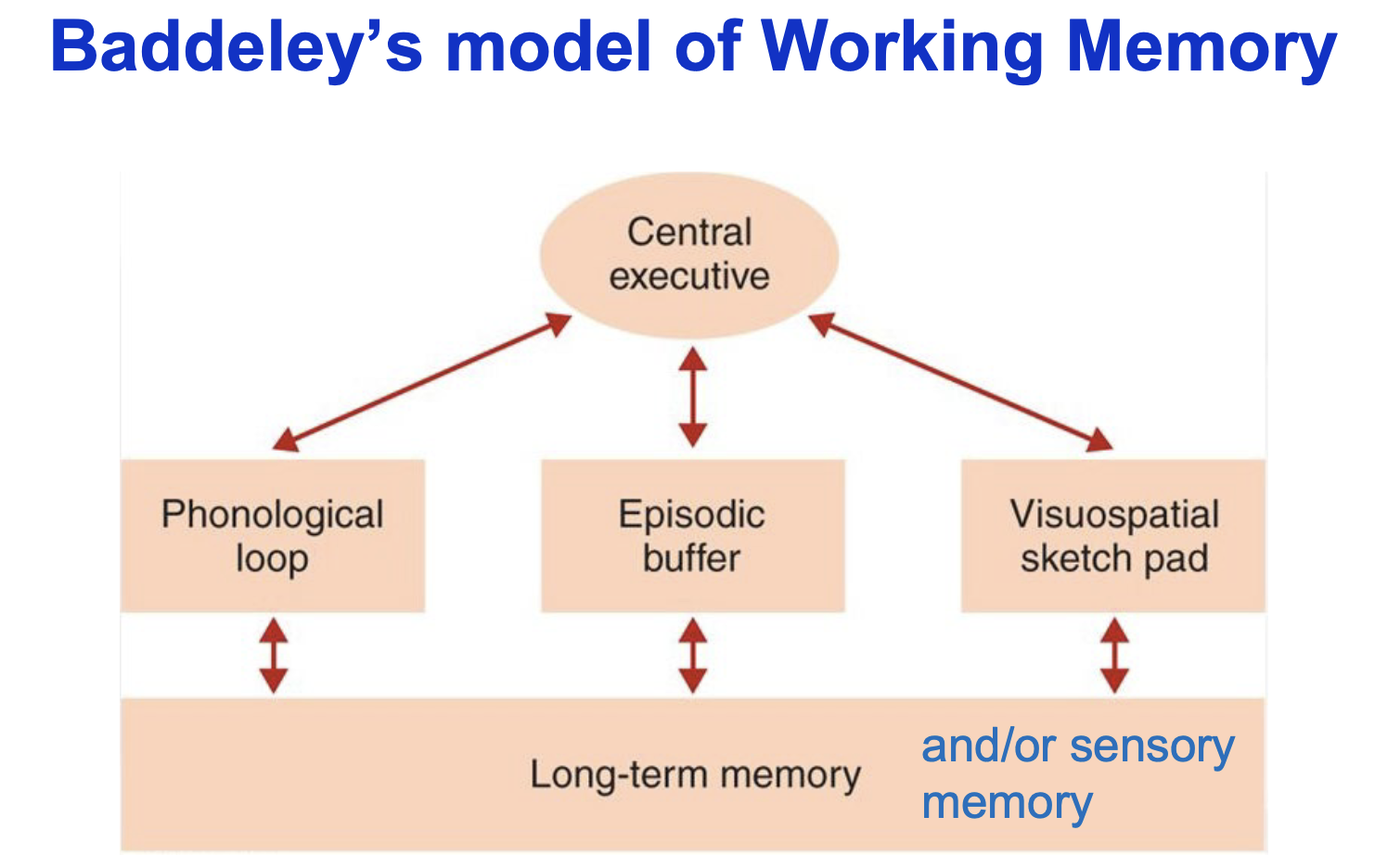
Baddeley’s Working Memory Model Components
Central Executive
Visuospatial Sketchpad
Phonological Loop
Episodic Buffer
Info can come from
Sensory Memory
LTM
Internal (Information you’ve created)
What is Central Executive in the WM model?
The Big Boss
Plans out how to achieve current goals
Deletes no longer needed information
Add new internally created information
Connect storage systems to current goals: Grant priority to information that is most relevant (closely related to attention)
Monitor and evaluate current performance
What is Phonological Loop
Stores verbal info in an articulatory/phonological code
internal monologue
What is Visuospatial Sketchpad?
The processing of visual and spatial information
What is Episodic Buffer?
The connection between the Working Memory and Long Term Memory
Holds current goals, plans, and info retrieved from LTM
What’s the evidence for different components in a working memory system?
Performance declines when doing two tasks at once
But this depends on WHICH two tasks
Only if they use the same
components of working memory
True or False: Individual differences in Working Memory Tests are correlated with intelligence
TRUTH SUPERNOVA

How can we tell if working memory training is effective?
Do people improve on exactly the task that is trained? YES
Do people improve on other tasks that are pretty similar (Near transfer)? PROBABLY YES.
Do people improve on tasks that are quite different, but thought to rely on the same underlying ability (Far transfer) ? NO CONVINCING DATA.
Do the trainees improve at real-life tasks, like school grades, driving, etc? NO CONVINCING DATA.
Important to note that training working memory is a controversial take but there are many claims
What is Attention? (How does it Influence Memory)
Attention is processing info
Memory is a by-product of processing – thinking and doing.
Attention is a limited resource
Unattended information gets weaker sensory processing than attended.
Poor perception of unattended input
Later: Poor memory of that unattended input
Rossiel and Scaggs 2008 (Attention)
Students were shown altered pictures of their college campus
“Is this scene familiar?” 97% of students said yes
“Do you see something wrong” 80% of students said no
Poor memory for unattended information
Naveh-Benjamin & Brubaker, 2019 (Attention)
Study Phase: words presented one at a time for 6 seconds
Full attention group: focus on the words only
Divided attention group: they had to press a button to indicate high, medium, or low pitch (dual task: focusing on the words and pitch)
Intentional and Incidental study groups
Recall the words
Naveh-Benjamin & Brubaker, 2019 Results (Attention)
Those in the direct focus intentional AND incidental groups showed significantly better performance than those in the dual task condition. This indicates that direct focus is essential for better memory.
Melton, 1970 (Benefits of Distributed Practice)
Present list of words one at a time.
Some words occur only once, some occur twice.
Meaning: Extra study time for repeats.
Vary the number of other words in-between repetitions of the same word.
• Immediate repetition = massed practice.
• Intervening words = distributed practice.Recall test at end.
Cepeda et al, 2008 (Benefit of Distributed Practice)
People study trivia facts
Then they get to review them at a certain delay: from same day to days later
Test at 7 days, 35 days, 70 days, and/or 350 days later
Result: Letting more time pass before re-study is better... up to a point
(about 20 days) – waiting 105 days is too long.

What is the Generation Effect
Higher accuracy for generated words
Testing Effect
Practice Tests are good for long term retention as well as delayed feedback
Roediger & Karpicke, 2006 (Taking a Test)
College students read a passage describing science experiment
Then, different groups
Review/re-study three more times (SSSS)
Review/re-study twice, then recall everything they can (SSST). NO feedback on this practice test.
NO re-study, try to recall everything three times
(STTT). NO feedback on these practice tests.Everyone takes a final test:
• 5 minutes later OR
• A week later
Provided evidence for practice test and delayed feedback being useful
Organization in Memory
We have better memory when we see the relationships between items
Bower (1969) (Organization of Memory)
Participants were asked to remember 112 mineral names
Had to remember in random order or organized into subcategories
Random condition: 18% recall
Organized condition: 65% recall
Shows the importance of memory organization
True or False: People organize material themselves, and it
helps during retrieval.
TRUEEE

Von Restorff Effect
We are able to remember the information that stands out from the background
distinctiveness helps with memory
True or False: Sleep aids in memory consolidation
MEGA TRUE

Two forms of LTM?
Declarative: Episodic and Semantic
Non declarative (Procedural memory)
What is Episodic Memory
Memory of..
Single Events + Personal events where time and place is relevant
“What did you have for breakfast?” Recall question
“Was CROW in the list of the words you just studied?” Recognition question
What is Semantic Memory?
Knowledge of facts (i.e BTS debuted on June 13th, 2013)
Time and Place are irrelevant
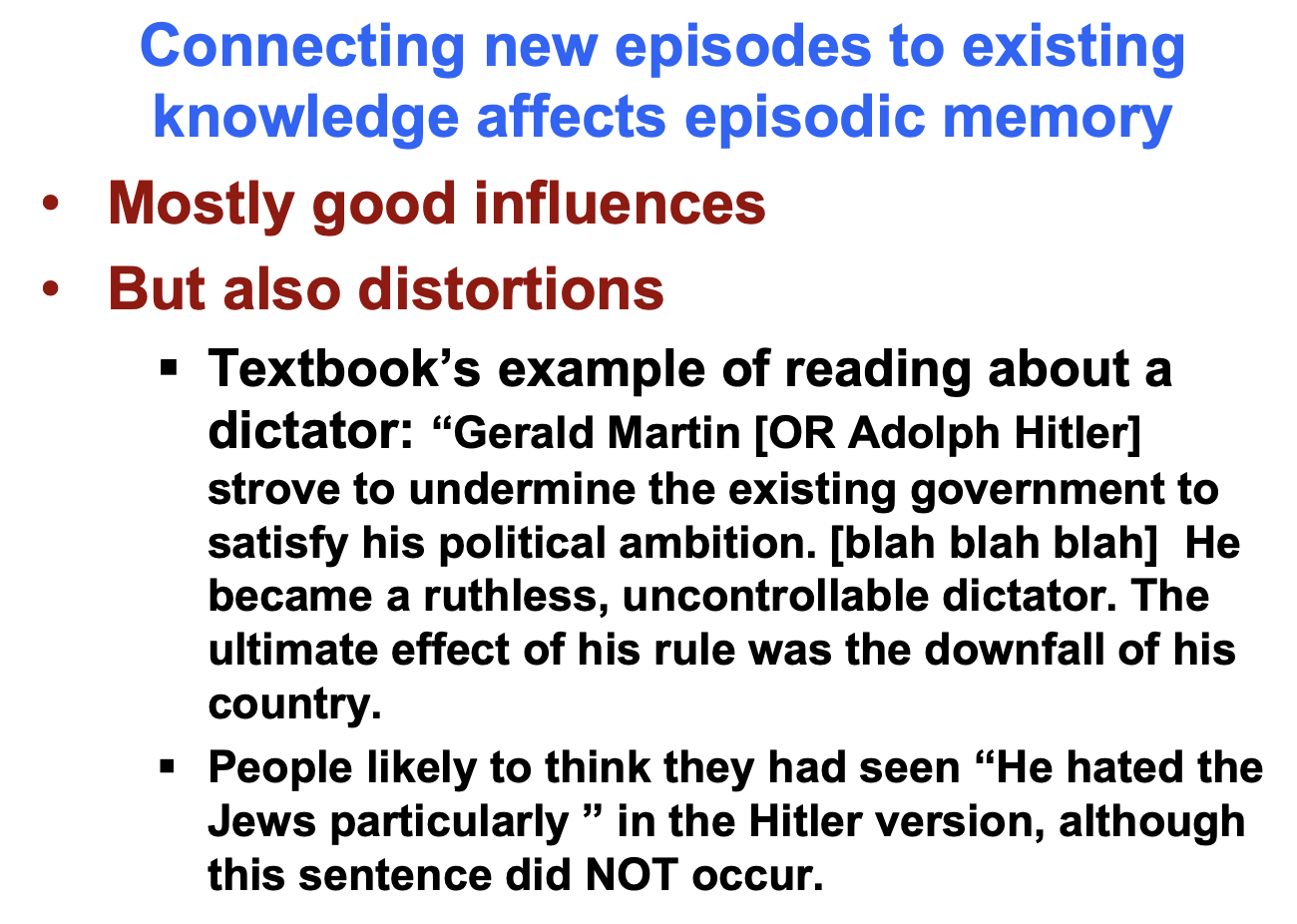
True or False: Connecting new episodes to existing knowledge affects episodic memory (for verbal and non verbal items)
TRUTH HYPERNOVA
Note: It can be mostly good influences but it can also be distorted
Leads to better memory consolidation
Attention to meaning matters: LOP results
Using existing knowledge to organize current material into patterns is useful
Voss and Pellerr (2007) (Test on Episodic Memory)
Let people study a large set of squiggles (random shapes)
Task during the Study Phase: rate each Squiggle based off the meaning (does it look like a face, animal, etc)
Recognition test: Presented with new and already studied squiggles
Squiggles higher in meaning: 82% recognition
Squiggles low in meaning: 46% recognition
Suggests that if meaning is attached to an item/concept we will remember it better

Carmichael, Hogan, & Walter, 1932 (Episodic Memory Test)
Participants studied ambiguous figures with LABELS then recalled them by drawing them (what is remembered)
Distortions happened during the recall test but not in the recognition test

Dual coding theory
We are able to picture the concrete word while also understanding its general meaning
Dog: Knowing what a dog is and picturing a dog (visual)
Freezing: Knowing the definition but also imagining the temperature (somatosensory)
Cuy: Knowing what it is but also picturing a taste #YUM.COM (Olfactory)
True or False: Mostly, people remember the meaning of events rather than the surface form.
Ts is true!
GIST memory is better than VERBATIM memory
Intentional vs Incidental Study
Intentional: being told there is going to be a memory test (before showing them the material)
Incidental: person isn’t told that it’ll be a memory test until they receive the material
Intentional is better because it gives your brain time to prepare for the task at hand

Hyde & Jenkins, 1973 (Incidental vs Intentional Memory Test)
Subjects studied 24 words, then attempted to recall them.
Different groups had different tasks during the study phase.
Does the word contain an E or a G? yes/no
What part of speech is it? Noun/verb/adj.
How common is the word? 5-point scale
How pleasant is the word? 5-point scale
No task: “Control”
Half the subjects warned about memory test, half not
Results indicate that intentional memory tests produce better results

What are Levels of Processing
Shallow processing: simply maintaining the knowledge of the object
Rote memorizing is an example
Deep processing: expanding beyond the knowledge of the object by applying it, and knowing its meaning
aka elaborate rehearsal
Intentional vs Incidental doesn’t matter, it is HOW subjects initially process the material
What are LOP manipulations of Study Tasks?
Orthographic (Shallow)
Does the word have certain letters
How are the letters organized?
Phonological (Medium)
Does the word sound similar to other words?
How many syllables?
Semantic (Deep)
What are the characteristics of this word?
What is Self Reference?
Applying the adjective to yourself
Aids in enhancing memory if you can apply things to yourself
True or False: Rote rehearsal is useful in keeping things in Short Term Memory
TRUEEEEE

What is Deep processing?
Whatever produces the best memory
Difficult task: more effort = better memory
• Difficult = more errors, longer reaction times
True or False: Orthographic tasks can be more difficult than semantic tasks, but still lead to worse memory.
TRUEE
What are Negative vs Positive Items in Semantic tasks?
Negative Item: The answer to the study question is NO
Positive Item: The answer to the study question is YES
Semantic process is better but there is no use for negative items
True or False: Semantic tasks force you to think about what you already know about an item – and this works best for positive items
#TRUTH!
True or False: Experts only have good memory for things in their field of expertise
Yesssss #tru
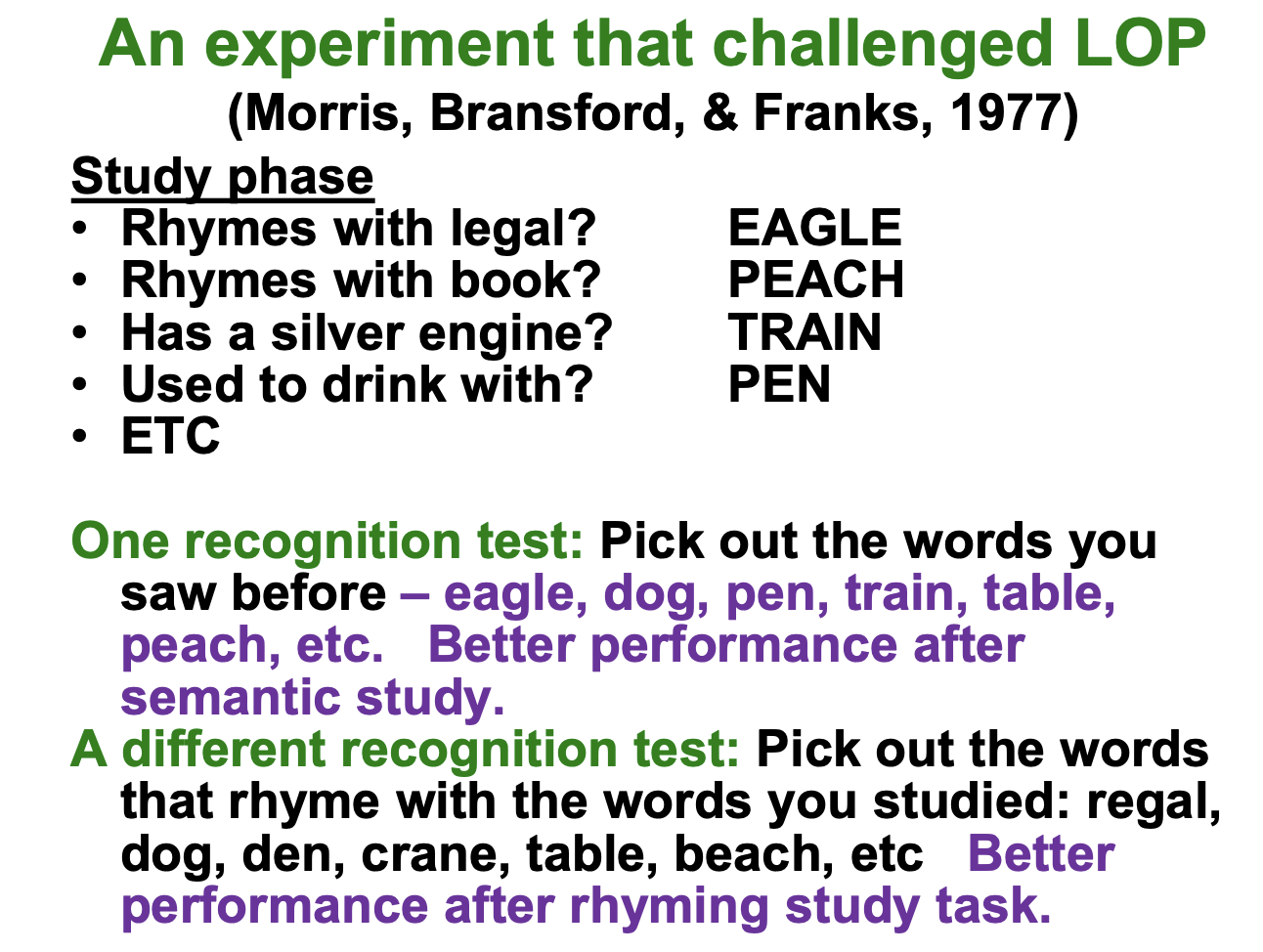
Morris, Bransford, & Franks, 1977 (Experiment that Challenged LOP)
Study Phase: Given a set of words and questions
ex. Rhymes with Legal? EAGLE
One recognition test: Pick out the words you saw before
A different recognition test: Pick out the words that rhyme with the words you studied
What is the difference between LOP and TAP
Levels of Processing: Only considers the encoding aspect (what happens)
integrate current items with prior knowledge
Transfer Appropriate Processing: Considers both encoding and retrieval of information
meaning based retrieval cues
What is a retrieval cue?
Contextual cues that are used to fish out information from your memory
What are you thinking about
What is Priming Effect
Accuracy is higher for items that were studied earlier
What is priming score
Accuracy difference between studied words and new words
Kuo and Van Petten 2006 (TAP at Work)
One study task: Think about this object in real life, and decide whether it is larger or smaller than the computer monitor (roughly 18 x 18 inches)
Half the objects were “large” and half “small”
• This qualifies as a “deep” study task
Another study task: Think about this object in real life, and decide if the drawing color is a good one for that object.
• Another “deep” study task

TAP Experiments suggest that…
Results suggest
Encoding specificity: People can learn different things about the same material depending on study task
Transfer-appropriate processing: Better performance if memory test asks about what was actually learned
WHat is Context Dependent Memory
Better performance when study and test contexts are similar
Types of Contexts?
Environmental (Alpha)
Semantic (Beta)
Pharmacological (State of mind, ex. sober vs drunk)
Languages (Autobiographic things like “picnic”
Emotional
Note: in these cases, we often don’t know exactly what the mental operations were, but assume that having the same context at study and test produced greater overlap than different contexts.
True or False: Environmental Context Effect is very Powerful
No no no…(False)

What are the Broader divisions of Context
Alpha: Context and Material are unrelated
Beta: Context changes the meaning of the material
Mood Congruent Memory
Better memory for material that matches your mood
Mood Dependent Memory
Better memory when mood of encoding match mood of retrieval
Mood-congruent memory (mood & material match)
Mood induction: Let people get into desired mood (good or bad)
Study words or pictures that are emotionally positive or negative
Test memory for the positive and negative material
Results that would support Mood Congruity
• Good mood: Positive material > negative
• Bad mood: Negative material > positive
Some evidence that this happens, but mood-congruity effect strongest in clinically depressed people
Existence of Mood-dependent memory (Encoding & retrieval match)?
Does it exist?
Many experiments had null results, most memory researchers were skeptical
Eich & Metcalfe (1989) showed that mood congruity makes a difference WHEN subjects are more engaged in the encoding task
What is the relationship between Semantic and Episodic Memory?
Initial learning happens through personal experience (episodes)
Over time the info gathered from episodic events are organized and stored semantically
Why is temporal and spatial context of learning not part of semantic memory?
Same info (re)experienced in different contexts
Info may have been internally created void of external influences (ex. Jungkook is a man)
Why should we think that semantic and episodic memory are sort of separate systems?
Certain types of brain damage create loss of stored memory
Different types of info lost depending on the type of brain damage
What is amnesia?
Damage to medial part of temporal lobe (hippocampus and surrounding cortex)
Memory for events (episodes) that occurred shortly before the brain damage are impaired
General world knowledge intact
What is Semantic Dementia?
Damage to temporal pole (anterior part of temporal lobe)
Deterioration of general knowledge
Memory for personal experience (episodes) is much better
What is the difference between Semantic Dementia and Amnesia?
Amnesiacs’ episodic memory is impacted
Semantically demented patients semantic memory is impacted

True or False Damage in Semantic Dementia is located in the anterior temporal lobe
ts is true asf

Types of Semantic Memory Lab questions?
Lexical Decisions: Is “tart” a word vs is “glorp” a word
Category Decision: Is “trout” a type of fish vs is “strawberry” a clothing item
Property Decision: Do “owls” have wings, Do “salmon” have wings
Similarity Judgement: From 1-7 how similar are sparrows and chickens
True or False: Judgments about similarity and category membership affect decisions
TRUUUUU

Things that a theory of semantic memory should explain?
The basis for similarity judgments
Why are TABBY & LION similar? Why are BUS & PLANE similar
Hierarchical structure of categories
Animal —> Mammal —> Dog —> Rottweiler
And, people’s preference for a particular level: the basic level (DOG in this case)
Typicality of the items in a categories
Why ROBIN is a more typical bird than OSTRICH