B2.3 Cell Specialization
 Call Kai
 Learn
Learn Practice Test
 Spaced Repetition
 Match
Match Flashcards
 Knowt Play
1/34

There's no tags or description
Looks like no tags are added yet.
Name | Mastery | Learn | Test | Matching | Spaced | Call with Kai | Chat |
|---|
No analytics yet
Send a link to your students to track their progress
35 Terms
Gametes
Gametes are reproductive cells.
Male gametes are sperm.
Female gametes are ova (eggs).
Gametes have haploid nuclei. (half the chromosomes to combine w sperm)
When gametes fuse during fertilization, a diploid zygote is formed.
Sperm
male gametes
Sperm are the smallest cells in the body with a length of 50 to 70µm, and a width of 2 to 3µm.
Sperm are small cells with a streamlined shape, adapted to swimming.
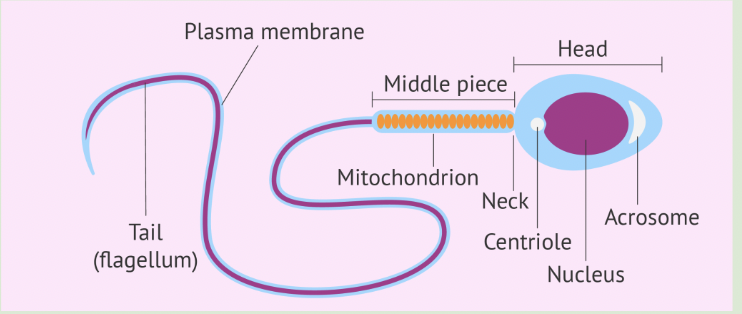
Sperm are composed of three sections, a head, a midpiece and a flagellum (tail)
Adaptations of Sperm
The head of sperm contains a haploid nucleus and an acrosome.
The haploid nucleus contains the paternal genetic information which combines with the maternal genetic information at fertilization.
The acrosome contains hydrolytic enzymes, which help the sperm to fertilize the egg.
The midpiece contains many mitochondria that provide the sperm with ATP energy to swim
The flagellum allows the sperm to swim through the female reproductive system to reach the egg.
Egg (Ovum)
female gametes
Ova (egg cells) are the cell with the largest volume with a diameter of approximately 100µm.
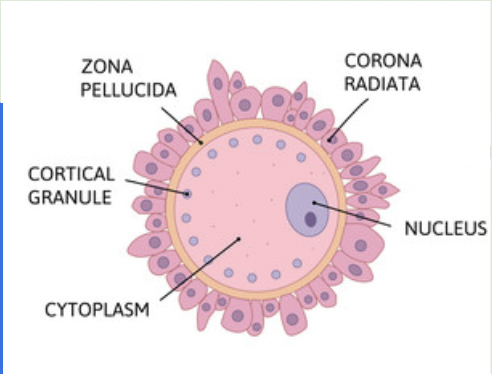
Eggs (Ova) are large cells that contain a haploid nucleus with the maternal genetic information which is combined with the male genetic information at fertilization.
Adaptations of Egg Cells
The ovum is surrounded by a glycoprotein matrix, known as the zona pellucida, which prevents polyspermy after fertilization.
The ovum contains many vesicles known as cortical granules which make the zona pellucida impenetrable to sperm after fertilization.
The cytoplasm of the egg contains many lipid droplets which provide the developing embryo with energy after fertilization.
Fertilization
The fusion of gametes is called fertilization, which leads to the development of a zygote.
When gametes fuse during fertilization, a diploid zygote is formed.
Zygote
The fusion of gametes is called fertilization, which leads to the development of a zygote.
The zygote is a totipotent stem cell.
Totipotent stem cells can develop into all other cell types or develop into an embryo.
The zygote develops into a blastocyst through cell division over five days.
When gametes fuse during fertilization, a diploid zygote is formed.
Stem Cell
Stem cells are undifferentiated cells which have an unlimited capacity to divide, and can differentiate into specialized cells.
Totipotent
Totipotent stem cells can develop into all other cell types or develop into an embryo.
Zygotes are totipotent.
Pluripotent
Pluripotent stem cells can differentiate into all types of cells, but not develop into an embryo.
Embryonic stem cells are pluripotent.
Multipotent
Multipotent stem cells can differentiate into a limited range of cells.
Adult stem cells are multipotent.
Embryonic Stem Cells
The zygote develops into a blastocyst through cell division over five days.
The blastocyst contains embryonic stem cells.
Embryonic stem cells are pluripotent, meaning that they can differentiate into all other cell types but not into an embryo.
Adult Stem Cells
The blastocyst develops into a foetus, as the embryonic stem cells differentiate into specialized cells.
Some adult stem cells remain to replenish dying cells and repair damaged tissue.
Most adult stem cells are multipotent, meaning that can form a range of closely related cells.
Hematopoietic stem cells are multipotent as they can differentiate into all types of blood cells, but not other cell types.
Specialized Cells
All cells from a multicellular organism have the same genome.
Stem cells differentiate into specialized cells by expressing some genes and not expressing others.
Cell Differentiation
Stem cells differentiate into specialized cells by expressing some genes and not expressing others.
Morphogens
The embryonic stem cells differentiate into specialized cells and tissues in a controlled manner through a group of gene regulating chemicals, known as morphogens.
Morphogens are a group of gene regulating chemicals (Transcription factors) which determine the specialized cell that develops according to their concentration.
Morphogens are produced and released from embryo cells, and diffuse through tissues.
The morphogens spread, creating a concentration gradient across tissue, with the highest concentration near the source cells.
Morphogens bind to receptors on cells, resulting in the activation or repression of genes.
The concentration of the morphogen determines which genes will be expressed, determining the type of specialized cell.
Stem Cell Niche
Adult stem cells are multipotent stem cells that replenish dying cells, and repair damaged tissue.
Adult stem cells are located in stem cell niches. Stem cell niches are locations in the body where stem cells can be maintained or promoted to proliferate and differentiate.
exmaples:
Bone marrow is a niche for hematopoietic stem cells which can differentiate into all types of blood cells
Hair follicles contain various pools of stem cells, such as epithelial, melanocyte, and mesenchymal stem cells that self-renew, differentiate, regulate hair growth, and maintain skin homeostasis
Neurons
Neurons have a width ranging from 4 to 100µm, and can have a length of over 1m.
a specialized cell transmitting nerve impulses; a nerve cell.
Striated Muscle Cells
long cylindrical cells that contain numerous myofibrils arranged in a highly ordered fashion, forming the contractile elements of skeletal muscle.
Muscles contract and are involved in movement.
There are three types of muscle cells:
Cardiac Muscle
Striated Muscle (also known as skeletal muscle)
Smooth Muscle
Striated and Cardiac Muscle
Striated muscle is attached to the skeleton and is also known as skeletal muscle. Striated muscle is involved in the movement of bones
Both muscle types contain contractile myofibrils.
Scientific Model
Scientific models are simplified versions of complex systems.
It is possible to use cubes as model cells to identify the relationship between surface area of a cell and volume of a cell as the cell grows.
Microvilli
The cells lining the proximal convoluted tubule include extensions of the cytoplasm known as microvilli.
The microvilli increase the rate of absorption of nutrients and water as filtrate passes through the nephrons of the kidney.
Erythrocytes
Erythrocytes (red blood cells) are thin and flat with a biconcave shape, which increases their surface area for the exchange of gases.
Proximal Convoluted Tubule
The cells lining the proximal convoluted tubule include extensions of the cytoplasm known as microvilli.
a segment of the renal tubule responsible for the reabsorption and secretion of various solutes and water.
Nephron
each of the functional units in the kidney, consisting of a glomerulus and its associated tubule, through which the glomerular filtrate passes before emerging as urine.
Alveoli
Gas exchange happens at the alveoli in the lungs. Alveolar epithelial tissue is composed of two types of cells which facilitate the exchange of gases.
Alveolar tissue is adapted for the rapid exchange of gases, and consists of two types of cells:
2 types of Pneumocytes
Type I Pneumocytes
Type I Pneumocytes are long and extremely flat cells adapted for gas exchange.
Type II Pneumocytes
Type II Pneumocytes are cuboid-shaped cells which secrete a surfactant that reduces surface tension in the alveoli and provides a liquid for rapid diffusion of gases.
The type II pneumocytes contain many secretory vesicles (lamellar bodies), which release the surfactant by exocytosis.
Diffusion
the movement of molecules from an area of high concentration to low concentration due to molecular kinetic energy; that is, the endless and random movement of molecules. Osmosis is a specialized type of diffusion: the diffusion of water.
Cardiac Muscle
Cardiac Muscle: located in the heart, and is responsible for the continued rhythmic beating of the heart.
Cardiac muscle cells are branched and connected by intercalated discs to other muscle cells.
Cardiac muscle cells are branched and connected by intercalated discs to other muscle cells.
Electrical impulses trigger contraction of the cardiac muscle cells.
Intercalated discs are gap junctions between cells, and allow ions to flow between two cells.
Both muscle types contain contractile myofibrils.
Striated Muscle Fibres
Striated Muscle Fibres
Striated muscles are composed of long multinucleated fibres that are formed by the fusion of cells.
Since muscle fibres are formed by the fusion of cells, it is debatable if muscle fibres should be considered cells.
Striated muscle fibres are atypical multinucleate cells forming from the fusion of several cells. Striated muscle fibres can range in length from a few millimeters to several centimeters, and have a diameter of 10 to a 100µm.
Myofibrils
A myofibril (also known as a muscle fibril or sarcostyle) is a basic rod-like organelle of a muscle cell. Skeletal muscles are composed of long, tubular cells known as muscle fibers, and these cells contain many chains of myofibrils.
Intercalated Discs
Intercalated discs are gap junctions between cells, and allow ions to flow between two cells.
Gap Junctions
A Gap Junction is defined as a junctional complex that facilitates intercellular communication by allowing the passage of metabolites, ions, and second messengers between adjacent cells through connexin protein channels.
Multinucleate
having many nuclei
a eukaryotic cell that contains two or more nuclei within a single common cytoplasm
Acrosome
The acrosome contains hydrolytic enzymes, which help the sperm to fertilize the egg.
an organelle that develops over the anterior (front) half of the head in the spermatozoa (sperm cells) of humans and many other animals
Cortical granules
The ovum contains many vesicles known as cortical granules which make the zona pellucida impenetrable to sperm after fertilization.
Flagellum
flagellum (tail)
The flagellum allows the sperm to swim through the female reproductive system to reach the egg.