3.3 Supply Side Policies
 Call Kai
 Learn
Learn Practice Test
 Spaced Repetition
 Match
Match Flashcards
 Knowt Play
1/23

There's no tags or description
Looks like no tags are added yet.
Name | Mastery | Learn | Test | Matching | Spaced | Call with Kai | Chat |
|---|
No analytics yet
Send a link to your students to track their progress
24 Terms
Supply-side policies
A range of measures intended to have a direct impact on long-run aggregate supply and specifically the potential capacity output of the economy (outward shift of LRAS)
Privatisation
The transfer of the ownership of a firm/industry from the public sector to the private sector to improve incentives (and thus efficiency)
Deregulation
Removing or reducing regulations which allows new firms to enter the market
Subsidies
The government may pay subsidies with the aim of encouraging the production and consumption of goods and services at a lower price
Income tax cuts
Gives people a greater incentive to work longer hours/boosts productivity
Flexible labour markets
-Reduces impediments to free market, reduces bureaucracy and ‘red tape’
-Short term contracts
-Flexible working arrangements
-Hiring and firing fairness
-Contracts, terms and conditions, pay
-Reduces the power of trade unions, minimum wages and regulations which affects firms’ decision to employ
Competition policy
Aims to increase the amount of competition in the market to reduce monopoly power
Free-trade agreements
Reduces tariff barriers and other obstacles to trade
Incentives and technology
-Tax reform to encourage incentives and entrepreneurial spirit
-Incentives to develop new technology – investment e.g. offer firms a tax break for investing
-Drive to embracing ‘knowledge driven economy’
-Regional policies to encourage R&D, enterprise, investment, location, expansion
-Provide support for new companies getting started
-Improved infrastructure
Reducing welfare benefits
Gives people a greater incentive to get a job
Public sector investments
Improves infrastructure like transport and lowers costs
Education
Increasing funding to schools and universities improves labour productivity and skills
Vocational training
Schemes to provide new skills to those who lose their job or left school early
Housing supply
Increasing supply of council housing improves geographical mobility
Health spending
Public spending on healthcare can reduce hours lost to ill-health
Approaches to supply-side reforms
- (Free) Market-led policies: designed to make markets work better and give the private sector more freedom
- State/government intervention in markets to overcome different types of market failure
Main Objectives of Supply-Side Policies
-Improve incentives to look for work and invest in people’s skills
-Increase labour and capital productivity
-Increase occupational and geographical mobility of labour to help reduce the rate of unemployment
-Increase investment and research and development spending
-Promoting more competition and stimulate a faster pace of invention and innovation to improve competitiveness
-Provide a strong platform for sustained non-inflationary growth
-Encourage the start-up and expansion of new businesses / enterprises especially those with export potential
-Improve the trend rate of growth of real GDP
-It is about the government creating the right conditions to allow market forces to create growth themselves as opposed to direct govt action e.g. spending money
Key supply-side challenges
-Persistent productivity gap
-High rates of youth unemployment
-Deep and widening regional economic divide
-Structural trade deficit (current account of BoP)
-Low trend growth rate of real GDP
-Rise of emerging nations
-Low capital investment & research
-Rising inequality / relative poverty
Policies to reduce unemployment
-Making work seem more attractive so long-term unemployed people will be more incentivised to work again
-Providing good quality information about vacancies
-Reducing unemployment benefits
-Improved education
-Low-cost child care
-Legislation to help disabled workers
-Reducing benefits and income tax
Policies to control inflation (cost-push)
-Reduce corporation tax
-Stimulate investment
-Provide subsidies
Policies to improve the balance of payments
-Give subsidies to domestic infant industries to encourage them to become internationally competitive
-Increase funds at universities to encourage innovation
-Greater international competitiveness should improve the current a/c of the BoP.
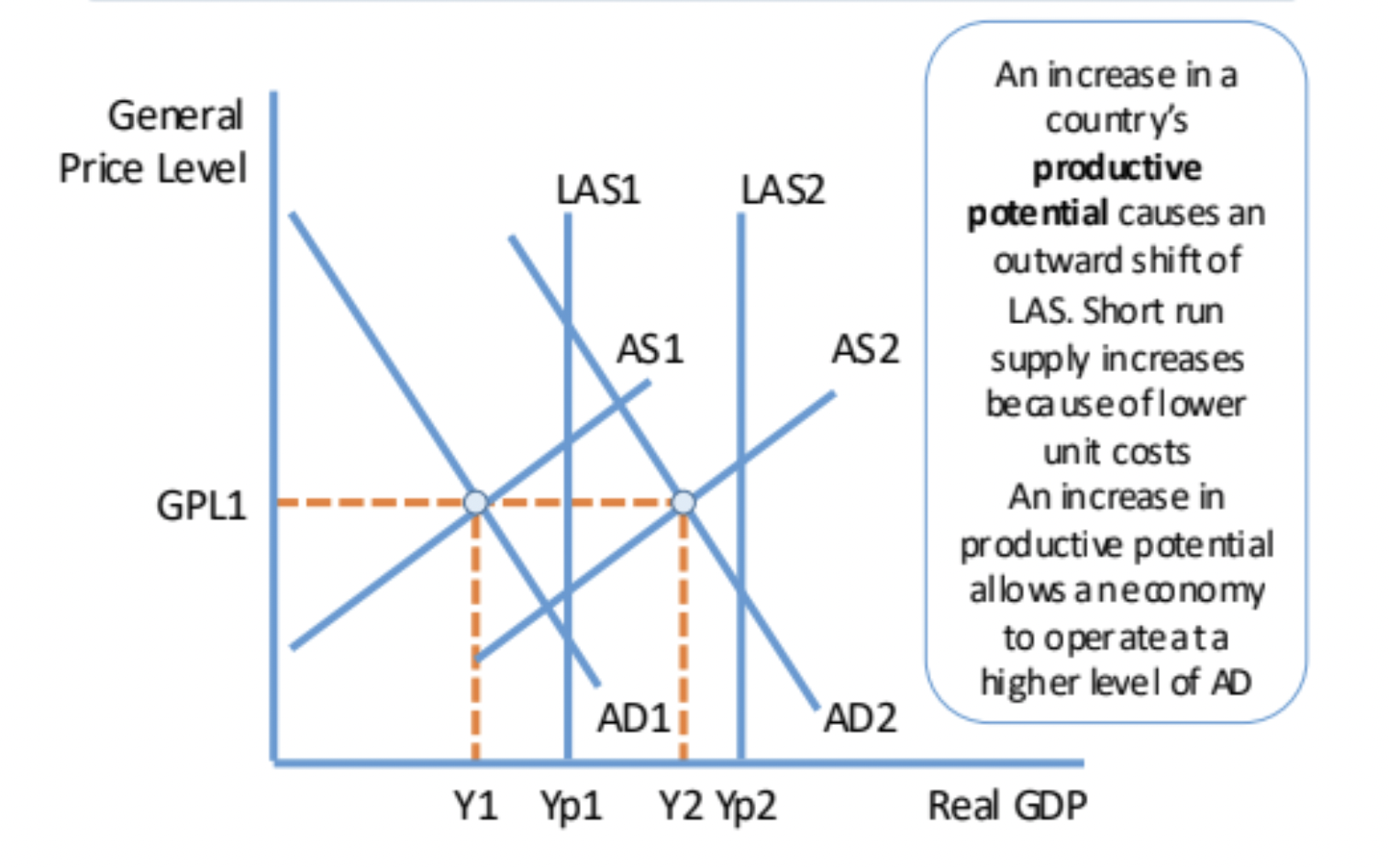
Showing long-run economic growth using AD/AS
-An increase in a country’s productive potential causes an outward shift of LAS
-Short run supply increases because of lower unit costs
-An increase in productive potential allows an economy to operate at a higher level of AD
Impact of successful supply-side policies
-A sustained improvement in the possible trade-off between inflation and unemployment (Phillips Curve)
-Be more flexible in response to external demand and supply-side shocks such as rising energy prices
-Raise living standards through stronger long term economic growth / an increase in underlying trend rate of growth
-Reduce unemployment by lowering the natural rate of unemployment (less frictional & structural unemployment)
-Improve competitiveness in global markets and achieve a stronger balance of trade in goods and services
Limitations of supply-side policies
-Time lags
-The level of aggregate demand is also important in making business investment and innovation viable
-Some supply-side policies (e.g. reduce higher-rate income taxes) might lead to greater inequalities of income & wealth
-Sustainability issues if policies aim to raise a country’s long term growth rate, leading to increased externalities such as pollution
-Supply-side policies look to achieve relative improvements e.g. In productivity, but other countries will be making gains too