Recorded Lecture: Neuro Basics and Examination
 Call Kai
 Learn
Learn Practice Test
 Spaced Repetition
 Match
Match Flashcards
 Knowt Play
1/45

There's no tags or description
Looks like no tags are added yet.
Name | Mastery | Learn | Test | Matching | Spaced | Call with Kai | Chat |
|---|
No analytics yet
Send a link to your students to track their progress
46 Terms
What are the parts that make up the brainstem?
Midbrain, pons, medulla oblongota
How many lobes do you have in the brain?
4×2 = 8
What is the function of the frontal lobe? Lesion? Mneumonic?
“On top of” everything “A CEO”
Aphasia: Broca’s (speech production)
Controls plan, programming, movement
Emotional, behavioral control, personality, olfaction
What is the function of the temporal lobe? Lesion?
Hearing and language comprehension
Aphasia: Wernicke’s (understanding)
What is the difference between Broca’s aphasia and Wernicke’s aphasia? Lobe affected and treatment?
Broca’s aphasia “BEN”
Broken speech - difficulty saying what they actually want to say
Expressive aphasia
Non-fluent aphasia
Lobe: frontal lobe
Treatment: yes/no questions
Wernicke’s aphasia
Unable to understand - difficulty understanding what you’re saying
Receptive aphasia
Fluent aphasia
Word salad → “wowsome", fantabulous”
Lobe: temporal lobe
Treatment: gestures/demonstrations
Which side of the brain is a lesion that affects language most common/is the dominant hemisphere?
Left
What is the function of the parietal lobe? Lesion?
Perceptual disorders e.g. unilateral neglect → common w/ R brain, R parietal lobe lesion → neglecting left side i.e. only shaving the R side of the face
Sensory loss
What is the function of the occipital lobe? Lesion?
Visual loss
How many cranial nerves do we have?
12×2 = 24
Name all cranial nerves and type.
Olfactory - S
Optic - S
Oculomotor - M
Trochlear - M
Trigeminal - B
Abducens - M
Facial - B
Vestibulocochlear - S
Glossopharyngeal - B
Vagus - B
Accessory - M
Hypoglossal - M
Which cranial nerves are sensory, motor, both?
Sensory: I, II, VIII
Motor: III, IV, VI, XI, XII
Both: V, VII, IX, X
Where are the cranial nerves located?
“CE MI PONS MEDU”
Cerebrum: I, II
Midbrain: III, IV
Pons: V, VI, VII, VIII
Medulla oblongota: XI, X, XI, XII
Name, type, function, and effect of CN I.
Olfactory
Sensory
Sense of smell
Anosmia - loss of smell
Name, type, function, and effect of CN II.
Optic
Sensory
Vision: color, acuity, peripheral vision, pupillary light reflex
Blindness, myopia (short-sighted), presbyopia (far-sighted)
What is a normal pupillary ligth reflex?
Shine light in one eye and L&R constrict (L2 senses light “danger!” warns L3 and R3 to constrict)
What cranial nerve is affected if a light is shone in the L eye and L constricts, but R stays the same?
R3
What cranial nerve is affected if a light is shone in the L eye and L stays the same, but R constricts?
L3
What cranial nerve is affected if a light is shone in the L eye and L and R do not constrict?
L2
Name, type, function, and effect of CN III.
Oculomotor
Motor
Function and if affected - all eye muscles except superior oblique (IV) and lateral rectus (VI)
Movement of eyeball → strabismus - lateral (lazy eye)
Opens eyeball → ptosis - drooping of eyelids
Constricts pupils → dilation of pupils
Name, type, function, and effect of CN IV.
Trochlear
Motor
Look down and in (at nose) - superior oblique
Name, type, function, and effect of CN VI.
Abducens
Motor
Look out (abducting) - lateral rectus
Lesion → medial strabismus
If there is a lesion to the glossopharyngeal and vagus, what other cranial nerve is likely to be affected?
“CE MI PONS MEDU”
11 (spinal accessory) or 12 (hypoglossal) because they are located in the medulla oblongota
Describe the cranial nerve and muscle action of each of the eye muscles
superior rectus 3 up
inferior rectus 3 down
medial rectus 3 in
lateral rectus 6 out
superior oblique 4 down and in
inferior oblique 3 up and out
Name, type, function, and effect of CN V.
Trigeminal
Both
Function
Sensation to face
Corneal reflex - Afferent (closes eye to protect)
Sensation to anterior 2/3rd of tongue
Dampens sound (hyperacusis - whispering is too loud)
Jaw jerk
Name, type, function, and effect of CN VII.
Facial
Both
Function
Movement of face
Corneal reflex - Efferent
Taste to anterior 2/3rd of tongue
Dampens sound
Lacrimation (crying), salivation (drooling)
What movements of the face does the facial nerve not perform? Which nerves do these actions?
Opening eyelids - 3
Closing eyelids - 7
Mastication - 5 “triCHEWminal”
What cranial nerve does smiling?
CN VII
What cranial nerve does chewing?
V
What cranial nerve does swallowing?
A lot - 9, 10 mainly
What cranial nerve moves the tongue?
CN XII
Name, type, function, and effect of CN VIII.
Vestibulocochlear
Sensory
Balance and hearing
Hearing loss
Conductive - outer ear (putting finger in ear, noise cancelling headphones)
Sensorineural - inner ear
Describe the steps to diagnose hearing loss and which type and side.
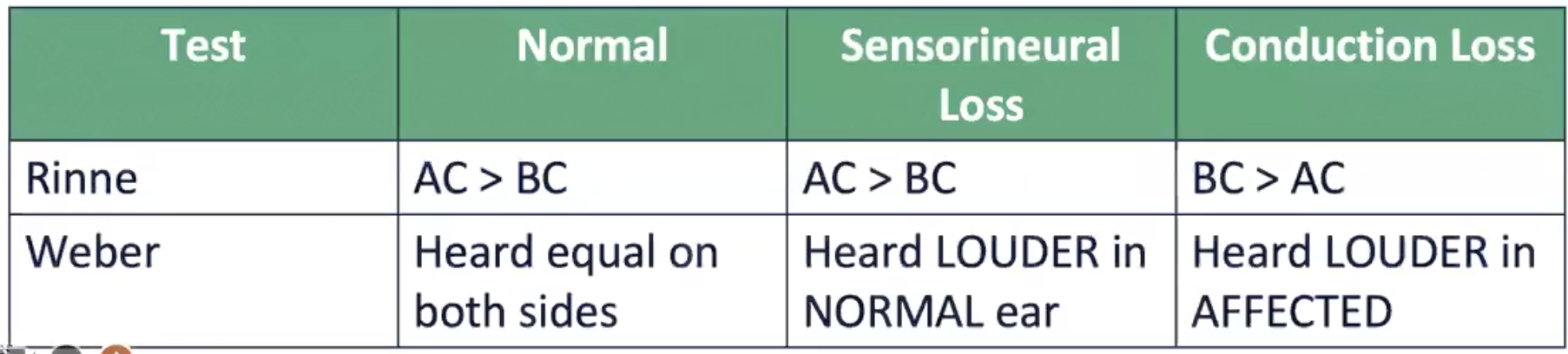
Step 1: Rinne’s test for type (conductive vs sensorineural) - tuning fork vibration at mastoid process BC → “cant hear it anymore” → tuning fork to ear AC
Normal: AC > BC
Sensorineural loss: AC > BC
Conduction loss: BC > AC
Step 2: Weber’s test for side (right vs left) - tuning fork to top of head
Normal: heard equal on both sides
Sensorineural loss - heard louder in normal ear
Conduction loss - heard louder in affected ear
“CANS” → Conductive = louder to Affected; Sensorineural = louder in Normal ear
Determine the type of hearing loss and which ear if Rinne’s test showed BC > AC and Weber’s test showed louder R.
Conductive hearing loss in R side
Determine the type of hearing loss and which ear if Rinne’s test showed AC > BC and Weber’s test showed equal.
Normal
Determine the type of hearing loss and which ear if Rinne’s test showed AC > BC and Weber’s test showed louder R.
Sensorineural loss in L side
Determine the type of hearing loss and which ear if Rinne’s test showed BC > AC and Weber’s test showed louder L.
Conductive hearing loss in L side
Name, type, function, and effect of CN IX.
Glossopharyngeal
Both
Function
Gag reflex - Afferent
Posterior tongue sensation and taste
Name, type, function, and effect of CN X.
Vagus
Both
Gag reflex - Efferent
Deviation of uvula
If R10 affected → uvula deviates L (MOVES OPPOSITE)
Name, type, function, and effect of CN XII.
Hypoglossal
Motor
Moves tongue
Atrophy or “Lick your lesion” R12 affected → tongue moves to R
If a patient “talks normally but doesn’t make sense”, leans to the right when sitting and has difficulty lifting his right arm overhead, and becomes frustrated when given instructions and is fluent but nonsensical speech, what lobe is damaged?
Left temporal lobe Wernicke’s area
What presentation indicates injury to the CN XI nerve?
Shoulder droop and weakness with shoulder shrug
What presentation indicates involvement of the left parietal lobe?
Impaired safety awareness, difficulty recognizing his right-sided weakness
Name, type, function, and effect of CN VI.
Spinal accessory
Motor
Shoulder elevation → test SCM & traps (SB same side, rotate opposite) by shrugging shoulders
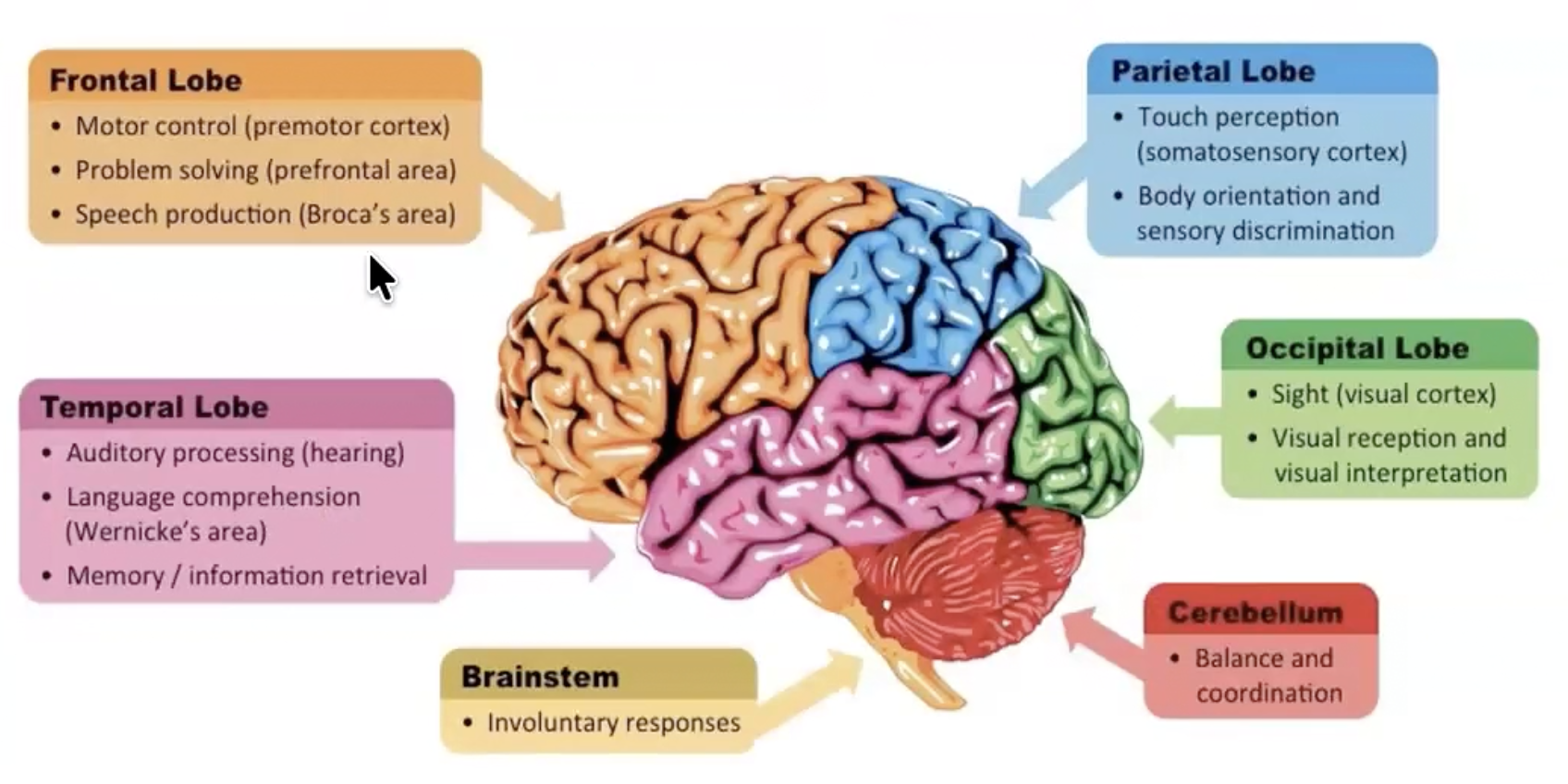
Give a summary of the functions of each brain lobe.
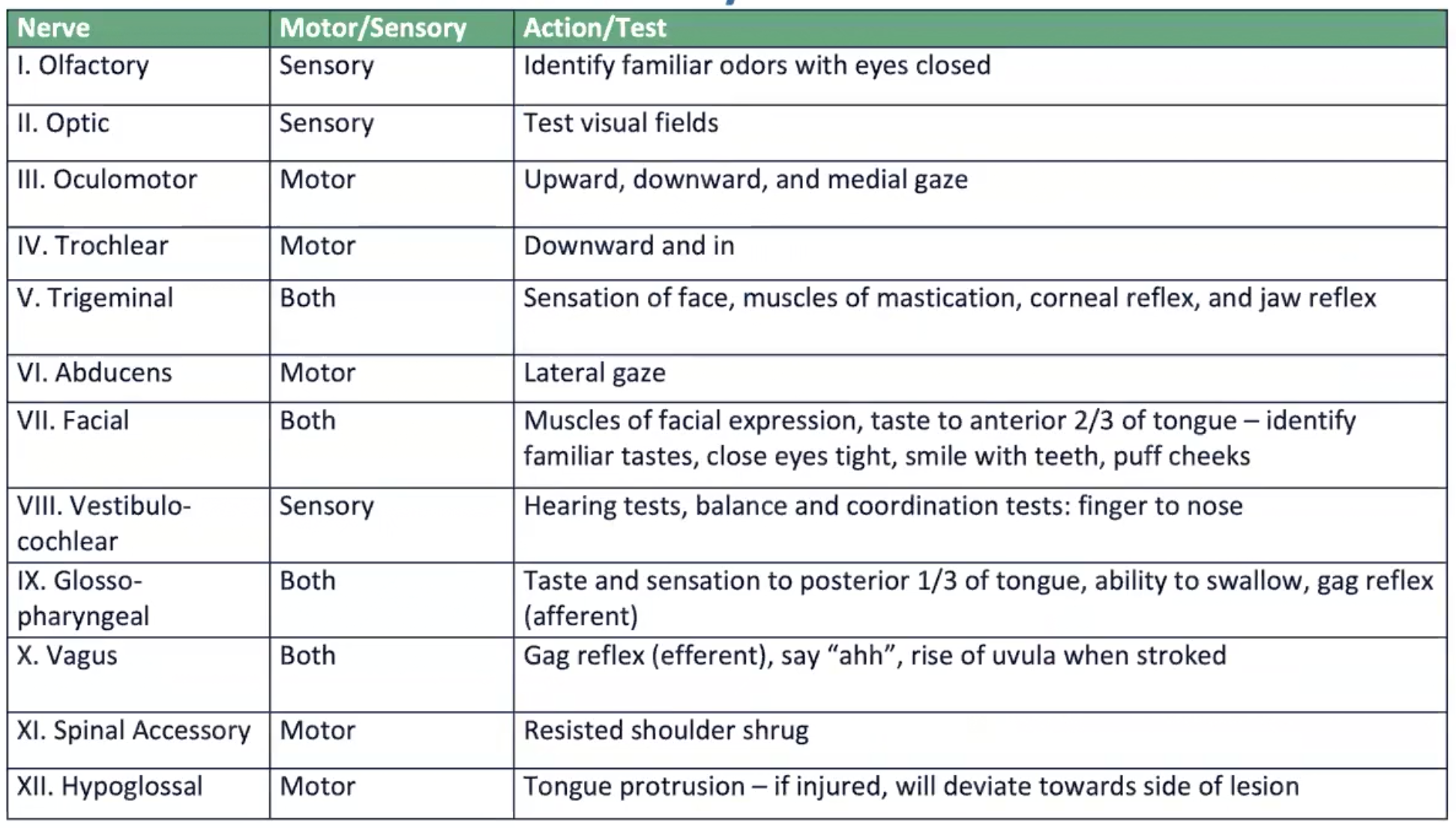
Give a cranial nerves summary of name, type, and action/test.
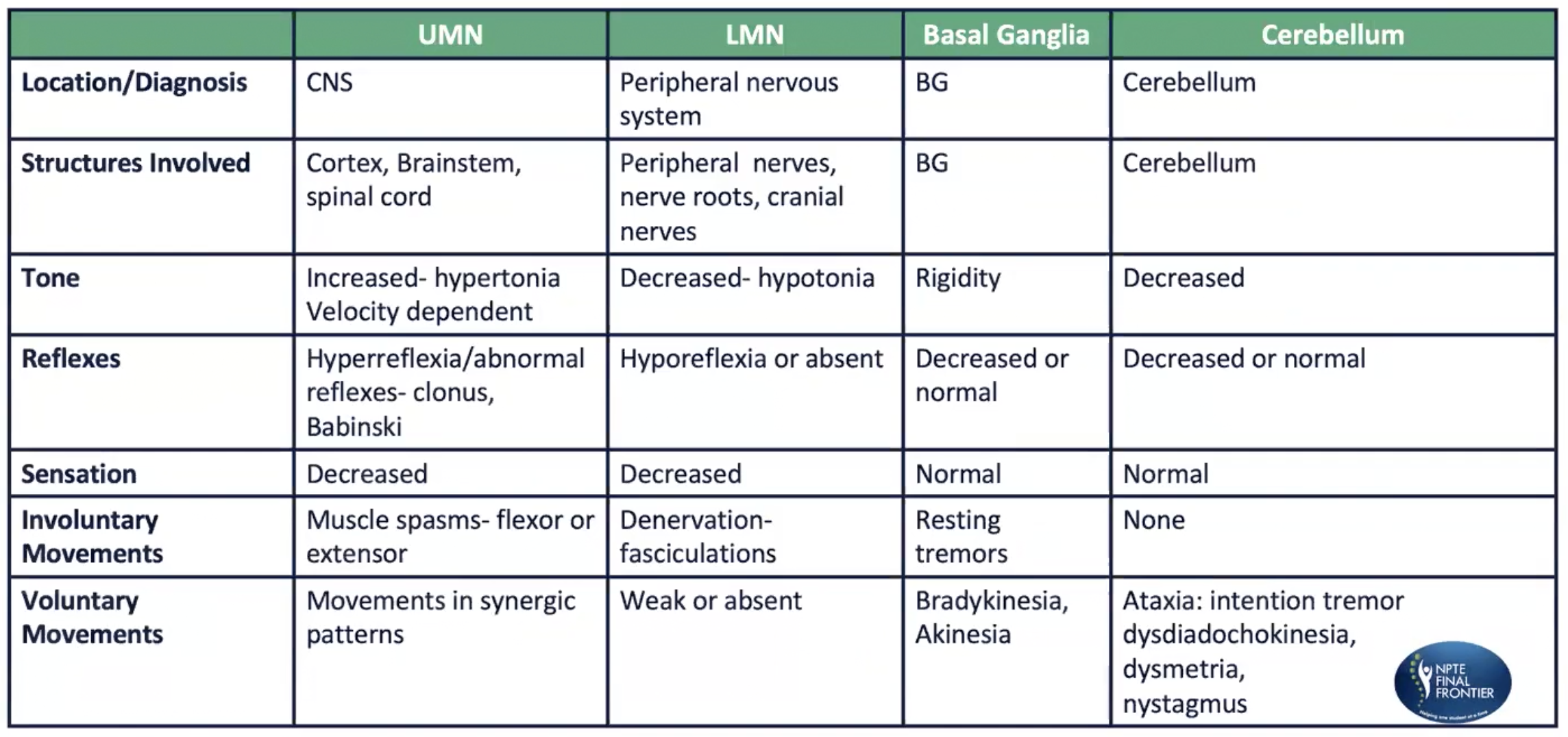
Give a lesion location summary of UMN, LMN, BG, and Cerebellum.