Energetics EQ
0.0(0)
Studied by 2 people Call Kai
 Learn
Learn Practice Test
 Spaced Repetition
 Match
Match Flashcards
 Knowt Play
Card Sorting
1/22

Earn XP
Description and Tags
23 Terms
1
New cards
Suggest one improvement that would reduce errors due to heat loss in the student’s experiment. \[1\]
Use a draught screen
2
New cards
Suggest why the value for the standard enthalpy of formation of liquid antimony, in the data given, is not zero. \[1\]
Antimony is not in its standard state
3
New cards
Define the term *standard molar enthalpy of formation. [3]3*
Enthalpy change when 1 mole of a compound is formed from its constituent elements under standard conditions and species in their standard states
4
New cards
State Hess’s law. \[1\]
Enthalpy change of reaction is independent of route from reactants to products
5
New cards
What is the meaning of the term *enthalpy change*? \[2\]
Heat energy change measured under conditions of constant pressure
6
New cards
Deduce 2 reasons why the student’s value for the standard enthalpy of combustion of ethanol is different from a Data Book value. \[2\]
1. Heat loss to surroundings
2. Incomplete combustion
7
New cards
Explain why it is important that the reaction mixture is stirred before recording each temperature. \[1\]
This ensures all of the solution is the same temperature
8
New cards
Suggest one reason why the value for the enthalpy change of reaction cannot be measured directly. \[1\]
1. Impossible to react the exact amount of water
2. Very difficult to measure the temperature rise of a solid
3. Difficult to prevent solid dissolving
4. A solution could form
9
New cards
State the meaning of the term standard enthalpy of combustion. \[2\]
Enthalpy change when one mole of a compound is completely burnt in the presence of oxygen, with all species in their standard states and under standard conditions.
10
New cards
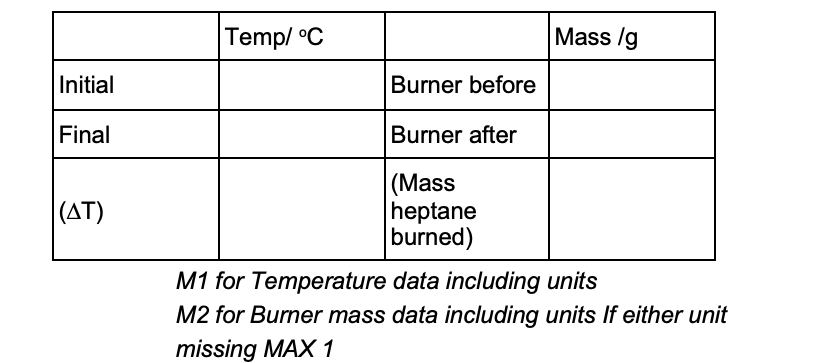
A student does an experiment to determine a value for the enthalpy of combustion of heptane.
The figure below shows some of the apparatus used.
(a) Design a table to record all the readings necessary to determine an experimental value for the enthalpy of combustion for heptane in this experiment. \[2\]
The figure below shows some of the apparatus used.
(a) Design a table to record all the readings necessary to determine an experimental value for the enthalpy of combustion for heptane in this experiment. \[2\]
11
New cards
The student considered using a glass beaker on a tripod and gauze instead of the clamped copper calorimeter.
Suggest **two** disadvantages of using a glass beaker on a tripod and gauze. \[2\]
Suggest **two** disadvantages of using a glass beaker on a tripod and gauze. \[2\]
1. Glass is a poorer conductor than copper
2. Tripod and gauze reduce heat transfer
3. Tripod and gauze would have a fixed height above the flame
12
New cards
Suggest one addition to this apparatus that would improve the accuracy of the enthalpy value obtained. \[1\]
Use a draught screen (wind shield)
13
New cards
A student determines the enthalpy change for the reaction between calcium carbonate and hydrochloric acid.
CaCO3(s) + 2 HCl(aq) → CaCl2(aq) + CO2(g) + H2O(l)
The student follows this method:
* measure out 50 cm3 of 1.00 mol dm–3 aqueous hydrochloric acid using a measuring cylinder and pour the acid into a 100 cm3 glass beaker
* weigh out 2.50 g of solid calcium carbonate on a watch glass and tip the solid into the acid
* stir the mixture with a thermometer
* record the maximum temperature reached.
The student uses the data to determine a value for the enthalpy change.
Explain how the experimental method and use of apparatus can be improved to provide more accurate data.
Describe how this data from the improved method can be used to determine an accurate value for the temperature change. \[6\]
CaCO3(s) + 2 HCl(aq) → CaCl2(aq) + CO2(g) + H2O(l)
The student follows this method:
* measure out 50 cm3 of 1.00 mol dm–3 aqueous hydrochloric acid using a measuring cylinder and pour the acid into a 100 cm3 glass beaker
* weigh out 2.50 g of solid calcium carbonate on a watch glass and tip the solid into the acid
* stir the mixture with a thermometer
* record the maximum temperature reached.
The student uses the data to determine a value for the enthalpy change.
Explain how the experimental method and use of apparatus can be improved to provide more accurate data.
Describe how this data from the improved method can be used to determine an accurate value for the temperature change. \[6\]
Stage 1: Apparatus
1a. Use a burette/pipette (instead of a measuring cylinder)
1b. Use a polystyrene cup (instead of a beaker) /insulate beaker
1c. Reweigh the watchglass after adding the solid 1d: Use powdered solid
Stage 2: Temperature Measurements
2a. Measure and record the initial temperature of the solution for a few minutes before addition
2b. Measure and record the temperature after the addition at regular intervals (eg each minute) for 8+ minutes/until a trend is observed
Stage 3: Temperature Determination
3a. Plot a graph of temperature against time
3b. Extrapolate to the point of addition
3c. Determine ΔT at the point of addition
1a. Use a burette/pipette (instead of a measuring cylinder)
1b. Use a polystyrene cup (instead of a beaker) /insulate beaker
1c. Reweigh the watchglass after adding the solid 1d: Use powdered solid
Stage 2: Temperature Measurements
2a. Measure and record the initial temperature of the solution for a few minutes before addition
2b. Measure and record the temperature after the addition at regular intervals (eg each minute) for 8+ minutes/until a trend is observed
Stage 3: Temperature Determination
3a. Plot a graph of temperature against time
3b. Extrapolate to the point of addition
3c. Determine ΔT at the point of addition
14
New cards
Suggest how, without changing the apparatus, the experiment could be improved to reduce the percentage uncertainty in the temperature change. \[1\]
Increase the concentrations of the solutions
15
New cards
Which reaction has an enthalpy change equal to the standard enthalpy of formation of lithium fluoride? \[1\]
\
**A** Li(g) + F2(g) → LiF(s)
**B** Li+(g) + F–(g) → LiF(s)
**C** Li+(aq) + F–(aq) → LiF(s)
**D** Li(s) + 1/2F2(g) → LiF(s)
\
**A** Li(g) + F2(g) → LiF(s)
**B** Li+(g) + F–(g) → LiF(s)
**C** Li+(aq) + F–(aq) → LiF(s)
**D** Li(s) + 1/2F2(g) → LiF(s)
**D** Li(s) + 1/2F2(g) → LiF(s)
16
New cards
Two reactions of iron with oxygen are shown.
Fe(s) + O2(g) → FeO(s) ΔH = – 272 kJ mol–1
2 Fe(s) + O2(g) → Fe2O3(s) ΔH = – 822 kJ mol–1
What is the enthalpy change, in kJ mol–1, for this reaction? \[1\]
2 FeO(s) + O2(g) → Fe2O3(s)
A +550
B –278
C –1094
D –1372
Fe(s) + O2(g) → FeO(s) ΔH = – 272 kJ mol–1
2 Fe(s) + O2(g) → Fe2O3(s) ΔH = – 822 kJ mol–1
What is the enthalpy change, in kJ mol–1, for this reaction? \[1\]
2 FeO(s) + O2(g) → Fe2O3(s)
A +550
B –278
C –1094
D –1372
B -278
17
New cards
Explain how to set up an experiment to calculate the enthalpy change of the combustion of a fuel. \[6\]
1. Measure initial mass of spirit burner containing the desire fuel using a balance.
2. Measure a known volume of water into a boiling tube.
3. Insulate the calorimeter with a lid/ draught screen etc.
4. Insert a thermometer into the water and record the initial temperature.
5. Ignite the fuel and measure the temperature change of the water over a defined period of time.
6. Measure the final mass of the spirit burner and find the mass of fuel combusted
7. use q=mcΔT to calculate the energy released.
8. Divide this value by the moles of the fuel combusted and calculate the enthalpy changes, converting it to kJ mol-1
18
New cards
Define *mean bond enthalpy*
Enthalpy change when one mole of a particular bond is broken, in its gaseous state, is averaged over a range of compounds
19
New cards
Why do values calculated using mean bond enthalpies differ from those calculated using Hess’ Law?
Mean bond enthalpies are an average on that particular bond across a range of compounds. They are not 100% accurate depending on the type of environment the bond is in for that particular compound
20
New cards
Explain why the value given for the O=O bond enthalpy in part (b) is not a mean value. \[1\]
O2 is the only substance with a O=O bond
21
New cards
A student planned and carried out an experiment to determine the enthalpy of reaction when magnesium metal displaces zinc from aqueous zinc sulfate.
Mg(s) + Zn2+(aq) ⟶ Mg2+(aq) + Zn(s) The student used this method:
• A measuring cylinder was used to transfer 50 cm3 of a 1.00 mol dm−3 aqueous solution of zinc sulfate into a glass beaker.
• A thermometer was placed in the beaker.
• 2.08 g of magnesium metal powder were added to the beaker.
• The mixture was stirred and the maximum temperature recorded.
\
Suggest how the students’ method, and the analysis of the results, could be improved in order to determine a more accurate value for the enthalpy of reaction.
Justify your suggestions.
Do not refer to the precision of the measuring equipment. Do not change the amounts or the concentration of the chemicals. \[6\]
Mg(s) + Zn2+(aq) ⟶ Mg2+(aq) + Zn(s) The student used this method:
• A measuring cylinder was used to transfer 50 cm3 of a 1.00 mol dm−3 aqueous solution of zinc sulfate into a glass beaker.
• A thermometer was placed in the beaker.
• 2.08 g of magnesium metal powder were added to the beaker.
• The mixture was stirred and the maximum temperature recorded.
\
Suggest how the students’ method, and the analysis of the results, could be improved in order to determine a more accurate value for the enthalpy of reaction.
Justify your suggestions.
Do not refer to the precision of the measuring equipment. Do not change the amounts or the concentration of the chemicals. \[6\]
**Stage 1 Improved insulation**
1a Insulate the beaker or use a polystyrene cup or a lid
1b To reduce heat loss
**Stage 2 Improved temperature recording**
2a Record the temperature for a suitable time before adding the metal
2b To establish an accurate initial temperature
OR
2c Record temperature values at regular time intervals
2d To plot the temperature results against time on a graph
**Stage 3 Improved analysis of results**
3a Extrapolate the cooling back to the point of addition
3b To establish a (theoretical) maximum temperature OR temperature
change (e.g. at the 4th minute) OR adjust for the cooling /apply a cooling
correction
3a and 3b could be seen on an extrapolated sketch graph
(Note– IGNORE use of measuring equipment with greater precision)
1a Insulate the beaker or use a polystyrene cup or a lid
1b To reduce heat loss
**Stage 2 Improved temperature recording**
2a Record the temperature for a suitable time before adding the metal
2b To establish an accurate initial temperature
OR
2c Record temperature values at regular time intervals
2d To plot the temperature results against time on a graph
**Stage 3 Improved analysis of results**
3a Extrapolate the cooling back to the point of addition
3b To establish a (theoretical) maximum temperature OR temperature
change (e.g. at the 4th minute) OR adjust for the cooling /apply a cooling
correction
3a and 3b could be seen on an extrapolated sketch graph
(Note– IGNORE use of measuring equipment with greater precision)
22
New cards
Write an equation, including state symbols, to show the reaction taking place when the standard enthalpy of combustion for ethanol is measured. \[2\]
C2H5OH(I) + 3O2(g) ⟶ 2CO2(g) + 3H2O(I)
23
New cards
Explain why it is difficult to determine the enthalpy change of this following reaction:
\
C(s) + 1/2O2(g) → CO(g\`) \[1\]
\
C(s) + 1/2O2(g) → CO(g\`) \[1\]
Difficult to prevent C and O2 reacting and forming CO2