A-Level Biology - 3.8.4 Gene technologies allow the study and alteration of gene function allowing a better understanding of organism function and the design of new industrial and medical processes
 Call Kai
 Learn
Learn Practice Test
 Spaced Repetition
 Match
Match Flashcards
 Knowt Play
1/34

There's no tags or description
Looks like no tags are added yet.
Name | Mastery | Learn | Test | Matching | Spaced | Call with Kai | Chat |
|---|
No analytics yet
Send a link to your students to track their progress
35 Terms
What does recombinant DNA technology involve?
transfer of fragments of DNA from one organism, or species, to another
What is a vector in recombinant DNA technology?
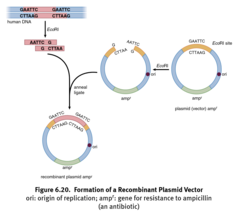
used to transfer DNA fragment from one organism to another
usually a plasmid
What allows DNA to be translated within cells of the recipient (transgenic) organism?
genetic code is universal, as are transcription and translation mechanisms
Name three ways fragments of DNA can be produced
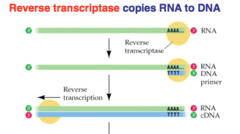
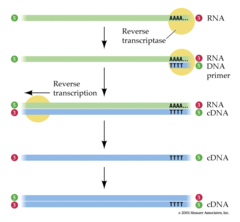
conversion of mRNA to *complementary DNA* (cDNA) using *reverse transcriptase*
using *restriction enzymes* to cut a fragment containing the desired gene from DNA
creating the gene in a *'gene machine'*.
How can fragments of DNA be produced using reverse transcriptase?
*mRNA* transcribed from the desired gene is isolated
mRNA combined with *reverse transcriptase enzyme* and *DNA nucleotides*
to create a single strand of *complementary DNA* (cDNA)
Give one advantage of producing fragments of DNA using reverse transcriptase
mRNA is used as a template, which doesn't contain introns
What does reverse transcriptase do?
converts RNA to DNA
How can fragments of DNA be produced and inserted into plasmids using restriction enzymes?
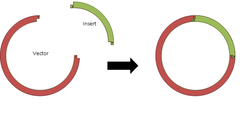
restriction enzymes cut donor DNA at a *specific base sequence* to produce a DNA fragment
cut open plasmid with the *same* enzyme that cuts at the same base sequence
enzymes leave *sticky ends* on DNA fragment and plasmid (single strand of DNA with exposed bases)
*complementary* sticky end strands pair
What do restriction enzymes (restriction endonucleases) do?
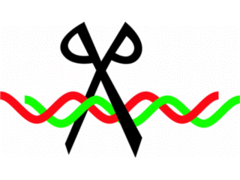
cut DNA at a specific base sequence
(eg donor DNA or plasmid)
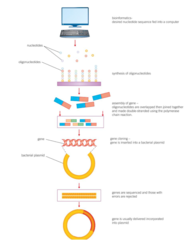
How can a fragment of DNA be produced by a gene machine?
computer used to generate DNA sequence
DNA nucleotides joined in a specific order by DNA ligase into short fragments of DNA
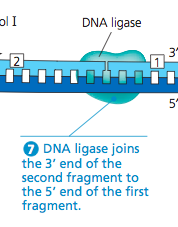
What does DNA ligase do?
joins DNA fragments together
by forming phosphodiester bonds between nucleotides
Name two methods for amplifying DNA fragments
polymerase chain reaction (PCR)
(*in vitro* method)
culture of transformed host cells
(*in vivo* method)
How can DNA fragments be amplified by an *in vivo* method?
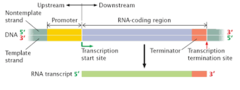
1) promoter and terminator regions added to DNA fragments
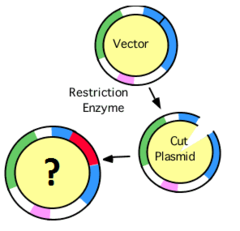
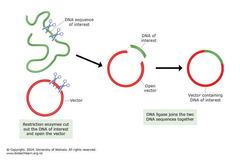
2) restriction endonucleases and ligases used to insert fragments of DNA into vectors
3) host cells transformed using these vectors
4) marker genes used to detect genetically modified (GM) cells/organisms
Why are promoter and terminator regions added to DNA fragments during in vivo cloning?
needed in order for the GM cell to produce a protein
the vector must have promoter regions (*initiate transcription*) and terminator regions (*halts transcription*)
What is the role of restriction endonucleases during in vivo cloning?
cuts section of plasmid vector with the same enzyme that cut the DNA fragment
leaves sticky ends (exposed DNA bases) complementary to those of the DNA fragment
What is the role of ligase during in vivo cloning?
joins plasmid and DNA fragment together by forming phosphodiester bonds between them
forms recombinant plasmid
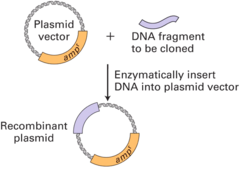
How are host cells transformed during in vivo cloning?
host cell takes up recombinant plasmid
plasmids and host cell mixed together in an ice cold solution then subjected to heat shock - increases permeability of bacterial cell wall
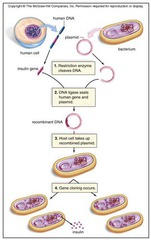
Why are marker genes used during in vivo cloning?
used to detect genetically modified (GM) cells or organisms
marker gene is a sequence of DNA inserted into the vector
if cell takes up the vector, it will express the protein associated with the gene
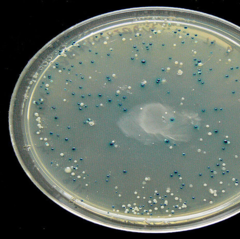
What is in a PCR mixture?
DNA fragment to be amplified
free DNA nucleotides
DNA polymerase
primers
What are primers?
short sequences of single stranded DNA that are complementary to the base sequence of and bind to the start of the fragment
allow DNA polymerase to initiate DNA replication
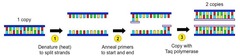
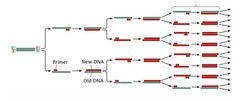
Describe the process of PCR
mixture heated to 95℃ to separate DNA strands by breaking hydrogen bonds between them
add primers and DNA nucleotides
cool to 55℃ so primers bind to complementary base sequences on DNA fragments
heat mixture to 72℃ - DNA polymerase attaches to primers and joins DNA nucleotides, forming new DNA strand
reaction will repeat, doubling amount of DNA each time
What are the advantages of recombinant DNA technology in agriculture, industry and medicine?
*agriculture:*
-create GM crops with higher yield or resistant to drought
*industry:*
-large quantities of enzymes produced quickly and cheaply
*medicine:*
-large quantities of vaccines produced rapidly
-create drugs with improved efficacy and safety
What are the disadvantages of recombinant DNA technology in agriculture, industry and medicine?
*agriculture:*
-transgenic crops could breed with wild populations, creating 'superweeds'
*industry:*
-a few large companies have near-total control of the market
-biotechnology may introduce toxins into supply
*medicine:*
-patent ownership may limit use of life-saving technologies
How can recombinant DNA technology be used in gene therapy?
mutated allele causing disease may be replaced with a healthy allele
mutated allele may be inactivated by inserting a section of DNA in it
What is a DNA probe?
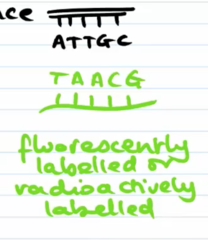
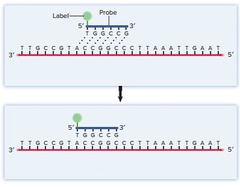
short, single stranded fragment of DNA with a base sequence complementary to the gene of interest
What are DNA probes used for?
to locate specific alleles of genes
can be used to screen patients for heritable conditions, drug responses or health risks
What is the differed between genetic screening and genetic fingerprinting?
Genetic screening involves locating specific alleles
Genetic fingerprint involves identifying an organism's VNTRS
How can labelled DNA probes and DNA hybridisation be used to locate specific alleles of genes?
1) extract DNA fragment and amplify using PCR
2) add restriction endonucleases to cut at specific base sequences to isolate the target gene
3) separate alleles using gel electrophoresis
4) DNA treated to form single strands
5) labelled DNA probe added and mixture cooled - it hybridises with complementary DNA fragment
6) sample washed to remove unbound probe
7) UV light shone on sample to see if it fluoresces OR autoradiography (exposure to xray film) to identify if specific alleles were present
How is screening individuals for genetically determined conditions and drug responses useful in genetic counselling?
can offer advice to individuals at risk of genetic disorders
allows informed choices about treatment options
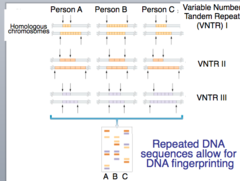
What are VNTRs?
variable number tandem repeats
short DNA base sequences that are repeated many times, found in non-coding regions
What is the probability of two organisms having the same VNTRs?
very low
What is genetic fingerprinting?
a technique that uses VNTRs to identify differences in organsims' DNA
analyses DNA fragments that have been cloned by PCR
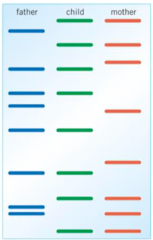
What two things can genetic fingerprinting be used to determine?
genetic relationships
genetic variability within a population
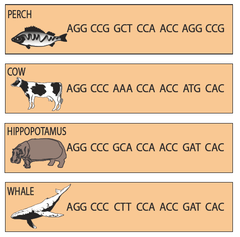
How can gel electrophoresis be used in the process of genetic fingerprinting?
1) DNA fragments extracted and amplified using PCR
2) restriction endonucleases isolate VNTRs
3) DNA mixture tagged (to be seen under UV light) and placed in wells in the gel
4) electric voltage is applied to the gel - phosphodiester backbone is negatively charged so DNA fragments move to positive end of the gel
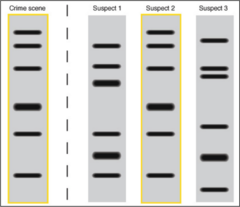
5) smaller DNA fragments move further along the gel, so pattern of banding of different DNA fragments can be compared
Give three applications of genetic fingerprinting
*forensic science* - identifying suspects
*medical diagnosis*
*animal and plant breeding* - to prevent inbreeding