h - Synthetic polymers

0.0(0)
Studied by 6 people
call kaiCall Kai
learnLearn
examPractice Test
spaced repetitionSpaced Repetition
heart puzzleMatch
flashcardsFlashcards
GameKnowt Play
Card Sorting

1/6

flashcard set

Earn XP

Description and Tags

4h (4.44-4.50)

Last updated 11:29 AM on 2/16/24
Name
Mastery
Learn
Test
Matching
Spaced
Call with Kai

No analytics yet

Send a link to your students to track their progress

7 Terms

1
New cards

Addition polymer

  • Polymers are made by joining up lots of small repeating units called monomers
    The monomers that make up addition polymers have double covalent bond

  • Lots of unsaturated monomer molecules can open up C=C double bonds + join to form polymer chains, called addition polymerisation
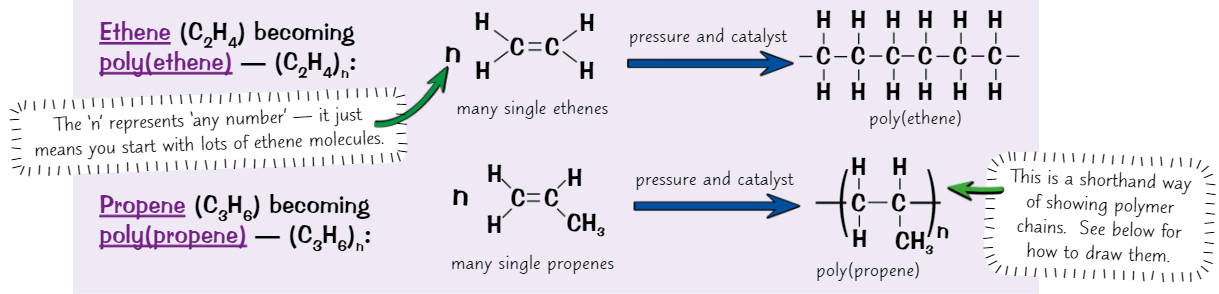
<ul><li><p><strong>Polymers</strong> are made by joining up lots of small repeating units called <strong>monomers</strong><br>The monomers that make up <strong>addition polymers</strong> have <strong>double covalent bond</strong></p></li><li><p>Lots of <strong>unsaturated monomer molecules </strong>can open up <strong>C=C</strong> <strong>double bonds</strong> + join to form <strong>polymer chains</strong>, called <strong>addition polymerisation</strong></p></li></ul>
2
New cards

Naming + formula of polymers

  • Name of from type of monomer it’s made from - put brackets around it + put ‘poly’ in front
    e.g. propenepoly(propene)

  • To get formula of polymer, put formula of monomer in brackets + put a small ‘n’ after
    e.g. C₃H₆ → (C₃H₆)ₙ

3
New cards

How to draw repeat unit of polymer

  • Join carbons together in a row with no double bonds, put pair of brackets around repeating unit, and put an ‘n’ after

  • Draw a bond from each of 2 carbons in chain that pass through brackets - shows that chain continues

  • To get displayed formula of monomer from displayed formula of polymer, do the reverse

  • Draw out the repeating unit of polymer, get rid of 2 bonds going out through brackets + put double bond between carbons
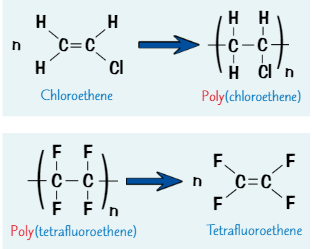
<ul><li><p>Join carbons together in a <strong>row </strong>with <strong>no </strong>double bonds, put pair of <strong>brackets</strong> around repeating unit, and put an ‘<strong>n</strong>’ after</p></li><li><p>Draw a bond from each of 2 carbons in chain that pass through brackets - shows that chain continues</p></li><li><p>To get <strong>displayed formula </strong>of <strong>monomer </strong>from displayed formula of <strong>polymer</strong>, do the reverse</p></li><li><p>Draw out the <strong>repeating unit </strong>of polymer, get rid of 2 bonds going out through brackets + put <strong>double bond </strong>between <strong>carbons</strong></p></li></ul>
4
New cards

Problems with disposal of addition polymers

  • Inert - don’t react easily because C-C bonds in polymer chain are very strong + not easily broken

    • so it takes long time for addition polymers to biodegrade (be broken down by bacteria/other organisms)

  • Burning plastics can release toxic gases

    • so it’s difficult to dispose of polymers → best thing is to reuse then recycle

5
New cards

Condensation polymerisation

  • Involved 2 different types of monomer

  • Monomers react together + bonds form between them, making polymer chains

  • Each monomer must contain at least 2 functional groups, one on each end of molecule

  • Each functional group can react with functional group of another monomer, creating long chains of alternating monomers
    For
    each new bond formed, a small molecule (e.g. water) is lost

6
New cards

Polyesters

  • Formed when dicarboxylic acid monomers + diol monomers react together

  • Dicarboxylic acid monomers contain 2 carboxylic acid (-COOH) groups + diol monomers contain 2 alcohol (-OH) groups

  • When carboxylic acid group reacts with alcohol group, forms ester link

  • Polyesters are condensation polymers - each time ester link forms, a molecule of water is lost
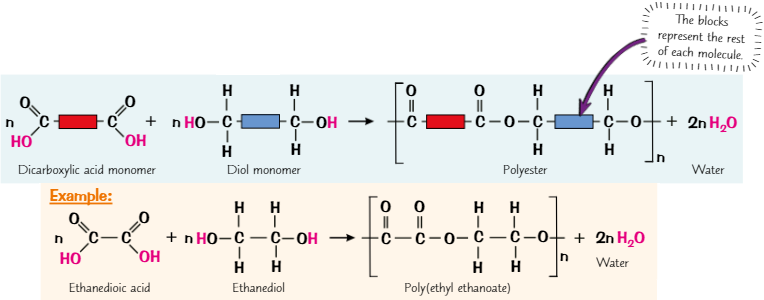
<ul><li><p><em>Formed when </em><strong><em>dicarboxylic acid monomers</em></strong><em> + </em><strong><em>diol monomers </em></strong><em>react together</em></p></li><li><p><strong><em>Dicarboxylic acid monomers</em></strong><em> contain </em><strong><em>2 carboxylic acid </em></strong><em>(-COOH) groups + </em><strong><em>diol monomers</em></strong><em> contain </em><strong><em>2 alcohol </em></strong><em>(-OH) groups</em></p></li><li><p><em>When carboxylic acid group reacts with alcohol group, forms </em><strong><em>ester link</em></strong></p></li><li><p><em>Polyesters are </em><strong><em>condensation polymers</em></strong><em> - each time ester link forms, a molecule of </em><strong><em>water </em></strong><em>is </em><strong><em>lost</em></strong></p></li></ul>
7
New cards

Biopolyesters

Biodegradable polyesters, known as biopolyesters, can be broken down by bacteria + other living organisms in environment over time

They decompose + don’t stay in landfill forever, reducing polymers’ pollutant effect

Explore top flashcards

flashcards
FRST 211 Final
41
Updated 1067d ago
0.0(0)
flashcards
Magnetism Flashcards
21
Updated 283d ago
0.0(0)
flashcards
Level H Unit 7
20
Updated 1203d ago
0.0(0)
flashcards
A&P Lab #4: Heart
68
Updated 1130d ago
0.0(0)
flashcards
BIO 101 Exam 3 (Chapters 7-10)
230
Updated 870d ago
0.0(0)
flashcards
FRST 211 Final
41
Updated 1067d ago
0.0(0)
flashcards
Magnetism Flashcards
21
Updated 283d ago
0.0(0)
flashcards
Level H Unit 7
20
Updated 1203d ago
0.0(0)
flashcards
A&P Lab #4: Heart
68
Updated 1130d ago
0.0(0)
flashcards
BIO 101 Exam 3 (Chapters 7-10)
230
Updated 870d ago
0.0(0)



