Muscular system
 Call Kai
 Learn
Learn Practice Test
 Spaced Repetition
 Match
Match Flashcards
 Knowt Play
1/23

Earn XP
Description and Tags
Sports science
Name | Mastery | Learn | Test | Matching | Spaced | Call with Kai | Chat |
|---|
No analytics yet
Send a link to your students to track their progress
24 Terms
Major functions of the muscular system?
Movement - muscles pull on the bone to move the skeleton.
Support/posture - Muscles contract isometrically for extended periods of time (muscle tone) in order for us to stay upright.
Maintain bodily functions - Produce heat or contract involuntarily when cold (shivering), Digest food. Initiate breathing.
How many muscles are there in the body?
600
What do muscles work in? (example)
Pairs. Example (Triceps, Biceps.)
What does the Muscular system help with?
Everyday movements such as running, jumping, kicking, swimming and swinging a bat to hit a ball are made possible by the intrinsic link between the Skeletal & Muscular Systems.
Anterior veiw and Posterior view — name all of the muscles.
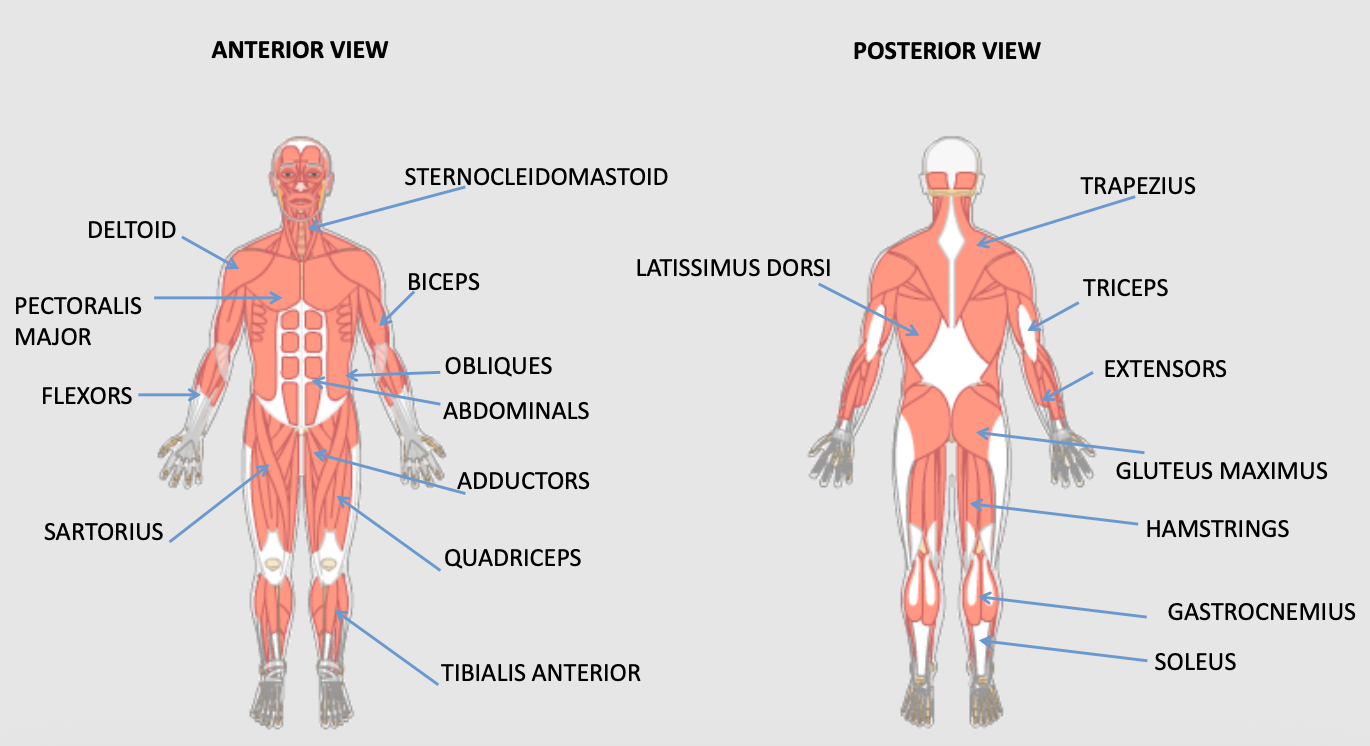
What are the three main types of muscles?
Skeletal - These external muscles (e.g. bicep, quadricep, tibialis anterior, etc) are attached to the bones that make up the skeleton. They are under your direct conscious control, so they are also known as voluntary muscles.
Smooth - Found in blood vessels and the walls surrounding many internal organs such as the intestine, bladder, stomach and diaphragm. They are known as involuntary muscles because you have no conscious control over them.
Cardiac - Cardiac muscles make up the walls of the heart. They are involuntary muscles and can be made stronger via exercise, allowing the heart to become more efficient.
What are the muscle attachments? (3)
Ligaments - Connect bones to other bones.
Tendons - Help muscles pull through the joint and on the bones as they contract.
Cartilage - Articular cartilage covers the bones’ surfaces where they articulate or meet to form the joint.
Articular cartilage has two primary purposes:
Smooth movement - Extremely slippery, articular cartilage allows bones to glide over each other as a joint moves (reducing friction).
Shock absorption - Articular cartilage acts as a shock absorber, cushioning bones against impacting each other during a weight-bearing activity, such as walking, jogging or jumping.
Origin and insertion
Origin - The origin is the site where a muscle is attached to a stable bone, which the muscle can pull against.
Insertion - The insertion occurs where the muscle attaches to a bone that is pulled by the action of the muscle.
How do muscles make movement?
Agonists and antagonists, they work as a team. While one contracts, the other relaxes to move.
Example: consider a biceps curl, which involves elbow flexion. The biceps brachii contracts and shortens and is responsible for flexing the elbow; because it causes movement, it is known as the agonist. To allow the biceps to contract, the triceps must lengthen and relax. Therefore, the triceps is known as the antagonist because it opposes the action of the biceps.
Reciprocal inhibition
Used to describe how muscles work in teams.
One muscle contracts and the opposite muscle relaxes to allow movement.
Example: Elbow flexion: Biceps = agonist, Tricep = antagonist.
Elbow extension - Biceps = antagonist, Tricep = agonist.
Types of muscular contractions
Isocentric - concentric and eccentric.
Isometric
Isokineric
Isocentric - Concentric, eccentric
Isocentric - Moving contraction whereby the length of a muscle changes.
Concentric - Muscle shortens
Eccentric - Muscle lengthens
Isometric
Contracting against a force with no significant movement occurring.
Example -
Pushing or pulling a door the opposite way.
Isokinetic contraction
speed or velocity of the movement is held constant regardless of the magnitude of force applied to the resistance
Muscle fibre types (twitch)
Slow twitch - Red fibres, contract slowly, produce low forces, able to perform for extended amounts of time.
Fast twitch - White fibres, contract fast, produce large forces, fatigue quickly, larger in diameter.
Muscle control
The muscle belly consists of thousands of muscle fibres. Near the end of a muscle, the fibres thicken and eventually become the tendon. A single muscle fibre is made up of many myofibrils.
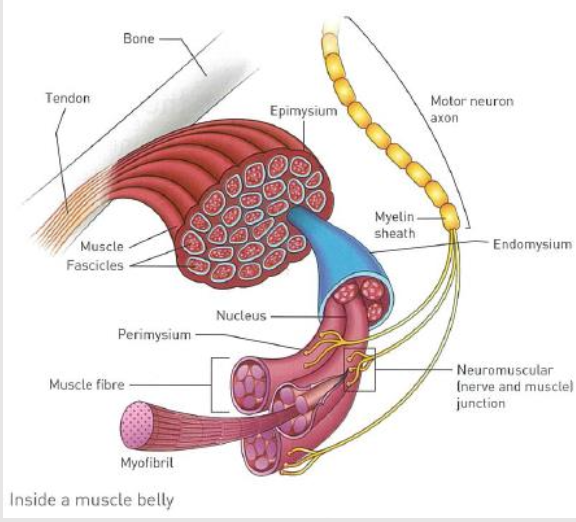
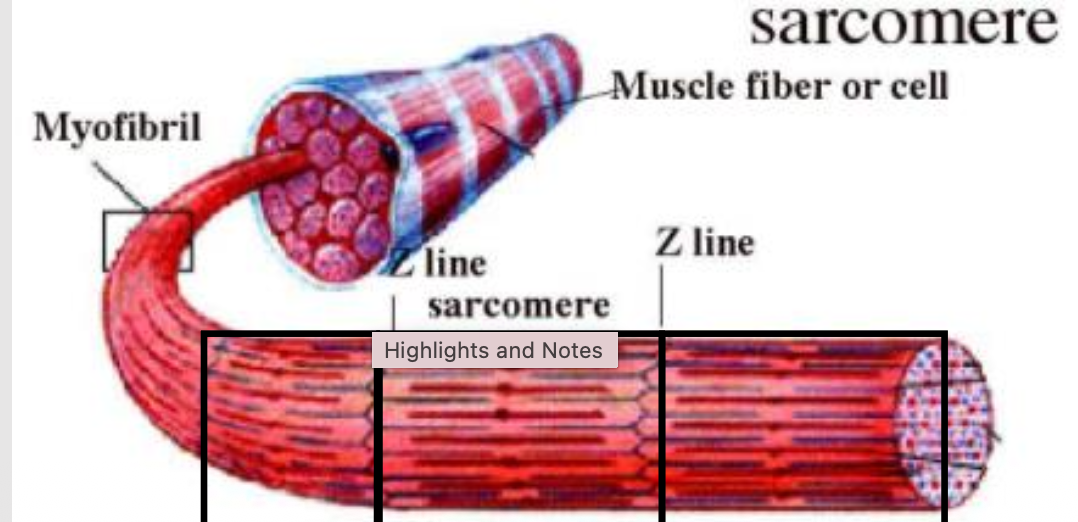
What is this?
These have many units, known as sarcomeres, which
are arranged end-to-end (like the carriages of a train).
The sliding filament theory
How muscles contract involves the myofilaments sliding across each other - the actin sliding over the myosin. This stimulates the myosin heads to conduct an oar-like projection and reach out to attach to the actin filaments (binding site), forming a cross-bridge. The cross-bridges pull the actin filaments towards the centre of the sarcomere and the muscle contracts. This happens thousands of times along the whole length of the muscle and results in a shortening of the muscle’s overall length. As the cross-bridges relax, the muscles lengthen and return to their normal resting state.
Effects of exercise
These effects can be categorised into 2 categories:
1. Short-term (acute) responses.
▪ An acute response refers to ‘an immediate response to one (or more) of the bodies
systems as a result of exercise’.
▪ These changes occur during the exercise bout.
2. Long-term (chronic) adaptations.
▪ A chronic adaptation refers to ‘the long term affects on one or more of the bodies
systems as a person sustains their exercise habit’.
▪ Adaptations usually can be seen long term, after 6+ weeks of training.
Short-term
Increase demand for fuel by the muscles.
▪ Increase in blood flow directed to the muscles being exercised.
▪ Increase demand for O2.
▪ Increased muscle fibre recruitment.
▪ Increase in waste products.
▪ Lactic acid.
▪ Can lead to muscle soreness.
▪ Carbon dioxide.
▪ Increase in muscle temperature
Long-term
Muscles become stronger.
▪ Muscles become bigger in size. This is known as hypertrophy.
▪ Usually larger cross-sectional development in MALES.
▪ 6-8 weeks for changes to be seen.
▪ Changes can be lost if not maintained.
▪ Decrease in size known as atrophy - as a result of a lack of exercise. ▪ Firmer looking body (muscle tone).
▪ Better posture.
▪ Increased strength of tendon & ligaments.
How are muscles attached to bones?
Muscles attach to bones across a joint via tendons.
How does the muscular system help with movement?
Each muscle does one of two actions — contract or relax. When a muscle contracts, it pulls on the bones it is attached to in order to create movement of a joint. Opposing muscles must relax to move.