Module 1: Properties + Structure of Matter
 Call Kai
 Learn
Learn Practice Test
 Spaced Repetition
 Match
Match Flashcards
 Knowt Play
1/44

There's no tags or description
Looks like no tags are added yet.
Name | Mastery | Learn | Test | Matching | Spaced | Call with Kai | Chat |
|---|
No analytics yet
Send a link to your students to track their progress
45 Terms
Mixture
can be separated into pure substances
Homogenous or heterogeneous
Properties change as relative amounts of each substance change
Varied composition
Pure substance
Can’t be separated
Homogeneous
Constant properties (e.g. colour, density)
Fixed composition
Impure substance
contaminated with other substances (mixture)
Homegenous
uniform composition
heterogeneous
non-uniform composition (irregular particles)
pure substances
elements/compounts
solution
homogeneous mixture, particles so small they don’t dissolve
suspension
heterogeneous, dispersion of particles that settle on standing
physical change
no new substance is formed (e.g. change of state, dissolving, separating)
chemical change
at least one new substance formed
sugns of chemical change
gas, precipitate forms, colour change, temp change, odor, solid disappears
physical properties
characteristics we can observe without changing into different substances (particle size, melting/boiling point, electrical conductivity, density, colour)
sedimentation + decantation
solids settle to bottom, liquid carefully poured off
separating dissolved solids
evaporation to dryness: liquid boiled off
crystalisation: solution becomes saturated, solute crystals form
distillation
solution boiled, vapour condesnced back into liquid + separated. 2 liquids can be separated if boiling points 40-50 degrees apart
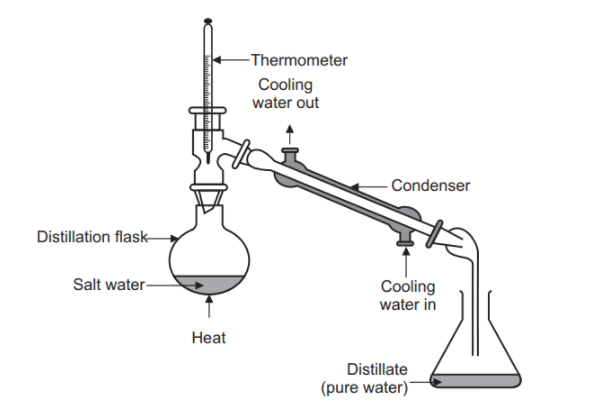
fractional distillation
mixture of liquids separated through many distillations (when boiling points are close together)
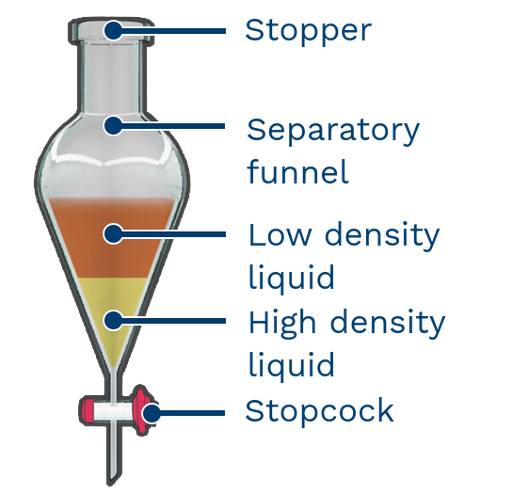
separating funnel
immiscible liquids (don’t become homogeneous) separate into distinct layers, denser at the bottom. bottom liquid drained out
chemical properties
chemical changes/reactions a substance undergoes when exposed to other substances, heat or light (reaction with oxygen, water, acids/bases, decomposition)
properties of metal elements
solids at room temp, shiny/lustrous, conductors of heat + electricity, maleable + ductile
elements in the same group share
similar chemical properties due to same number of valence electrons
isotope
variants of an element that have the same number of protons but different number of neutrons (can change physical properties slightly)
orbital
volume of space surround nucleus of atom through which 1 or 2 electrons randomly move. each orbital accomodates 2 electrons
sublevels/subshells
each shell is split into sublevels/subshells. each subshell is made up of orbitals. subshells: s(2 electrons), p,(6 electrons) d(10 electrons), f (14 electrons). 1st level has s subshell, 2nd has s and p, 3rd has s, p, d, 2th has s,p,d,f
s orbital shape
spherical
p orbital shape
dumbell/double pear
orbital notation
1s¹ (1: energy level, s: sublevel, ¹: no of electrons in orbital
electron configuration sequence
1s
2s 2p
3s 3p
4s 3d 4p
5s 4d 5p
6s 4f 5d 6p
7s 5f 6d 7p
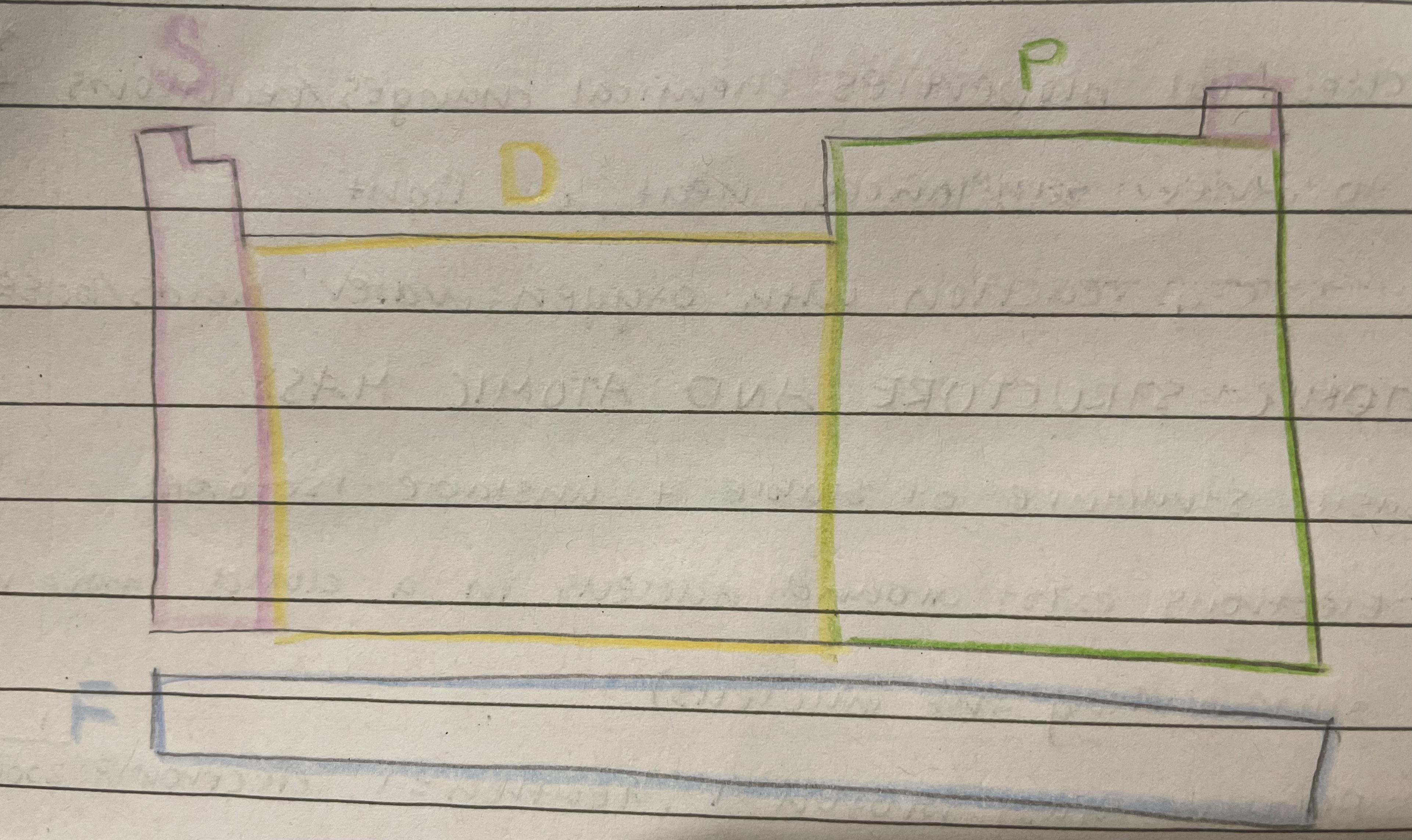
electron configuration sequence rule
d always 1 shell number behind, f always 2 behind
electron configuration shorthand
replace core shells with previous noble gas in brackets, then valence shell configuration (e.g. potassium: [Ar] 4s¹)
Carbon-12 scale
used to define all different types of relative mass, all elements mass is measured relative to the mass of carbon, which is 12
relative atomic mass
average mass of the isotopes present in the naturally occuring element
calculating relative atomic mass
relative isotopic mass x relative abundance + relative isotopic mass x relative abundance
relative molecular mass
add up relative atomic masses of each atom in molecule
relative formula mass
mass of repeating unit in a giant structure (used in ionic/ginat convalently bonded molecules)
Atomic emission spectroscopy
if we heat atoms to a high temperature (>1500°C), some electrons get excited out of their normal energy levels into higher energy levels, then after a short time, fall back to normal (ground) state. As they fall back to ground state, they release excess energy as visible, UV or infrared light (energy emitted = energy absorbed). The greater the amaound of energy released, the shorter the wavelength of radiation emitted (lots of energy = UV, medium = visible, low = infrared)
atomic emission spectrum
set of bright/coloured lines on black backgrounds representing different wavelengths emitted by atom, unqiue for each atom. Each line represents an electron that gets excited then emits photons of specific wavelengths. Some elements produce distinctive flame colours as one electron transition occurs more frequently than any others
flame colours
strontium: deep red, lithium: dull red, calcium: orange-red, sodium: yellow, barium: apple green, copper: blue-green, potassium: lilac
Bohr theory
electrons move around the nucleus in fixed orbits, when they absorb energy they move to larger radius orbits. electrons can only have certain discrete energies
Schrodinger theory
treated electrons as waves, they move at extremely high speeds + fairly randomly through orbitals around the nucleus. Lead to the idea of energy levels, sublevels + orbitals