Biology Unit 4 AOS 1
 Call Kai
 Learn
Learn Practice Test
 Spaced Repetition
 Match
Match Flashcards
 Knowt Play
1/60

There's no tags or description
Looks like no tags are added yet.
Name | Mastery | Learn | Test | Matching | Spaced | Call with Kai | Chat |
|---|
No analytics yet
Send a link to your students to track their progress
61 Terms
What is an antigen?
Any molecule that triggers an immune response
What is a self antigen? What are the 2 types?
Self antigens are located on the surface of cells, the immune system does not attack them. 2 types:
MHC Class I markers: found on all nucleated cells
MHC Class II markers: found on specialised cells of the immune system
What are non-self antigens?
The immune system recognises non-self antigens as foreign and will try to attack. This includes allergens which are a type of antigen that triggers an allergic reaction.
What are pathogens? What are the 2 types?
Pathogens are disease-causing agents. 2 types:
Cellular: made up of cells, can be prokaryotic or eukaryotic, replicable via sexual or asexual reproduction. Includes bacteria, fungi, parasites, and protists.
Non-cellular: non-living pathogens, dormant without a host, need to utilise machinery of the host to replicate. Includes prions and viruses.
What is phagocytosis?
The process by which a phagocyte engulfs and digests a pathogen or other foreign material.
What are lysosomes?
Organelles containing digestive enzymes that break down engulfed material (Including lysozymes).
What are cytokines?
Signalling molecules that attract immune cells to the site of infection, and promote inflammation by triggering mast cells to release histamine.
What is antigen presentation?
Pathogen antigens are displayed on MHC Class II markers on the cell’s surface.
What is degranulation?
Release of chemicals stored in granules into surrounding cells
What are death ligands?
Signalling molecules that trigger apoptosis in a cell
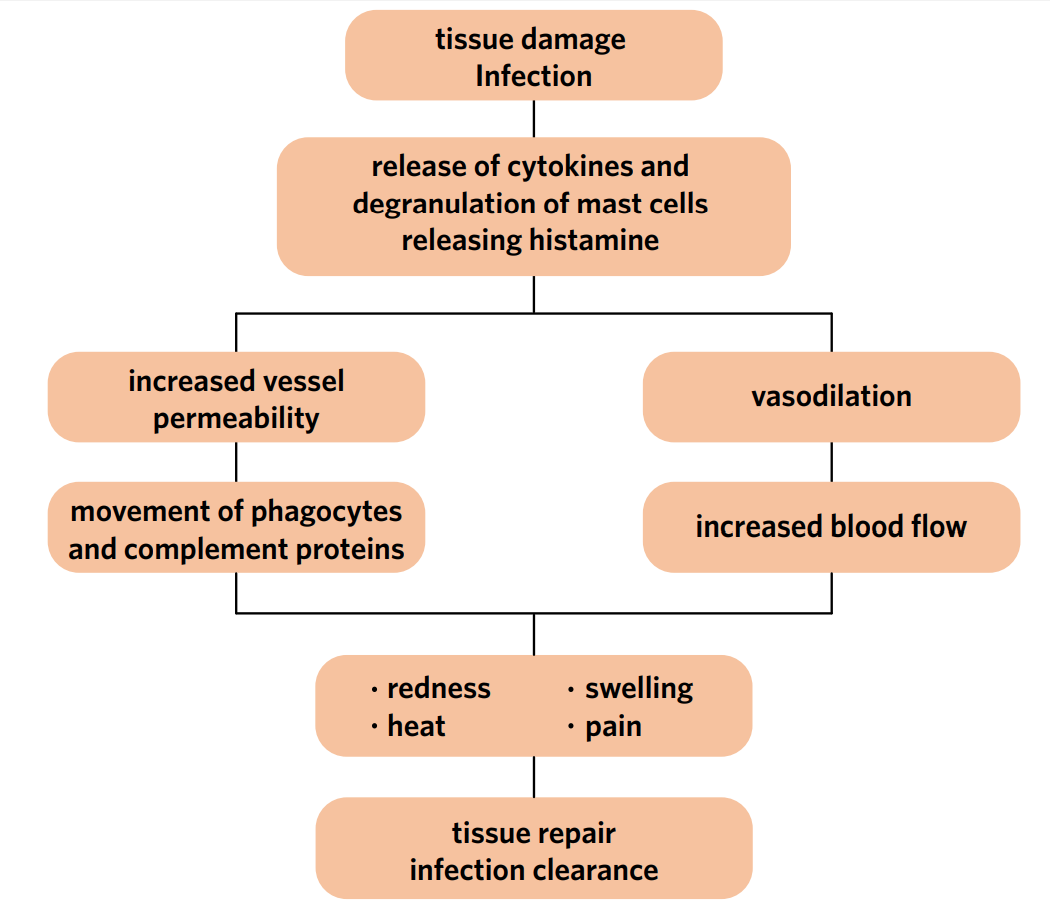
What is an inflammatory response?
Caused by the release of histamine, an inflammatory response is an innate immune response characterised by redness, swelling, heat, and pain.
What is vasodilation?
The widening of blood vessels to increase blood flow into tissue
What is capillary permeability?
Increased movement of fluid, proteins, and leukocytes from capillaries into surrounding tissues.
What is histamine?
A chemical released by mast cells that promotes inflammation by causing vasodilation and increases capillary permeability
What are complement proteins?
Plasma proteins that assist in the destruction and removal of pathogens
What is chemotaxis?
The movement of immune cells towards a site of infection in response to chemical signals
What is opsonisation?
The binding of complement proteins to the surface of a pathogen, enhancing recognition and phagocytosis
What is cell lysis?
The bursting of a cell due to disruption of its membrane
What is the innate immune response?
Involves the 1st and 2nd line of defence
It is non-specific: its response to foreign antigens is general, same regardless of the pathogen type
It responds quickly, within minutes or hours to slow the spread of pathogens around the body, allow a localised response, and allow the body more time to determine a specific response to the pathogen
What are physical barriers?
In animals: they prevent and/or slow the entry of pathogens into the body
Includes the skin, mucus, cilia, linings of the respiratory, gastrointestinal, and genitourinary tracts
In plants: they prevent and/or slow the entry of pathogens
Includes thick bark, waxy cuticle, formation of galls or other structures that can isolate infected tissue, thorns that deter herbivores and some insect vectors, closure of stomata to prevent pathogen entry
What are chemical barriers?
In animals: they inhibit the growth and development of pathogens and/or destroy pathogens
Includes lysozyme enzymes in tears and saliva (destroys bacterial cell walls), acidic sweat (inhibits pathogens growth, supports good bacteria, destroys cell membranes of invading bacteria), stomach acid, antibacterial proteins in semen, low pH of the vagina
In plants: they inhibit the growth and development of pathogens and/or destroy pathogens
Includes production of antimicrobial chemicals and toxins, chemicals that interfere with pathogen metabolism/growth/reproduction and chemicals that repel insects and herbivores that may transmit pathogens (e.g.chitinases, phenols, defensins, oxalic acid, glucanases)
What are microbiota barriers?
In animals: they are non-pathogenic bacteria that prevent the colonisation and proliferation of pathogenic microorganisms by competing for space
Includes normal microbiota on the skin and in the lower gastrointestinal tract, and microbiota in the vagina
What are the cellular components of the innate immune response - 2nd line of defence?
Leukocytes: white blood cells
Phagocytes: a type of leukocyte that engulfs and digests pathogens, cellular debris, and other non-self materials through phagocytosis
Granulated cells: leukocytes that contain granules (membrane-bound vesicles) filled with chemicals that can be released during infection, inflammation, or allergic responses
Name and describe the 3 types of phagocyte
Neutrophils: rapid responders, perform phagocytosis once then self-destruct. Dead neutrophils contribute to pus.
Macrophages (APC): can perform multiple rounds of phagocytosis, releases cytokines, displays antigens on its MHC II marker in the adaptive immune system, cleans up
Dendritic cells (APC): can perform multiple rounds of phagocytosis, releases cytokines, displays antigens on its MHC II marker in the adaptive immune system
Name and describe the 3 types of granulated cell
Natural killer cells: recognise infected or abnormal self cells (e.g. viral-infected, self), releases death ligands, destroys infected or abnormal cells with insufficient MHC I markers
Mast cells: causes inflammation through the release of histamine
Eosiniophils: degranulate, releasing toxic chemicals mediators to destroy invading pathogens
What are the 3 non-cellular components of the innate immune system?
Cytokines, specifically interferons: released by viral-infected cells that signal to neighbouring cells that viral infection is present and stimulates the production of antiviral proteins
Complement proteins: react with each other and aid in the destruction of pathogens via opsonisation, attraction of phagocytes to pathogens, and the formation of membrane attack complexes (MAC)
Fever: increased body temperature that helps to inhibit the growth and reproduction of some pathogens, increases metabolic activity and immune cell function to enhance the immune response, and can damage host cells if prolongs or is extreme
Describe the inflammatory response
The inflammatory response is triggered by the release of histamines from mast cells. The key events are:
Vasodilation: blood vessels dilate/widen, causing increased blood flow at the site of injury and allowing more leukocytes to arrive in the area. This causes redness and heat at the site of injury (heat increases metabolic rate so cells can repair faster)
Increased permeability of blood vessels: leaky blood vessels (walls of blood vessels permeable to fluid), helps leukocytes move from blood vessels to neighbouring tissue (site of injury). This causes swelling, and excess fluid is taken back up into the lymphatic system
Attraction of phagocytes: cytokines signal and attract phagocytes (neutrophils, macrophages, etc.) to the site of injury. Histamine can also signal to attract phagocytes. These phagocytes then go on to engulf and destroy the pathogen (perform phagocytosis).
What is the adaptive immune response / second line of defense?
Specific: responds to each particular pathogen in a unique and tailored manner
Creates immunological memory: results in production of cells that allow the body to respond to future exposure of previously encountered pathogens quickly and effectively
What are lymphocytes? What are the 2 types?
They are a type of leukocyte
Each lymphocyte has a different receptor to a particular antigen
Each lymphocyte is able to create clones (proliferate) = clonal selection and expansion
2 types:
B cells / B lymphocytes (B stands for bone marrow, where they begin and mature!)
Key role in the humoral immune response
Differentiate into plasma cells and B memory cells
T cells / T lymphocytes (T stands for thymus, where they mature! {although they also begin in the bone marrow})
Key role in the cell-mediated immune response
Differentiate into cytotoxic T cells (TC), T helper cells (TH), and T memory cells
Lymphocytes monitor and scan lymph for pathogens and antigen-presenting cells (APCs) displaying foreign antigens, initiating the adaptive immune response
What is humoral immunity?
Involves the action of plasma cells that produce antibodies
What is cell-mediated immunity?
Involves the action of T lymphocytes including T helper cells and cytotoxic T cells
What are the 4 key components of the lymphatic system?
Lymph
Lymphatic vessels
Primary lymph tissue
Secondary lymph tissue
What is lymph?
Fluid that is taken up into lymphatic vessels from surrounding tissues, transports immune cells such as lymphocytes and phagocytes, returns excess tissue fluid to the bloodstream
What are lymphatic vessels?
A network of vessels throughout the body that transports lymph, carries lymph from tissues to lymph nodes before returning it to the bloodstream
What is primary lymph tissue?
Responsible for the production and maturation of lymphocytes, includes bone marrow and thymus (B and T cells are produced in bone marrow, B cells mature in the bone marrow, T cells travel to the thymus and mature there)
What is secondary lymph tissue?
Includes lymph nodes and spleen, contains mature lymphocytes
What is the role of the lymphatic system?
Production of lymphocytes in primary lymphoid tissues
Transports APCs to secondary lymphoid tissues where antigen recognition by mature lymphocytes takes place and the adaptive immune response is activated
How does antigen recognition work?
Mature lymphocytes are found in clusters in secondary lymphoid tissues \
They scan passing lymph for foreign antigens, including pathogens and APCs (cells with MHC II markers displaying foreign antigens from pathogens consumed by phagocytosis, APCs are usually macrophages, dendritic cells which are most important for activating TH cells, and B cells)
If a foreign antigen matches the receptors of a specific TH cell, this initiates the adaptive immune response
Activated TH cells release cytokines (interferons), which coordinate the adaptive immune response by activating other immune cells
Depending on which cells are activated, the adaptive immune response proceeds via:
Humoral immunity / immune response: activation of B cells to produce antibodies (extracellular)
Cell-mediated immunity / immune response: activation of TC to destroy infected body cells (intracellular)
What are the 2 types of adaptive immunity? What are their subtypes?
Natural: acquired unintentionally, without medical intervention
Active: a person develops their own antibodies and memory cells
Passive: antibodies created by a natural external source
Artificial: acquired intentionally, by means of medical technology
Active: a person develops their own antibodies and memory cells after getting vaccinated
Passive: antibodies created by a natural external source
Describe natural active immunity
Individual’s own immune system encounters and responds to a pathogen, creating its own antibodies and memory cells for the pathogen
Natural: occurs without medical intervention
Active: person’s own immune system is creating antibodies and memory cells
Describe natural passive immunity
Individual acquires antibodies from a natural, non-medical source
Via breastfeeding: human breast milk contains antibodies produced from the mother’s immune system
Via the placenta: some antibodies produced by the mother are able to cross the placenta and enter the foetus’ bloodstream via the umbilical cord
These methods are very helpful, as babies have poorly developed adaptive immune systems
Describe artificial active immunity
Individuals own adaptive immune system produces antibodies and memory cells as a result of medical intervention, primarily vaccinations.
Describe artificial passive immunity
Individual acquires antibodies from an external source via medical intervention
For example, receiving antivenom for a snake bite contains snake venom antibodies that will neutralise the venom but it does not lead to active immunity as the antibodies they recieve will not trigger the production of memory cells
Describe the steps in the cell-mediated response
INTRACELLULAR
(in the lymph)
An APC, such as a dendritic cell, engulfs a pathogen by performing phagocytosis and presents its antigens
The APC presents the antigen on MHC II to a specific TH cell with a complementary T cell receptor. This activates the TH cell and it then releases cytokines which cause clonal expansion, producing many TH cells that have the complementary receptor to the specific antigen
The APC also presents the antigen on MHC I to a specific TC with a complementary T cell receptor, the TC then binds to its complementary antigen
TH cells release more cytokines to initiate clonal expansion of the specific TC , producing many identical copies
(in the blood)
TC travels from lymph to the rest of the body, binding to any infected cells displaying the target antigen on their MHC I marker
TC releases chemicals that tripper apoptosis in the infected cell, killing it
(in the lymph)
Some of the activated T lymphocytes (TH and TC) form memory T lymphocytes, which enable a faster and stronger response upon subsequent exposure to the same antigen
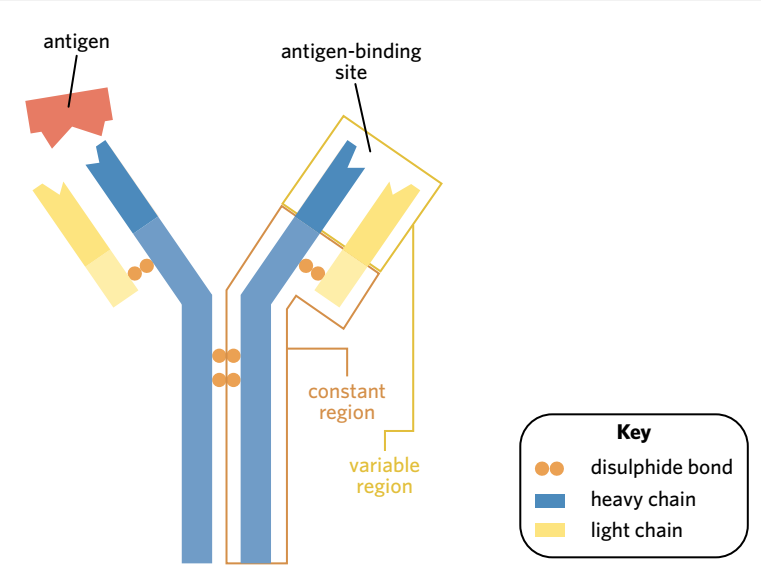
Draw the structure of an antibody with labels
Describe the humoral immune response
EXTRACELLULAR
An APC, such as a dendritic cell, engulfs a pathogen by performing phagocytosis and presents its antigens
A specific B cell with unique antibodies on its surface encounters the APC OR free antigen OR pathogen, and binds to the complementary antigen using its B-cell receptor
The B cell engulfs and processes the antigen (endocytosis), then presents the antigen on its MHC II molecules
An previously activated TH (by binding to an APC) recognises the antigen presented on MHC II by the B cell and releases cytokines, which activate the B cell
The activated B cell undergoes clonal expansion due to the cytokines, producing many of the same specific, complementary B cells
The B cells differentiate into plasma cells and memory B cells
The plasma cells produce and secrete large amounts of antibodies specific to the antigen. These antibodies bind to their complementary antigen and assist in agglutinating, neutralising, immobilising, opsonising, and removing the pathogen
Memory B cells remain in the body, enabling a faster and stronger humoral immune response upon subsequent exposure to the same antigen
What are intracellular threats?
Pathogens or dangers inside host cells
Immune system uses cell-mediated immunity (via T cells) to:
Destroy virus-infected cells
Destroy abnormal or cancerous cells
Attack transplanted organs (organ rejection)
Examples of intracellular threats:
Viruses (e.g. HIV, influenza)
Cancer cells (from genetic mutations)
Key cell: cytotoxic T cells
What are extracellular threats?
Pathogens outside of cells, in places such as the bloodstream
The immune system uses humoral immunity (via B cells) to:
Produce antibodies that bind to pathogens
Neutralise invaders before they infect cells
Examples of extracellular threats:
Bacteria
Viruses before they enter cells
Key cell: B-cells
Describe the allergic response
(first exposure, mild reaction)
Allergen is introduced into the body
B cell inappropriately recognises the allergen as a pathogenic antigen and undergoes clonal selection and differentiation
Plasma cell produces IgE antibodies
Secreted IgE antibodies bind to mast cells
Allergen binds to specific IgE antibodies on surface of mast cells
Histamine is released via degranulation, leading to a mild inflammatory response (redness, swelling, heat)
B memory cells remain in the body
(second exposure, severe reaction)
Allergen is re-introduced into the body, body responds more quickly to produce more IgE antibodies
IgE antibodies bind to surface of mast cells more quickly, releasing more histamine and creating a more severe inflammatory response
Physiological effects of histamine release occur, including vasodilation and increased mucus secretion
Symptoms of allergy, including mild symptoms such as sneezing, itchy/runny/blocked nose, red eyes, rash, wheezing, through to severe symptoms such as shortness of breath, swollen lips, and death
Once a person has been exposed or has had an allergic reaction, even a very limited exposure to a very small amount of allergen can trigger a severe reaction
IgE antibodies can remain fixed to mast cell for weeks-months
Distinguish between infectious and