Immunology Unit 2 - Antigens and Antibodies
 Call Kai
 Learn
Learn Practice Test
 Spaced Repetition
 Match
Match Flashcards
 Knowt Play
1/114

There's no tags or description
Looks like no tags are added yet.
Name | Mastery | Learn | Test | Matching | Spaced | Call with Kai | Chat |
|---|
No analytics yet
Send a link to your students to track their progress
115 Terms
Antigen (Ag)
any substance that has the ability to interact w/ a B-cell receptor (BCR), T-cell receptor (TCR), or antibody (Ab)
Immunogen
substance capable of inducing an immune response
all are antigens
Hapten
a molecule that is too small alone to be immunogenic
elicits an immune response only when attached to a carrier molecule (e.g. protein)
Antibodies are made against the hapten-carrier aduct (combination of protein carrier and hapten)
when do haptens elicit an immune response?
only when attached to a carrier molecule like a protein
Abs are made against the hapten-carrier adduct

Epitope
an antigenic determinant — the site on a complex antigenic molecule which combines with an Ab, BCR, or TCR
Very small: 6-12 a.a’s or monosaccharide molecules
antigens are often multivalent — carry two or more of different _____ or may have more than one copy of the same _____ (repeated several times)
Valency: number of ____/molecule
antigenic determinant
the site on a complex antigenic molecule which combines with an Ab, BCR, or TCR
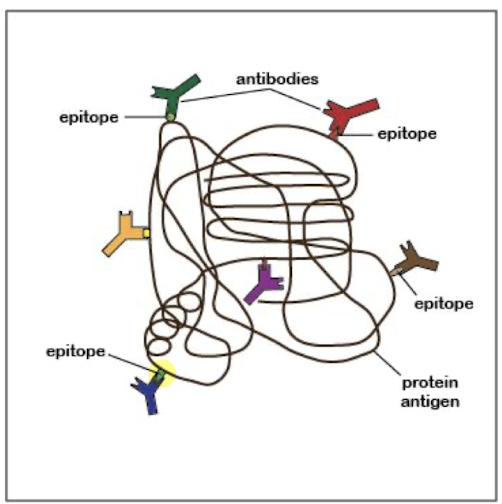
multivalent
carrying two or more different epitopes or more than one copy of the same epitope (repeated several times)
Valency
number of epitopes/ molecule
what are the two parts that interact during Ag binding
Epitope on antigen binds to Ag paratope
Paratope (antigen-binding site) region on the antibody that binds to an epitope
is the epitope on the Ag or Ab
Ag → binds to Ab paratope
is the paratope on the Ag or Ab
Ab → binds to the Ag epitope
Immunogenicity
the inherent ability of an immunogen to stimulate an immune response resulting the formation of antibodies or activation of immune lymphocytes (e.g. T-cells)
Antigenicity
capacity of Ag or hapten to bind Ab, BCR, or TCR
-Specific reactivity— where it will bind, how it will bind
Heterologous (heterophile) antigens
related Ag from another species
-capable of stimulating the production of abs that react w/ cells/tissues of other animals/plants
what are the aspects of the physical nature of immunogens
Foreignness → degree recognized as non-self
Size/degrability → large antigens must be able to be processed, must be stable in vivo
Complexity → size and foreignness aren’t enough→ larger, more complex molecules, and/or multivalency = more effective immunogens
what is foreignness as a physical nature of immunogens
Degree recognized as non-self
Greater the phylogenetic difference, the greater the immune response
Size/ degradability as the physical nature of immunogens
large antigens must be able to be processed (i.e. digestible by phagocytotic cells)
must be stable in vivo (sufficient retention time) to stimulate immune response
Complexity as the physical nature of immunogens
size and foreignness aren’t enough
usually larger molecules, >10kDa are better immunogens
Better immunogens have more antigenic sites (epitopes) → multivalent
More complex molecule= more effective immunogen (ex. complex proteins)
Must contain amino acid or monosaccharide sequence variation
Polysaccharides→ cross-linking improves immunogenicity
Lipids and nucleic acids are generally weak immunogens
Synthetic polymers have a few simple, repeating units, poor immunogens (ex. foreign body implants)
what improves immunogenicity in polysaccharides?
cross-linking
what size molecules are typically better immunogens?
typically larger molecules, >10 kDa
what must be contained in an amino acid or monosaccharide sequence to be an immunogen
needs variation
what molecules/ substances are typically weak immunogens?
Lipids and nucleic acids
synthetic polymers (few simple, repeating units)
do better immunogens have more or less antigenic sites?
more, multivalent
what is another term for immunoglobulins?
antibodies and gamma (y) globulins
what are immunoglobulins/ antibodies produced by
by B-cells (B-lymphocytes, plasma cells)
where are most antibodies (but not all) isolated during serum protein electrophoretic separation
gamma globulin fraction of serum
where is IgG and most other immunoglobulins usually separated into during serum protein electrophoresis
Gamma (Y) band
where is IgA separated into during electrophoresis?
Typically right before gamma fraction in the beta fraction
What are typically antigens/ immunogens
In nature these are usually either carbohydrates or proteins because surface molecules of pathogens are typically glycoproteins, polysaccharides, glycolipids, or peptidoglycans.
what is an example of a hapten?
Urushiol, which is the toxin found in poison ivy. When absorbed through the skin from a poison ivy plant, urushiol undergoes oxidation in the skin cells to generate the actual hapten, which then covalently binds to skin proteins to form hapten-carrier adducts.
Antigens may have ______ and bind to a specific Ab or cell receptor, but may not have immunogenicity if they do not stimulate an immune response upon binding.
antigenicity
what are the strongest immunogens?
complex proteins
In nature lipids and nucleic acids are usually complexed with what molecules?
proteins or carbohydrates
in the context of immunology, by themselves they are weak immunogens
what are the five human classes (isotypes) of antibodies
IgG, IgM, IgA, IgD, and IgE
what specific proteins/antibodies show up in the Gamma band/fraction during protein serum electrophoresis?
IgG, IgM, IgE, CRP
what specific proteins/antibodies show up in the alpha 1 band/fraction during protein serum electrophoresis?
alpha-1-antitrypsin
what specific proteins/antibodies show up in the alpha 2 band/fraction during protein serum electrophoresis?
ceruloplasmin, haptoglobin
what specific proteins/antibodies show up in the beta band/fraction during protein serum electrophoresis?
transferrin, C3, IgA
globulins
a family of globular proteins that have higher molecular weights than albumin and are insoluble in pure water but dissolve in dilute salt solutions.
The lightest globulins are the alpha globulins, which typically have molecular weights of around 93 kDa, while the heaviest class of globulins are the gamma globulins, which typically weigh about 1193 kDa.
what are the various parts of the chemical structure of immunoglobulins
Monomer: basic 4-polypeptide chain structure that resembles the letter Y
Two light chains (L chains): k (kappa) or λ (lambda)
Two heavy chains (H chains): gamma, mu, alpha, delta, or epsilon
Variable (V) region: amino-terminal region (N-terminus)
On Fab fragments (fragment antigen binding) → 2 (one for each chain)
Sequence difference on both chains VH and VL
3 small hypervariable regions: HV1 (CDR1), HV2 (CDR2), and HV3 (CDR3) → make antibodies different from one another
Constant (C) region: carboxy-terminal region (C-terminus)
Includes Fc fragment (fragment crystallizable)
Biological activity, mediates effector functions → cells have receptors for Fc portion of antibody
J chain: IgM and dimeric IgA only → links monomers together, helpful for transport of antibodies across lumen
Secretory component: IgA only → most frequent Ab in mucosal areas; protects from proteolytic enzymes and loosely binds to mucous so it’s not cleared

what is the monomer of an Ab?
basic 4-polypeptide chain structure that resembles the letter Y
what are the possible light chain isotypes that Abs can have?
either κ or λ light chains, not both (2 of one type).
no functional difference between them
what are the types of heavy chain that Abs can have?
gamma (IgG), mu (IgM), alpha (IgA), delta (IgD), epsilon (IgE)
what proportion of Abs in humans have kappa chains vs. lambda chains
2/3 are kappa, 1/3 lambda
what is each antigen binding site formed by on Abs?
one heavy-chain variable region and one light-chain variable region.
The variation in sequences in the paired chain regions creates the great diversity of antigen-binding specificities
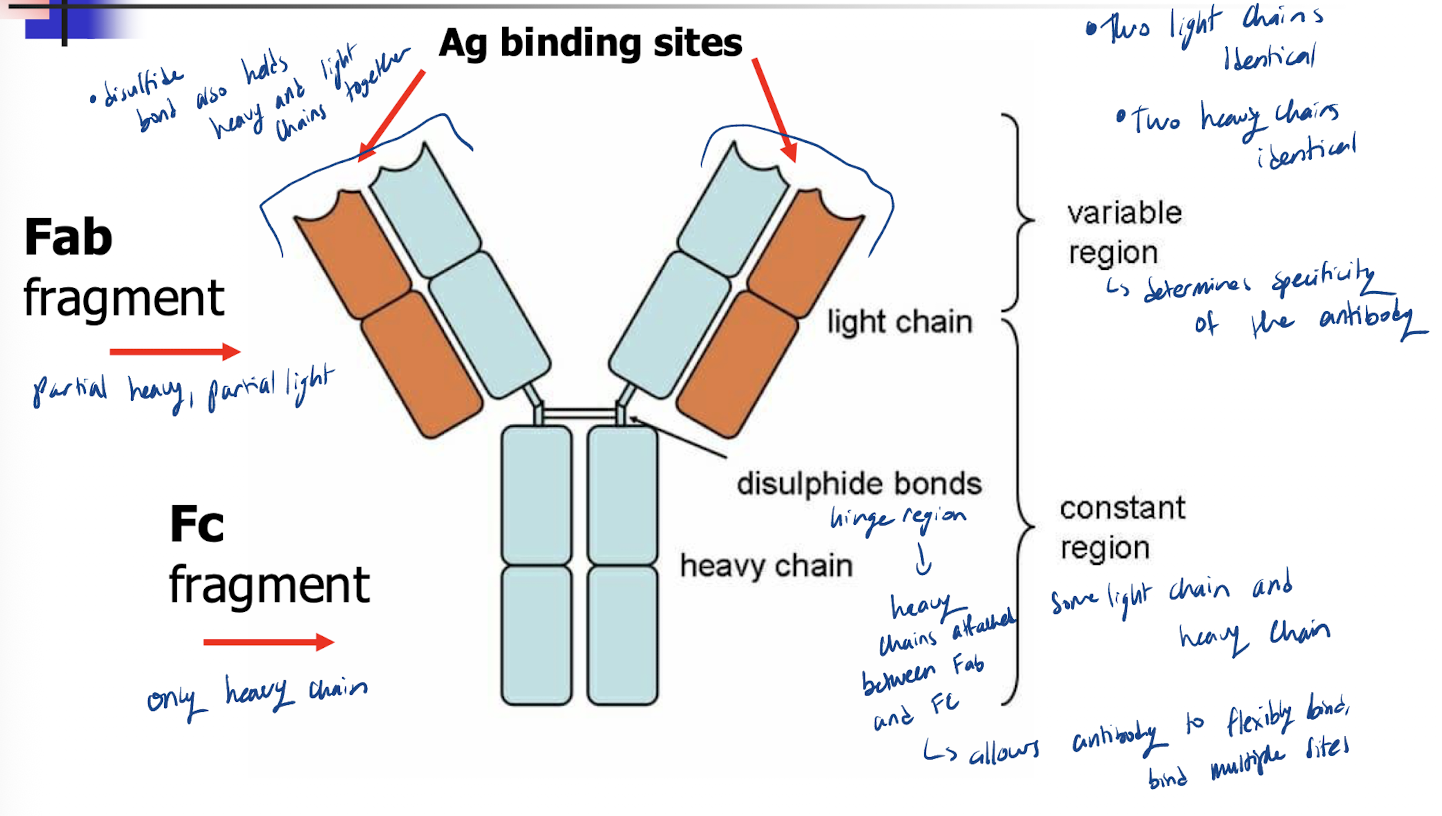
what chains make up the variable region and the constant regions in the Ab
variable→ top half of the Fab fragment→ light and heavy chain
constant→ bottom half of Fab fragment—> light and heavy chain; Fc fragment→ heavy chain

Why are hypervariable regions in Abs also known as complementarity determining regions?
they provide a binding surface complementary to that of the antigen
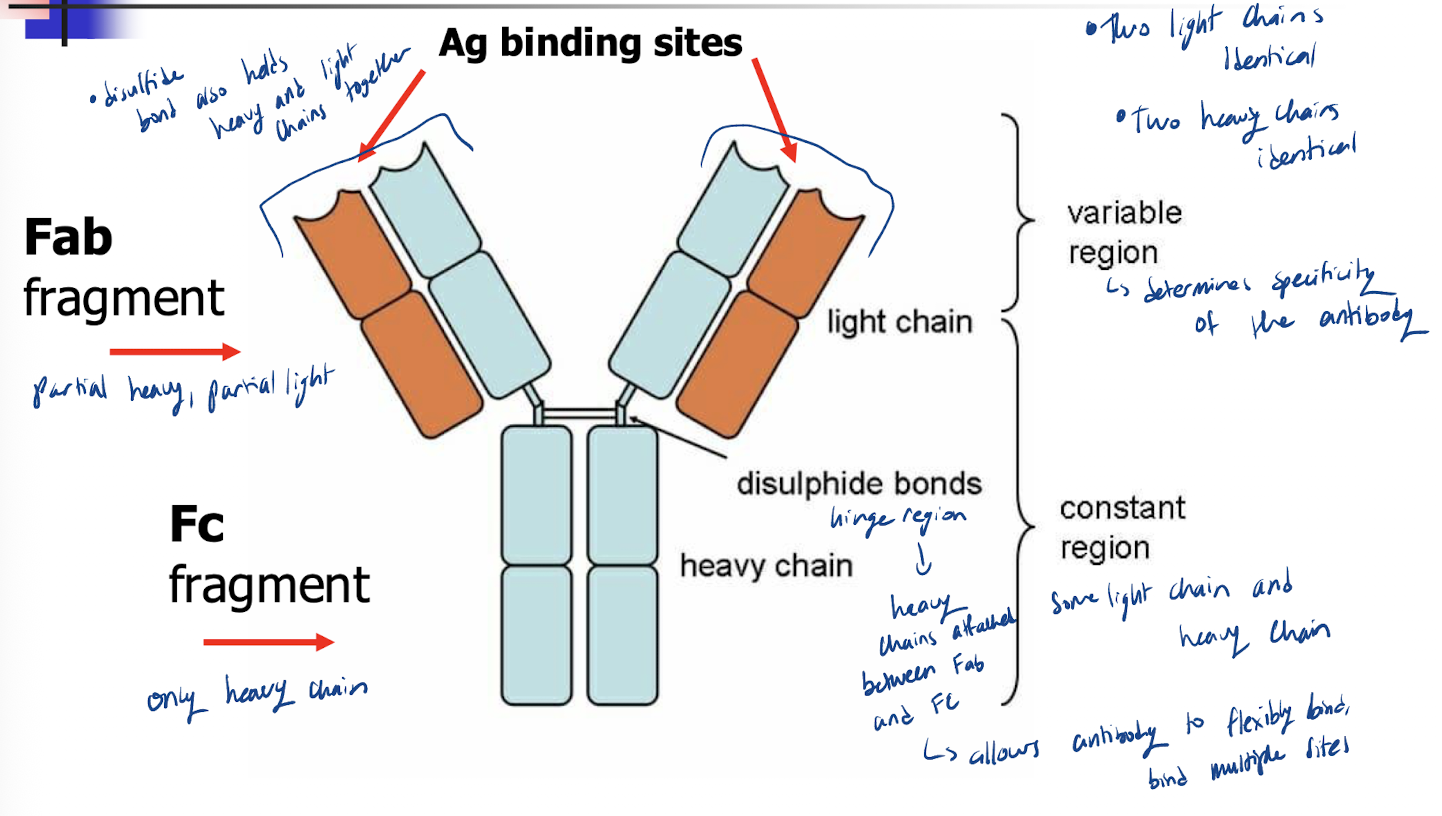
where is the variable region (amino-terminal region) on Abs
on Fab fragments (fragment antigen binding)
sequence differences on both the heavy and light chains (VH and VL)
Three small hypervariable regions w/i: HV1 (CDR1), HV2 (CDR2), HV3 (CDR3) → make Abs different from one another

what are elements of the constant region (carboxy-terminal region)
Includes Fc fragment (fragment crystallizable)
Biological activiy, mediates effector functions
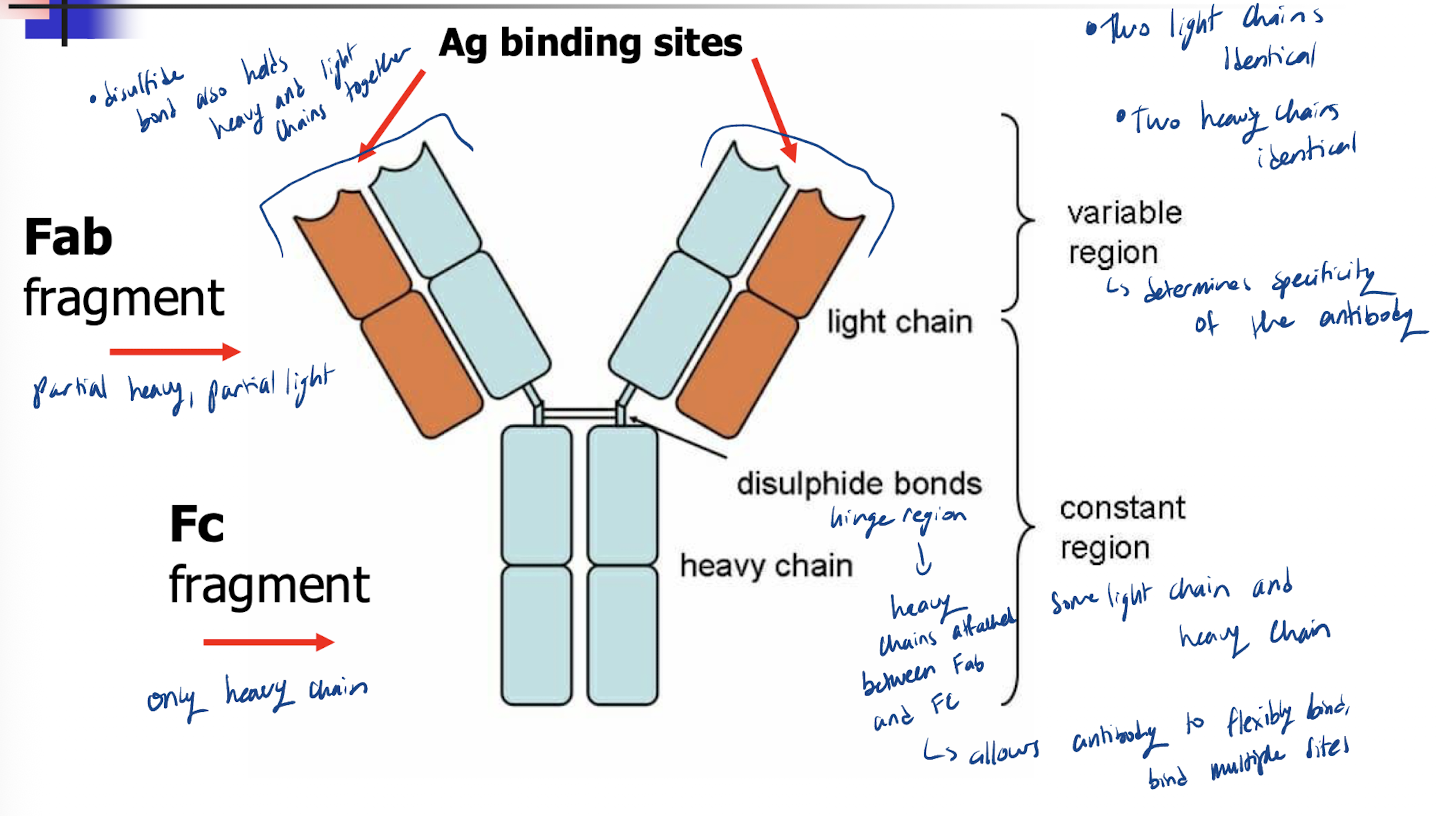
what chains of the Ab are included in the Fab and Fc fragments respectively?
Fab → partial heavy, partial light
Fc→ only heavy chain

what links the Fab fragment to the Fc fragment in an Ab and acts as flexible hinges?
heavy chain regions w/ disulfide bonds
allows the two Fabs to adopt a variety of spatial configurations→ Ab can bind Ag tightly w/ both Fabs even when spaced apart
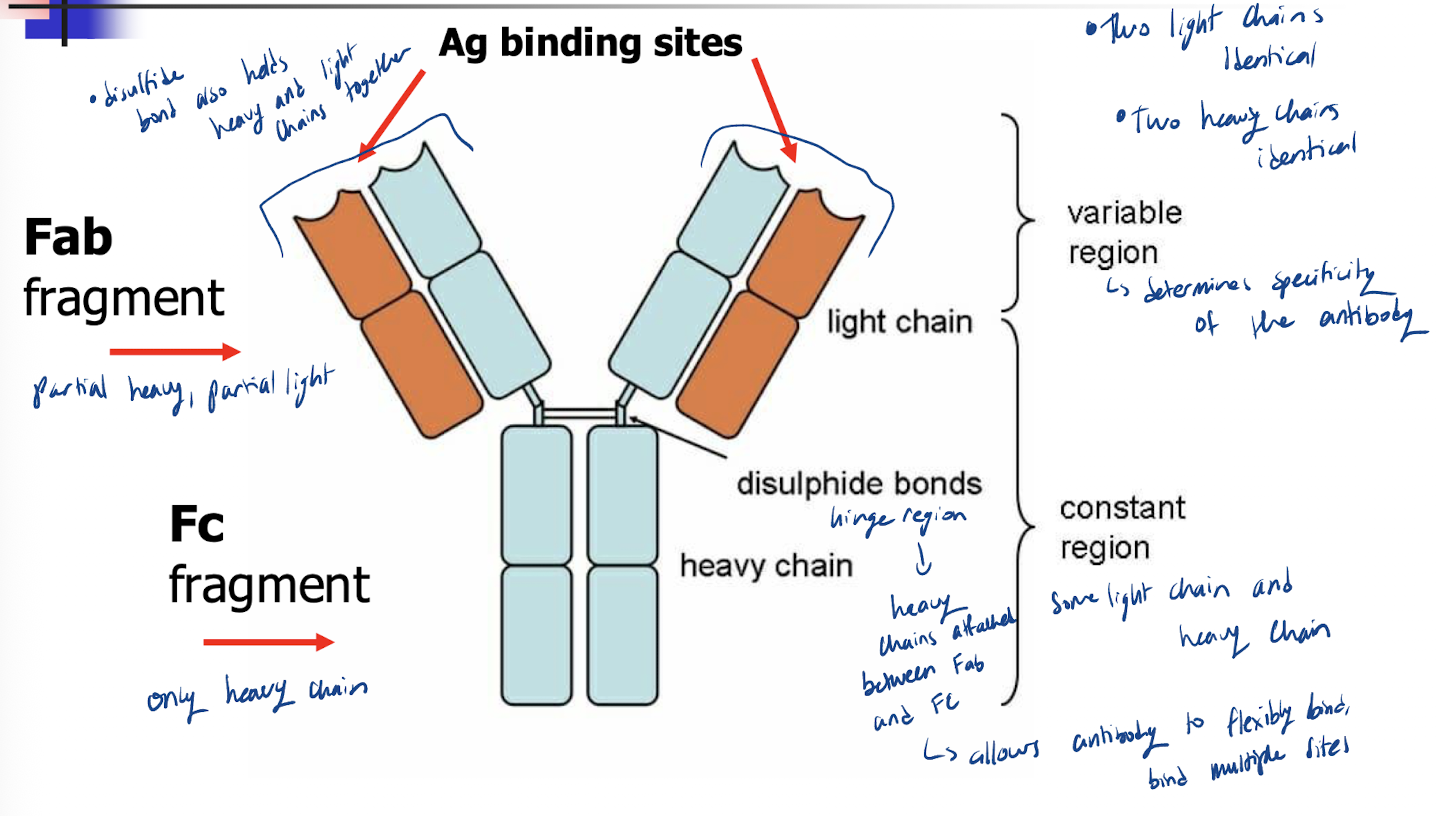
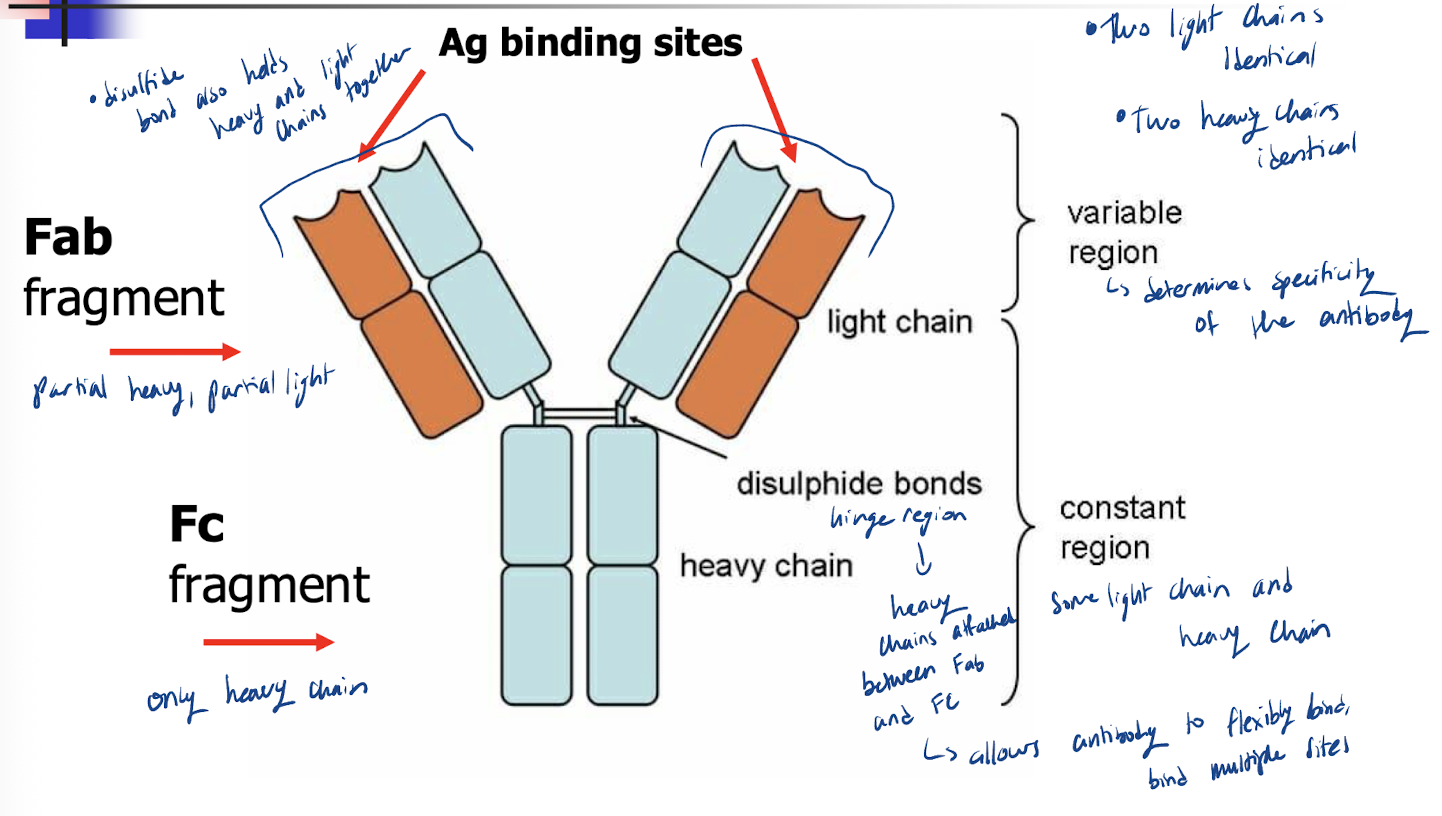
what holds together the two heavy chains and the heavy chains to the light chains (Fab region) in an Ab
disulfide bonds
what Abs have J chains?
IgM → holds together pentamer
dimeric IgA → holds together two monomers

what Ab has a secretory component?
IgA → most frequent Ab in mucosal areas
protects from proteolytic enzymes and loosely binds to mucous so it’s not cleared by the body
what is the J chain required for?
required for IgM or dimeric IgA to be secreted into the mucosa to protect the mucosal epithelia.
small 137 residue polypeptide that regulates the multimerization of IgM and IgA by disulfide bonds.
required for Ig transport across the mucosal epithelium. The _____ is bound by the epithelial cell receptor, taken up via endocytosis, and released into the apical surface (lumen).
what does the secretory component do?
wrap around two IgA monomers joined by a J chain protein fragment resulting in a configuration with each of the two antigen binding regions of the two constituent y-shaped antibodies exposed.
protect IgA antibodies from degradation by the gastric acids and enzymes of the digestive system→ especially important in the transfer of immune system components during breastfeeding.
can IgM and IgA be monomers?
IgM → no, is only a pentamer
IgA→ can be dimeric or a monomer
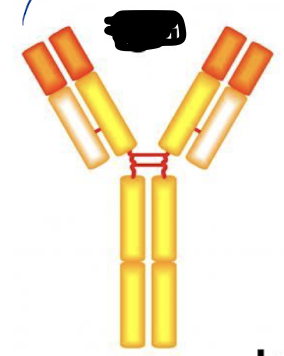
Identify the Ab in the picture
IgG

Identify the Ab in the picture
IgE

Identify the Ab in the picture
IgD
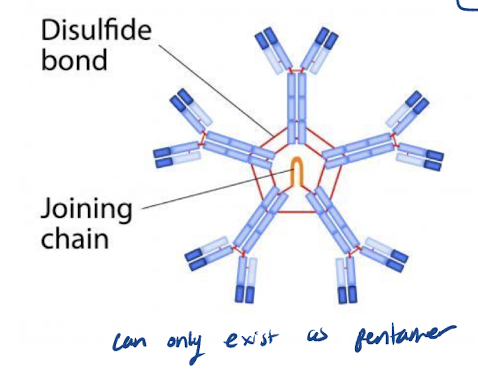
Identify the Ab in the picture
IgM
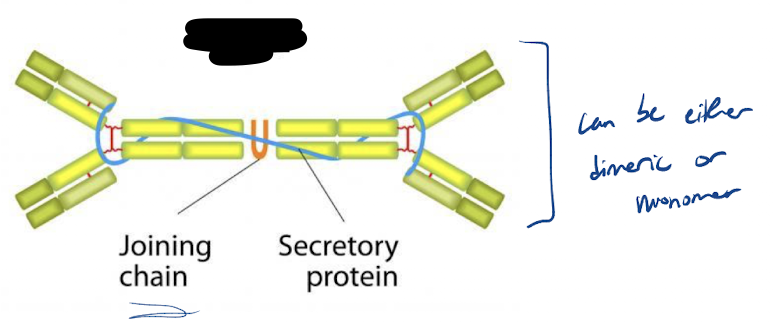
Identify the Ab in the picture
IgA
what are the different shapes of antigen binding sites on the Fab fragments that Abs can have?
Pocket → small, compact epitopes on Ags
Grooves→ unfolded polypeptides bind
Extended surface → larger epitopes
Knob → Ab paratope intrudes into epitope pocket in Ag

what does the pocket antigen binding site bind?
small, compact epitopes on Ags

what does the groove shaped antigen binding site bind?
unfolded polypeptides
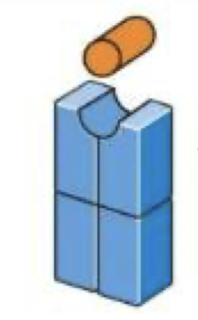
what does the extended surface shaped antigen binding site bind?
larger epitopes
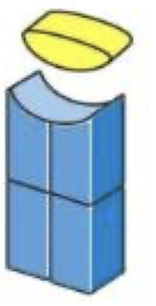
what does the knob shaped antigen binding site bind?
antibody peritope enters Ag epitope

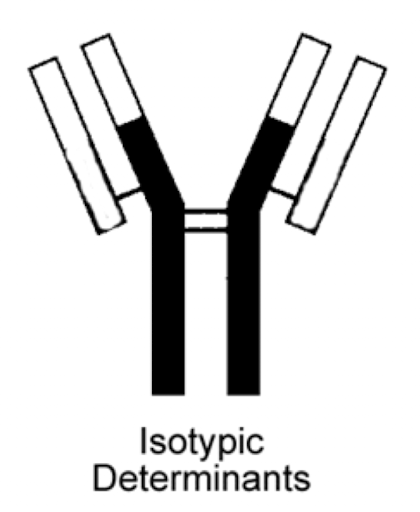
what are the determinants on immunoglobulins?
Isotypes: five main types or classes (G, A, M, D, E) and some subclasses (IgG → 4; IgA→ 2; no subclasses for the rest)
Determined by the heavy chains
Allotypes: multiple alleles for the same Ab (e.g. different alleles for all four IgG subclasses)
Determined in the constant region
Idiotypes: unique amino acid sequence of VH and VL domains
Determined in the variable region
What are idiotypes in the context of determinants of Abs and what are they determined by?
unique amino acid sequence of VH and VL domains
Determined in the variable region

what are allotypes in the context of Ab determinants and what is it determined by?
multiple alleles for the same Ab (e.g. different alleles for all 4 IgG subclasses)
Determined in the constant region

how many isotypic subclasses do IgG and IgA have respectively?
IgG→ 4
IgA→ 2
What are aspects of the isotype determinant of Abs and what is it determined by
five main types or classes (G, A, M, D, E) and some subclasses (IgG has 4; IgA 2; no subclasses for the rest)
Determined by the heavy chains
what is the most abundant Ab, making up 75% of total serum Ab?
IgG
also has the longest half-life and is a monomer
what subclasses of IgG activate complement?
IgG3 (most effective), then IgG1 and IgG2
IgG4 doesn’t activate it
C1q must cross-link 2 or more IgG
what is the only Ab that can cross the placenta so that at birth, human babies have the same level of this Ab as their mother?
IgG
what antibody has the best anamnestic Ab and rapidly increases after second exposure to an antigen?
IgG
what is IgG very good at doing to pathogens?
neutralizing them
makes it so they’re no longer infectious and can then be phagocytosed
how does IgG work as an opsonin (subclasses, affinity)
IgG1 and IgG3 have high affinity for FcR on phagocytes
what does the Fc portion of IgG1, IgG2, and IgG4 bind to in relation to pathogens?
Protein A produced by Staphylococcus aureus
Ab gets stuck facing the wrong direction and immune cells can’t recognize the Ab
IgG3 doesn’t get stuck and can still work on S. aureus
What is the order of abundance of the subclasses of IgG?
IgG1, IgG2, IgG3, IgG4 → numbered in decreasing order of abundance in the serum
what is the half-life of the subclasses of IgG
IgG1, 2, 4= 21 days
IgG3= 7 days
when are IgG molecules actively transported via the Fc portion to a baby in a pregnant woman?
beginning in the 2nd trimester
what percent of total serum Ab does IgM make up and what is its half-life?
5-10%, 6 days
when can IgM be a monomer?
only on the surface of a B-cell
what Ab has the highest possible valence of all antibodies?
IgM → pentamer → 10 antigen binding sites
where is IgM generally confined due to its large size?
intravascular spaces
J chain can enhance transport across mucous membranes
what is the first Ab produced, early after antigenic exposure (primary response) and has little anamnestic response?
IgM
what Ab is excellent at agglutination and is used in diagnostic tests?
IgM
why does IgM activate complement better than IgG
it’s a pentamer, so it doesn’t need multiple Abs to activate the pathway
after binding to pathogens, it can change its conformation to the ‘staple’ or ‘crab’ form to expose its five binding sites for C1q
What Ab binds to FcR on white blood cells?
IgM
what percent of total serum Ab does IgA make up, in what forms, and what is the half life?
10-15% of serum
Monomer (blood) and dimer (mucous membranes)
6 days
what is the most predominant Ab in secretions: tears, saliva, breast milk, intestinal secretions, genital secretions, and other mucous membranes?
breast fed infants may recieve up to 1g/ day
IgA
what component does IgA have that protects it against proteolytic enzymes?
secretory component
how does IgA in a baby’s gut protect it from pathogens?
it binds microorganisms, preventing attachment to the gut epithelium and facilitating expulsion in the feces → natural passive immunity
what percent of total serum Ab is IgD and what is its half-life?
<1% of total serum Ab and 3 day half-life
what Ab is found on the surface of B lymphocytes (as a BCR) and functions in the activation of B cells?
IgD
what percent of total serum Ab is IgE and what is its half-life?
<.01% and half-life of 2 days
Can IgE function as a soluble antibody?
no, it works as a cell-surface receptor
rapidly extracted from circulation by these cells
does not dissociate once bound keeping cell receptors loaded for weeks to months
what cells have high affinity receptors (FcεRI) for IgE
Mast cells and basophils
what Ab is a very potent activator of allergic reactions?
IgE