Bio chapter 14-16
 Call Kai
 Learn
Learn Practice Test
 Spaced Repetition
 Match
Match Flashcards
 Knowt Play
1/91

Earn XP
Description and Tags
TT1 Y11
Name | Mastery | Learn | Test | Matching | Spaced | Call with Kai | Chat |
|---|
No analytics yet
Send a link to your students to track their progress
92 Terms
Nervous system
Control movement by sending electrical impulse along neuron
Neuron
Network of specialized cells
Control Nervous System (CNS)
brain, spinal cord
impulse - receptor - effector
Peripheral Nervous System (PNS)
other nerve
to and from CNS
Synapse
in between 2 neuron (Axon terminal and Dendrites)
move in 1 direction
though diffusion
Reflex Arc
Automatic response to a stimulus to minimize damage on body
-response of effector
-involuntary response, don’t use brain as coordinator of reaction
Pathway
Receptor - sensory - relay - motor - effector
Sensory Neuron
long, nucleus middle
sense organ - CNS
Relay Neuron
shortest, fast
many dendrites
Motor Neuron
long
CNS - effectors (skin/glands)
Axon
insulated by fatty sheath
‘e’ impulse jump from node
Schwann cell
Fatty Sheath from around Axon
Connect to other neuron to receive impulse to form network
Sense organ
Detect change in internal and external environment and stimulate electrical impulse in response
Antagonistic Muscle
Pair of muscle that work together , one contracts the other relax
BCC
Bright Circular Contract
DRC
Dim Radical Contract
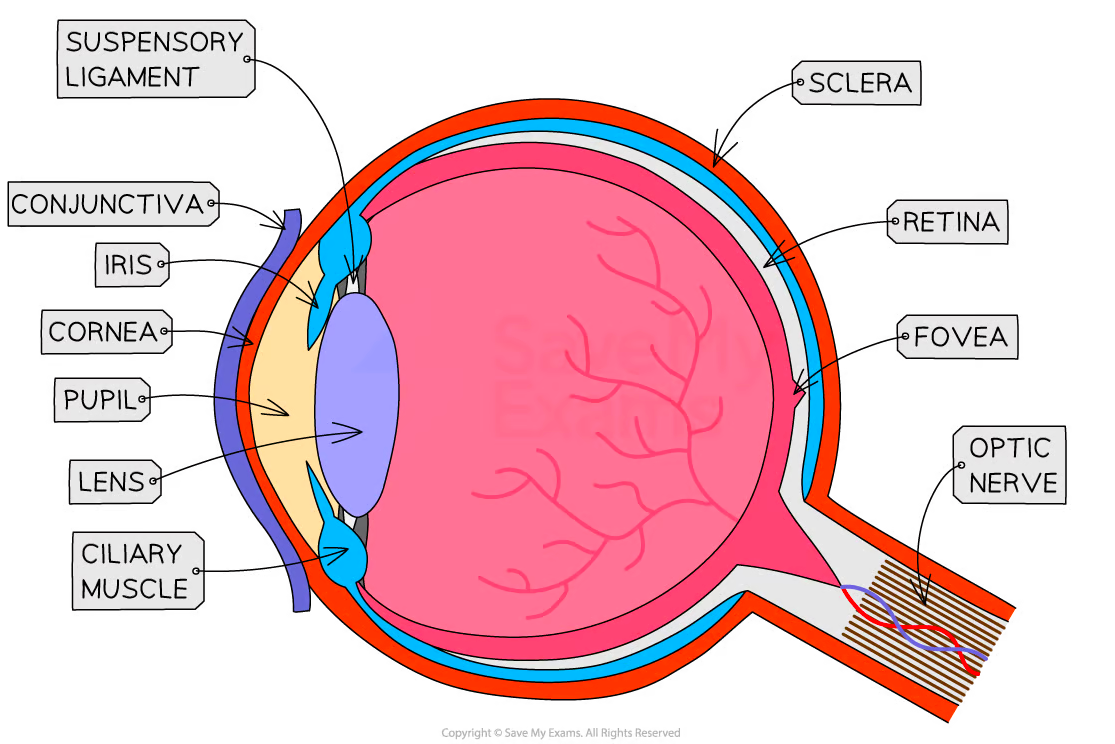
Structure of eye
Cornea - transparent , protect + referact light
Iris - control amount of light entering
Pupil - allow light into eye (eye color)
Retina - contain cone and rod cell
Optic nerve - carry electrical impulse to brain
Lenses - change shape and focus on light on retina
Pupil Reflex
Protect Retina from damage in bright light and not seeing in dim light
Cone cell
high concentration in fovea
for color, bright light
3 type (red.green.blue)
Rod cell
everywhere but in fovea
black and white
Dim light
pupil dilate, allow more light in
DRC = radical contract
Bright light
pupil contract, precent too much light to entering and damage retina
BCC = circular contract
Distant, Far
lenses thin
suspensory ligament tight
ciliary muscle relax
refract less light
Flow
cornea - aqueous humor - pupil - lense - vitreous humor - retina
Hormones
Chemical Substance produce by glands carried by blood which alters the activity of one or more specific target organ.
help control growth, metabolism , homeostasis
Endocrine Gland
Produce and release hormone into bloodstream
Adrenal, Ovaries, Testes
Ductless Gland
Excrete hormone into blood, travel to target audience and cause change in cell
Adrenal Gland
produce adrenaline hormone (flight/fight response in danger)
increase blood glucose concentration
Adrenaline
increase heart rate (pump faster + deeper)
increase breathing rate (inhale more O)
increase pupil diameter (let more light in)
Pancreas
Produce insulin ( decrease glucose con.) and glucagon (increase glucose con.)
Nerve vs Endocrine system
nerve faster + short term ,endo slow + long term
nerve electrical impulse , endo chemical hormone
nerve CNS: brain, spinal cord , endo: glands+ muscle
Testes Vs Ovaries
produce testosterone, male hormone
produce oestrogen , female hormone
Homeostasis
Maintain constant internal environment in organ despite external changes for optimal environment for body to function
Flow
Receptor (sense change in eni. send info to CC in B/SC)
Control center ( brain effector G/M respond to stimuli)
Effector (output/corrective action to reverse change)
Liver
change of glucose to glycogen(insulin) or glycogen to glucose(glucagon)
Brain
Detect change in internal body temperature
Hypothalamus (monitor temp in blood as it pass though brain)
Air
Good conductor of heat
Cold
Blood vessel away skin contract
skeletal muscle contract+ relax = shivering = more energy release = heat from muscle
hair erector muscle contract = hair stand up = trap heat
produce less sweat
Hot / Increase in body temperature
blood vessel need skin dilate = more blood
heat loss increase
hair erector relax= hair lie flat = trap less heat
produce more sweat
hormone that increase con. of glucose
Adrenaline and glucagon
Tropism (movement)
Response by plant towards/away from external form one direction
Phototropism
respond of plant to or away light source
Gravitropism
respond in which plant grow to or from gravity
Auxin (plant hormone)
at shaded area of plant
transport down shoot
elongation at shady site = grow faster = bend towards light
Diabetes Mellitus (can’t control glucose conc)
Type 1 = lack insulin
Type 2 = lack insulin receptor
Antibiotic (Penicillin, Fungi Penicillium)
Kill bacteria by cell bursting / inhabit growth of bacteria
Antibiotic resistant
bacterial mutate due to natural selection
become immune to antibiotic , when antibiotic release some not kills
so become resistant and reproduce
Prevent Antibiotic Resistant
finish full course of antibiotic ensure all bacteria die
only use antibiotic for serious infections
Asexual reproduction
a process which results in reproduction of genetically identical offspring
1 parent
no fusion of gamete
no mix genetic information (clone)
Sexual Reproduction
A process involving fusion of nuclei of 2 gamete cell to form zygote
2 parent
fusion of gamete
genetic diversity
Fertilization
Fusion of gamete nuclei
Gamete
Haploid (23 chromo)(only in sex cell)
Zygote
Diploid cell (46 chromo)(fertilized egg cell)
Sexual Reproduction : pros + cons
more genetic diversity
less vulnerable to disease
disease doesn’t spread easily
not killed by same pathogen
require 2 parent
slower process
need more enrgy
Asexual Reproduction : pros + cons
faster reproduction
consistent offspring
energy efficient
no need pollination
disease spread easily
can be killed by same pathogen
no genetic diversity
vulnerable to disease
Making more of the same kind of organism
Both asexual and sexual reproduction
Male part of plant
Anther , filament
Female part of plant
Stigma , Style, Ovary (Ovule)
Pollen grain
egg cell /male sex cell
Pollination
Transfer of pollen grain from anther to stigma
Sepal
Protect unopen flower
Petal
brightly colored to attract pollinating insect
Anther
Produce and contain pollen grain
Filament
Hold anther up
Stigma
Collect pollen form insect / air (sticky/long)
Style
Allow pollen tube to travel egg and distribute pollen (link stigma to ovary)
Ovary (inside is ovule)
produce female sex cell and keep in ovule
Self - Pollination
Transfer of pollen grain from anther to stigma of the same or different flower on the same plant
decrease genetic variation
limit adaptability of offspring to change in environment condition
use less energy
no need attract pollinating insect
Cross Pollination
Transfer of pollen grain from anther to stigma of a same flower on different plant of same species
(air / animal)
increase genetic variation
depend on pollinator except wind
can adapt and more resistant to disease
Germination
Start of growth in seed that contain zygote which develop into embryo plant and grow into seedling
Water (swell = seed coat split + embryo start grow)
Oxygen (respiration = growth)
Temperature (enzyme work in optimum temp)
Production of plumule
Emerging shoot
Production of Radical / Pumule
Emerging root / Shoot
Food for plant when germination
in cotyledon
supply seedling with food + energy for growth
until plant grow leave = photosynthesis
Fertilization in plant
pollen grain reach stigma
pollen tube is from down the style
pollen grain go down pollen tube to ovary
pollen grain fuse with egg cell
zygote forms
Germination
oxygen
temperature
water
Male Prostate gland
Prostate gland - produce fluid (semen) that provide sperm cell with nutrients
Sperm duct - sperm pass to mix with fluid then go gland then ejected
urethra - carry urine and sperm , ring of muscle in urethra prevent mix
testis - produce sperm + testosterone
scrotum - sac what support testes outside of body ensure kept at optimum temp
penis - pass urine out from bladder, allow semen pass into vagina
Female Reproductive System
Oviduct/fallopian tube - connect to uterus
Ovary - contain ava , mature and develop when hormone release
Uterus - muscular bag where zygote develop to fetus
Cervix- ring of muscle at lower end of uterus, keep fetus in place
Vagina - muscle tube that lead inside women
Features of Gamete
Egg cell - energy store in cytoplasm to support dev + transport by cilia in wall of oviduct
Sperm cell - tail to propel towards egg + mitochondria for energy
Fertilisation
Sperm reach egg cell , digest wall of cell , fuse with nuclei with enzyme from acrosome, egg harden ensure one sperm only enter
Conception + growth and dev of fetus
fertilisation in oviduct , fertilised egg / zygote implant in thickened lining of uterus, placenta grow, grow big
Umbilical Cord
Join fetus blood supply to placenta for exchange of nutrients and waste product
Placenta
Connect fetus to umbilical cord allow exchange of substances
prevent toxin + pathogen in fetus blood
mum and fetus blood never mix, run in diff direction
Amniotic sac
surround fetus
protect fetus from physical activity
act as cushion
Placenta + umbilical cord
water, amino acid, nutrients , oxygen , glucose
large surface area, thin wall
though diffusion
Hormone (Oestrogen , Testosterone )
growth of reproductive organ
growth of body hair
emotional change
menstrual cycle
Menstrual Cycle
Menstruation = no fertilisation
Follicular phase = FSH , dev in ovary, oestrogen = thicken uterus lining
ovulation = mature follicule release egg (day 14)
Luteal phase = progesterone = maintain thick lining for pregnancy
FSH
development of follicule in ovary + mature egg in ovary
pituitary gland
LH
trigger ovulation , release egg cell
stimulate progesterone
pituitary gland
Oestrogen
repair + thicken lining
stimulate LH,stop FSH
developing follicle
Progesterone
maintain thick uterus lining
stop FSH+LH
corpus luteum
Sexually transmitted disease
Disease that spread through sexual contact caused by bacteria, virus, parasite, blood , pregnancy, childbirth
HIV become AIDS (final stage)
HIV (virus)
attack immune system , weaken body ability = less lympocytes = weaken body ability to fight disease
avoid being destroyed by lympocyte by changing protien coat
infect lympocyte and use it to multiply so less L
less anitbiotic made = cant find infection