Structural 1.2 - the nuclear atom
 Call Kai
 Learn
Learn Practice Test
 Spaced Repetition
 Match
Match Flashcards
 Knowt Play
1/16

There's no tags or description
Looks like no tags are added yet.
Name | Mastery | Learn | Test | Matching | Spaced | Call with Kai | Chat |
|---|
No analytics yet
Send a link to your students to track their progress
17 Terms
Describe the atomic model
atoms contain a positively charged, dense nucleus, composed of protons and neutrons. Negatively charged electrons occupy the space outside the nucleus.
Summarize Dalton's model of the atom
In the start of the 19th century John Dalton proposed that: all matter is composed of tiny individual particles called atoms, Adams can't be created or destroyed, atoms different elements are different, atoms can combine to form molecules.
Summarize Thompson's model of the atom
at the end of the 19th century, J. J. Thompson discovered that Adams contain a nucleus, using the gold foil experiment.
Summarize Boris model of the hydrogen atom
more picture of the hydrogen atom as a small solar system with an electron moving an orbit at an energy level around a positively charged nucleus of one proton. The electrostatic force of attraction between the oppositely charged to subatomic particles, prevents the electron from leaving the atoms orbit. Most of the volume of an atom is empty space.
What is the function of neutrons?
mutually charged neutrons, are crucial for the stability of nuclei of elements that have more than one proton. Without the neutrons, the positively charge protons would mutually repel each other, and the nucleus would fall apart.
Define the terms: atomic number, mass number.
atomic number (Z) is defined as the number of protons in an atom. Atoms are neutral, that's the number of protons must be equal to the number of electrons.
Mass number (A) is defined as the number of protons and neutrons in an atom.
A=P+N
Why don't we consider the massive electrons?
remember that the electrons mass is so tiny that it's considered negligible and can be ignored for calculation purposes.
Thus, and atoms total mass depends on the mass of protons and neutrons only.
What is an isotope?
isotopes are atoms of the same element with different numbers of neutrons, they often have different physical properties.
Why do isotopes exist , especially if Adams said the same element have the same number of protons and electrons?
even though all neutral atoms of the same element have the same number of protons and electrons, the number of neutrons can vary.
Therefore, atoms of the same element do not necessarily have the same mass number (A).
Explain the relationship between the physical and chemical properties of isotopes of the same element
Isotopes of an element have essentially identical chemical properties.
They differ in mass (physical property), because they have different numbers of electrons.
What is isotopic abundance?
It has been established that all atoms of a particular element don't have the same number of neutrons, and therefore don't have the same mass—in other words, isotopes exist.
The relative amount in which each isotopes present in an element is called isotopic abundance.
What is average atomic mass?
average economic mass is the average of all the masses of the elements isotopes divided by the average of all the various abundances of a particular element.
The average atomic mass is the mass expressed in the periodic table of elements.
What is mass spectrometry?
The mass spectrometer can measure the mass and abundance of isotopes. Thus, mass Spectra are used to determine the relative atomic masses of elements from their isotopic composition.
Describe the process of mass spectrometry
Elements to be tested, our vaporized in order to analyze the individual atoms.
The atoms are the ionized by high energy electrons which knockout an electron to produce a positively charged ion via the following reaction: X(g) + e- → X+(g) + 2e-
The positively charged ions are attracted to a negatively charged plate and deflected by a magnetic field, which is placed at right angles to their path.
The amount of deflection is inversely proportional to their mass/charge ratio (m/z) ratio.
This is equivalent to the mass when the ion has a single positive charge.
If a compound is analyzed in a mass spectrometer, the electron collisions during the ionization step are so energetic, they can cause a molecule to break up into different fragments.
This results in what's called a fragmentation pattern, and it provides useful information about the actual structure of the compound.
What does carbon have to do with the relative atomic mass of elements
because the mass of atoms are very very small numbers that are generally beyond our direct experience, the masses of atoms needed to be recorded in some capacity that was relative to an agreed-upon standard period
Because carbon is a very common element, and it's easy to transport as it's in the solid state at room temperature, it's isotope carbon 12 (12C) is given a relative atomic mass of exactly 12.
What are mass spectra?
the results of analysis by a mass spectrometer are presented in the form of a mass spectrum. (the plural of mass spectrum is mass spectra)
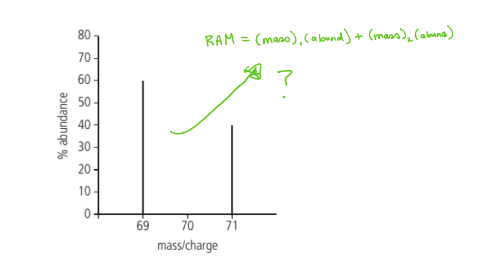
Explain a mass spectrum graph. What do the axis show?
When the spectrometer measures the mass charge ratio of the deflected particles, this is displayed on the horizontal axis, using the carbon 12 scale. In most cases, the charge of the ion is plus one so the horizontal axis generally also gives the mass.
The relative abundance of the ions corresponding to different isotopes is shown on the vertical axis.
In the below, graphic of the mass spectrum of gallium, it shows that in 100 atoms, 60 atoms of a mass of 69 and 40 items of a mass of 71. This information from the spectrum can be used to calculate the relative atomic mass of the element.