Chapter 3: Evaluating a Company's External Environment
 Call Kai
 Learn
Learn Practice Test
 Spaced Repetition
 Match
Match Flashcards
 Knowt Play
1/23

There's no tags or description
Looks like no tags are added yet.
Name | Mastery | Learn | Test | Matching | Spaced | Call with Kai | Chat |
|---|
No analytics yet
Send a link to your students to track their progress
24 Terms
macro-environment
The macro-environment encompasses the broad environmental context in which a company is situated and is comprised of six principal components: political factors, economic conditions, sociocultural forces, technological factors, environmental factors, and legal/regulatory conditions.
PESTEL analysis
PESTEL analysis can be used to assess the strategic relevance of the six principal components of the macro-environment: political, economic, sociocultural, technological, environmental, and legal forces.
The components of a company's external environment
Macro environment
industry and competitive environment
company
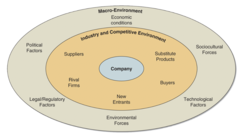
Political factors
political policies and processes, including the extent to which a government intervenes in the economy.
economic conditions
general economic climate and specific factors such as interest rates, exchange rates, the inflation rate, unemployment rate, rate of economic growth, trade deficits or surpluses, savings rates, per capita domestic product.
sociocultural forces
societal values, attitudes, cultural factors, and lifestyles that impact businesses, as well as demographic factors such as the population size, growth rate, and age distribution.
technological factors
pace of technological change and technical developments that have the potential for side-ranging effects on society, such as genetic engineering and nanotechnology.
environmental forces
ecological and environmental forces such as weather, climate, climate change, and associated factors such as water shortages.
legal and regulatory factors
regulations and laws with which companies must comply such as consumer laws, labor laws, antitrust laws, and occupational health and safety regulations.
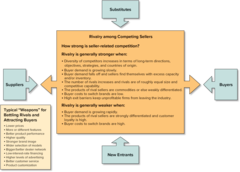
Five Forces Model of Competition
buyers
substitute products
supplier
new entrants
rivalry among competing sellers
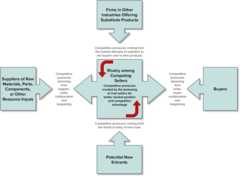
Rivalry among competing sellers
buyers
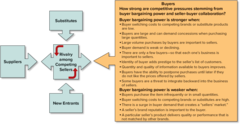
Rivalry among competing sellers
substitute products
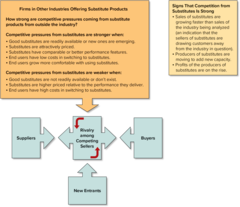
Rivalry among competing sellers
suppliers

Rivalry among competing sellers
suppliers of resource inputs

Rivalry among competing sellers
new entrant
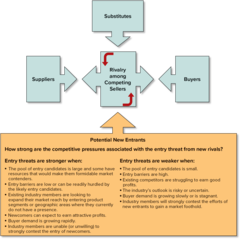
Rivalry among competing sellers
Rivalry among competing sellers
driving forces
Driving forces are the major underlying causes of change in industry and competitive conditions.
Industry's Driving Forces
changers in an industry's long-term growth rate
increasing globalization
changes in who buys the product and how they use it
product innovation
technological change and manufacturing process innovation
marketing innovation
entry or exit of major firms
diffusion of technical know-how across more companies and more countries
changes in cost and efficiency
growing buyer preferences for differentiated products instead of a standardized commodity product
regulatory influences and government policy changes
changing societal concerns, attitudes, and lifestyles
strategic group mapping
Strategic group mapping is a technique for displaying the different market or competitive positions that rival firms occupy in the industry.
strategic group
A strategic group is a cluster of industry rivals that have similar competitive approaches and market positions.
Procedures for constructing a strategic group map
1. Identify the competitive characteristics that delineate strategic approaches used in the industry
2. plot firms on a two-variable map based upon their strategic approaches
3. assign firms occupying the same map location to a common strategic group
4. draw circles around each strategic group, making the circles proportional to the size of the group's share of total industry sales revenues.
Two reasons why some positions can be more attractive than others
1. Industry driving forces may favor some strategic groups and hurt others.
2. Competitive pressures may cause the profit potential of different strategic groups to vary.
key success factors
Key success factors are the strategy elements, product attributes, competitive capabilities, or intangible assets with the greatest impact on future success in the marketplace.
common types of industry key success factors
technology related KSFs
Manufacturing related KSFs
Distribution related KSFs
Marketing-related KSFs
Skills-and capability-related KSFs
Other types of KSFs