Endocrine and Urinary Systems Overview for NPTE
 Call Kai
 Learn
Learn Practice Test
 Spaced Repetition
 Match
Match Flashcards
 Knowt Play
1/77

There's no tags or description
Looks like no tags are added yet.
Name | Mastery | Learn | Test | Matching | Spaced | Call with Kai | Chat |
|---|
No analytics yet
Send a link to your students to track their progress
78 Terms
Metabolic Syndrome
Metabolic syndrome consists of signs and symptoms that are risk factors and are strongly linked to type 2 diabetes, cardiovascular disease, and stroke. A diagnosis is made if three or more are present.
Waist circumference criteria
Waist circumference > 40 inches in men or > 35 inches in women.
Triglyceride level criteria
Triglyceride level of 150 mg/dL or higher.
HDL level criteria
High Density Lipoprotein (HDL) level < 40 mg/dL in men or < 50 mg/dL in women.
Blood pressure criteria
Systolic BP = 130 mm Hg and/or diastolic BP = 85 mm Hg.
Fasting plasma glucose level criteria
Fasting plasma glucose level > 100 mg/dL.
Hypothalamus
Responsible for regulation of the ANS (body temperature, appetite, sweating, thirst, sexual behavior, rage, fear, blood pressure, sleep).

Pituitary gland
Secretes endorphins and reduces a person's sensitivity to pain. It controls ovulation and works as a catalyst for the testes and ovaries to create sex hormones.
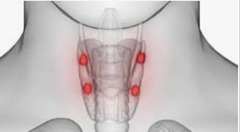
Thyroid gland
Produces hormones that act to control the rate at which cells burn the fuel from food.
Parathyroid gland
Regulates calcium and phosphate metabolism.
Adrenal gland
Produces corticosteroids that will regulate water and sodium balance, the body's response to stress, the immune system, and metabolism.
Addison's Disease
Adrenal insufficiency - decreased cortisol and aldosterone, leading to decreased BP, dehydration, hyperkalemia, decreased glucose, bronze pigmented skin, weight loss, anorexia, GI disturbances, generalized weakness, and intolerance to cold and stress.
Cushing's Disease
Causes: pituitary tumor with increased ACTH secretion. Symptoms include increased BP, water retention, hypokalemia, increased glucose, ruddy appearance, weight gain, centripetal obesity, proximal muscle weakness, increased susceptibility to infection, and poor wound healing.
ACTH
Adrenocorticotropic hormone secreted by the pituitary gland.
Cortisol
A steroid hormone produced by the adrenal glands that regulates metabolism and immune response.
Aldosterone
A hormone produced by the adrenal cortex that regulates sodium and potassium levels in the body.
High Density Lipoprotein (HDL)
A type of cholesterol that helps remove other forms of cholesterol from the bloodstream.
Triglycerides
A type of fat found in the blood, elevated levels can indicate metabolic syndrome.
Systolic Blood Pressure
The pressure in your blood vessels when your heart beats.
Diastolic Blood Pressure
The pressure in your blood vessels when your heart rests between beats.
Fasting Blood Glucose
The level of glucose in the blood after fasting for at least 8 hours.
Body Mass Index (BMI)
A measure of body fat based on height and weight, calculated as weight in kilograms divided by the square of height in meters.
Cushing's Disease
Pituitary Adenoma → more ACTH secreted by PITUITARY GLAND → stimulates Adrenal gland → more CORTISOL is released.
Cushing's Syndrome
Adrenal gland tumor → Adrenal gland secretes more CORTISOL → drug toxicity.
Hyperthyroidism
Increased T3 and T4, low TSH.
Hypothyroidism
Decreased T3 and T4, high TSH.
Increased HR
A symptom of Hyperthyroidism.
Decreased HR
A symptom of Hypothyroidism.
High BMR
A symptom of Hyperthyroidism.
Low BMR
A symptom of Hypothyroidism.
Heat intolerance
A symptom of Hyperthyroidism.
Cold intolerance
A symptom of Hypothyroidism.
Increased glucose absorption
A symptom of Hyperthyroidism.
Decreased glucose absorption
A symptom of Hypothyroidism.
Restlessness, insomnia
A symptom of Hyperthyroidism.
Sleepiness, tiredness, proximal muscle weakness
A symptom of Hypothyroidism.
Diarrhea
A symptom of Hyperthyroidism.
Constipation
A symptom of Hypothyroidism.
Silky hair, moist palm
A symptom of Hyperthyroidism.
Brittle nails, dry skin and hair
A symptom of Hypothyroidism.
Weight loss and increased appetite
A symptom of Hyperthyroidism.
Weight gain and decreased appetite
A symptom of Hypothyroidism.
Increased perspiration
A symptom of Hyperthyroidism.
Decreased perspiration
A symptom of Hypothyroidism.
Hyperreflexia
A symptom of Hyperthyroidism.
Prolonged deep tendon reflexes
A symptom of Hypothyroidism.
Exophthalmos, Graves' disease
A symptom associated with Hyperthyroidism.
Myxedema, Hashimoto's disease
A symptom associated with Hypothyroidism.
Hyperparathyroidism
Elevated calcium and decreased serum phosphate.
Hypoparathyroidism
Low calcium and high phosphorus.
Type 1 Diabetes Mellitus
Pancreas produces no insulin → insulin dependent DM.
Type 2 Diabetes Mellitus
Body's resistance to insulin → insulin resistant DM.
Hypoglycemia
Glucose is
Hyperglycemia
Glucose >300 mg/dl.
Well Hydrated
Patient should be well hydrated during exercise.
Morning Exercise
Exercise in the morning is recommended to avoid hypoglycemia resulting from fluctuations in insulin sensitivity.
Safe Blood Glucose Levels
What are safe blood glucose levels to exercise?
When Not to Exercise
When not to exercise?
Diabetic Foot Care
Diabetic foot care?
Type 2 DM Case
A 45-year-old male, who is obese (BMI 33 kg/m2) with type 2 DM, is working out on the treadmill in a hospital setting. While exercising, the patient suddenly develops lightheadedness, dizziness, and instability.
FITT Principle - Frequency
Frequency: 3-7 days/week.
FITT Principle - Intensity
Intensity: 11-13 on RPE Scale (can go up to 17).
FITT Principle - Time
Time: Minimum of 150 mins./week, can be progressed to 300 min/week.
FITT Principle - Type
Type: Moderate intensity aerobic exercises involving larger muscle groups.
Stress Incontinence
Involuntary leakage of urine during cough, sneezing, or exertion. Can be seen postpartum, pelvic floor muscle weakness.
Urge Incontinence
Involuntary contraction of the detrusor muscle with a strong desire to void (urgency). Can be seen with infections, Parkinson's disease, UMN lesions.
Overflow Incontinence
Incontinence caused by an acontractile or underactive detrusor muscle. Bladder is overdistended, cannot empty completely, and urine dribbles or leaks out. Can be seen with benign prostatic hyperplasia, DM.
Functional Incontinence
Incontinence due to mobility, dexterity, or cognitive deficits. Can be seen with dementia, lower extremity weakness.
Incontinence Intervention
Which of the following is MOST appropriate intervention for this patient?
Incontinence Treatment - Stress
Stress incontinence: Strengthen pelvic floor muscles.
Incontinence Treatment - Urge
Urge incontinence: Treat infections, voiding schedule.
Incontinence Treatment - Functional
Functional incontinence: Clear clutter, improve accessibility, and prompted voiding.
Incontinence Treatment - Overflow
Overflow incontinence: Behavioral modification like double voiding, medication and catheterization.
Physical Therapy Intervention
What is the BEST initial physical therapy intervention?
Urination Frequency
Do you urinate more than eight times a day?
Urine Dribbling
Do you dribble the urine during the day or night?
Premature Urine Loss
Do you have premature loss of urine because you can't unfasten your pants on time?
Urine Loss with Coughing
Do you ever lose urine when you laugh or cough suddenly?