Hematology Introduction & Cell Identification
 Call Kai
 Learn
Learn Practice Test
 Spaced Repetition
 Match
Match Flashcards
 Knowt Play
1/10

There's no tags or description
Looks like no tags are added yet.
Name | Mastery | Learn | Test | Matching | Spaced | Call with Kai | Chat |
|---|
No analytics yet
Send a link to your students to track their progress
11 Terms
Hematology
science of blood and blood-forming tissues
Study: predict, detect, and diagnose disease
Practical skills: staining, counting, analyzing, determining genotype and phenotypes
Blood Function
Transport
Gas exchange (RBCs)
Immunological support (WBCs)
Coagulation (platelets)
Blood Cell Identification
Based on 3 things:
Nucleus: color, character (chromatin, shape, nucleoli), and amount
Cytoplasm: color, character (shape), amount
Granules: color, character (size), number
RBC Identification
6-8 μm
Biconcave disk
Nucleus: none
Cytoplasm: reddish-pink, area of central pallor
Granules: none

Platelet Identification
2-4 μm
Round/elliptical
Nucleus: none
Cytoplasm: clear to light blue (may not be visible)
Granules: fine, azurophilic (dark purple), aggregated in centre

Neutrophil Identification
most abundant WBC
12-17 μm
Nucleus: 3-5 lobes, chromatin is clumped and coarse, darkly stained
Cytoplasm: light pink
Granules: lavender, fine, numerous, & evenly distributed

Eosinophil Identifcation
12-17 μm
Nucleus: 2 lobes, condensed chromatin
Cytoplasm: light pink, obscured by granules
Granules: orange-red, large, spherical, uniform size, evenly distributed

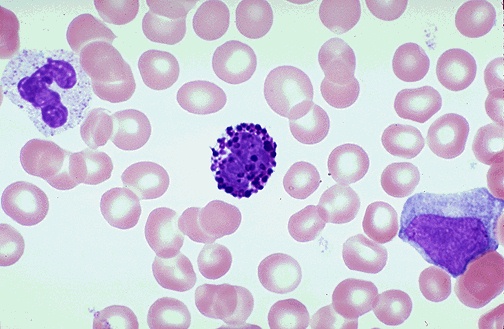
Basophil Identification
12-17 μm
Nucleus: lobulated, often obscured by granules, coarse chromatin
Cytoplasm: light pink, obscured by granules
Granules: blue/black, large, abundant, prominent
Large Lymphocyte Identification
14-20 μm
Irregular shape
Nucleus: round or slightly indented, flat, dense chromatin
Cytoplasm: clear or pale blue, can be indented by RBC
Granules: few irregularly distributed purple medium granules

Small Lymphocyte Identification
7-10 μm
Shape: round
Nucleus: round, oval, or notched; darkly stained with clumped chromatin
Cytoplasm: small rim of light blue
Granules: usually none

Monocyte Identification
15-20 μm
Irregular shape
Nucleus: irregular, lacey / delicate chromatin
Cytoplasm: abundant, opaque, grey-blue, often vacuolated
Granules: many, fine, azurophilic or lilac
