Intro & Fossil Record - Exam 1
 Call Kai
 Learn
Learn Practice Test
 Spaced Repetition
 Match
Match Flashcards
 Knowt Play
1/26

There's no tags or description
Looks like no tags are added yet.
Name | Mastery | Learn | Test | Matching | Spaced | Call with Kai | Chat |
|---|
No analytics yet
Send a link to your students to track their progress
27 Terms
What are the characteristics of life?
Are composed of cells
Have a metabolism
Reproduce and pass on traits
Respond to stimuli
Maintain homeostasis
What are the characteristics of metazoa?
Multicellular
Heterotrophic
Motile at some point in their life cycle
Display symmetry
Usually reproduce sexually
Homology
Characteristics inherited with some modification from a corresponding feature in a common ancestor

Developmental Homolgy
Embryonic structures shared between similar species that indicate common ancestry (Fish, salamander, tortoise, chicken, human)
Genetic Homology
Shared ancestry indicated by molecular similarity in genes, chromosomes, proteins (eye genes shared between humans, mice, fruit flies)
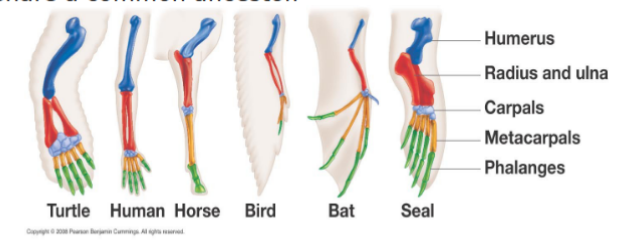
Structural Homology
Anatomical or physical features between organisms that share a common ancestor (arm bones in many vertebrates)
Analogy
Features with similar function due to convergent evolution (vertebrate and cephalopod eyes)
Homoplasy
Features that simply look alike; may or may not be homologous or analogous (bird and bat wings are homologus; insect and bird wings are analogous)
How are homologies useful in reconstructing evolutionary trees?
Provide patterns that can be used as evidence for common descent
Heterochrony
Evolutionary change in timing of development (growth of neck bones in giraffes vs okapi)
Paedomorphosis
Retention of ancestral juvenile characteristics (gills in axolotls vs salamanders, small rounded skulls in humans vs apes)
What major events occurred during the Hadean eon?
4.6 Ba - The formation of the Earth and Moon, indicated by dating meteorites and rocks from the Moon
What major events occurred during the Archean eon?
3.8 Ba - hydrosphere and oldest rocks formed
3.5 - 3.4 Ba - Bacterial stromatolites formed the very first fossils
What major events occurred during the Proterozoic eon?
2.2 Ba - Oxygen appears in large quantities within the atmosphere
1.0 Ba - Algeas appear as the first multicellular organisms
Continents become apparent
700 Ma - Modern oxygen levels reached
635 Ma - First animals appear, and begin radiating (rapidly evolving to new species) in 550 Ma (these were the Ediacaran fauna)
~541 Ma - Ended by mass extinction by an ice age
What notable events occurred during the Ediacaran period?
635 to 542 Ma - Ediacaran deposits formed in Australia
First known animal fossils resembling cnifarians, annelids, arthropods, and echinoderms, and none were clearly linked to existing phyla
What are examples of Ediacaran animals?
Dickinsonia, Spriggina, Kimberella
What notable events occurred during the Cambrian period?
541 to 488 Ma - shallow seas present with hot and dry terrestrial climate
Dramatic increase in oxygen, produced by algaes
Most recognizeable animal phyla appeared, except for Bryozoa
All major body plans are present (sponges, cnidarians, protostome and deuterostome, bilaterians)
THE BURGESS SHALE
What is the significance of the Burgess Shale?
Formed in British Columbia ~505 Ma
Contains fossils of 97% of animal genera, with 10 species not in any known phylum
35-40% of these are primitive arthropods
Sponges, crinoids, brachiopods, molluscs, polychaetes
Graptolites and ammonites
Cnidarians in later strata
What notable events occurred during the Ordovician period?
488 - 443 Ma
Radiation of modern phyla
Dominant groups were trilobites, brachiopods, bryozoans; less diverse or currently extinct
Corals, crinoids, brachiopods, snails, clams, cephalopods appear
Life began to transition to terrestrial environments (arthropods and land plants)
Jawless fish appear
Ends by mass extinction; 60% of all marinne invertebrates and 25% of all families went extinct likely due to ice age
What notable events occurred during the Silurian period?
443 Ma - jawed fish and freshwater fish appear, plants begin to colonize land
What notable events occurred during the Devonian period?
350 Ma - Major radiation of terrestrial forms (arachnids, insects, amphibians); massive diversification of fishes (Age of Fishes)
What notable events occurred during the Carboniferous period?
359 Ma - First forests dominated by insects, first reptiles evolve
What notable events occurred during the Permian period?
299 Ma - All major groups of modern reptiles and mammal-like reptiles evolved
What notable events occurred during the Mesozoic period?
252 Ma - Age of Reptiles, modern orders gradually increase, major extinction ~65 Ma at end of Cretaceous period
What are the limitations of the fossil record?
No record of soft-bodied forms
Doesn’t resolve relationships between/among protostomes and deuterostomes
No definitive evidence of animal ancestors
Ediacaran fossils raise more questions than answer on animal origin due to most not appearing to be of modren phyla
Which period had the largest mass extinction event?
The Permian event 250 Ma at 95% of all life; due to volcanic activity, an increase in methane and CO2, and rapid global warming that removed oxygen from oceans and caused land desertification
Why did the Chicxulub asteroid impact allow for catastrophic species selection?
Most species were wiped out and the environment shifted dramatically, allowing for remaining species to slot into previously unavailable niches and radiate.