Advanced Pathophysiology Exam I
 Call Kai
 Learn
Learn Practice Test
 Spaced Repetition
 Match
Match Flashcards
 Knowt Play
1/93

There's no tags or description
Looks like no tags are added yet.
Name | Mastery | Learn | Test | Matching | Spaced | Call with Kai | Chat |
|---|
No analytics yet
Send a link to your students to track their progress
94 Terms

Disseminated Gonococcal Infection
Hemorrhagic pustules on an erythema base, often on extremities
Key Features: fever, arthralgia, tenosynovitis
Potential for septic arthritis and endocarditis

Rocky Mountain Spotted Fever
Petechial rash starting on wrists and ankles that spreads centrally
Key features: high fever, HA, hx of tick bite
Risk of systemic involvement including vasculitis and organ failure
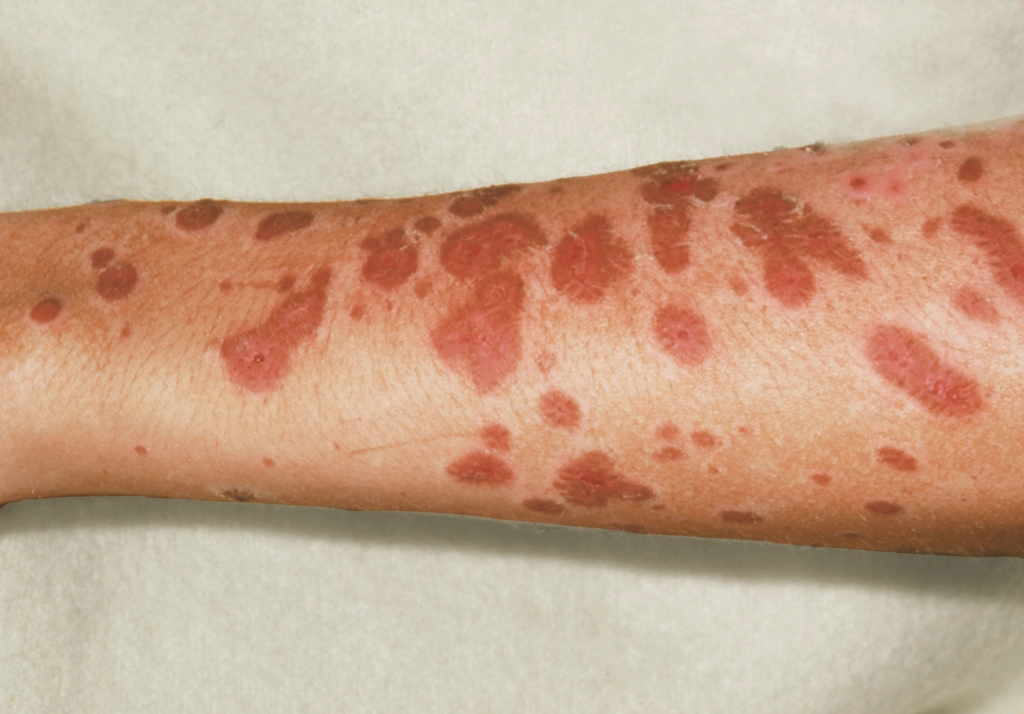
Stevens-Johnson Syndrome
Painful red or purplish rash that spreads and blisters — leads to skin sloughing
Key features: usually drug induced or infection related, involves mucous membranes, can progress to TEN
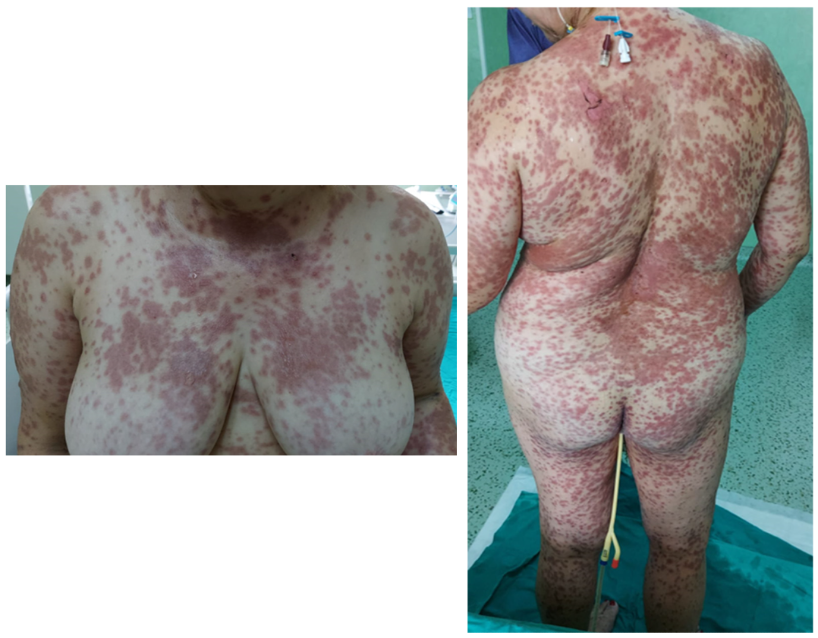
Toxic Epidermal Necrolysis (TEN)
Widespread erythema, necrosis, and bullies detachment of the epidermis and mucous membranes.
Key features: often drug induced, severe pain
Risk of sepsis and multi organ failure

Meningococcemia
Petechial or purpuric rash, often starting on the trunk and lower extremities
Key features: rapid onset, fever, HA, neck stiffness
Potential progression to septicemia and shock

Staphylococcal Scalded Skin Syndrome (SSSS)
Diffuse erythema followed by blistering and desquamation, primarily in infants and young children
Key features: fever, irritability
Risk of dehydration and secondary infections

Kawasaki Disease
Polymorphous rash, often on trunk
Key features: fever for more than 5 days, conjunctivitis, strawberry tongue, swollen hands and feet
Risk of coronary artery aneurysm

Endocarditis
Petechiae, Janeway lesions, Osler nodes, Roth spots
Key features: fever, heart murmur
Potential for embolic events leading to organ damage
Henoch-Schonlein Purpura
Palpable purpuric rash, non-blanchable, often on buttocks, legs, and feet; can be accompanied by edema
Key features: affects children, preceded by URI
Pain, arthralgia, and renal involvement (hematuria, proteinuria)
Epigenetic Processes
DNA methylation
Histone modifications
Noncoding RNAs
Imprinting
Metaplasia
reversible replacement of one cell type for another
Atrophy
Decrease in cell size
Hypertrophy
Increase in cell size
Dysplasia
Abnormal change in cell size, shape, and organization
Often precancerous
Prokaryote
No true nucleus, no organelles
Eukaryote
Has nucleus, organelles, more complex
4 Major Categories for Organelle Function
Genetic control
Manufacturing, distributing, breaking down molecules
Processing energy
Communication between cells
Necrosis
Accidental cell death
Apoptosis
programmed cell death
Decrease in ATP production leads to…
Failure of sodium-potassium and sodium-calcium pump channels — water freely enters cell = cellular swelling — calcium accumulation = cell death
Reperfusion Injury can cause
Oxidative stress
Increase in free radicals
Inflammation
What prevents formation of free radicals?
Antioxidants
Senescence
cells stop dividing
Edema
Fluid pushed out of capillaries into tissue
Caused by increase in capillary hydrostatic pressure, leads to increase in capillary permeability
Renin-angiotensin-aldosterone system
Regulates BP and fluid balance
Elevated BNP levels mean…
Fluid overload + cardiac strain
Isotonic
No fluid shift
0.9% NS, LR
Hypotonic
Fluid shifts into cells
0.45% NS
Hypertonic
Fluid shifts out of cells
D5LR
What are the steps of phagocytosis?
Recognition and adherence
Engulfment
Infusion to form phagolysosomes
Exocytosis
Processes of epigenetics
DNA methylation
DNA hydroxymethylation
Histone modifications
Noncoding RNAs
Two X -chromosomes and one Y
Klinefelter Syndrome
DNA methylation
Associated with transcriptional silencing
Epigenetic process
DNA Hydroxymethylation
Associated with neural tube defects and disease severity in multiple myeloma
Histone modifications
Can up or down regulate gene expression
Noncoding RNAs
can alter activity of oncogenes and tumor suppressor genes
Innate Immunity
First line of defense
Skin, mucous, stomach acid
Opsonization
Process that makes bacteria more susceptible to phagocytosis
Complement System involves…
Opsonization
Anaphylaxtoxic activity
Cell lysis
What are some bacteria that are resistant to phagocytosis?
TB, Listeria, Leprosy, Typhoid fever, Brucellosis
Eosinophils
Primary defense against parasites
Basophils
Release histamines
B cells
Produce antibodies
Signs of Inflammation
Redness, Warmth, Pain, Swelling, Loss of Function
Interferons
Are released by infected cell to help neighboring cells resist infection
4 Phases of Wound Healing
Coagulation
Inflammation
Proliferation - Angiogenesis
Repair w fibroblasts
T cells
Coordinate immune response
Call cells to come help
Cytotoxic T cells
Attack and destroy infected cells
Natural active immunity
Acquired through infection
Natural passive immunity
Acquired through placenta and breast milk
Artificial active immunity
Vaccination
Artificial passive immunity
Admin of IG antibodies
Type I Hypersensitivity
Immediate, rapid reaction
Type II Hypersensitivity - cytotoxic
Antibodies bind directly to cells
Type III Hypersensitivity
Involves immune complex
Type IV Hypersensitivity
Delayed reaction
Type I Diabetes involves an attack on…
Pancreatic beta cells
Multiple sclerosis involves an attack on…
Myelin
Signs of bacterial infection
Pus, odor, neutrophil breakdown
Antigenic variation
How viruses can elude immune system
How do stress and elevated cortisol levels affect the immune system and wound healing?
Cause chronic inflammation — Suppress the immune response — delayed wound healing
Eczema
Dysfunction of skin barrier and immune activation — itchiness and redness
Psoriasis
A chronic autoimmune T-cell disorder causing excessive keratinocyte proliferation and silver plaques
What key enzyme does HIV use?
Reverse transcriptase — turns viral RNA into DNA
Acute HIV
Highly contagious
Flu-like s/s
Latent HIV
Slow decline of immune system
Asymptomatic
Virus continues to replicate but bone marrow can keep up
Acquire Immunodeficiency Syndrome (AIDS)
Th cell <200
Severe immunosuppression — allows for opportunistic infections
Allostatic overload
Chronic overstimulation of regulatory systems, can lead to onset of disease
Benign tumor
Encapsulated, well-differentiated, well-organized
Do not invade beyond their capsule
Malignant tumor
Rapidly growing
Loss of differentiation and organization
Hallmark of malignant tumor (10)
Anaplasia — loss of cellular differentiation
Replicative immortality
Tumor promoting inflammation
Invasion and Metastasis
Genomic instability
Inducing angiogenesis
Resisting cell death
Reprogramming energy metabolism
Uncontrolled Cellular proliferation
Avoiding immune destruction
What enzyme enable replicative immortality?
Telomerase
Cancer Stem Cells
Can change appear and function of cells to drive cancer progression
Warburg effect
Cancer cells produce ATP through glycolysis even in the presence of oxygen
Cancer from epithelial tissue
Carcinoma
Cancer from ductal or glandular structure
Adenocarcinoma
Cancer from connective tissue, bone, muscle
Sarcoma
Cancer from lymphatic tissue
Lymphoma
Cancer from blood forming cells
Leukemia
Carcinomas in Situ
Preinvasive
Could remain stable, progress to malignancy, or regress and disappear
“Guardian of the genome”
Tp53, tumor suppressing gene
Decides whether injured DNA will be repaired or undergo apoptosis
How does HPV progress to cancer
Prolonged infection leads to viral DNA being integrated into genomic DNA
Cachexia
Loss of muscle with or without fat loss
Cancer staging system
Stage 1 — cancer confine to organ or origin
Stage 2 — locally invasive
Stage 3 — spread to regional structures
Stage 4 — spread to distant sites
TNM system
System for staging cancer
T — tumor size
N — nodular involvement
M — metastasis
How are tumor markers used
Used to follow clinical course but not for initial diagnosis
Epidermis is made of…
Keratinocytes, melanocytes, Langerhans cells
Dermis is made of…
Connective tissue, blood vessels, nerve endings, glands
Hypodermis is made up of..
Adipose tissue
Functions of integumentary system
Protective barrier, thermoregulation, sensory reception, synthesis for vitamin d
Impetigo
Affects epidermis
Characterized by honey colored crusts around mouth
Tinea (ringworm)
Circular, scaly, red lesion with central clearing
Primary concern with Melanoma?
Tendency for early invasion and metastasis