anterior muscles and movements
 Call Kai
 Learn
Learn Practice Test
 Spaced Repetition
 Match
Match Flashcards
 Knowt Play
1/24

There's no tags or description
Looks like no tags are added yet.
Name | Mastery | Learn | Test | Matching | Spaced | Call with Kai | Chat |
|---|
No analytics yet
Send a link to your students to track their progress
25 Terms
anterior muscles
• Sternocleidomastoid m
• Scalene mm
• Abdominal mm
• Diaphragm m
• Intercostal mm
Sternocleidomastoid
Longus capitis m
• Anterior vertebrae in cervical region to skull
• Flex head
• Longus colli m
• Anterior vertebrae in cervical region
• Flex neck
P Watching an athletic event, socializing, driving
A Unilaterally:
Laterally flex the head and neck to the same side
Rotate the head and neck to the opposite side
Bilaterally:
Flex the neck
Assist to elevate the rib cage during inhalation
• Sternal head: Top of manubrium
Clavicular head: Medial one-third of the clavicle
Mastoid process of temporal bone and the lateral portion of superior nuchal line of occiput
N Spinal accessory (XI) nerve, C2

scalenes
· Anterior, middle, and posterior scalene mm
· Lateral flexion of cervical spine
P Driving, deep breathing with exertion (running,
cycling)
A Unilaterally: With the ribs fixed, laterally flex the head and neck to the
same side
Rotate head and neck to the opposite side
Bilaterally:
Elevate the ribs during inhalation
Flex the head and neck • Transverse processes of third through sixth cervical
vertebrae (anterior tubercles)
I First rib
N C3 to C8

Brachial plexus and subclavian artery
· Pass between anterior and middle scalene mm
· Tightness causes compression and can cause thoracic outlet syndrome
rectus abdominus
· Surrounded by rectus sheath
P Lower body dressing, bed mobility (supine to sit)
A Flex the vertebral column
Tilt pelvis posteriorly
• Pubic crest, pubic symphysis
I Cartilage of fifth, sixth, and seventh ribs and xiphoid process
N Ventral rami of T5 t

internal oblique
P Bed mobility, playing a racket sport (trunk rotation), lifting (increasing intra-abdominal pressure to stabilize lumbar spine)
A Unilaterally:
Laterally flex vertebral column to the same side
Rotate vertebral column to the same side
Bilaterally:
Flex the vertebral column
Compress abdominal contents
• Lateral inguinal ligament, iliac crest, and thoracolumbar fascia
I Internal surface of lower three ribs, rectus sheath to linea alba
N Ventral rami of T7 to T12, Li, iliohypogastric, and ilioin

external oblique
P Bed mobility, lifting (increasing intra-abdominal
pressure to stabilize lumbar spine)
A Unilaterally: Laterally flex vertebral column to the same side
Rotate vertebral column to the opposite side
Bilaterally:
Flex the vertebral column
Compress abdominal contents
• External surfaces of fifth to twelfth ribs
I Anterior part of the iliac crest, rectus sheath to linea alba
N Ventral rami of T5 to T12

transverse abdominis
P Carrying a child or pet (increasing intra-abdominal
pressure to stabilize lumbar spine)
A Compress abdominal contents
• Lateral inguinal ligament, iliac crest, thoracolumbar fascia, and internal surface of lower six ribs
I Rectus sheath to linea alba
N Ventral rami of T7 to T12, L1, iliohypogastric, and ilioing

diaphragm
P Singing, playing a trumpet (deep breathing)
A Draw down the central tendon of the diaphragm
Increase the volume of the thoracic cavity during inhalation
Costal attachment: Inner surface of lower six ribs
Lumbar attachment: Upper two or three lumbar vertebrae
Sternal attachment: Inner part of xiphoid process
Central tendon
N Phrenic C3 to C5

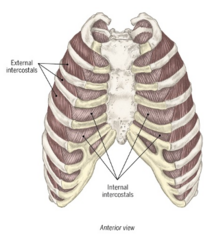
intercostals
P Singing, playing the trumpet (deep breathing) A External intercostals: Draw the ribs superiorly (increasing the space of the thoracic cavity) to assist with inhalation Internal intercostals: Draw the ribs inferiorly (decreasing
the space of the thoracic cavity) to assist with exhalation
• Inferior border of the rib above
I Superior border of the rib below
N Thoracic
neck flexion
sternocleidomastoid
activities like working on a car in supine

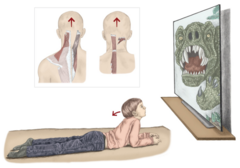
neck extension
Trapezius
activities like lifting your head up to watch a movie while in prone
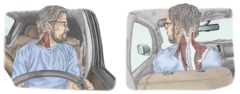
neck rotation
· Ipsilateral Neck Rotation
ipsilateral neck rotation for activities like looking out the window while driving
· Contralateral Neck Rotation
contralateral neck rotation for activities like driving
neck lateral flexion
tilt head as far as possible toward each shoulder

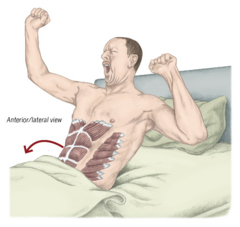
trunk flexion
rectus abdominis
sitting up after a long night's rest
trunk extension
erector spinae
standing at the sink to complete self-care activities
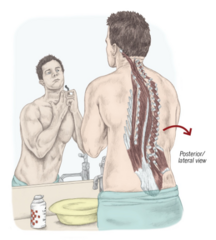
trunk rotation
The external oblique, internal oblique, multifidi, and rotatores contribute to trunk rotation for activities like completing dowel rod exercises

Trunk Lateral Flexion
The iliocostalis, external oblique, internal oblique, longissimus, and quadratus lumborum contribute to trunk lateral flexion for activities like completing seated stretches

Rib Cage Elevation/Expansion
The anterior scalene, middle scalene, posterior scalene, sternocleidomastoid, and external intercostals contribute to expansion of the rib cage during inhalation for activities like running.
The internal intercostals and serratus posterior inferior contribute to depression of the rib cage during exhalation for activities like running.
trunk control
Essential motor component for many activities
· E.g. required for infant to crawl, safe lifting, sitting and standing balance
Patient Transfers and Safe Lifting
Stagger stance:
• One foot slightly in front of other, hips & knees flexed
• E.g. vacuuming or sweeping
Weight-shifting:
• Moving body weight from one leg to other
• E.g. lifting, carrying, moving patients
Recommendations:
· Stagger stance
· Bend the legs
· Keep back straight
· Hold load close to body
· Avoid rotation of trunk
· Contract abdominal mm
· e.g. patient transfer
Abdominal muscle contractions
stabilizes lunar spine
Occupational and Clinical Perspectives Rest and Sleep
Positioning
• Supine position recommended
• Supports neutral position and natural curvature of spine
Occupational and Clinical Perspectives Abnormal Muscle Tone
e.g. Abnormal muscle tone in cerebral palsy:
• Affects core strength, function, and development
• Example: unable to sit upright with low muscle tone
• Postural supports increase independence.
Occupational and Clinical Perspectives Spinal Injuries
Spinal cord injury:
· Blocks transmission of neurological signals from brain to/from body
· Creates functional impairments
Degenerative disease:
e.g.Compression of a spinal nerve root (radiculopathy) may create sensory and motor impairment over time
Adaptive equipment:
Supports occupations while limiting trunk flexion
• Reacher: Extension of UE for object manipulation, lower body dressing
• Sock aid: Don socks without trunk flexion
• Seating and postural support: Customized seating systems