Chapter 20 - Errors & Changes
 Call Kai
 Learn
Learn Practice Test
 Spaced Repetition
 Match
Match Flashcards
 Knowt Play
1/24

There's no tags or description
Looks like no tags are added yet.
Name | Mastery | Learn | Test | Matching | Spaced | Call with Kai | Chat |
|---|
No analytics yet
Send a link to your students to track their progress
25 Terms
Matching time! Go to the bookmark bar and complete the matching activity.
:3
Which of the following best describes the Prospective Approach to reporting accounting changes and errors?
a. Apply going forward only, with no changes to past statements
b. Restate past statements as if the new method had always been used
c. Apply to the current period only, adjusting the beginning retained earnings balance
A
Which of the following best describes the Retrospective Approach to reporting accounting changes and errors?
a. Apply going forward only, with no changes to past statements
b. Restate past statements as if the new method had always been used
c. Apply to the current period only, adjusting the beginning retained earnings balance
B
Which of the following best describes the Modified Retrospective Approach to reporting accounting changes and errors?
a. Apply going forward only, with no changes to past statements
b. Restate past statements as if the new method had always been used
c. Apply to the current period only, adjusting the beginning retained earnings balance
C
T/F A change in accounting principle must be justified and cannot be made on a whim
True
If FASB mandates a new rule, should it be classified as a change in accounting principle, estimate, or reporting entity?
Change in Accounting Principle
How are most voluntary changes in accounting principles reported?
a. Retrospectively
b. Prospectively
c. Modified Retrospectively
A
A change in accounting principle that usually should not be reported by revising the financial statements of prior periods is a change from:
a.The weighted-average method to the FIFO method
b.The weighted-average method to the LIFO method
c.FIFO method to the weighted-average method
d.LIFO method to the weighted-average method
B; changes to LIFO are handled prospectively due to inadequate records
How are inventory changes to LIFO handled?
a. Retrospectively
b. Prospectively
c. Modified Retrospectively
Prospectively
T/F Estimates are a critical element of accounting and often parallel what actually occurs in the future.
FALSE: They often differ from what actually occurs
Universal Semiconductors estimates warranty expense as 2% of sales.
• After a review during 2024, Universal determined that 3% of sales is a more realistic estimate of its payment experience.
• Sales in 2024 are $400 million.
Prepare the journal entry to recognize the warranty expense changing from 2% to 3%

Because this is a change in accounting estimate, there would be no adjustments for the prior periods that used 2%. The company would just make a basic warranty expense allocation.
According to the book, changing Depreciation, Amortization, and Depletion Methods is considered a
“_______________via a_________________”
a. Change in accounting estimate via a change in accounting principle
b. Change in accounting principle via a change in accounting estimate
c. Change in reporting entity via a change in accounting principle
d. Change in accounting estimate via a change in reporting entity
A; Change in accounting estimate via a change in accounting principle
How are accounting errors accounted for?
a. Prospectively
b. Retrospectively
c. Modified Retrospectively
d. Accounting errors will automatically self correct and thus do not need to be accounted for.
B
If Retained Earnings is impacted by an error, the correction is called a
Prior Period Adjustment
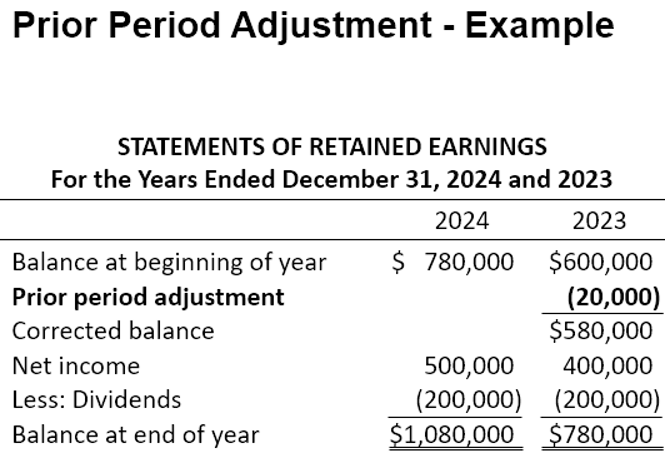
What are the 4 steps to correcting an error?
A correcting journal entry is made
Previous financial statements are restated (if they’re incorrect)
Prior period adjustment to retained earnings
Disclosure note
If an error is discovered in the same period it occurred, how do you fix it? Select all that apply.
a. A correcting journal entry is made
b. Previous financial statements are restated
c. Prior Period adjustment to retained earnings
d. A disclosure note is made explaining the error
A
If an error made in 2022 is discovered in 2024, how do you fix it? Select all that apply.
a. A correcting journal entry is made
b. Previous financial statements are restated
c. Prior Period adjustment to retained earnings
d. A disclosure note is made explaining the error
All of the above
A is technically correct because prior period adjustment is a correcting entry
If an error made in 2022 is discovered in 2027, how do you fix it? Select all that apply.
a. A correcting journal entry is made
b. Previous financial statements are restated
c. Prior Period adjustment to retained earnings
d. A disclosure note is made explaining the error
B, C, and D are correct. You would not do a correcting entry because most errors correct themselves after 3 years.
A stupid idiot understated this year’s ending inventory. What is the net impact on this year’s retained earnings and net income? What about next year?
This year: Net income and Retained earnings understated
Next year: Net income and Retained earnings overstated
A stupid idiot recorded a 1 million dollar asset as an expense. All at once. What is the impact on this year’s net income, retained earnings, and net assets?
Net income: Understated
Retained earnings: Understated
Net assets: Understated
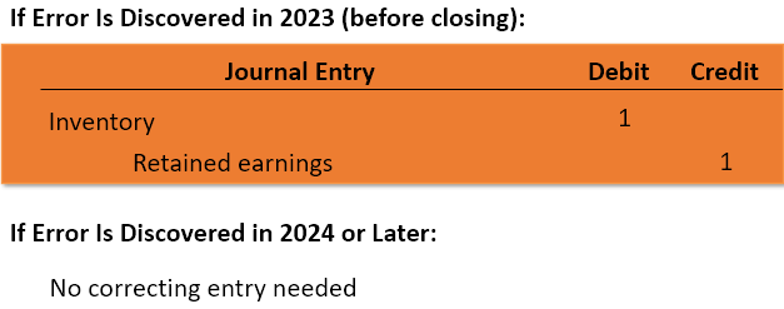
In early 2024, Overseas Wholesale Supply discovered that $1 million of inventory had been inadvertently excluded from its 2022 ending inventory count.
Prepare the journal entries for the error correction if the error was discovered in:
2023
2024
What is a change in accounting principle?
a. A change from one generally accepted principle to another
b. A revise of an estimate because of new information or experience
c. A change from reporting as one type of entity to another type of entity
d. A correction of an error being recorded incorrectly or not at all
A
What is a change in accounting estimate?
a. A change from one generally accepted principle to another
b. A revise of an estimate because of new information or experience
c. A change from reporting as one type of entity to another type of entity
d. A correction of an error being recorded incorrectly or not at all
B
What is a change in reporting entity?
a. A change from one generally accepted principle to another
b. A revise of an estimate because of new information or experience
c. A change from reporting as one type of entity to another type of entity
d. A correction of an error being recorded incorrectly or not at all
C
What is an error correction?
a. A change from one generally accepted principle to another
b. A revise of an estimate because of new information or experience
c. A change from reporting as one type of entity to another type of entity
d. A correction of an error being recorded incorrectly or not at all
D