2.4 - Sexual reproduction in mammals
 Call Kai
 Learn
Learn Practice Test
 Spaced Repetition
 Match
Match Flashcards
 Knowt Play
1/16

There's no tags or description
Looks like no tags are added yet.
Name | Mastery | Learn | Test | Matching | Spaced | Call with Kai | Chat |
|---|
No analytics yet
Send a link to your students to track their progress
17 Terms
What is sexual reproduction?
The fusion of haploid gametes from 2 different parents to form a diploid zygote, resulting in genetic variation in the offspring
What are gametes?
Haploid reproductive cells (sperm & egg) produced by meiosis that carry half the genetic material of an organism & fuse during fertilisation to form a diploid zygote
What are male gametes like?
Many, Mobile, Minute:
small cells that can move
if they can propel themselves, they’re motile (e.g. sperm)
if they are easily carried by the wind or animals, they’re mobile (e.g. pollen)
produced in very large numbers & made in the testes
What are female gametes like?
Few, Fixed, Food:
ova/eggs in animals & ovules in plants are relatively large cells & tend to be stationary
contain food reserves (e.g. lipids, proteins, carbohydrates) & are produced in fairly small numbers
made in the ovaries
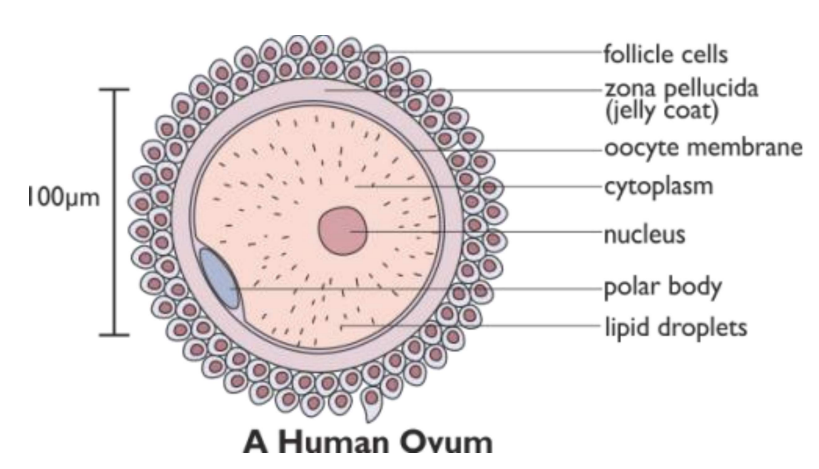
What are the 7 features of a human ovum?
Follicle cells
Zona pellucida (jelly coat)
Oocyte membrane
Cytoplasm
Nucleus
Polar body
Lipid droplets
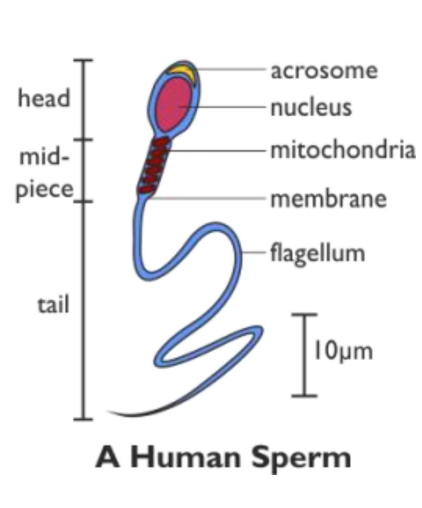
What are the 5 features of a human sperm cell?
Acrosome (contains digestive enzymes)
Nucleus
Mitochondria
Membrane
Flagellum
What are the 2 different ways in which gametes are produced?
Spermatogenesis: produces spermatozoa
Oogenesis: produces an ovum
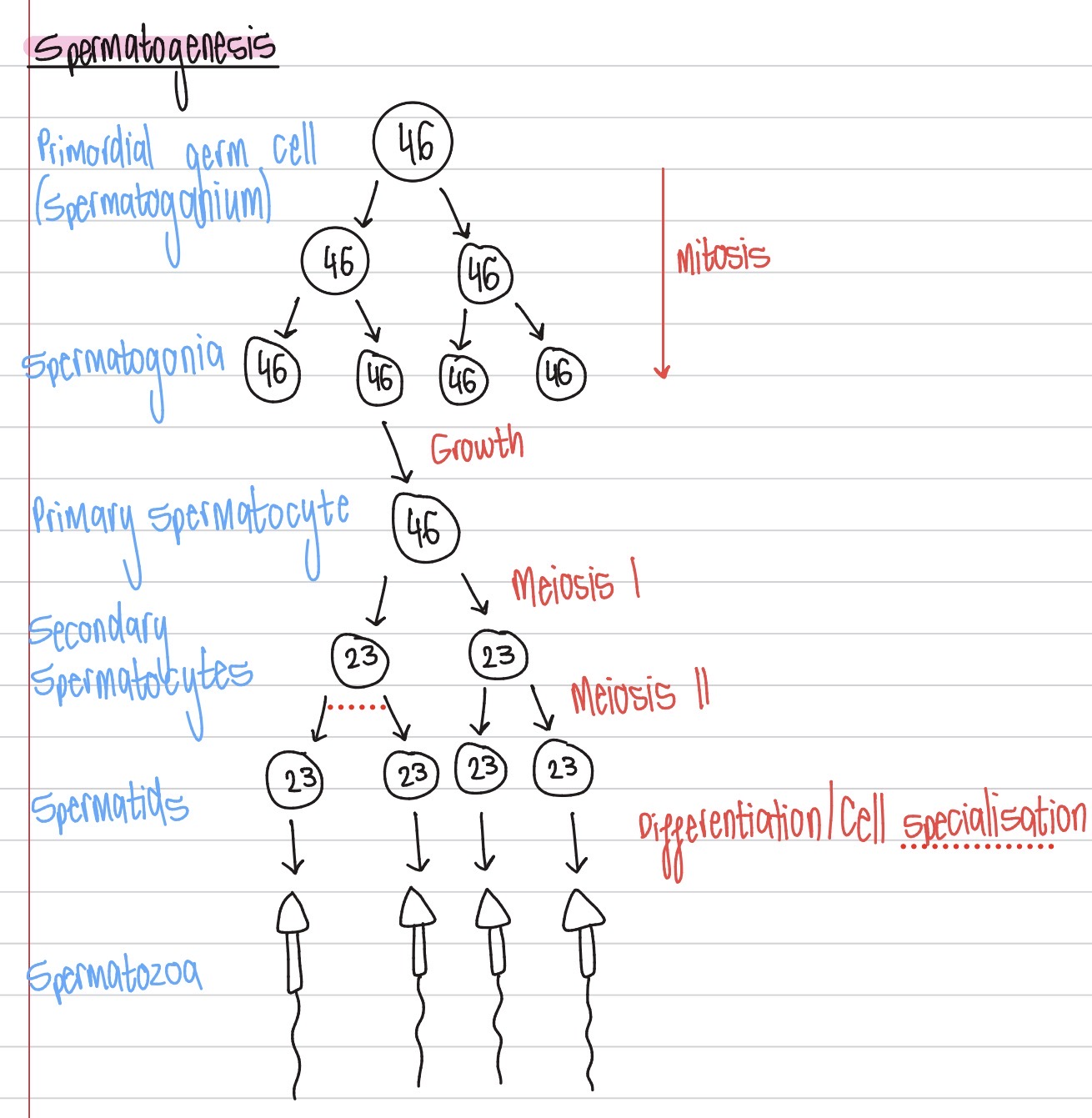
Outline the process of spermatogenesis
Primordial germ cell (spermatogonium) divides by mitosis several times to form spermatogonia
Spermatogonia undergo growth to form primary spermatocytes
Primary spermatocytes undergo meiosis I to form secondary spermatocytes, which undergo meiosis II to form 4 spermatids
Spermatids undergo cell differentiation to form spermatozoa
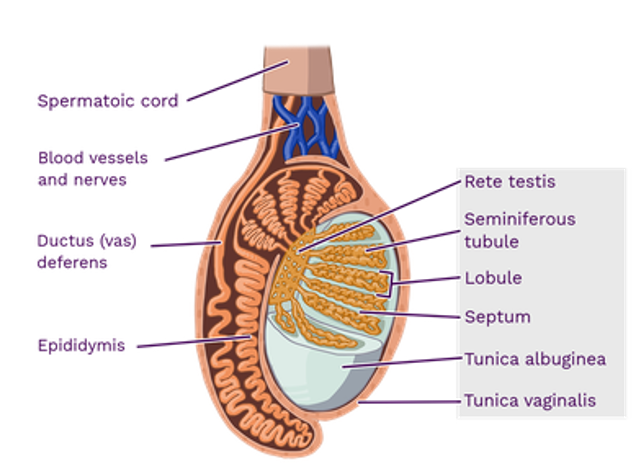
Where is sperm produced & where does it leave the testes?
Sperm is produced in the seminiferous tubule & leaves the testes via the vas deferens
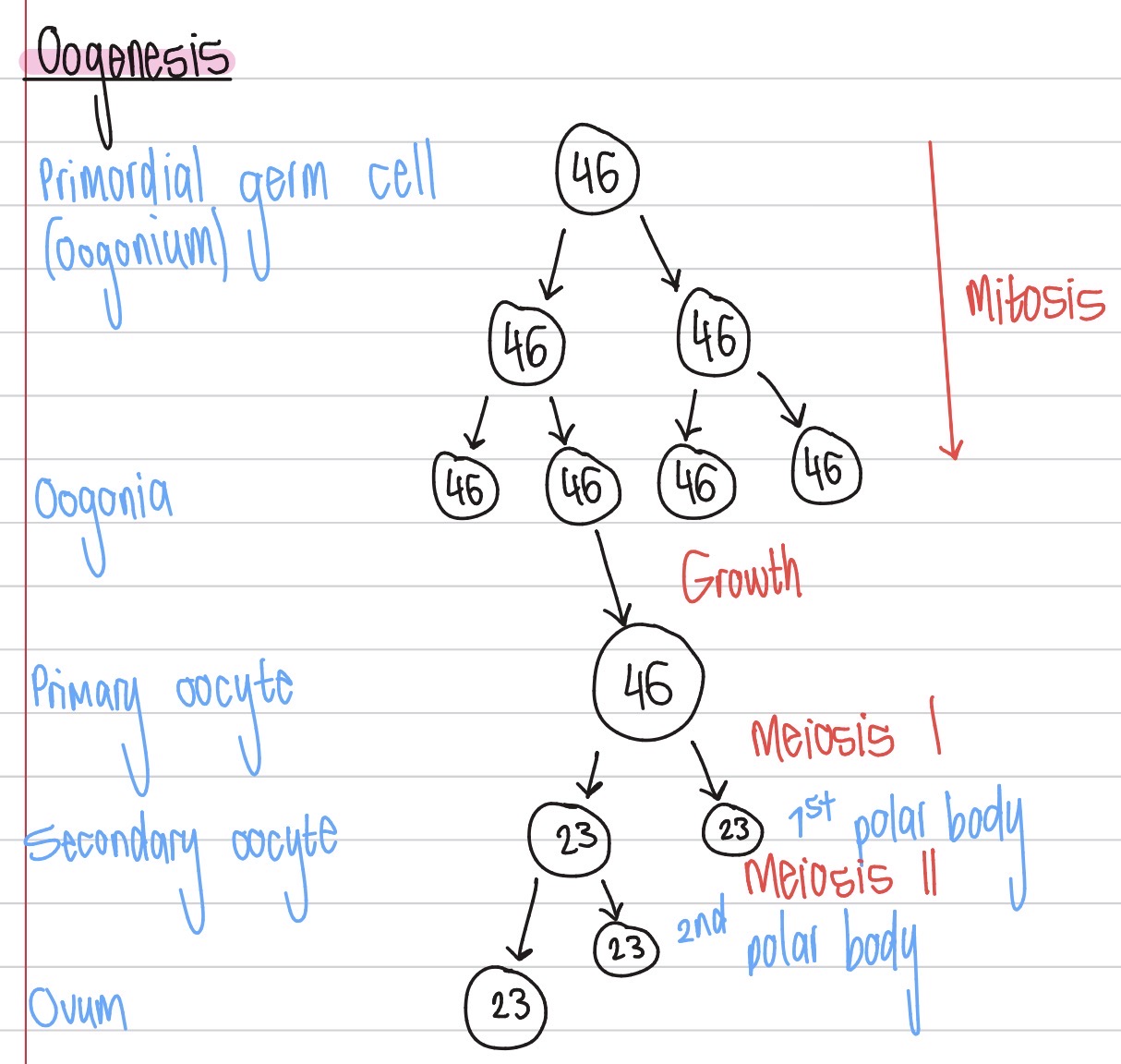
Outline the process of oogenesis
Primordial germ cell (oogonium) divides by mitosis several times to form oogonia
Only one undergrows growth to form a primary oocyte
The primary oocyte undergoes meiosis I to form a secondary oocyte & the 1st polar body
The secondary oocyte undergoes meiosis II to form an ovum & the 2nd polar body
What is an advantage of the unequal division during meiosis in oogenesis?
The ovum contains the nutrients in the cytoplasm to nourish the embryo after fertilisation
When does the second division of meiosis in oogenesis occur?
After the ovum has been fertilised by a sperm cell
In humans, where does fertilisation take place?
Near the top of the oviduct:
sperm are carried there by currents in uterus & oviducts (only use flagella to swim when close to oviduct)
Outline the process of fertilisation
The sperm swim through follicle cells & release digestive enzymes from the acrosome to digest the zona pellucida & enter the ovum (acrosome reaction)
A single sperm fuses with the oocyte membrane & its nucleus enters the ovum; the rest of sperm cell breaks down
This triggers the cortical reaction, which hardens the zona pellucida to prevent polyspermy; the sperm nucleus also causes the egg to complete meiosis II
Male & female nuclei replicate their DNA, their membranes break down & chromosomes combine to form a diploid zygote, which immediately begins mitosis
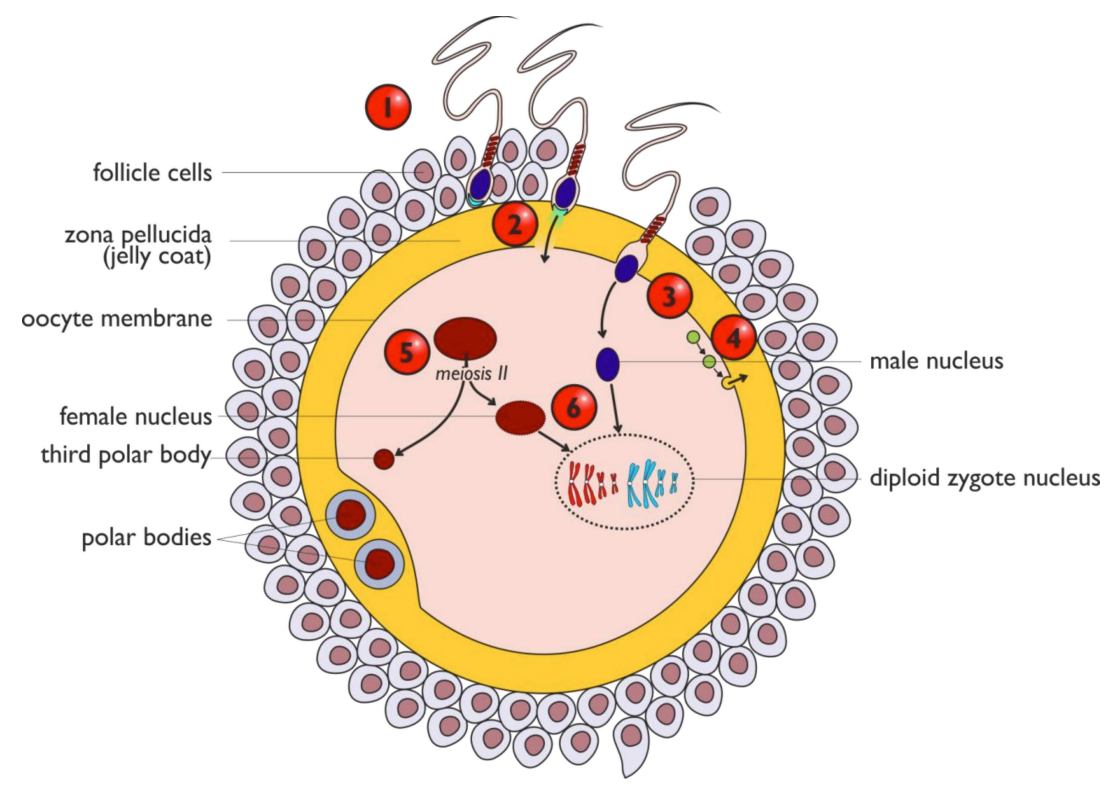
What is the acrosome reaction?
Sperm release hydrolytic, digestive enzymes from the acrosome to digest the zona pellucida, allowing them entry into the ovum
What is the cortical reaction?
Cortical granules release enzymes that harden the zona pellucida to prevent multiple sperm entering (polyspermy)
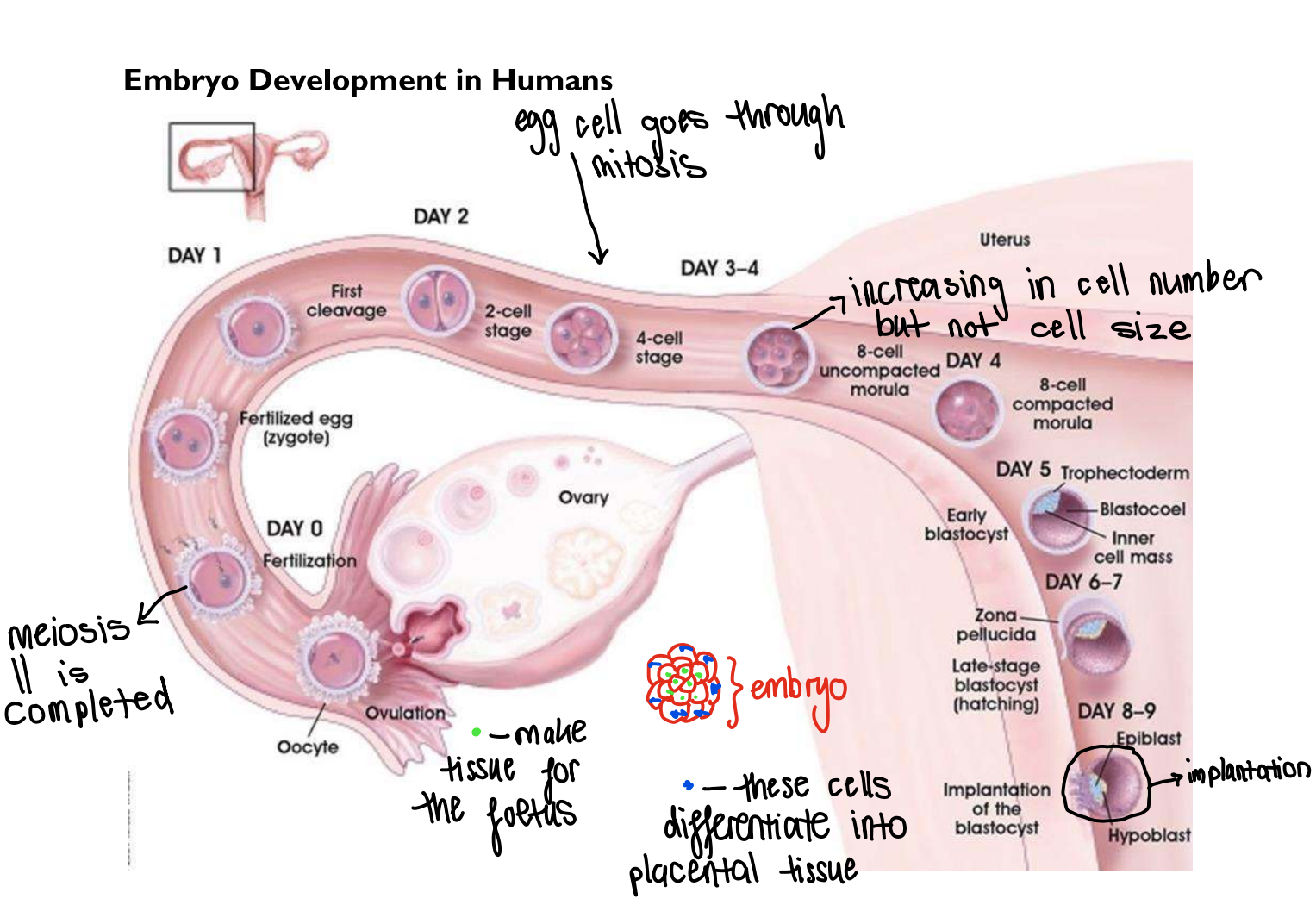
Outline the process of embryo development
Day 0
fertilisation occurs near the top of oviduct & the zygote travels towards the uterus, propelled by cilia
Days 1-3
as it moves, the zygote divides repeatedly by cleavage (mitotic divisions with short interphase & no growth)
Days 4-5
the zygote becomes a morula (ball of 8 cells) & reaches the uterus. After 7 divisions, it forms a blastocyst (128 cells arranged in a hollow ball)
Days 8-9
the blastocyst embeds in the endometrium (uterus lining) during implantation, marking the start of pregnancy