Microbiology Ch. 7 - Microbial Growth and Nutrition
 Call Kai
 Learn
Learn Practice Test
 Spaced Repetition
 Match
Match Flashcards
 Knowt Play
1/27

Earn XP
Description and Tags
Exam 1
Name | Mastery | Learn | Test | Matching | Spaced | Call with Kai | Chat |
|---|
No analytics yet
Send a link to your students to track their progress
28 Terms
microbial reproduction
called binary fission
cell mass doubles, DNA replicates and two strands separate, synthesis of a partition or septum separates the cell into two genetically identical cells

generation (or doubling time)
the interval of time between successive binary fissions
what does shorter doubling time mean?
shorter incubation period of disease
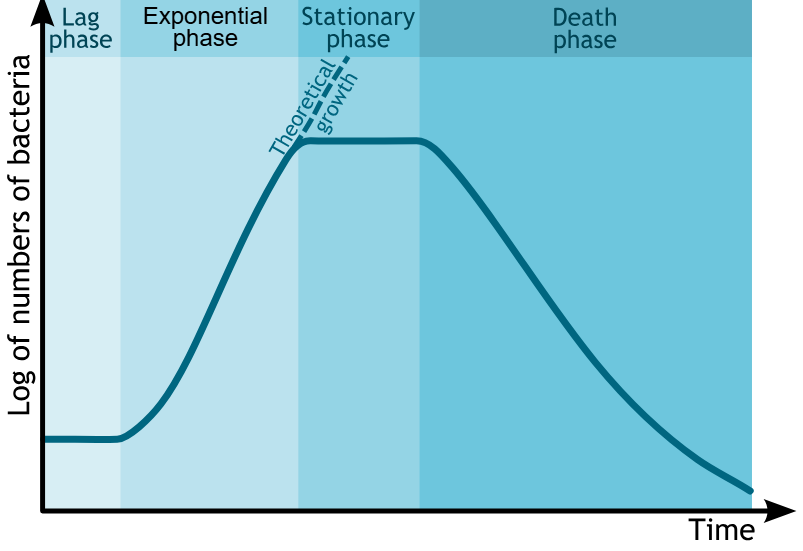
microbial growth phases
lag: no cell division occurs, bacteria adapt to their environment
log: exponential growth, human disease symptoms develop
stationary: reproductive and death rates equalize
decline: accumulation of waste products and scarcity of resources
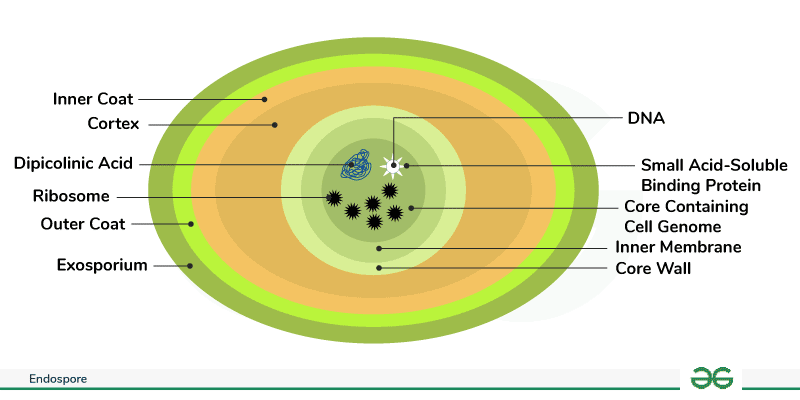
endospores
responsible for nutrient limitation
highly resistant structure formed by species of bacillus and clostridium when nutrient supplies are low
resistant to desiccation and heat
core contains small acid-soluble proteins (SASPs)
ca2+ linked dipicolinic acid is absent in vegetative cells
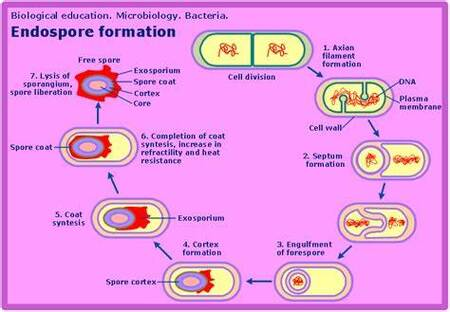
formation of bacterial spore
DNA replicates
one chromosome condenses at the end of the cell and it pushes its way into the cell as a transverse septum
transverse septum forms, and the primitive spore, the forespore (contains cytoplasm, DNA, and dipicolinic acid, which stabilizes proteins and DNA), is cut from the remainder of the cell
the outer layer, the cortex, developed around the forespore, and pieces of the spore coat form
the walls of the spore are complete, and the mature spore is formed while the vegetative cell disintegrates
the free spore is released, and under favorable nutrient conditions, the spore will germinate and develop into a vegetative cell
germination
form spore to vegetative cell when environmental conditions are favorable again, breaking down protective layers
optimal prokaryotic growth factors
temperature, oxygen, pH, and osmotic conditions
psychrophiles optimal temperature
15 °C
largest portion of all prokaryotes on earth
mesophiles optimal temperature
10-45 °C
pathogens that thrive in the human body
thermophiles optimal temperature
60 °C
live in compost heaps and hot springs
hyperthermophiles
80+ °C
archaea that are found in sea floor hot water vents
obligate aerobes
require oxygen to grow
anaerobes
do not or cannot use oxygen
aerotolerant species are insensitive to oxygen
obligate anaerobes
killed by oxygen
facilitive prokaryotes
grow with oxygen or in reduced oxygen environments
capnophilic bacteria
require low oxygen and lots of carbon dioxide
thioglycollate broth
used to test an organism’s oxygen sensitivity
majority of species grow optimally in what pH?
neutral, 7.0 pH
acidophiles
acid-tolerant prokaryotes
barophiles
can withstand high hydrostatic pressure
halophiles
salt-tolerant prokaryotes
complex medium
(think unknown composition) chemical unidentified medium
synthetic medium
(think made, known) chemical composition is known
selective medium
(think two different cannot be together) contains ingredients to inhibit the growth of certain species and allow the growth of others
differential medium
(think two different can be together) contains specific chemicals to indicate species that possess or lack a biochemical process
act as visual indicators to show differences (dyes, cells, etc.)
enriched medium
required by some fastidious organisms
adds extra nutrients
streak-plate isolation method
spreads out individual cells to form discrete colonies of species