Ch 8: The Terrestrial Planets
 Studied by 0 people
 Call Kai
 Learn
Learn Practice Test
 Spaced Repetition
 Match
Match Flashcards
 Knowt Play
1/17

There's no tags or description
Looks like no tags are added yet.
Name | Mastery | Learn | Test | Matching | Spaced |
|---|
No study sessions yet.
18 Terms
How do Mercury, Venus, & Mars each compare with Earth in mass & radius?
Mercury: mass is 1/18 of Earth’s & radius is 1/3 of Earth’s
Venus: similar mass & radius to Earth
Mars: mass is 1/10 of Earth’s & radius is 1/2
How to the interior structures of Mercury, Venus, & Mars compare with Earth’s?
Mercury: large molten core, almost no mantle activity due to small size
Venus: iron core & rock mantle similar to Earth, crust isn’t broken into plates
Mars: cooler interior than Earth, dormant mantle
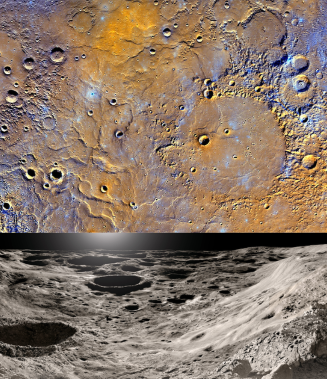
What is the surface of Mercury like?
Covered in craters, rays, scarps (steep cliffs), troughs (wrinkles in crust formed from shrinking), & hollows (irregular shaped pits created by volcanic activity)
Does Mercury have an atmosphere?
Why or why not?
Not really. There are trace amounts of gas around Mercury; the atmosphere is trillions of times thinner that Earth’s atmosphere
Its gravity is too weak to hold an atmosphere & high temps cause molecules to move so fast they escape to space
What is peculiar about Mercury’s rotation?
What causes this oddity?
It spins 3 times for every 2 trips it makes around the Sun (3 Mercury days = 2 Mercury years)
Due to a combination of the Sun’s tidal forces slowing Mercury’s orbit & spin and Mercury’s highly elliptical orbit affecting its rotational speed
What is the dominant gas in Venus’s atmosphere?
How do astronomers know this?
Carbon Dioxide
Determined by spectroscopy & space probe measurements
What are the clouds of Venus made of?
Sulfuric acid
Why is Venus so hot?
It has a runaway greenhouse effect
The dense atmosphere traps a lot of infrared light
Can we see the surface of Venus?
How do astronomers know what the surface of Venus is like?
No, the thick clouds cover our view
Scientists use radar from spacecraft or stations located on Earth to map Venus
What sort of features are seen on Venus’s surface?
Is the surface young or old?
Lava fields, only 2 major highland regions, many volcanoes, narrow fault lines
Surface is young (scarcity of impact craters) do to volcanic activity
Some of the youngest surfaces on Earth are from plate ridges—is the same true on Venus?
No, Venus does not have plate tectonics like Earth, so new crust doesn’t form at plate ridges
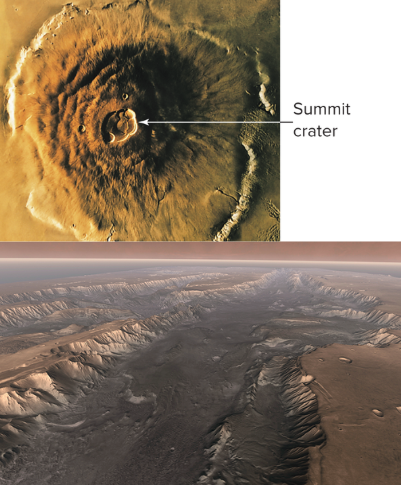
Describe some of the surface features seen on Mars.
Valles Marineris (deep canyon as big as U.S.), huge uplands, many volcanoes (Olympus Mons is largest volcano in Solar System), frozen polar caps
What are the Martian polar cap composed of?
Frozen water covered by frozen carbon dioxide (dry ice)
What is the Martian atmosphere like?
Mostly carbon dioxide, very low density atmosphere makes Mars unable to trap much heat, dry ice & water-ice crystals, strong winds
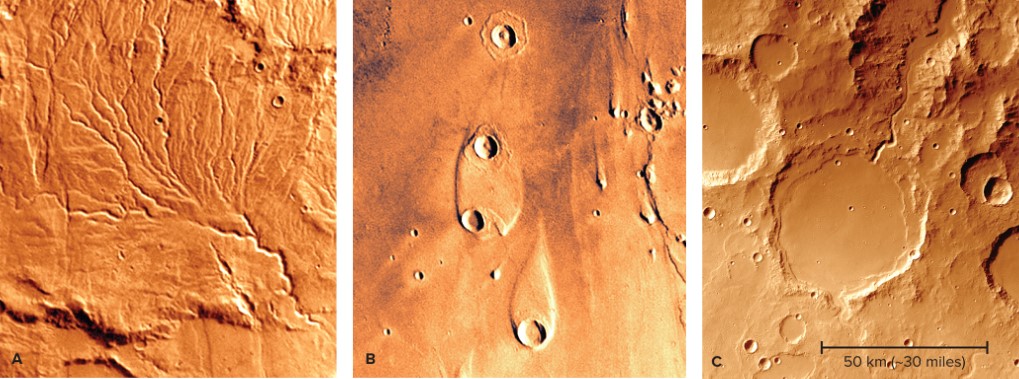
What is the evidence that Mars once had running water on its surface?
Dry riverbeds, teardrop shaped island formations, winding channels, “Martian blueberries” - small hematite sphere usually formed from minerals in water, rocks that contain minerals indicating they formed in a lake
What is the likely origin of Mars’s 2 moons?
What evidence supports this?
Possibly captured asteroids or an asteroid that was pulled apart by tidal forces
Most likely chunks of Mars that were knocked into orbit from a great impact. Scientists believe this possibility since the moons contain elements found in Mars’s crust & they have a nearly circular orbit
What explanations have been offered for why the atmospheres of the terrestrial planets are so different?
A planet’s mass & distance from the Sun play a major role
Mass affects gravitational strength which determines if a planet can retain gases, & distance from Sun influences greenhouse effect
How do astronomers explain why Earth’s atmosphere ended up with so little CO₂, compared with that of Mars & Venus?
Due to life & water on Earth
Our water & microorganisms removed much Carbon Dioxide from the atmosphere
Venus’s thick atmosphere trapped CO₂, & Mars’s CO₂ was trapped in rock form