Rectal exam, ovarian ultrasound and anatomy identification
 Call Kai
 Learn
Learn Practice Test
 Spaced Repetition
 Match
Match Flashcards
 Knowt Play
1/34

There's no tags or description
Looks like no tags are added yet.
Name | Mastery | Learn | Test | Matching | Spaced | Call with Kai | Chat |
|---|
No analytics yet
Send a link to your students to track their progress
35 Terms
what are we looking for when ultrasounding an ovary?
anechoic fluid fiilled structures = follicles } specifically their size so we can know if any are dominant or not
look for CLs - more mediuim echogenicity structures
why rectal exam the reproductive tract? (4)
pregnany diagnosis
not seen bulling
post natal check
abnormal reproductive signs
what is the method for rectalling a cow for a reproductive rectal?
lubricate hand
grasp tail with non-examining hand
hold slightly raised and to one side
wipe lubricant onto anus
cone fingers and tuck thumb in cone
gently ease hand through anus using body weight
open hand once inside anus and around wrist
what reproductive structure do we want to palpate first per rectum?
cervix
How do we want to hold the cervix per rectum exam?
grab it over the top, scooping it into your palm and move to midline of pelvis
how do we palpate up the uterine horns?
use thumb and index finger to palpate forward over length of horn, first over ventral curve, then laterally to its tip
what od we want to try palpate on the ovary
any follicles - be gentle!
any corpora lutea
when pregnancy diagnosing per rectum, on the ipsilateral horn of the pregnancy, what should we palpate on the ovary?
a corpus luteum
should we be able to palpate the oviduct per rectum?
no
if we can it’s often indicative of a pathology
desscribe the pathway of uterus palpation per rectum
identify cervix and hold correctly
move up the horn that is easiest for the hand rectal examining
palpate its ovary
work your way back along to the cornual ligament/uterus body
move up the other horn and palpate the ovary as well
from what point should we be able to palpate per rectum a pregnancy?
6 weeks
what are signs of pregnancy per rectal palpation
uterine horn enlargement
grape sized embryonic vesicle (if palpable)
slightly turgid/fluid feel to uterine horn
‘‘membrane slip’’
from what day is transrectal ultrasound performed for pregnancy diagnosing?
28 days
describe the ultrasound machine setup for transrectal ultrasonography
real time B-mode
linear array
7.5mHz
transducer probe
give 7 reasons we want to use ultrasound for diagnosis of pregnancy
increased accuracy?
definitive diagnosis earlier than manual
identify whether foetus/embryo is alive
can more accurately determine stage of pregnancy
detect twins
better to identify ovarian structure
client can see conceptus

Identify A-F
A = bulbourethral gland
B = prostate
C = ampulla
E = seminal gland
F1 = crus of penis
F2 = ischiocavernosus muscle

Identify D
Deep inguinal ring

Identify A-H
A- testes
B - cremaster muscle
C - tail of epididymis
E - parietal vaginal tunic and spermatic fascia
F = retractor penis
G = ductus deferens
H = spermatic cord
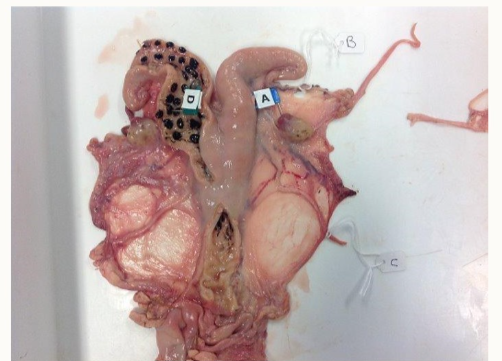
What species is this?
small ruminant - sheep

identify A -D
A = corpus luteum
B = oviduct
C = uterine artery
D = caruncles
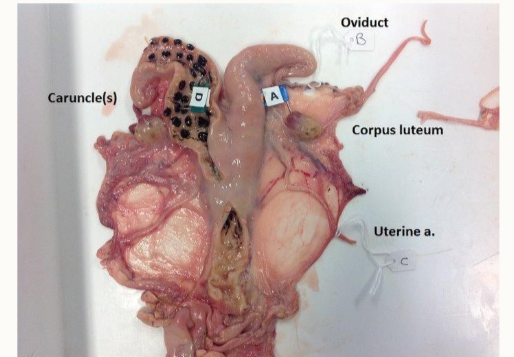

What will structure A become?
corpus albicans (A = corpus luteum)

what will happen inside structure B?
fertilisation
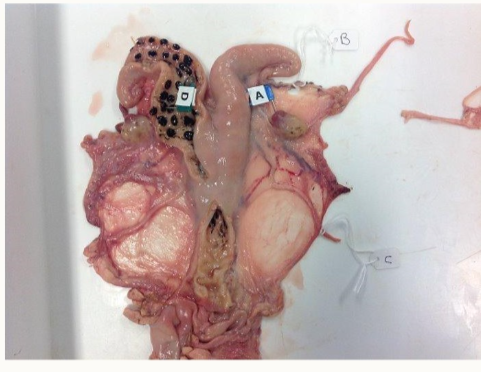
what is special about the venous return in this speices?
veins form a plexus around coiled ovarian artery
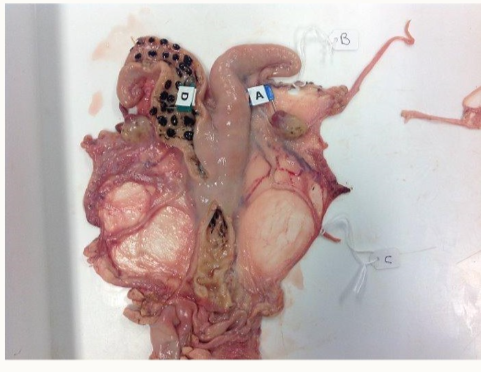
what type of placenta attaches here?
synepitheliochorial, cotyledonary non diffuse

which species have a similar placenta but how its its shape of the caruncles different?
cow - caruncles are convex as opposed to concave in small ruminants

What species is this from?
female dog

give the structures A-E
A = suspensory ligament
B = right uterine horn
C = left ovarian vain
D = emsovarium/ovary
E = right ureter

How is ligament A different in cats to this species?
long and elastic in cats
short and inelastic in dogs

which ligament supports structure B?
mesometrium
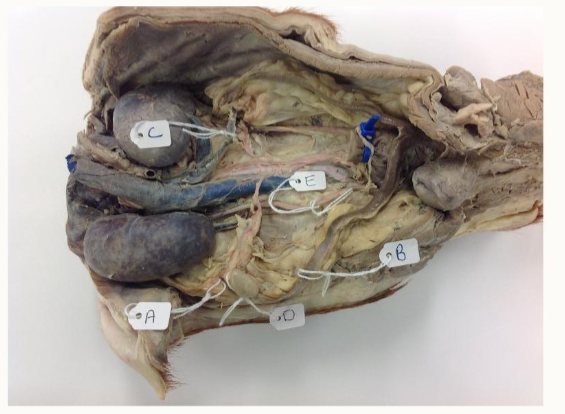
which vessel connects to C?
left renal vein

the ligament which supports D continues as which other ligament?
proper ligament

in which condition does structure E open into the vagina?
ectopic ureter
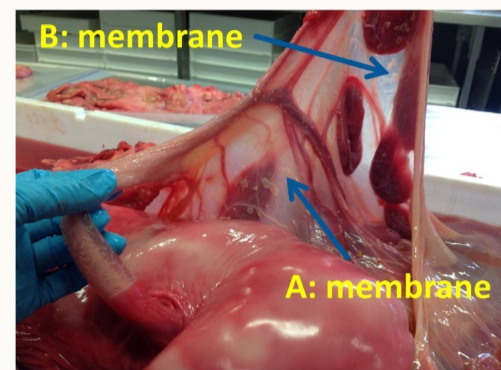
Label A + B
A = amnion
B = chorioallantois

name the species
label A + B
dog/cat
A = allantoamnion B = zonary, endotheliochorial
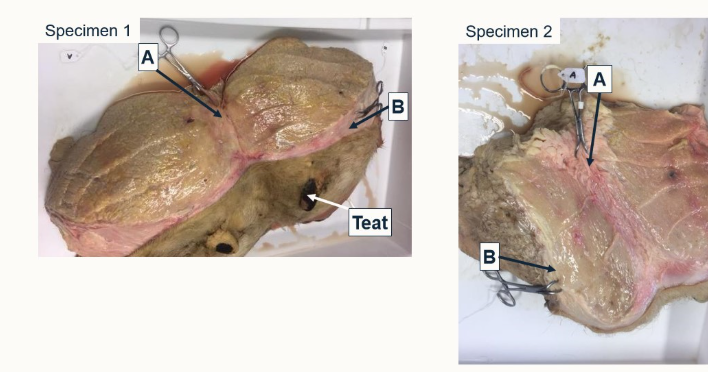
Identify A + B
A = medial suspensory ligament
B = lateral suspensory ligament