Antibodies
 Call Kai
 Learn
Learn Practice Test
 Spaced Repetition
 Match
Match Flashcards
 Knowt Play
1/20

There's no tags or description
Looks like no tags are added yet.
Name | Mastery | Learn | Test | Matching | Spaced | Call with Kai | Chat |
|---|
No analytics yet
Send a link to your students to track their progress
21 Terms
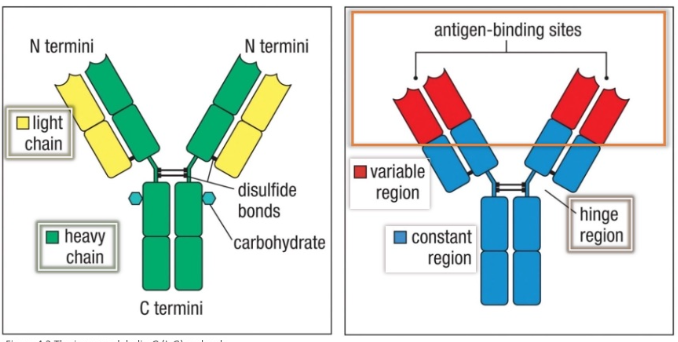
What is the structure of an antibody?
have two heavy and light chains which form variable and constant region
What does the hinge region do?
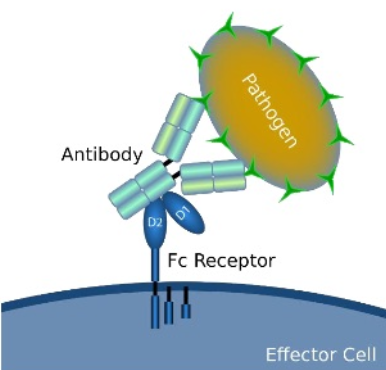
gives antibodies flexibility for optimal binding
for antigen binding: antigens can be irregulary spaced on the pathogen, the hinge region will allow antibody to bind to further spaced antigens at the same time.
for immune cell binding: phagocytoses can be actiavted via Fc tail binding to antibody, hinge region allows binding to immune cell and pathogen. (see image)
What does the constant region determine?
Determines the isotype of the antibody and is needed for binding Fc receptor on effector cells.
Isotype will determine the functions of the antibodies
What does the variable region determine?
determines the antigen specificty of the antibody (combination of heavy and light chain)
What are the two types of epitopes antibodies can bind?
Linear (continuous) — successive amino acids in sequence. Discontinuous — separate amino acids that come together due to protein folding into 3D structure.
Why does antibody binding depend on 3D structure of the intact antigen?
Discontinuous epitopes only exist when the protein is correctly folded — the binding site is formed by amino acids from different parts of the sequence coming together spatially.
What is a multivalent antigen?
An antigen containing multiple epitopes — either different epitopes on the same antigen, or repeated copies of the same epitope. Allows multiple antibodies to bind simultaneously.
Define serum level and half-life.
serum level: amount of isotypes can be found in your blood
half life: is time for half of the antibody isotope to be gone.
Distinguish between affinity and avidity?
affinity: binding strength of single interaction point
avidity: binding strength of all interaction points
What do we know about molecular mass, avidity and affinity of IgM?
IgM has a higher molecular mass because of its structure of being bound to the J-chain
Its affinity is low which is why it is perntameric and has a high avidity
Also because of the constant region of IgM being bound to the J chain it can no longer bind to immune cells therefor cannot be used for phagocytosis.
What are polyclonal antibodies?
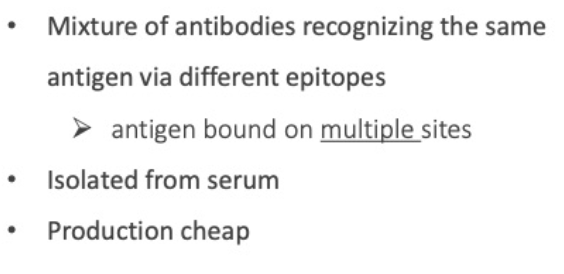
isolated from the serum after antigen injection and requires purification of antigen
usage: antisera → neutralising harmful effect of snake venom, passive transfer of antibodies againt viral infection (prophylactic, therapeutic)
What are monoclonal antibodies?
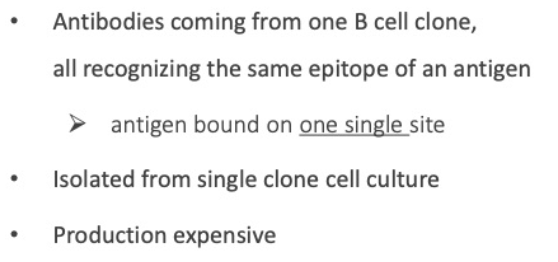
isolated from hybridoma cells
usage: fusion of immortalised tumor cell and specific B cell (to make the b cell immortal)
that way we have continuous growth of cells and production of antigen specific antibodies
there will be selection of one specific cell and clones made of that to secrete one specific antibody
→ all antibodies are specific to the same portion of the antigen
→ can be used for variety of diseases, research, and diagnostics.
Why are mouse monoclonal antibodies less effective over time?
Mouse antibodies trigger an immune response in the patient that neutralises the drug over repeated treatments, so scientists engineered increasingly human-looking antibodies to avoid this.
Where is genetic information for immunoglobulins stored?
In gene segments on germline DNA — germline configuration cannot be transcribed directly; segments must be joined first via somatic recombination
How is antibody diversity generated? (2 main processes)
1) Somatic recombination — RAG enzymes randomly join V, D, J gene segments; highest variation in CDR1, CDR2, CDR3 regions.
2) Junctional/functional diversity — TdT enzyme adds random nucleotides at coding joints during DNA repair → extra diversity specifically in CDR3
What is somatic recombination and when does it occur?
RAG enzymes cut and paste gene segments together — loops out unused segments (signal joint) and joins remaining segments (coding joint).
Occurs only during B and T cell development, before protein expression.
Light chain = 1 round, Heavy chain = 2 rounds (D-J then V-DJ)
What are CDRs and why do they matter?
Complementarity-Determining Regions (CDR1, 2, 3) — hypervariable loops that form the antigen-binding surface.
CDR3 has the highest variation due to junctional diversity.
What is junctional diversity and which enzyme causes it?
TdT enzyme adds random extra nucleotides at the coding joint after RAG cleaves the DNA → creates further sequence diversity → found specifically in CDR3
What determines antibody isotype?
The constant (C) region of the heavy chain — different C segments = different isotypes.
First two expressed are Cμ (IgM) and Cδ (IgD) before antigen encounter.
Other isotypes expressed after antigen encounter via class switching.
Why do naïve B cells express both IgM and IgD simultaneously?
Alternative splicing of the heavy chain RNA transcript — same variable domain, so both recognise the same antigen.
IgM and IgD are the only isotypes that can be co-expressed on a naïve B cell.
Summary — what are the 4 steps from gene to functional antibody?
1) Somatic recombination (RAG) → 2) Junctional diversity (TdT) → 3) Alternative splicing (IgM + IgD) → 4) Surface expression (B cell receptor, with Igα/Igβ)