Standard enthalpy change of combustion
 Call Kai
 Learn
Learn Practice Test
 Spaced Repetition
 Match
Match Flashcards
 Knowt Play
1/4

Earn XP
Description and Tags
https://www.youtube.com/watch?v=vnV75L9VUr0
Name | Mastery | Learn | Test | Matching | Spaced | Call with Kai | Chat |
|---|
No analytics yet
Send a link to your students to track their progress
5 Terms
How do we calculate standard enthalpy change of combustion
Thermal energy (kJ) / number of moles.
Why might standard enthalpy change of combustion be lower than published amount.
If we leave unlit spirit burner uncapped, then fuel with evaporate, makes it appear that we burned more fuel than we actually did, so results will show reaction to be less exo than it actually was.
A lot of the heat energy released by the fuel does not pass into the water, alot of heat energy transferred to metal calorimeter, and great deal of heat energy transferred to air.
How is energy change of water calculated
q = m c delta T
C is the specific heat capacity of water, the value is 4.18 J g-1 k-1
convert q into kj
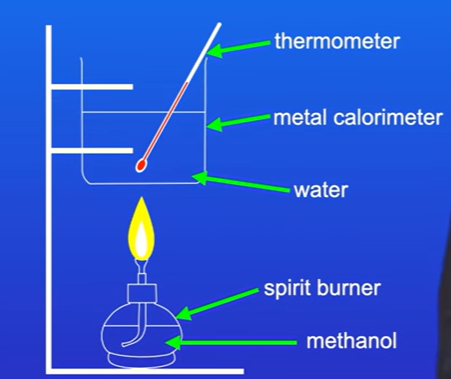
Methanol was combusted in a spirit burner, the thermal energy released was used to hear water in a calorimeter. The mass of water in the calorimeter was 300g.The temperature of water increased by 31.5 degrees C. The mass of methanol combusted was 2.65 g.
Calculate standard enthalpy change of combustion of methanol.
First calculate thermal energy that transferred into water ( q = m c delta T)
q = 300 × 4.18 × 31.5
= 39501 J = 39,501 kj
Work out moles of methanol. 2.65 g. molar mass of methanol is 32.0 g mol-1, so 2.65 / 32
number of moles = 0.0828
Calculate standard enthalpy change of combustion ( thermal energy (kJ) / number of moles)
39.501 / 0.0828 = -477.1 kJ mol^-1
This reaction is exothermic, so it must have negative sign,