D1.2 protein synthesis review
 Call Kai
 Learn
Learn Practice Test
 Spaced Repetition
 Match
Match Flashcards
 Knowt Play
1/24

There's no tags or description
Looks like no tags are added yet.
Name | Mastery | Learn | Test | Matching | Spaced | Call with Kai | Chat |
|---|
No analytics yet
Send a link to your students to track their progress
25 Terms

What is the primary function of the organelles labelled X in the electron micrograph?
A. Synthesizing lipids
B. Processing and packaging enzymes
C. Synthesizing proteins to be used within the cell
D. Synthesizing proteins to be secreted
C
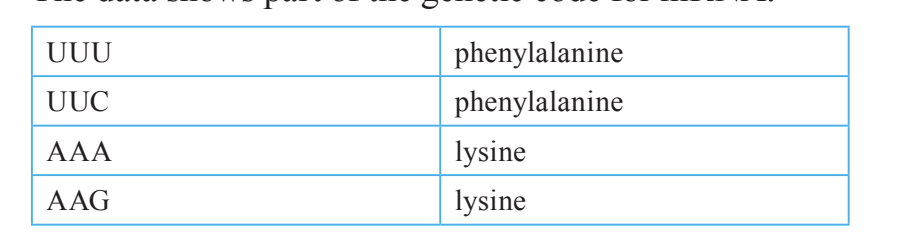
The data shows part of the genetic code for mRNA.
Which anticodon could be found on a tRNA molecule bonded to lysine?
A. AAG
B. UUC
C. TTT
D. GAA
B
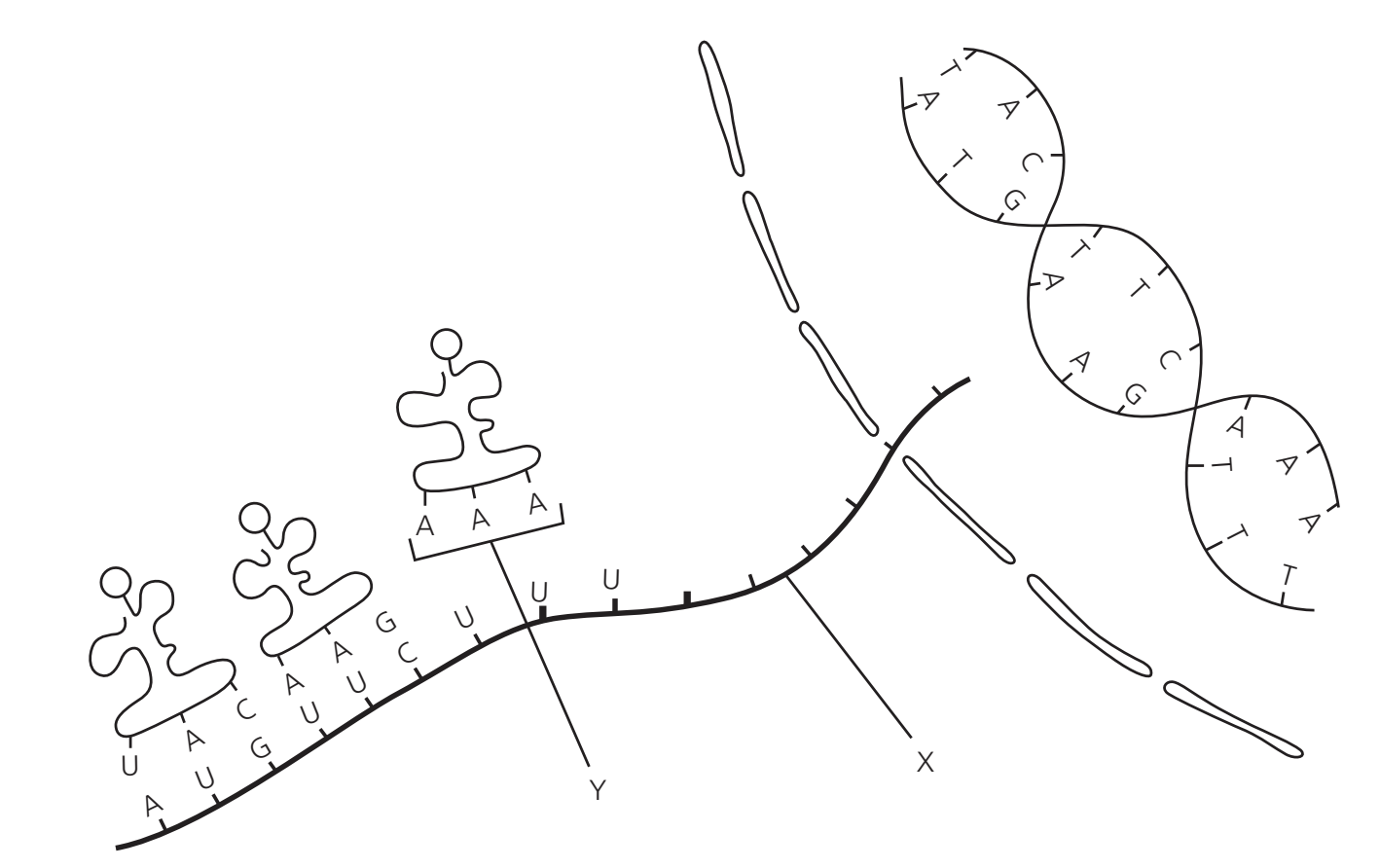
The diagram represents transcription and translation. What structures do the letters X and Y represent?
x | y |
A. DNA | Anticodon |
B. mRNA | Anticodon |
C. DNA | codon |
D. mRNA | codon |
B
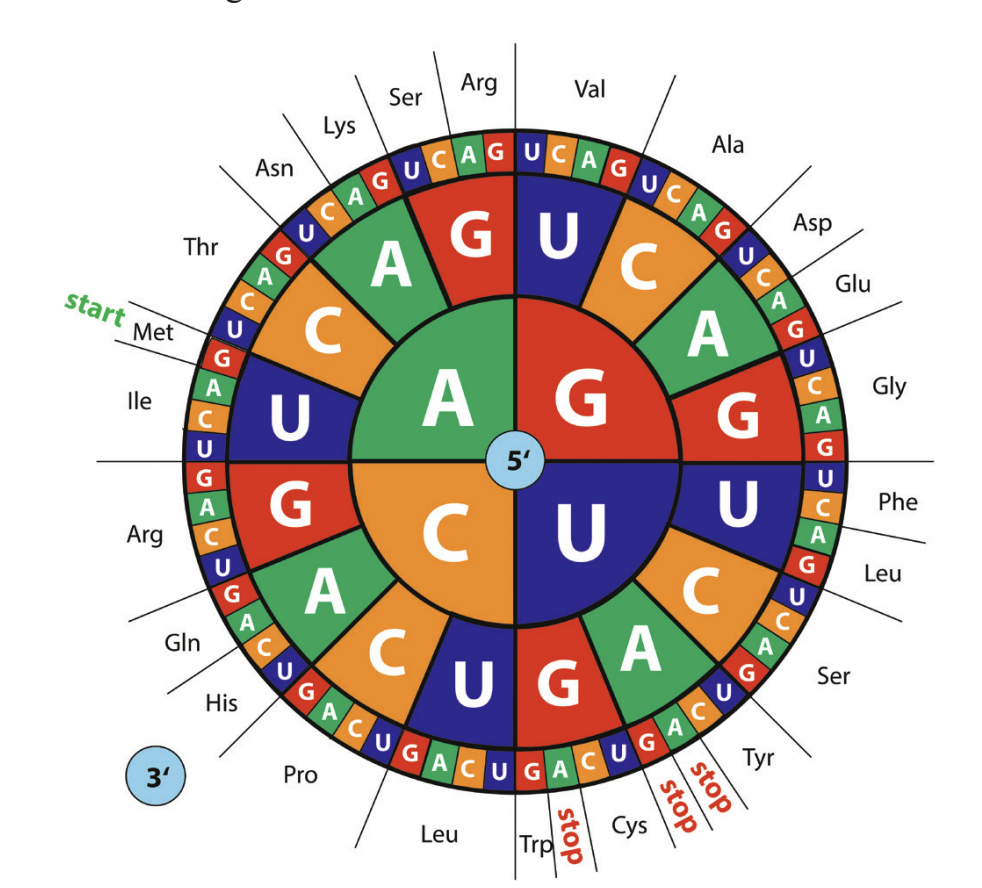
The diagram shows mRNA codons.
The mRNA sequence UGGA ACGUA codes for what amino acid sequence?
A. Glycine-Glutamine-Methionine
B. Methionine-Glutamine-Glycine
C. Threonine-Valine-Histidine
D. Tryptophan-Asparagine-Valine
D
What do DNA replication, transcription and translation have in common?
A. Take place in cell nucleus
B. Require free nucleotides
C. Catalysed by polymerase
D. Complementary base pairing
D
Which of the following statements correctly describes introns and/or exons in a eukaryotic cell?
A. Mutations to introns have no effect on the primary structure of protein
B. Different combinations of exons and introns allow more than one type of protein to be coded for by a gene
C. Exons are always translated into proteins
D. A single base-pair deletion on the first exon of a gene is likely to be more harmful than one that occurs on the last exon of a gene
D
Which regions of DNA code for the production of specific proteins?
A. Telomeres
B. Genes for ribosomal RNA
C. Exons
D. Regulators of gene expression
C
Which statement applies to tRNA?
A. There is at least one type of tRNA that combines with each known amino acid
B. One type of tRNA can combine with all of the known amino acids
C .tRNA carries out its main role within the nucleus
D. tRNA is produced by the process of translation
A

What is a feature of transcription in the single-celled organism shown in the electron micrograph?
A. mRNA splicing
B. Removal of introns
C. Codon-anticodon binding
D. Synthesis of RNA in a 5' to 3' direction
D
The number of protein-coding genes in the human genome is estimated to be about 20000, which is much less than the size of the proteome. What is one reason for this?
A. Exons are removed from RNA before translation
B. There are more types of amino acids than nucleotides
C. mRNA can be spliced after transcription
D. Base substitutions occur during transcription
C
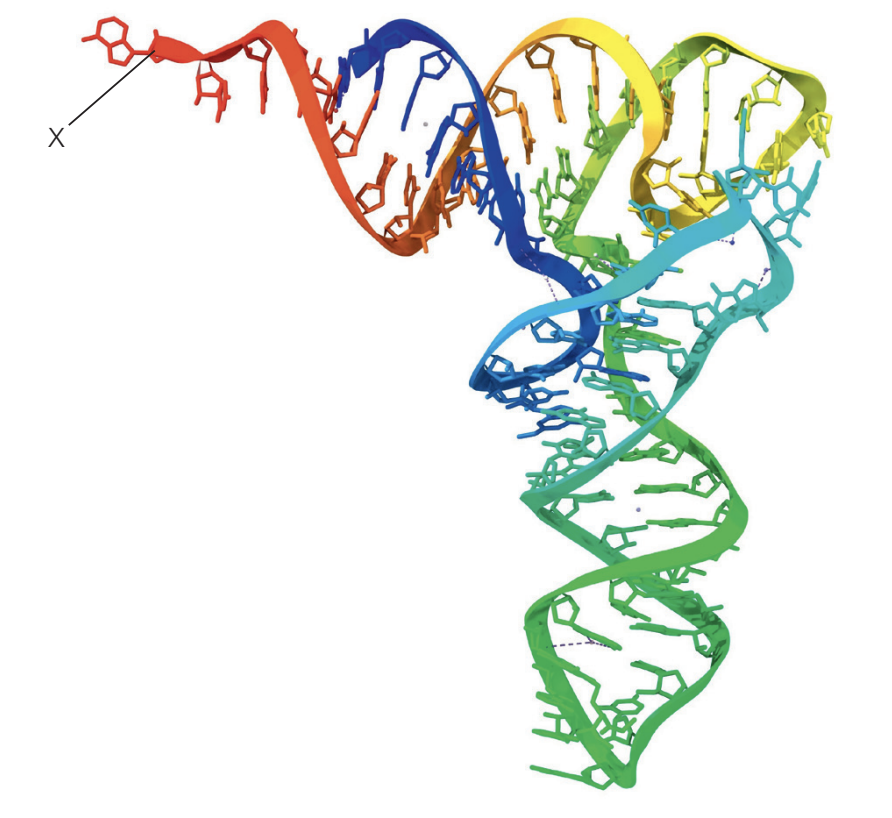
The diagram shows the three-dimensional structure of tRNA.
What can attach to the region marked X?
A. mRNA
B. An amino acid
C. An anticodon
D. The P site of the ribosome
B

The diagram shows the arrangement of introns and exons in a segment of pre-mRNA.
Pre-mRNA is immature mRNA containing introns and exons.
A
![<p>Human DNA has been analysed and details of certain genes are shown in the table below.</p><p class="p1">a. Calculate the average size of the introns for the albumin gene (show your workings). [2 marks]</p><p class="p1">b. With reference to the table shown, describe the relationship(s) between the gene size and the number of introns. [2 marks]</p>](https://assets.knowt.com/user-attachments/7e3f8b15-cac0-47b0-85b2-38392caee70a.png)
Human DNA has been analysed and details of certain genes are shown in the table below.
a. Calculate the average size of the introns for the albumin gene (show your workings). [2 marks]
b. With reference to the table shown, describe the relationship(s) between the gene size and the number of introns. [2 marks]
a. (25.0 - 2.1)/14; = 1.6 kb
b. Generally the longer or larger the gene size, the greater the number of introns; there are exceptions to this trend as shown by phenylalanine hydroxylase/albumin gene.
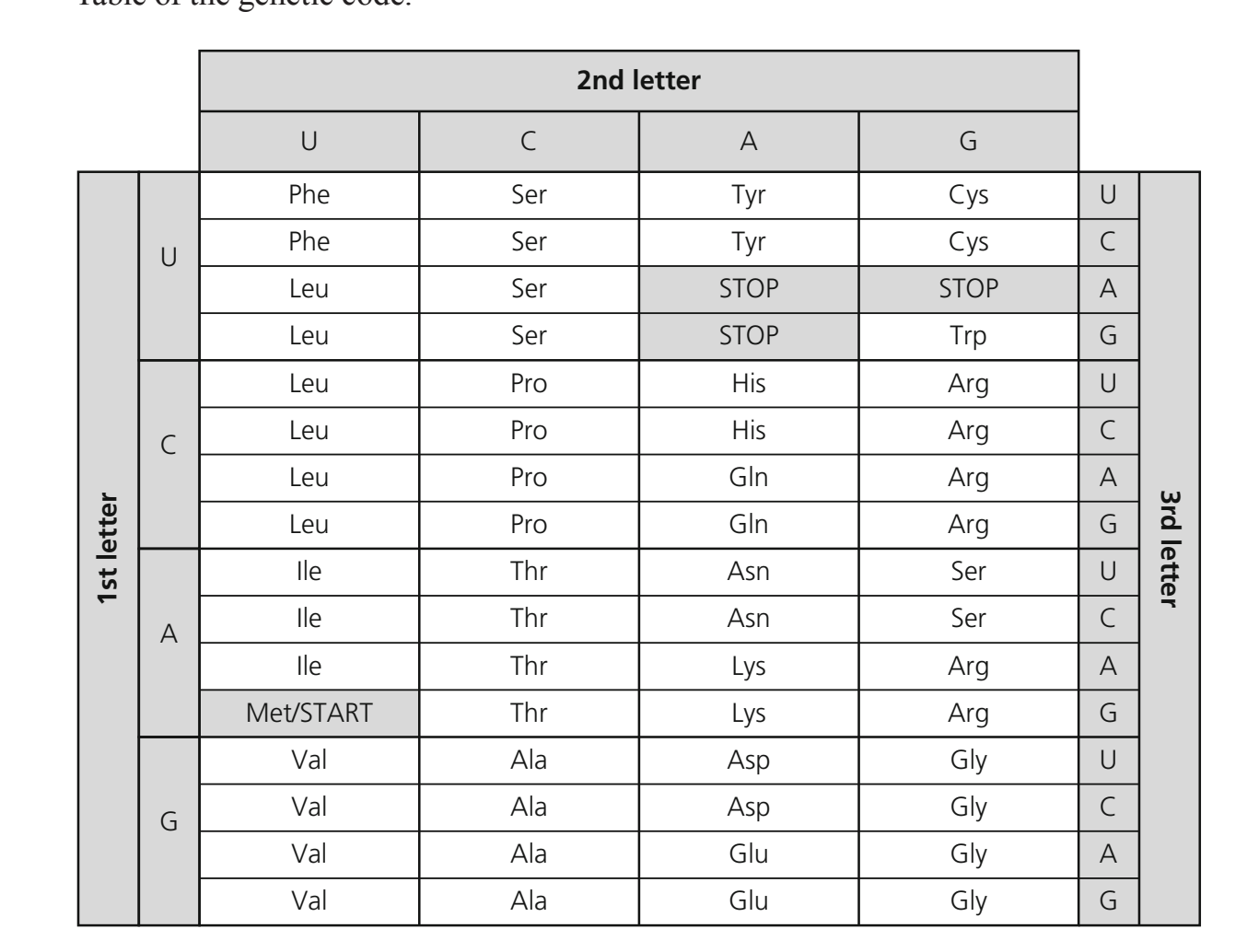
A short base sequence of mRNA and a table of the genetic code are shown below.
Sequence of mRNA:
AUGAGCCGAAGGUAGCUG
a. Outline the function of codons.
b. Determine the sequence of amino acids that could be translated from the sequence of mRNA.
c. Determine the DNA base sequence transcribed to form this sequence of mRNA.
a. (Three bases on mRNA) coding for one amino acid (in a polypeptide).
b. Met-Ser-Arg-Arg OR Start-Ser-Arg-Arg OR Met-Ser-Arg-Arg-Stop OR Start-Ser-Arg-Arg-Stop.
c. TAC TCG GCT TCC ATC GAC
Describe the stages in the production of mRNA by transcription [5 marks]
RNA nucleotides join together to form an RNA strand.
RNA polymerase separates DNA strands and builds the RNA strand.
The RNA strand is made using the DNA template strand.
Complementary base pairing is used, with uracil (U) instead of thymine (T).
RNA nucleotides are joined from the 5′ end to the 3′ end of the growing RNA strand.
Transcription starts when RNA polymerase binds to a promoter.
Distinguish between transcription and translation. [4 marks]
Transcription: DNA → mRNA.
Translation: mRNA → polypeptide/protein.
Transcription: uses RNA polymerase and occurs in the nucleus.
Translation: uses ribosomes and tRNA and occurs in the cytoplasm.
Outline how translation depends on complementary base pairing [3 marks]
Translation changes mRNA codons into a sequence of amino acids/polypeptide.
tRNA anticodons pair with complementary mRNA codons.
A pairs with U and G pairs with C; each tRNA carries a specific amino acid.
Telomeres are parts of chromosomes in eukaryotic cells.
a. Describe the function of telomeres. [4 marks]
b. Suggest why bacteria do not have telomeres. [1 mark]
a. Telomeres
Telomeres are repeated DNA sequences found at the ends of chromosomes.
They protect genes from being lost during DNA replication.
They protect chromosome ends from damage and prevent chromosomes from joining together.
Telomerase can lengthen telomeres, allowing some cells, such as cancer cells, to divide repeatedly.
b. Bacteria
Bacteria have circular chromosomes, so they have no ends to degrade during DNA replication.
Therefore, bacteria do not have the end-replication problem found in linear chromosomes.
5'-capping and 3'-polyadenylation are two kinds of post-transcriptional modifications that are present in eukaryotes but absent in prokaryotes.
Describe another post-transcriptional modification necessary to produce mature mRNA in eukaryotes. [2 marks']
Spliceosome recognizes/binds splice site; brings about the removal of introns/spliced exons join together to form mature mRNA.
Describe how the information carried on mRNA allows the synthesis of a complete polypeptide chain.[3 marks]
mRNA binds to the ribosome, and three bases on mRNA form a codon.
Each codon codes for a specific amino acid; the start codon begins translation.
A stop codon (UAG, UAA, or UGA) ends translation and releases the polypeptide.
a. State one function for a region of DNA that does not code for proteins. [1 mark]
b. Outline the role of the A-site of ribosomes in translation. [1 mark]
c. Outline the role of tRNA-activating enzymes in translation. [2 marks]
a.
Regulates gene expression and contains genes for tRNA/rRNA.
Contains promoters, enhancers, and silencers that control transcription.
b.
Site where tRNA carrying amino acids binds.
Site where the growing polypeptide chain is transferred and peptide bonds form.
c.
ATP provides energy to attach amino acids to tRNA.
A specific amino acid attaches to the 3′ end of tRNA.
Describe the roles of the different binding sites for tRNA on ribosomes during translation.[5 marks]
A, P and E sites are located on the large ribosomal subunit.
P site: holds the tRNA carrying the growing polypeptide chain.
A site: holds the tRNA carrying the next amino acid.
A peptide bond forms between the amino acids, and the polypeptide moves to the tRNA in the A site.
E site: the empty tRNA leaves the ribosome.
Describe the eukaryotic processing of pre-mRNA in terms of intron splicing, polyadenylation and 5' capping [7 marks]
Introns are non-coding regions that are removed from pre-mRNA by spliceosomes.
Exons are joined together to form mature mRNA.
Alternative splicing joins different combinations of exons, allowing one gene to produce different proteins.
A poly-A tail is added to the 3′ end of the mRNA.
A 5′ cap made of modified guanine is added to the 5′ end.
The cap and poly-A tail protect mRNA from breakdown.
The mature mRNA leaves the nucleus and is used for translation.
Describe how protein synthesis in bacteria differs from that in plant cells. [7 marks]
Prokaryotes vs. Eukaryotes
Prokaryotic ribosomes: 70S; eukaryotic ribosomes: 80S.
Prokaryotes have no nucleus, so transcription and translation can occur in the same area.
In prokaryotes, translation can begin immediately after mRNA is made.
In eukaryotes, mRNA must leave the nucleus before translation can begin.
Eukaryotic mRNA is processed, but prokaryotic mRNA usually is not.
Eukaryotic genes have introns and exons; introns are removed by splicing.
Eukaryotic mRNA receives a 5′ cap and poly-A tail, which help protect the mRNA and allow it to be transported out of the nucleus.
Explain how a polypeptide chain is synthesized in a eukaryotic cell. [7 marks]
Translation
Translation occurs on ribosomes.
tRNA-activating enzymes attach specific amino acids to tRNAs.
The ribosome binds to the mRNA at the start codon.
Each tRNA enters the A site, where its anticodon pairs with the mRNA codon.
The ribosome moves along the mRNA, and peptide bonds form between amino acids.
tRNA moves A → P → E, and leaves from the E site.
This repeats until a stop codon is reached, then the polypeptide is released.