UNIT 7: Evolution and classification
 Call Kai
 Learn
Learn Practice Test
 Spaced Repetition
 Match
Match Flashcards
 Knowt Play
1/74

There's no tags or description
Looks like no tags are added yet.
Name | Mastery | Learn | Test | Matching | Spaced | Call with Kai | Chat |
|---|
No analytics yet
Send a link to your students to track their progress
75 Terms
Outline how adaptive radiation provides evidence for evolution. [3]
diversification/ different species produced from a common/shared ancestor;
homologous features have similarities of structure
despite different functions;
(different) adaptation to different environments/different selective pressures;
pentadactyl limbs/Darwin’s finches/other example of adaptive radiation described correctly;
Describe polyploidy and how it can lead to speciation. [5]
polyploidy is having more than two (complete) sets of chromosomes/3n/4n/other specific example of polyploidy;
can be due to errors in meiosis/production of diploid gametes;
can be due to DNA replication without mitosis/cytokinesis;
polyploidy causes reproductive isolation;
diploids crossed with tetraploids produce infertile (triploid) offspring / triploid offspring are infertile;
tetraploids are therefore a new species/failure to interbreed/reproductive isolation leads to speciation;
(many) examples in the onion family/Allium/other valid example of speciation by polyploidy;
infertile interspecific hybrids can become fertile by becoming polyploid;
Polyploidy has been a cause of rapid speciation in some plant genera, such as Helianthus. Which observation is evidence that speciation has occurred? [1]
A. A polyploid plant reproduces asexually.
B. A polyploid plant produces male and female gametes.
C. Fertile offspring are produced when a polyploid plant crosses with a diploid plant.
D. Fertilization can occur between polyploid individuals.
D
Describe the barriers that exist to hybridization between species. [4]
courtship behaviour is often complex and unique to a species;
(at several stages in courtship ritual) rejection occurs if characteristic behaviour not exhibited;
species-specific egg fertilization;
compatibility of acrosome with vitelline layer;
inability of successfully attached wrong species sperm to develop continuity with egg membrane;
sterility of interspecific hybrids;
due to differences in chromosome number;
What can lead to the emergence of analogous structures? [1]
A. Divergent evolution from a recent common ancestor
B. Convergent evolution of unrelated species
C. Splits in the fundamental niche of a species
D. Splits in the realized niche of a species
B
![<p>Scientists studying ground finches (<em>Geospiza fortis</em>) on the island of Daphne Major in Galapagos found great differences in the shapes of the beaks. [1]</p><p></p><p>[Source: Public domain.]</p><p>What is the explanation for this variation in beak shape between the birds?</p><p>A. Ground finches grow larger beaks if there is competition for food.</p><p>B. They belong to different species.</p><p>C. They are adapted for different diets.</p><p>D. The more a beak is used by a ground finch, the larger it becomes.</p>](https://assets.knowt.com/user-attachments/fad341b5-a758-4ec7-85b5-96c980bb4d5c.png)
Scientists studying ground finches (Geospiza fortis) on the island of Daphne Major in Galapagos found great differences in the shapes of the beaks. [1]
[Source: Public domain.]
What is the explanation for this variation in beak shape between the birds?
A. Ground finches grow larger beaks if there is competition for food.
B. They belong to different species.
C. They are adapted for different diets.
D. The more a beak is used by a ground finch, the larger it becomes.
C
Outline how variation in organisms of the same species could lead to natural selection. [3]
a. survival of the better adapted/fittest ✔
b. more reproduction of better adapted/fittest/individuals with favorable variations ✔
c. genes for favorable variations/adaptations passed on to offspring ✔ Accept answers in the converse.
d. competition for resources/more offspring produced than the environment can support/a struggle for existence ✔ Accept answers in the converse.
Which factor(s) would favour evolution by natural selection?
I. Long lifespans
II. Favourable characteristics acquired by individuals during their lifetime
III. Variation within a species
A. II only
B. III only
C. I and II
D. I and III
[1]
B
Which statement best describes how evolution occurs?
A. Species which produce the most offspring are favoured by natural selection.
B. Mutations in somatic cells are passed on to offspring.
C. Natural selection decreases the frequency of unfavourable characteristics.
D. Changes in species lead towards greater complexity over time.
[1]
C
Outline how variation in organisms of the same species could lead to natural selection. [3]
a. survival of the better adapted/fittest ✔
b. more reproduction of better adapted/fittest/individuals with favorable variations ✔
c. genes for favorable variations/adaptations passed on to offspring ✔ Accept answers in the converse.
d. competition for resources/more offspring produced than the environment can support/a struggle for existence ✔ Accept answers in the converse.

Humans have been improving crop species for thousands of years by cross-breeding plants with desirable characteristics. The photograph shows the changes in dry cobs of corn (Zea mays) over 10 000 years.
What is the name of the process that was used to produce modern corn?
A. Selective breeding
B. Adaptive radiation
C. Discontinuous variation
D. Natural selection
A
What could be used as evidence for evolution?
I. Selective breeding of domesticated animals
II. The fossil record
III. Homologous structures
A. I and II only
B. I and III only
C. II and III only
D. I, II and III
D
Which is an example of evolution by selective breeding?
A. Selection of prey animals that can run faster than their predators
B. The variation in the size of different breeds of dogs
C. The tendency, during breeding, for birds to produce more offspring than will survive
D. Some female spiders only breeding with males which make the right signals
B
Which are examples of homologous structures?
A. The wings of bats and butterflies
B. The fins of fish and whales
C. The hindlimbs of frogs and grasshoppers
D. The forelimbs of primates and penguins
D
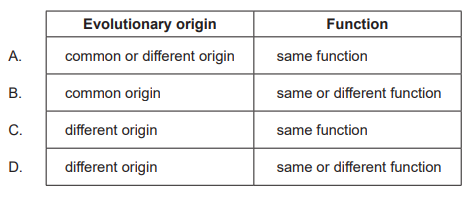
What are the evolutionary origins and functions of homologous structures?
B
What process best explains the formation of different pentadactyl limbs?
A. Adaptive radiation
B. Interbreeding
C. Selective breeding
D. Convergence
A
The bird and bat wings share homologous bone structures whereas the insect wing does not. Outline the conclusion that can be drawn about the evolution of these wings, based on homologous structures. [1]
a. bird and bat share a more recent common ancestor (than the insect) ✔
b. bird and bat are more closely related than insect and bat / insect and bird ✔
c. bird and bat wings evolved from a common ancestor (by natural selection) ✔

Which pentadactyl limb is adapted for flight?
D
The bird and bat wings share homologous bone structures whereas the insect wing does not. Outline the conclusion that can be drawn about the evolution of these wings, based on homologous structures.
[1]
a. bird and bat share a more recent common ancestor (than the insect) ✔
b. bird and bat are more closely related than insect and bat / insect and bird ✔
c. bird and bat wings evolved from a common ancestor (by natural selection) ✔
The pentadactyl limbs of mammals, birds, reptiles and amphibians are examples of which kind of structures?
A. Homologous
B. Analogous
C. Vestigial
D. Convergent
A
Outline evidence for evolution from the limbs of mammals such as pangolins. [2]
pentadactyl;
homologous with limbs of other vertebrates;
due to common ancestry;
adaptation;
Based on their structure, the insect and bat wings are analogous. Outline what is meant by an analogous trait. [2]
a. analogous traits have a different evolutionary history/ancestry ✔
b. different structures are adaptations for flight ✔
c. selective pressure leads to a similar solution to the problem of flying ✔
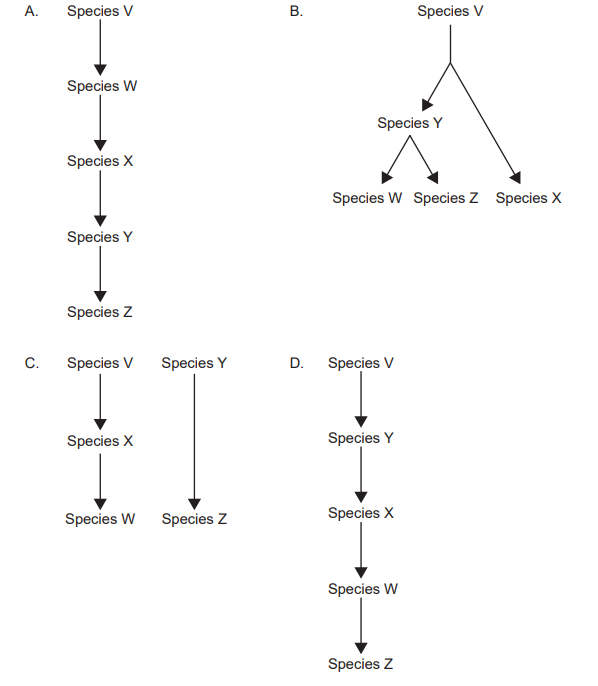
Which evolutionary pathway is most likely to result in the evolution of analogous structures in Species W and Z?
C
What can lead to the emergence of analogous structures?
A. Divergent evolution from a recent common ancestor
B. Convergent evolution of unrelated species
C. Splits in the fundamental niche of a species
D. Splits in the realized niche of a species
B
Based on their structure, the insect and bat wings are analogous. Outline what is meant by an analogous trait.
a. analogous traits have a different evolutionary history/ancestry ✔
b. different structures are adaptations for flight ✔
c. selective pressure leads to a similar solution to the problem of flying ✔
Explain how natural selection can lead to speciation. [7]
a. variation is required for natural selection/evolution/variation in species/populations ✔
b. mutation/meiosis/s3xual reproduction is a source of variation ✔
c. competition/more offspring than the environment can support ✔
d. adaptations make individuals suited to their environment/way of life ✔
e. survival of better adapted «individuals)/survival of fittest/converse ✔
f. inheritance of traits/passing on genes of better adapted «individuals»
OR
reproduction/more reproduction of better adapted/fittest «individuals» ✔
g. speciation is formation of a new species/splitting of a species/one population becoming a separate species ✔
h. reproductive isolation of separated populations ✔
i. geographic isolation «of populations can lead to speciation» ✔
j. temporal/behavioral isolation «of populations can lead to speciation» ✔
k. disruptive selection/differences in selection «between populations can lead to speciation» ✔
l. gradual divergence of populations due to natural selection/due to differences in environment ✔
m. changes in the gene pools «of separated populations»/separation of gene pools ✔
n. interbreeding becomes impossible/no fertile offspring «so speciation has happened» ✔
Which is an example of speciation?
A. Selective breeding to produce new varieties of the wheat Triticum aestivum with higher crop yield
B. Evolution of different courtship behaviours in separate populations of the cricket Gryllus rubens
C. Natural selection leading to an increase in the frequency of darker individuals of Biston betularia
D. Selective feeding by koalas (Phascolarctos cinereus) on Eucalyptus species
B
Explain how speciation occurs, including the different processes of isolation and selection. [7]
Species is a group of organisms that interbreeds (normally in the wild) and produce fertile offspring;
within an interbreeding population there is variety / variation exists;
some adaptations favour survival to reproductive age /survival of the fittest / natural selection;
alleles for these adaptations become more frequent/are inherited in the population /change with time;
speciation is the formation of new species;
(speciation) occurs because populations have become reproductively isolated / no longer able to interbreed / exposed to different selection pressures;
behavioural isolation involves differences in courtship or mating behaviours;
temporal isolation involves differences in the timing of courtship or mating behaviours;
geographical isolation / allopatric refers to the physical barriers that exist that keep two populations from mating;
polyploidy can lead to reproductive isolation;
stabilizing selection is when the two extremes of a trait have lower reproductive fitness (OWTTE) / favours average phenotype;
directional selection is when one extreme of the trait has lower reproductive fitness (OWTTE);
disruptive/diversifying selection favours both extreme phenotypes / intermediate phenotype has lower fitness;
Which is an example of speciation?
A. Selective breeding to produce new varieties of the wheat Triticum aestivum with higher crop yield
B. Evolution of different courtship behaviours in separate populations of the cricket Gryllus rubens
C. Natural selection leading to an increase in the frequency of darker individuals of Biston betularia
D. Selective feeding by koalas (Phascolarctos cinereus) on Eucalyptus species
Distinguish between species richness and evenness as components of biodiversity. [1]
richness is how many species are in an area, evenness considers the relative number of each species;
Explain how biogeographic factors affect the richness and evenness of biodiversity.
biogeographic features are combinations of species, habitats and physical features;
richness is the number of different species present (in an area);
evenness refers to relative abundance of the different species (in an area) /OWTTE;
large nature reserves/large islands (potentially) have greater biodiversity /richness / evenness;
large areas (tend to) have more species/populations/habitats/richness
OR
large areas have more stability/higher biodiversity index
OR
have less chances of loss of a species;connected areas/nature reserves have more diversity than isolated ones
OR
corridors between (small) areas/ reserves increases richness/biodiversity;the greater the surface:perimeter ratio, the greater the biodiversity;
edges are transition areas
OR
have greater richness/lower evenness
OR
are less stable;circular shape has more biodiversity than rectangular shape;
biodiversity measured by Simpson’s / diversity index;
one additional abiotic factor affecting biodiversity;
Distinguish between species richness and evenness as components of biodiversity. [1]
richness is how many species are in an area, evenness considers the relative number of each species;
What is polyploidy?
A. Having an extra set of chromosomes
B. Having an extra sex chromosome
C. Having an extra autosome
D. Having two or more nuclei
A
Describe polyploidy and how it can lead to speciation. [5]
polyploidy is having more than two (complete) sets of chromosomes/3n/4n/other specific example of polyploidy;
can be due to errors in meiosis/production of diploid gametes;
can be due to DNA replication without mitosis/cytokinesis;
polyploidy causes reproductive isolation;
diploids crossed with tetraploids produce infertile (triploid) offspring / triploid offspring are infertile;
tetraploids are therefore a new species/failure to interbreed/reproductive isolation leads to speciation;
(many) examples in the onion family/Allium/other valid example of speciation by polyploidy;
infertile interspecific hybrids can become fertile by becoming polyploid;
Reject non-disjunction as a cause of polyploidy as it usually applies to a single bivalent.
Polyploidy has been a cause of rapid speciation in some plant genera, such as Helianthus. Which observation is evidence that speciation has occurred?
A. A polyploid plant reproduces asexually.
B. A polyploid plant produces male and female gametes.
C. Fertile offspring are produced when a polyploid plant crosses with a diploid plant.
D. Fertilization can occur between polyploid individuals.
D
![<p>The foxglove, <em>Digitalis purpurea</em>, was once classified in the figwort family. The figwort family has been reclassified and is now much smaller.</p><p>Why were species such as the foxglove moved into other families?</p><p>A. The appearance was too dissimilar.</p><p>B. The plants are found in different locations.</p><p>C. The genera were different.</p><p>D. The DNA sequences indicated different ancestry.</p><p>[1]</p>](https://assets.knowt.com/user-attachments/9e0fde7a-8797-45dd-97df-9b2402c84507.png)
The foxglove, Digitalis purpurea, was once classified in the figwort family. The figwort family has been reclassified and is now much smaller.
Why were species such as the foxglove moved into other families?
A. The appearance was too dissimilar.
B. The plants are found in different locations.
C. The genera were different.
D. The DNA sequences indicated different ancestry.
[1]
D
Explain how a newly discovered plant species would be classified and named. [7]
Naming:
binomial nomenclature/(plant is) given a binomial/double name;
first name is the genus and second name is the species/genus initial uppercase and species lower case;
names (of plant species) are international/are universally understood/are published in journals;
Classification:study the characteristics/structure/reproduction/chemical properties/DNA (of the plant);
put/classify (the plant) in a group/genus with other similar species;
natural classification corresponds with evolution/natural classification is based on many features;
analogous features/features due to convergent evolution should not be used;
hierarchy of groups/taxa (in traditional classification/3 or more taxa in correct sequence (kingdom-phylum-class);
two or more of bryophyta, filicinophyta, coniferophyta and angiospermophyta named;
a clade is a group of organisms evolved from a common ancestor;
base sequences/amino acid sequences used to group organisms into clades/deduce evolutionary relationships;
cladograms show the relationships between clades/likely evolutionary divergence of clades;
each branch point/node represents where species are formed via divergent evolution;
species are now classified into a sequence of clades (rather than a rigid hierarchy of taxa);
For mpi, common names such as ‘mosses’ are acceptable.

Scientists studied differences in the base sequences of a gene found in five animal species in order to determine their evolutionary relationships. A cladogram was constructed based on these differences.
What can be deduced from the cladogram?
A. There are only three clades shown.
B. Morphological differences between V and Z increase with time.
C. There is only one difference between the amino acid sequences of X and Y.
D. Y and Z have a more recent common ancestor than W and X.
D
Which term describes the whole of the genetic information of an organism?
A. Genome
B. DNA
C. Gene pool
D. Allele frequency
A
Outline how sex is determined in humans. [2]
genetically determined/determined by (pair of) sex chromosomes/X and Y chromosomes;
sperm carry either an X or a Y chromosome;
egg is X and if fertilized by X sperm leads to a female child / XX female
OR
egg is X and if fertilized by Y sperm leads to a male child / XY male;
State the reason that O. sativa and O. rufipogon are classified as different species. [1]
cannot interbreed to produce fertile offspring ✔
Which conditions of temperature and pH are most suitable for coral reef development?
| temperature range /°C | pH |
A. | 18 | 7.8 |
B. | 25 | 6.8 |
C. | 18 | 6.8 |
D. | 25 | 7.8 |
D
Discuss whether these studies show that habitat destruction can affect global bumblebee numbers. [2]
habitat destruction removes the plants/flowers/natural food source of the bees;
bees have to look for other food sources;
many of these alternative sources of food are not suitable for bee survival
OR
pollen with a different proportion of protein to lipid would reduce survival;no control where bees are fed their normal diet is included;
simulation is not using natural pollen / habitat;
OR
sample size is too small to make conclusions;
By the end of the 19th century in England, the dark form of the moth Biston betularia formed up to 98 % of the total population in industrial areas. From 1970, the percentage of dark forms decreased significantly. What is an explanation for the decrease?
A. An increase in environmental pollution killed the dark forms more than the light forms.
B. Reduction of pollution resulted in greater camouflage for light forms of the moth.
C. Dark forms could no longer find mates.
D. Light forms had superior feeding mechanisms.
B
What assumption is made when using the Hardy-Weinberg equation for calculating changes in allele frequencies in a population?
A. The population size is large.
B. Natural selection is taking place.
C. Mutations are occurring in the population.
D. There is variation among the phenotypes of the population.
A
Domestic dogs (Canis familiaris) have evolved from grey wolves (Canis lupus). Evidence suggests that the domestication of dogs first occurred around 30 000 years ago. Which best describes the evolution giving rise to the domestic dog?
A. The wolf produced offspring in large numbers which underwent natural selection.
B. Variations in the wolf population that resembled modern dogs favoured wolf survival.
C. Wolves showing favourable traits were selected for breeding.
D. Dogs were better suited to changes in the natural environment than wolves.
C
Suggest one way in which depth may act as a limiting factor for coral. [1]
low light levels/lower temperatures cannot support growth/metabolism ✔
Describe adaptations in mammals living in desert ecosystems to maintain osmolarity in their bodies. [4]
behavioural adaptations to avoid over-heating / hiding in burrows/out of sun during hot period of day / active at cooler times of the day/nocturnal animals / panting;
adaptations for heat exchange such as large ears;
may have longer loop of Henle (to reabsorb more water);
may produce more ADH (according to osmotic concentrations of the blood) / produce concentrated urine / lower volume of urine;
camel humps that store fat that releases (metabolic) water when broken down;
reduced sweat;
any other valid adaptation; (e.g., light coloured coats)
What is an outcome of natural selection?
A. Evolution
B. Mutations
C. Reproductive isolation
D. Variation
A
Explain how sexual reproduction gives rise to genetic variation. [2]
recombination of parental alleles during fertilization;
fertilized egg contains a mixture of paternal and maternal chromosomes;
crossing over/meiosis gives rise to new combinations of alleles;
Which is an example of natural selection?
A. A giraffe stretching its neck to reach higher leaves
B. A juvenile bird learning to sing
C. Development of antibiotic resistance in bacteria
D. Selective breeding of tail-less cats
C
Explain how natural selection can cause traits such as drought resistance to develop in wild plants. [7]
(natural selection occurs if) there is variation in degree of drought resistance among members of a population/same species;
variation is caused by mutations (when changes occur in the DNA/nucleic bases/chromosomes);
variation during meiosis occurs (with separation of chromosomes);
variation occurs during sexual reproduction (as different alleles combine);
some variations make some plants more drought-resistant;
example of variations: deeper roots/more storage tissue for water/thicker cuticles/less opening of stomata/other verifiable variations;
these variations let some survive and reproduce better/have more offspring
OR
(these variations) confer selective advantage;these variations/characteristics are passed onto offspring which survive better;
natural selection increases the frequency of these characteristics;
eventually leads to changes/evolution in the species / more drought-resistant plants;
Which process results in decreased variation?
A. Meiosis
B. Mutation
C. Sexual reproduction
D. Natural selection
D
Explain how evolution by natural selection depends on mutations. [4]
a. mutations cause variation among organisms of same species/population;
b. some variations/mutations make individual more suited to its environment/way of life;
c. individuals that are better adapted survive and produce offspring;
d. individuals pass on genetic characteristics/mutation/variation to offspring;
e. natural selection increases frequency of characteristics/alleles that make individuals better adapted;
What is required for natural selection to occur?
I. Acquired characteristics
II. Advantageous characteristics
III. Genetic variation
A. I only
B. I and III only
C. II and III only
D. I, II and III
C
Explain how natural selection can cause traits such as drought resistance to develop in wild plants. [7']
(natural selection occurs if) there is variation in degree of drought resistance among members of a population/same species;
variation is caused by mutations (when changes occur in the DNA/nucleic bases/chromosomes);
variation during meiosis occurs (with separation of chromosomes);
variation occurs during sexual reproduction (as different alleles combine);
some variations make some plants more drought-resistant;
example of variations: deeper roots/more storage tissue for water/thicker cuticles/less opening of stomata/other verifiable variations;
these variations let some survive and reproduce better/have more offspring
OR
(these variations) confer selective advantage;these variations/characteristics are passed onto offspring which survive better;
natural selection increases the frequency of these characteristics;
eventually leads to changes/evolution in the species / more drought-resistant plants;
Distinguish between continuous and discrete variation, using examples. [4]

Explain how sexual reproduction gives rise to genetic variation. [2]
recombination of parental alleles during fertilization;
fertilized egg contains a mixture of paternal and maternal chromosomes;
crossing over/meiosis gives rise to new combinations of alleles;
Explain how evolution by natural selection depends on mutations. [4]
a. mutations cause variation among organisms of same species/population;
b. some variations/mutations make individual more suited to its environment/way of life;
c. individuals that are better adapted survive and produce offspring;
d. individuals pass on genetic characteristics/mutation/variation to offspring;
e. natural selection increases frequency of characteristics/alleles that make individuals better adapted;
State the immediate consequence of a species producing more offspring than the environment can support.
competition/lack of resources/death/exceeding carrying capacity ✔
Explain the consequence of overpopulation on the survival and reproduction of better adapted individuals within a population. [3]
a. «better adapted» tend to survive more ✔
b. «better adapted» reproduce/produce more offspring ✔
c. pass on characteristics to their offspring «when they reproduce» ✔
d. their frequency increases «within the population» due to natural selection ✔
e. leading to evolution ✔
State one abiotic factor that could have determined the distribution of barnacles.
a. exposure/tides/waves ✔
b. temperature ✔
c. surfaces «of attachment» ✔
d. resource availability/nutrients ✔
e. pH ✔
f. light ✔
g. salinity ✔
Explain how natural selection can cause mate selection behaviour patterns to develop in a species such as eastern bluebirds. [3]
a. natural selection favours specific types of mate selection/behaviour;
b. (behaviour/mate selection) increases the chances of survival/reproduction;
c. chosen organisms/males will leave more offspring;
d. pass on gene(s) for behavior to offspring;
e. (behaviour/allele) will become more prevalent/frequent in a population;
![<p>Breeding plumage can be an important signal for mate selection in birds. Breeding plumage in red knots (<em>Calidris canutus</em>) includes a rusty red colour. Red knots have six recognized subspecies, each with different migratory routes.</p><p>The scatter graph shows the overall migration distance and the breeding plumage colouration for different subspecies of red knots. The darkest plumage colouration is 6.</p><p></p><p><br><span>Identify the relationship between migration distance and plumage colouration. [1]</span></p>](https://assets.knowt.com/user-attachments/7b4f3e48-1282-413f-8f4d-9477b63d53c4.png)
Breeding plumage can be an important signal for mate selection in birds. Breeding plumage in red knots (Calidris canutus) includes a rusty red colour. Red knots have six recognized subspecies, each with different migratory routes.
The scatter graph shows the overall migration distance and the breeding plumage colouration for different subspecies of red knots. The darkest plumage colouration is 6.
Identify the relationship between migration distance and plumage colouration. [1]
the longer the migration, the lighter the colour / vice versa;
too much variation so it is not possible to see a relationship;
![<p>Breeding plumage can be an important signal for mate selection in birds. Breeding plumage in red knots (<em>Calidris canutus</em>) includes a rusty red colour. Red knots have six recognized subspecies, each with different migratory routes.</p><p>The scatter graph shows the overall migration distance and the breeding plumage colouration for different subspecies of red knots. The darkest plumage colouration is 6.</p><p><br><span>Suggest </span><strong>two</strong><span> reasons, other than mate selection, for variation in plumage colouration in red knots. [2]</span></p>](https://assets.knowt.com/user-attachments/c39e04dc-dba4-4f3d-b8b6-0ccb32294e45.png)
Breeding plumage can be an important signal for mate selection in birds. Breeding plumage in red knots (Calidris canutus) includes a rusty red colour. Red knots have six recognized subspecies, each with different migratory routes.
The scatter graph shows the overall migration distance and the breeding plumage colouration for different subspecies of red knots. The darkest plumage colouration is 6.
Suggest two reasons, other than mate selection, for variation in plumage colouration in red knots. [2]
camouflage to avoid predators (in different migratory routes);
different diets (in different migratory routes);
less migratory distance leaves more energy to produce pigments (in plumage);
geographic isolation (due to different migratory routes) leads to different gene pools;
![<p>The table shows the estimated total number of genes in several organisms.</p><p></p><p>What can be deduced from the information in this table?</p><p>A. Throughout evolution, the number of genes increases.</p><p>B. The domestic dog is more closely genetically related to the fruit fly than to the human.</p><p>C. The number of genes does not determine evolutionary success.</p><p>D. Humans produce about half as many proteins as rice.</p><p>[1]</p>](https://assets.knowt.com/user-attachments/92a52129-1147-471f-ae05-0c165810d87e.png)
The table shows the estimated total number of genes in several organisms.
What can be deduced from the information in this table?
A. Throughout evolution, the number of genes increases.
B. The domestic dog is more closely genetically related to the fruit fly than to the human.
C. The number of genes does not determine evolutionary success.
D. Humans produce about half as many proteins as rice.
[1]
C
Natural selection can operate in different ways. What is the effect of disruptive selection?
A. It eliminates individuals with intermediate forms of a characteristic.
B. It eliminates individuals at random regardless of their characteristics.
C. It favours individuals with intermediate forms of a characteristic.
D. It favours individuals at one extreme of the range of variation in a characteristic.
A
Natural selection can operate in different ways. What is the effect of disruptive selection?
A. It eliminates individuals with intermediate forms of a characteristic.
B. It eliminates individuals at random regardless of their characteristics.
C. It favours individuals with intermediate forms of a characteristic.
D. It favours individuals at one extreme of the range of variation in a characteristic.
A

The graphs show how the frequency (f) of a trait within a population changes when subjected to selection pressures. Which graph shows stabilizing selection?
B
What assumption is made when using the Hardy-Weinberg equation for calculating changes in allele frequencies in a population?
A. The population size is large.
B. Natural selection is taking place.
C. Mutations are occurring in the population.
D. There is variation among the phenotypes of the population.
A
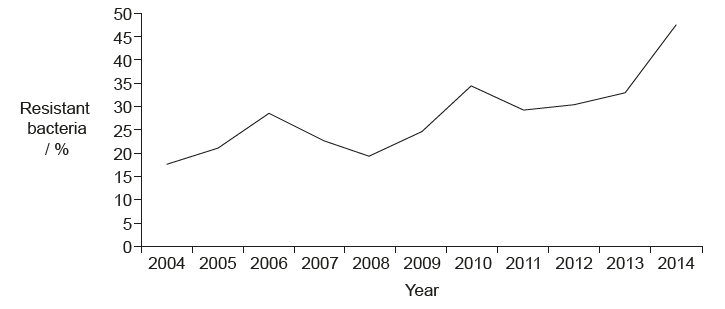
The graph shows the proportion of a bacterial population of Neisseria gonorrhoeae, displaying resistance to the antibiotic tetracycline.
What can be deduced from this graph?
A. Bacteria with beneficial adaptations survive and pass on their genes.
B. Immunity to tetracycline is triggered by over-use of the antibiotic.
C. Genetic variation in this bacterial population is increasing.
D. Use of tetracycline inhibits the growth of antibiotic-resistant N. gonorrhoeae.
A
Explain how natural selection could increase the prevalence of an antibiotic resistance gene in a species of soil bacterium.
[3]
if antibiotic is in the environment/soil there is selection (pressure);
bacteria without resistance (gene) die / converse;
bacteria with resistance (gene) reproduce
OR
bacteria exchange/obtain resistance genes using plasmids/by conjugation;offspring inherit (the gene for) resistance/resistance passed on (to offspring);