36 Diseases of the Upper Respiratory Tract 3
 Call Kai
 Learn
Learn Practice Test
 Spaced Repetition
 Match
Match Flashcards
 Knowt Play
1/27

There's no tags or description
Looks like no tags are added yet.
Name | Mastery | Learn | Test | Matching | Spaced | Call with Kai | Chat |
|---|
No analytics yet
Send a link to your students to track their progress
28 Terms
1. equine herpes virus 1 and 4
2. equine influenza virus
3. streptococcus equine ssp. equi
4. equine rhinitis A and B
What 6 pathogens does the real time PCR test for in horses?
Guttural pouch
What is the outpouching of the Eustachian tube that connects the throat to the middle ear in horses?
Guttural pouch
Which structure's purpose is to: equalize pressure, warm air, resonate during vocalization, and cool blood directed to the brain during exercise?
Retropharyngeal lymph node
(mandibular and suprapharyngeal may also be affected)
What lymph node commonly swells with strangles infection?
Streptococcus equi ssp. equi (gram +)
What is the causative agent of strangles in horses?
Any time you isolate it on a culture, the horse is infected and may spread it to other horses = NOT COMMENSAL
What does it mean that Streptococcus equi ssp. equi is a "primary pathogen"?
YES
Is Strangles reportable in KY?
10-14 days
How long is the incubation route for strangles?
1-4 days AFTER fever and continues to shed 2-6 weeks after purulent discharge
When does strangles SHED?
Horses can be carriers for years. Can persist in water for 1 month and on environmental surfaces for 1 week
What is the problem with strangles and how long it sticks around?
Crypts of lingual and palatine tonsils
Where does strangles attach in horses?
a. external carotid artery
b. CN VII (facial)
Select some of the structures present in the LATERAL compartment of the guttural pouch:
a. external carotid artery
b. CN VII (facial)
c. CN IX (glossopharyngeal)
d. CN X (vagus)
e. internal carotid artery
f. CN XI (accessory)
c. CN IX (glossopharyngeal)
d. CN X (vagus)
e. internal carotid artery
f. CN XI (accessory)
Select some of the structures present in the MEDIAL compartment of the guttural pouch:
a. external carotid artery
b. CN VII (facial)
c. CN IX (glossopharyngeal)
d. CN X (vagus)
e. internal carotid artery
f. CN XI (accessory)
Stylohyoid bone
What separates the medial from the lateral compartment in the guttural pouch?
Neutrophils influx
What cells influx that cause a problem with strangles?
10%
How many horses become CHRONIC carriers of strangles after infection?
Strangles
Thoughts?
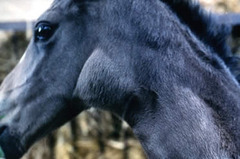
1. bastard strangles (metastasis of abscess/pus to remote area like lung or organs)
2. purpura hemorrhagica and myositis (delayed inflammation of small vessels in legs causing edema and skin sloughing)
3. carriers that hide infection in guttural pouch and sinus (at least 10% will develop)
What are the 3 MAIN COMPLICATIONS OF STRANGLES?
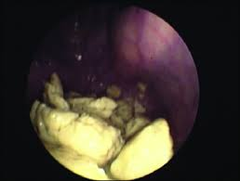
Strangles
Guttural pouch chondroids are a common complication of what disease?
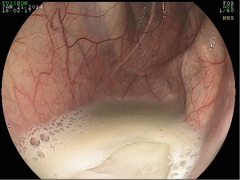
Strangles
Guttural pouch empyema is a common complication of what disease?
*qPCR with nasopharyngeal wash*
What is the specific diagnosis for strangles?
3 weeks after clinical signs have abated and 3 negative tests
When can you safety remove a horse from quarantine of strangles?
Risk based
Strangles vaccine is *core or risk based*
Give the horses that are getting intranasal vaccines their doses LAST because you will get some on you and carry it will you to other horses
What do you have to keep in mind when giving a horse an MLV Intranasal vaccine for strangles?
IM STRANGLES: killed given in hindquarters
Intramuscular strangles vaccines are *killed or MLV*, given in the *neck or hindquarters*
Lavage with saline and acetylcysteine (surgery if chondroids are present)
How can you treat guttural pouch empyema if it appears as a sequelae to strangles?
d. 10 horses
After an outbreak of strangles in a stable with 100 horses, what number of horses do you expect to become inapparent carriers?
a. 50 horses
b. 30 horses
c. 20 horses
d. 10 horses
b. Streptococcus equi ssp equi is NOT a normal commensal bacteria of the equine respiratory tract
Which of the following statements is true:
a. Streptococcus equi ssp equi is a normal commensal bacteria of the equine respiratory tract
b. Streptococcus equi ssp equi is NOT a normal commensal bacteria of the equine respiratory tract