Chapter 11 - THE STRUCTURE OF THE REPRODUCTIVE SYSTEMS ALLOWS REPRODUCTION
 Call Kai
 Learn
Learn Practice Test
 Spaced Repetition
 Match
Match Flashcards
 Knowt Play
1/29

There's no tags or description
Looks like no tags are added yet.
Name | Mastery | Learn | Test | Matching | Spaced | Call with Kai | Chat |
|---|
No analytics yet
Send a link to your students to track their progress
30 Terms
gonads
the primary sex organs; they produce the gametes
secondary sex organs.
they store the gametes, bring them together for fertilisation and support the developing baby.
The male gonads consist of
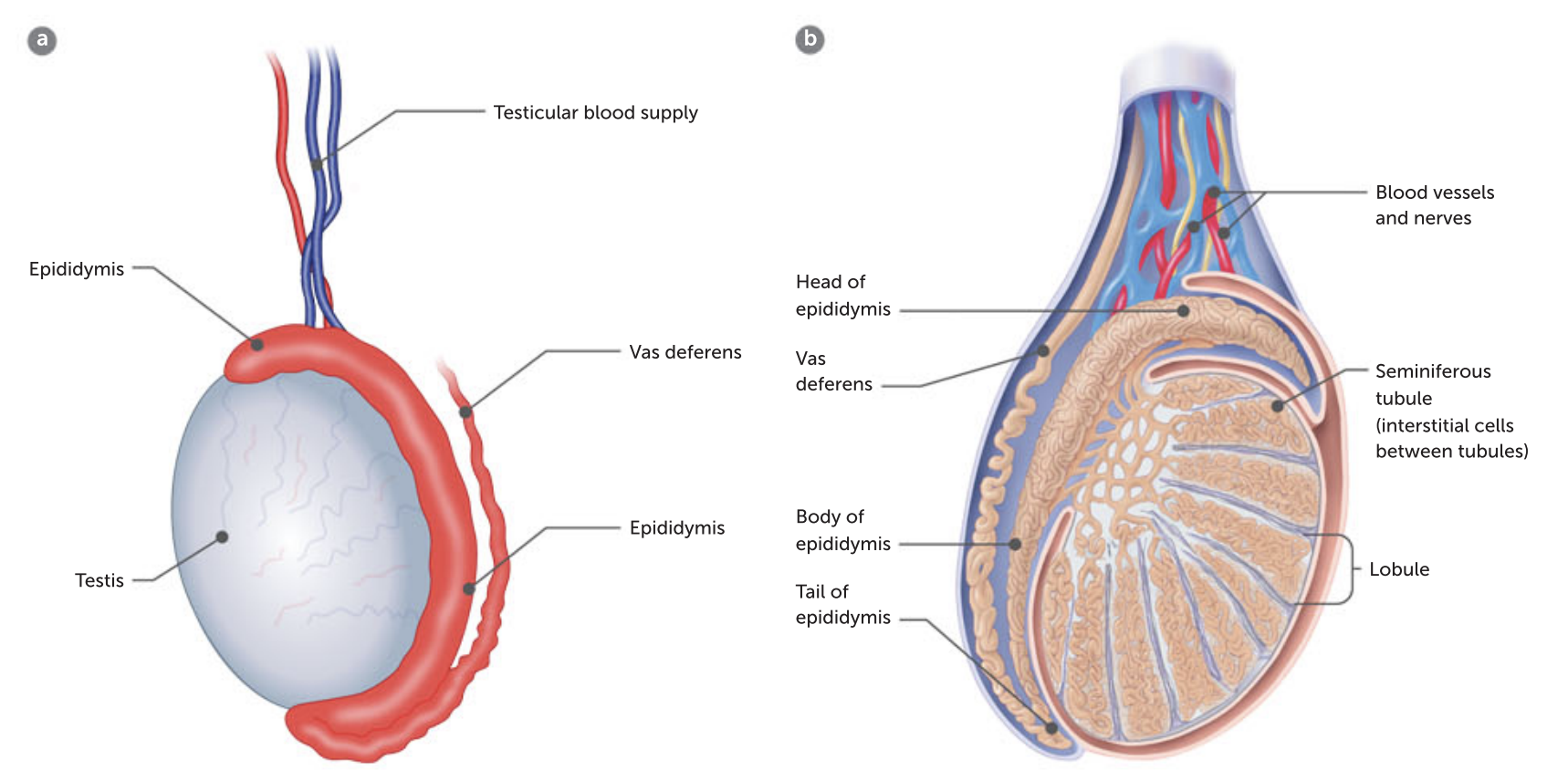
two testicles or testes, where the male gametes, spermatozoa (or sperm), are produced. The testes are held and supported in a skin-covered pouch called the scrotum.
prostate gland
is where the two vasa deferentia join the urethra. It is a single gland, shaped like a doughnut, which surrounds the urethra just below the bladder. It secretes a thin, milky, alkaline fluid that also becomes part of the semen.
Main role of the uterus
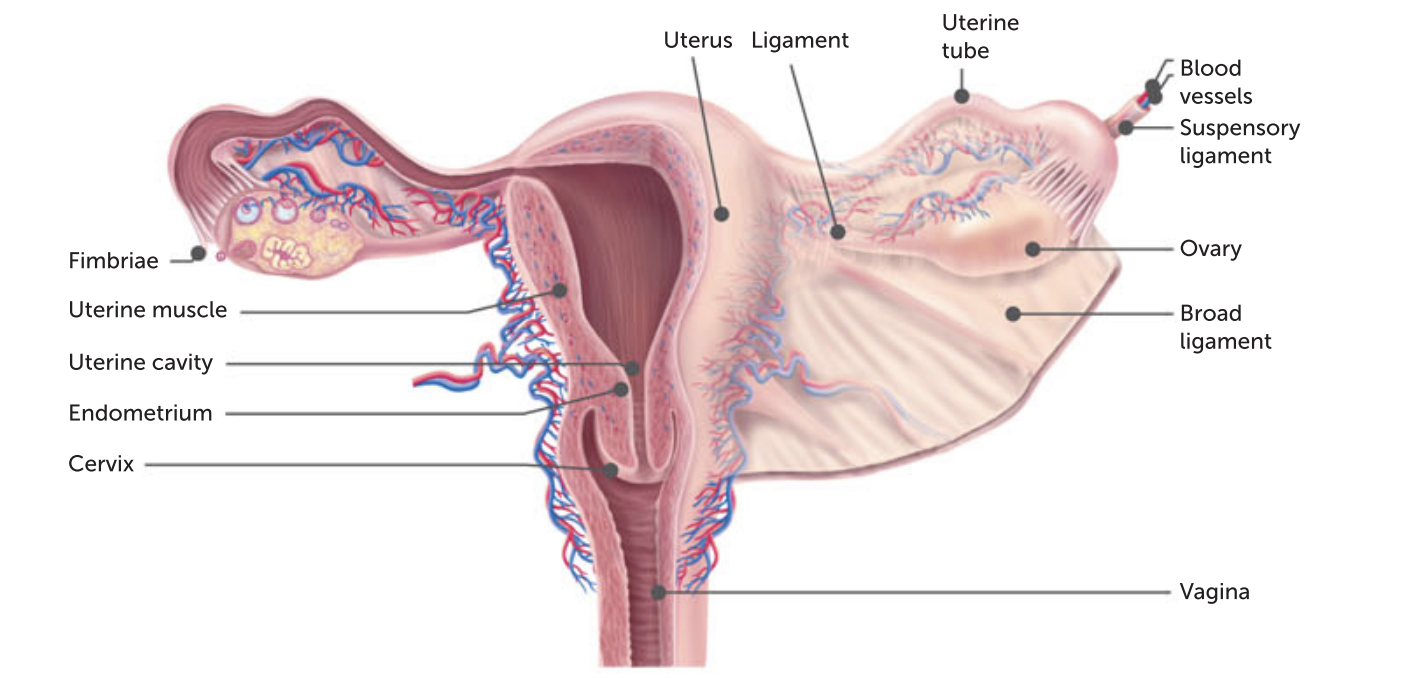
The uterus has a major role to play in protecting and nourishing the developing foetus during pregnancy.
labia majora
are two fleshy folds of skin, made up of fat and fibrous tissue, containing a large number of glands that produce an oily secretion. Their outer surfaces are pigmented and, after puberty, covered in hair. The inner surfaces are smooth, lack hair, and are moist from the oily secretions.
Production of sperm
Human sperm
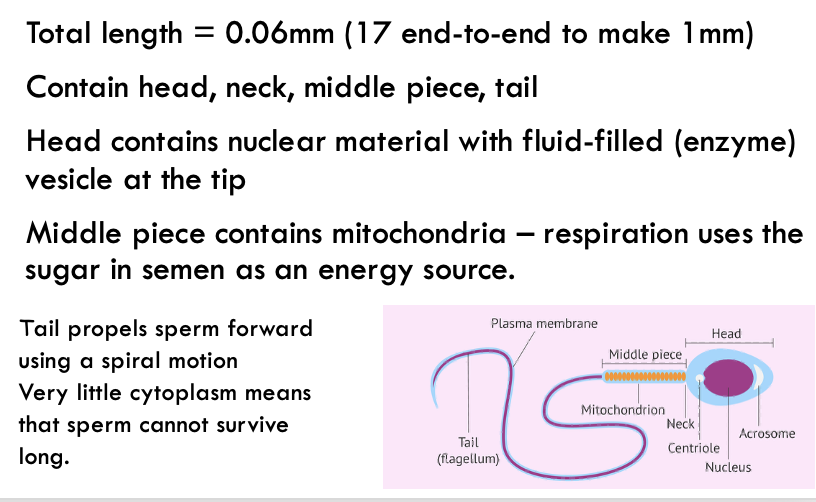
Human sperm are microscopic, being only about 0.06 mm long. Each sperm is made up of a head, neck, middle and tail, as follows:
• The head consists almost entirely of the nuclear material, with a fluid-filled vesicle at its tip, called the acrosome. In the fluid are enzymes, which are important if the sperm reaches an egg. The enzymes break down the layer of cells surrounding the egg so that fertilisation can occur.
• The neck lies between the head and the middle piece.
• The middle piece contains mitochondria, where respiration takes place to provide the sperm with energy for movement. Around the mitochondria is a thin layer of cytoplasm. Because there is so little cytoplasm, sperm have a short survival period and receive their nourishment from the semen in which they are suspended.
• The tail is capable of contractile motions to propel the cell forward.
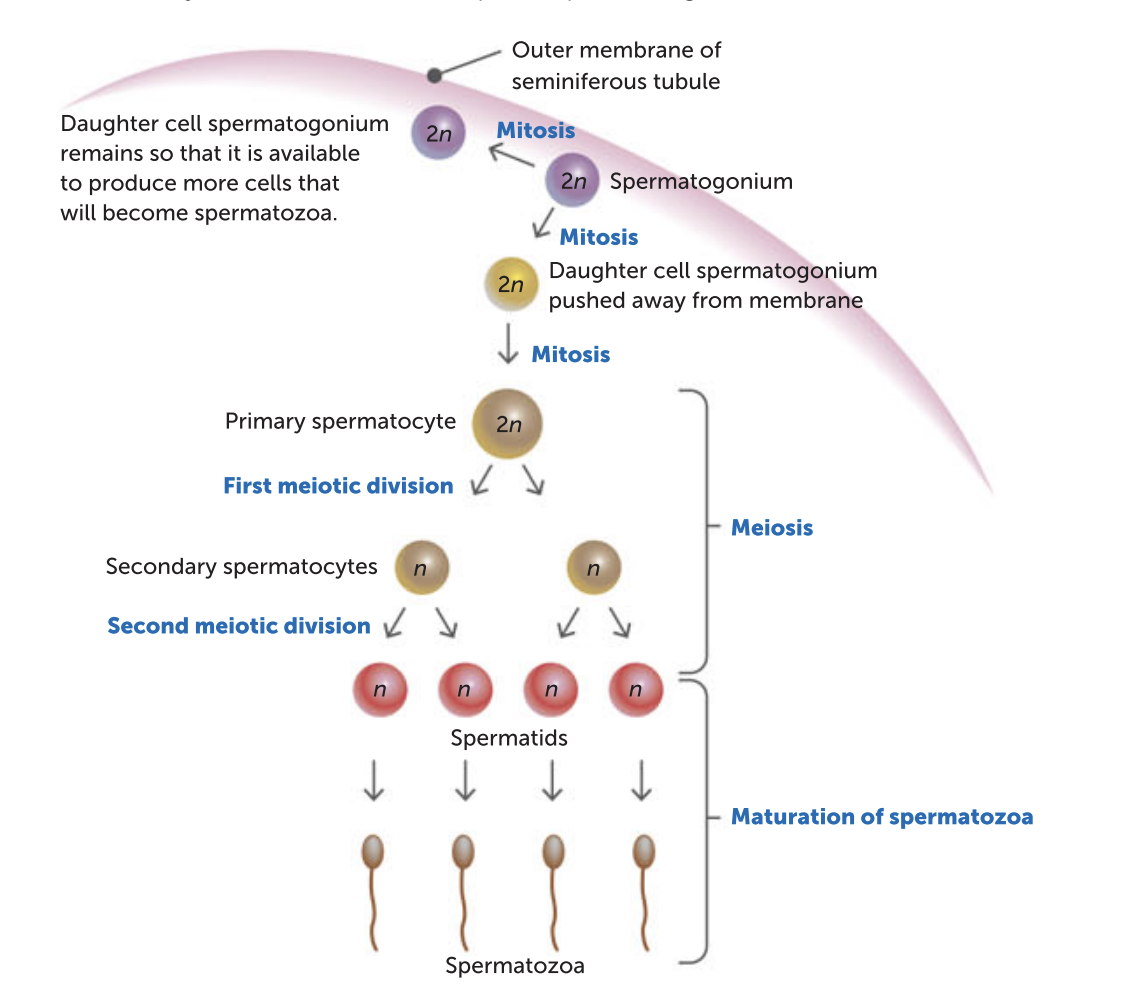
where does Spermatogenesis occur
in the seminiferous tubules of the testes, and results in four spermatozoa from each spermatogonium.
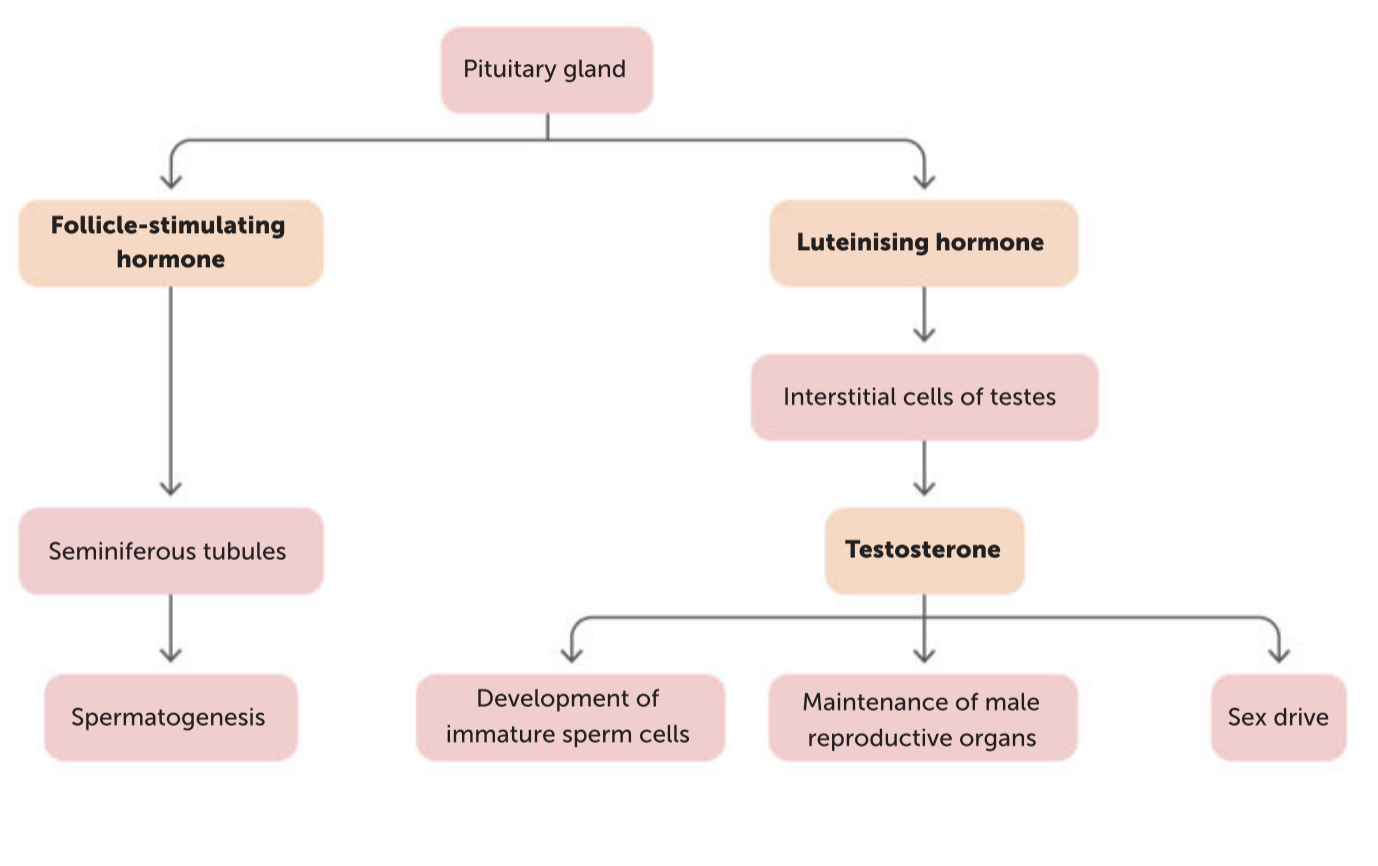
Two hormones secreted by the pituitary affect the gonads and are thus called gonadotropic hormones, or gonadotropins.
• Follicle-stimulating hormone (FSH) stimulates the development and maturation of the ovarian follicle in females. During its development, the ovarian follicle secretes its own hormone, oestrogen. Secretion of FSH is reduced as the level of oestrogen increases in the blood.
• Luteinising hormone (LH) promotes the final maturation of the ovarian follicle, ovulation, and the formation of the corpus luteum. The corpus luteum secretes another ovarian hormone, progesterone, as well as oestrogens. There is a gradual reduction in the production of LH as the level of progesterone in the blood increases.
Each follicle that develops goes through the following steps.
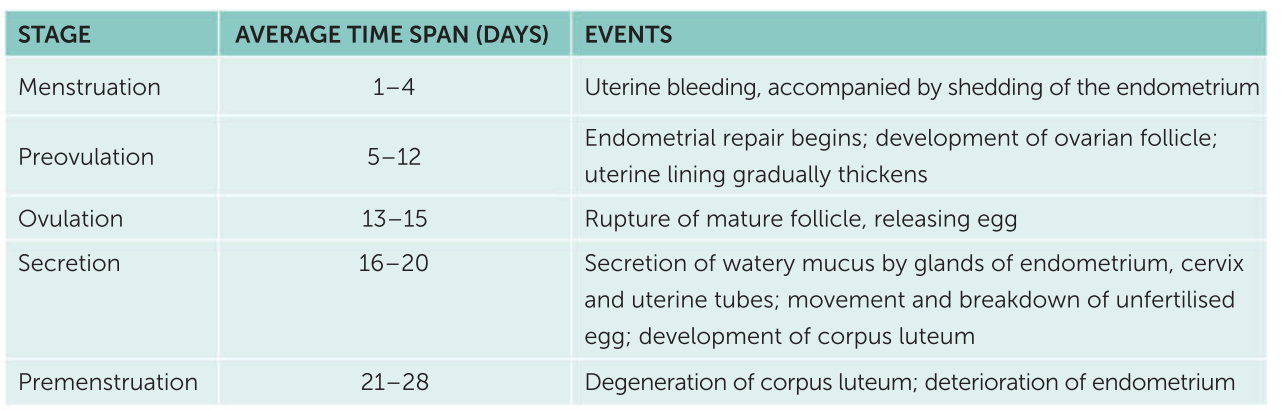
1) Cells forming the wall of the primary follicle begin to enlarge and divide, creating a layer of cells around the developing oocyte.
2) Secretions from these cells create a fluid-filled space that gradually forces the oocyte to the edge of the follicle. It is now referred to as a secondary follicle.
3) As more fluid accumulates within the follicle, it continues to enlarge and gradually moves towards the surface of the ovary.
4) On reaching the surface, it produces a bulge that looks like a swollen blister on the surface of the ovary. At this stage it is referred to as a mature follicle (previously known as a Graafian follicle).
SEXUAL REPRODUCTION & MALE ANATOMY
The survival of the human species depends on sexual reproduction.
In sexual reproduction, haploid (23 chromosomes per cell) male and female sex cells fuse (fertilisation) to form a new diploid (46 chromosomes per cell)
zygote that develops into a new human individual.
Internal fertilisation greatly improves chances of successful reproduction.
Reproductive systems are specialised for gamete production and fertilisation.
Male Reproductive system
Sex cells
Sex cells (gametes) are produced in the primary sex organs (gonads).
Female
gamete is the ovum; gonad is the ovary.
Male:
gamete is the spermatozoon; gonad is the testis.
how do secondary sex organs support reproduction
Secondary sex organs support reproduction by storing gametes, bringing them together for fertilisation & supporting the developing baby.
Gonads
Two external testicles that produce the spermatozoa.
Held & supported in the scrotum.
Production & development of sperm require a temperature of around 35°C
To maintain this temperature smooth muscle in the scrotum can contract to move the testicles towards the body’s warmth or relax to move them away from the body’s warmth.
INTERNAL TESTICLE STRUCTURE
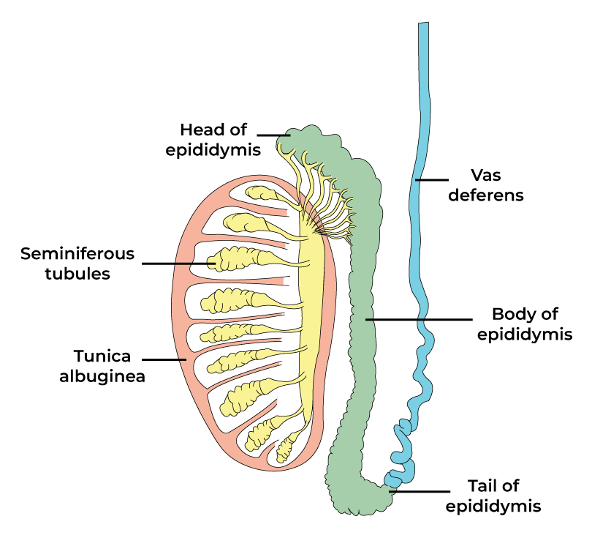
Testicle contains 200-300 lobules filled with seminiferous tubules.
The lining of the tubules produce the spermatozoa.
Interstitial cells between the tubules produce the hormone testosterone.
Testosterone - male secondary sexual characteristics and sperm maturation.
Epididymis:
convoluted tubule behind each testicle for storage & maturation of sperm.
Vas Deferens
Vas Deferens (sperm duct) carries sperm away from each testicle. Empty into urethra.
Urethra:
tube from bladder through penis to exterior. Carries urine & semen.
THE 3 SEMEN-PRODUCING GLANDS
Sperm are ejaculated in a liquid called semen.
Semen nourishes sperm & aids their transport.
Contains secretions from seminal vesicles, prostate gland & bulbo-urethral (Cowper’s) glands.
THE 3 SEMEN-PRODUCING GLANDS
Seminal vesicles (behind bladder) secrete thick fluid rich in sugars to nourish sperm.
Prostate gland (below bladder) adjusts pH to alkaline – sperm die in acid conditions.
Bulbo-urethral (Cowper’s) glands (below prostate) secrete mucus for lubrication preceding ejaculation.
PENIS ADAPTATIONS FOR INTERNAL FERTILISATION
Erectile tissue of penis enables internal fertilisation.
Air spaces of tissue become filled with blood.
Liquids, unlike gases, are incompressible.
Penis enlarges, stiffens, becomes erect & can successfully introduce sperm into vagina.
Internal fertilisation greatly improves chances of successful reproduction & survival of the human species.
The structure of spermatozoa